What Is RF Radiation? Frequency, Risks and Exposure
RF radiation is electromagnetic energy that travels in waves, spanning roughly 3 kilohertz to 300 gigahertz the band the FCC…
An RF blocker is a material or product engineered to block radio-frequency signals from passing through it, typically using a conductive layer that reflects or absorbs them rather than allowing them to travel freely. Silver is one of the most effective materials for this because it has the highest electrical conductivity of any metal, which is why silver-fiber fabric appears so often in RF-blocking clothing and accessories rather than in plastic or standard textile blends.
This page breaks down how RF blocking actually works at a material level, which fabrics and products genuinely block signal versus which ones just use the term loosely, where RF blockers are actually used clothing, phone pouches, home shielding and whether the effectiveness and safety claims around them hold up.
An RF blocker is any material, garment, or product designed to block radio-frequency signals from passing through it. Radio frequency itself spans a wide band of the electromagnetic spectrum, roughly 3 kHz to 300 GHz, which covers everything from Wi-Fi and Bluetooth to cellular and 5G signals, so an RF blocker is built to interrupt that transmission path rather than target one specific signal type. Most work uses a conductive layer, commonly silver, copper, or nickel, woven or coated onto a base material, that reflects or absorbs incoming radio waves rather than letting them pass through to whatever is on the other side.
The category includes a wide range of products: clothing woven with conductive fiber, phone pouches lined with metal mesh, paint additives for walls, and fabric panels used in home shielding projects. What separates a genuine RF blocker from something loosely marketed as such is whether the material has measurable conductivity a plain cotton or polyester product with no metal content will not block radio frequency signals, regardless of how it’s labeled.
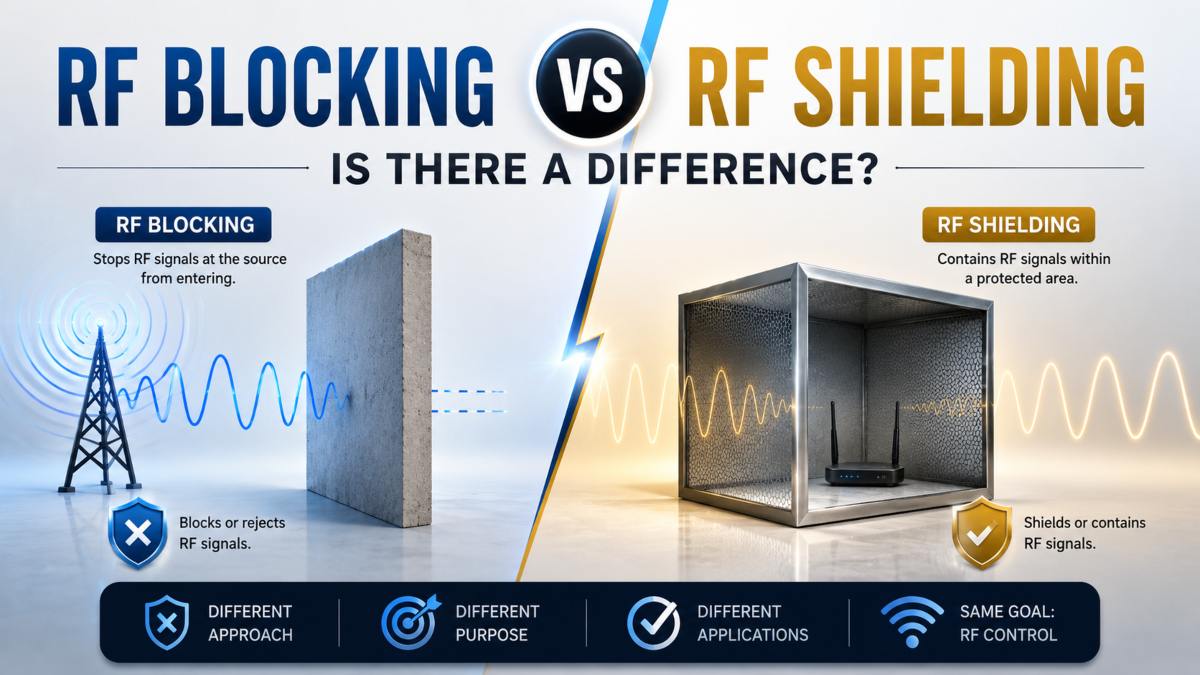
RF blocking and RF shielding describe the same underlying mechanism stopping radio frequency signals with a conductive barrier but they’re typically used in slightly different contexts. RF blocking is the more general term and gets applied to almost anything that reduces signal, including partial or single-layer products like a phone pouch or a piece of clothing. RF shielding tends to imply a more complete or engineered barrier, often referring to enclosed spaces, specialized rooms, or multilayer fabric systems designed to attenuate signals from all directions rather than from one side.
In practice, the two terms overlap significantly in product marketing, and a single conductive fabric can be accurately described as both “RF blocking fabric” and “RF shielding fabric” depending on how it’s used. The more useful distinction for a buyer isn’t the terminology it’s the material’s conductivity and the specific frequency range it’s been tested against, since those are the numbers that actually determine how much signal gets through.
 How Do RF Blockers Work?
RF blockers work by placing a conductive material between a radio frequency signal and its intended path, causing the signal to reflect off the surface or be absorbed and dissipated rather than pass through. This is the same principle behind a Faraday cage and Faraday fabric, just applied at a smaller and more wearable scale a continuous or tightly woven conductive layer creates a barrier that electromagnetic waves can’t easily penetrate. The degree of blocking depends on how conductive the material is, how densely it’s woven or applied, and whether any gaps or seams allow the signal to leak through.
Radio frequency signals are electromagnetic waves that interact strongly with electrically conductive materials. When a signal hits a conductive surface, the free electrons in that material respond to the wave’s oscillating electric field, generating an opposing current that cancels out much of the signal and reflects it rather than letting it continue through. Non-conductive materials like cotton, standard polyester, or wood don’t have free-moving electrons in the same way, so radio waves pass through them with little resistance. This is why effective RF-blocking products almost always rely on metals copper, nickel, or silver either woven into fibers, coated onto a surface, or built into mesh, rather than on any plant-based or synthetic material alone.
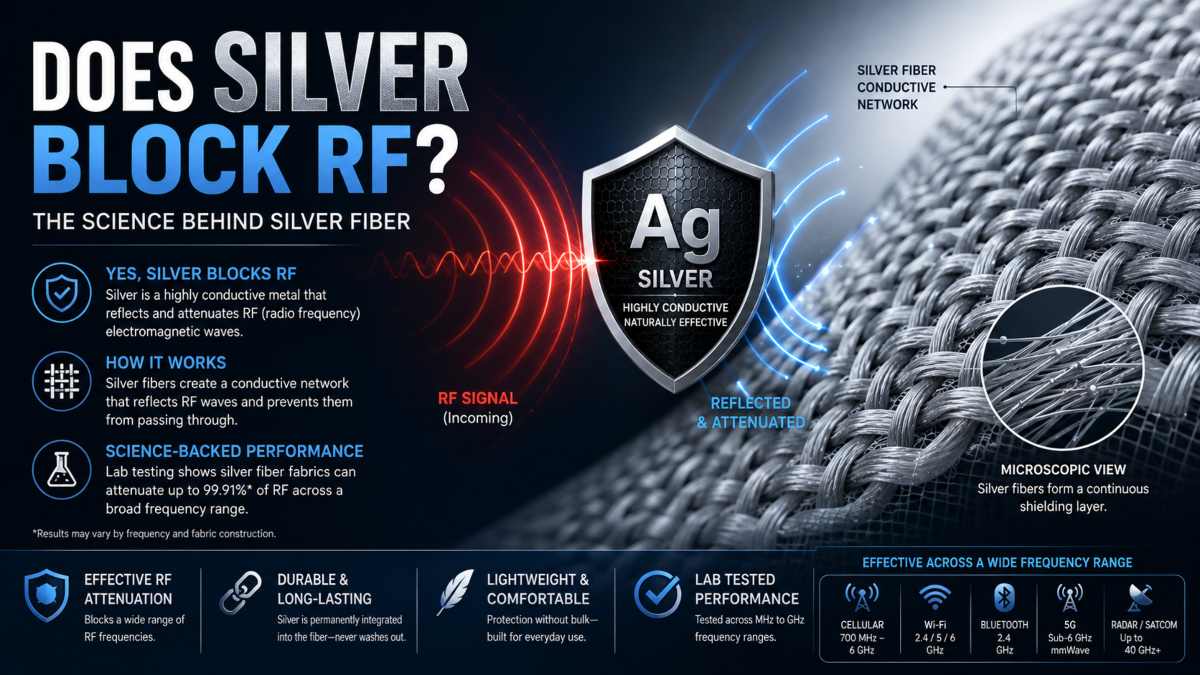
Yes, silver blocks RF signals more effectively than almost any other material available for wearable or fabric applications. Silver has the highest electrical conductivity of any metal around 6.3 × 10⁷ siemens per meter which means it responds more strongly to an incoming electromagnetic wave and reflects more of that signal than copper, aluminum, or nickel at comparable thickness.
In fabric form, silver is typically spun into or wrapped around a base fiber such as polyester, then woven into the final textile. Hence, the conductive layer runs throughout the material rather than sitting only on the surface. That structural difference silver integrated into the weave versus simply coated on top is a major factor in how much signal a given fabric actually blocks, and it’s worth checking before assuming two “silver fiber” products perform the same.
 What Materials Actually Block RF Signals
The materials that genuinely block RF signals are conductive metals primarily silver, copper, and nickel either woven into fiber, coated onto fabric, or built into a metallic mesh. Plain textiles like cotton, polyester, or wool have no meaningful effect on radio frequency on their own, no matter how tightly they’re woven, because blocking depends on electrical conductivity rather than material density.
Beyond fabric, everyday household materials come up often in this conversation too aluminum foil is a common comparison point people ask about. While it does block signal, it isn’t practical as a wearable or long-term shielding solution the way engineered fabric is. For a broader rundown of what qualifies as a legitimate signal blocking material, it’s worth understanding the full range before assuming any one option is a fit.
RF blocking fabric and RF shielding fabric refer to the same category of textile one with a conductive layer woven or coated into it and the two terms are used almost interchangeably in the market. Where a distinction does appear, “shielding fabric” more often refers to multilayer or higher-density constructions intended to attenuate the signal more completely. In contrast “blocking fabric” is applied more broadly, including to lighter single-layer textiles used in everyday clothing. The label on a product matters less than two concrete details: what the conductive material is, and what frequency range the fabric has actually been tested against, since those determine real-world performance far more than the terminology used to market it.
Conductive fabric is created by spinning a metal like silver or copper into or around a base fiber typically polyester or nylon so the finished textile carries electrical conductivity throughout the weave rather than just on its surface. This construction method matters because a coated fabric, where the metal sits only on top, tends to lose effectiveness more quickly as the coating wears, cracks, or washes away.
In contrast, fiber woven with metal running through it holds its conductive properties longer under normal use. Signal-blocking textiles built this way are what make RF-blocking clothing, phone pouches, and shielding panels functional products rather than novelty items, and the amount of silver or copper by weight in the finished fabric is one of the clearest indicators of how much signal it can attenuate.
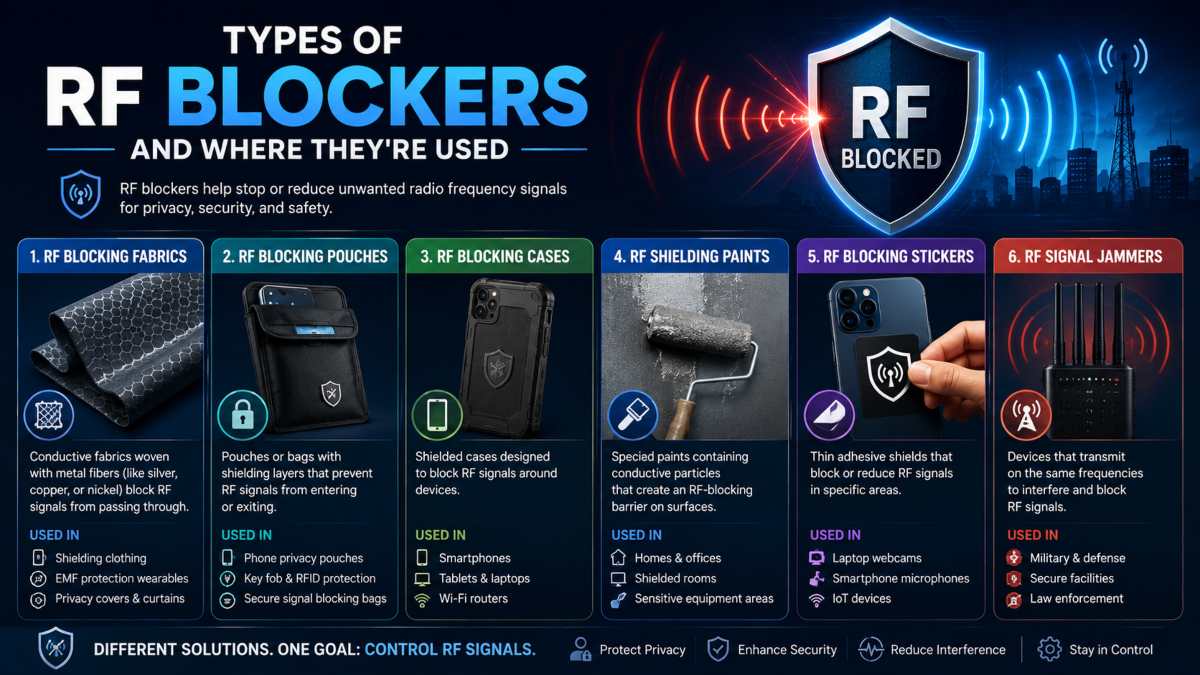
RF blockers fall into three main categories: wearable clothing and apparel, phone-specific pouches and cases, and home shielding materials such as paint, mesh, and curtains. Each category uses the same underlying conductive-material principle, but the construction and coverage differ significantly based on what’s being shielded and how completely it needs to block signal.
 RF Blocking Clothing and Apparel
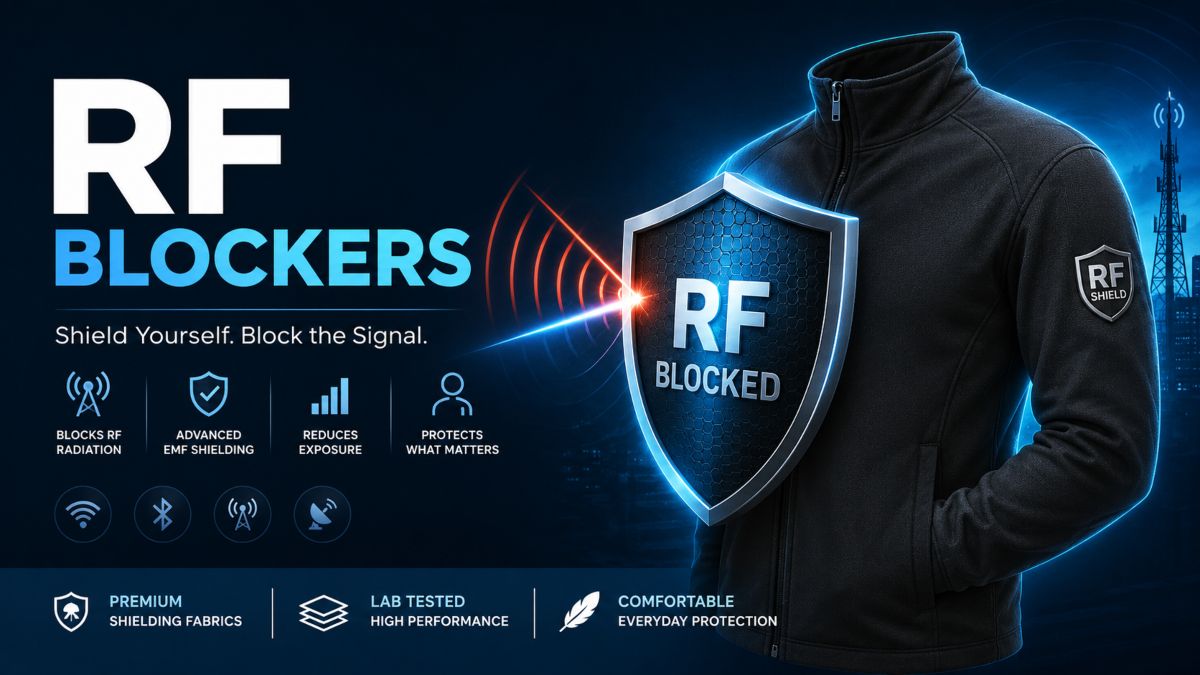
RF blocking clothing is fabric woven with a conductive fiber most commonly silver into everyday garments like shirts, hats, or scrubs, so the wearer carries a partial signal barrier without needing a separate device. Medical scrubs are one of the most established applications of this. For anyone weighing that category specifically, our complete guide to medical scrubs covers how the fabric performs in a clinical setting.
Because clothing only covers part of the body and isn’t a sealed enclosure, it reduces exposure to radio frequency in the areas it covers rather than blocking the signal completely, as an enclosed shielded room would. Effectiveness depends heavily on the percentage of conductive fiber in the weave and the frequency range the fabric was tested against, which is why lab-verified test data matters more than a general “RF blocking” label when comparing garments.
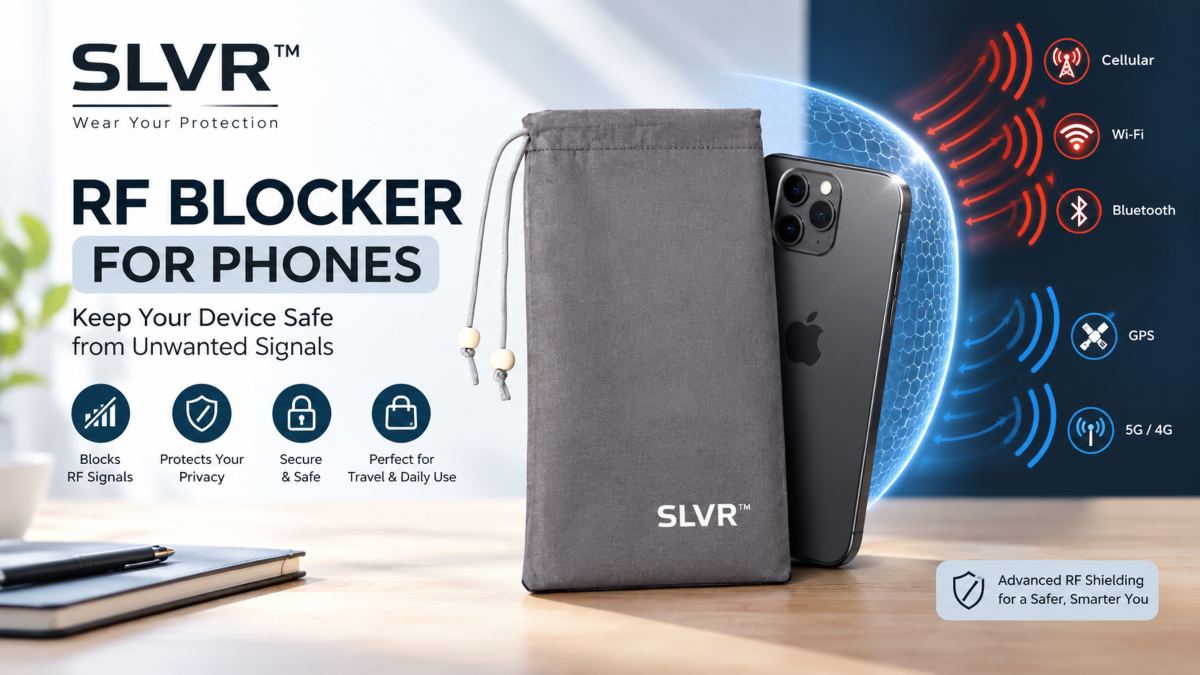
RF blockers for phones are typically pouches or sleeves lined with a conductive mesh or fabric that fully encloses the device, since a phone needs to be fully enclosed to meaningfully interrupt the signal to and from it. A pouch that only covers the back or one side of the phone will do little, because radio-frequency signals can still travel through any exposed edge a full enclosure is what separates a functional signal-blocking pouch from a case that simply looks similar.
It helps to understand how much radiation phones actually emit in the first place, and iPhones specifically have their own exposure profile worth knowing before deciding how much shielding is warranted.
These products are commonly used to temporarily cut cellular and Wi-Fi connectivity, such as during travel, sleep, or any situation where someone wants the phone fully disconnected without powering it off though it’s worth noting whether airplane mode alone reduces exposure as people often assume.
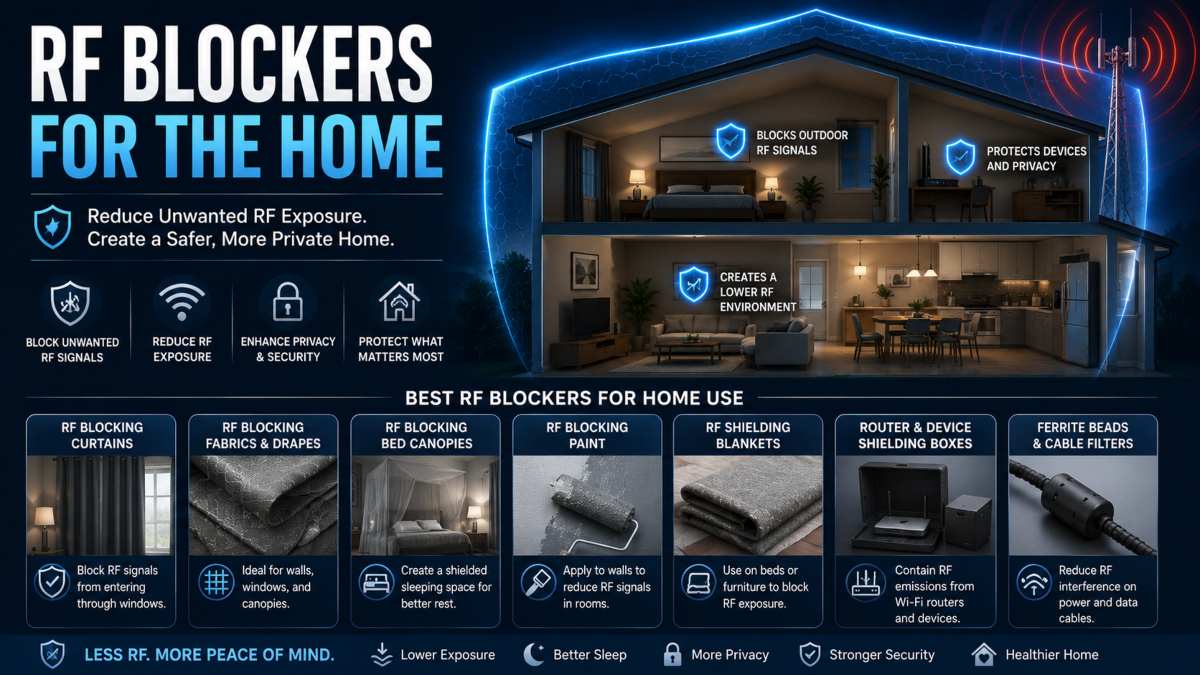
RF blockers for the home extend the same conductive-barrier concept to larger surfaces: shielding paint with metal particles mixed in, conductive window film, mesh canopies over beds, and curtains woven with silver or copper fiber.
Home shielding is more complex than clothing or phone pouches because a room has multiple surfaces, gaps, and openings windows, doors, outlets, and even proximity to external sources like safe distance from power lines that all affect how effective the shielding actually is. A single shielded wall or curtain will only reduce the signal from that direction, not across the whole space, which is why most home RF-blocking projects are approached one surface at a time.
For a broader walkthrough of reducing exposure throughout an entire home rather than a single room, it’s worth prioritizing the direction a specific signal source is coming from first. The same logic extends to workspaces anyone spending long hours at a desk may also want to consider protecting themselves while using a laptop, since that’s a common close-range exposure point people often overlook.
 Do RF Blockers Actually Work?
Yes, RF blockers work when they’re made from genuinely conductive material and tested against a specific frequency range but “does it work” is really a question of degree, not a yes-or-no answer. A well-constructed silver-fiber fabric can attenuate a meaningful percentage of a radio-frequency signal under lab conditions. At the same time, a product with minimal conductive content, gaps in coverage, or no test data to back it up may do very little. The clearest way to separate an effective product from a marketing claim is to look for actual test results the frequency range tested and the percentage of signal blocked rather than relying on the “RF blocking” label alone.
RF blockers can reduce 5G signal strength, but the extent depends on the specific frequency band involved, since 5G spans a wider, higher-frequency range than older cellular standards. Lower- and mid-band 5G frequencies behave similarly to 4G and are effectively blocked by the same conductive fabrics used for other cellular signals. In contrast, the highest millimeter-wave 5G frequencies require materials specifically tested for that upper range to attenuate reliably. For iPhone users specifically, it’s also possible to turn off 5G directly on the device as a complementary step alongside any fabric-based blocking, rather than relying on shielding alone.
The most common misconception is that any fabric labeled “silver” or “conductive” performs the same regardless of construction, when in reality the amount of conductive material, how it’s woven, and whether it fully encloses the target all significantly affect performance. Another frequent misunderstanding is treating partial coverage such as a shirt or a single curtain panel as equivalent to full shielding, even though radio-frequency signals will still reach a target from any uncovered angle. People also sometimes assume RF blocking is an all-or-nothing effect, when in practice it’s measured as a percentage of attenuation at a given frequency, meaning even well-made products reduce signal rather than eliminate it.
Yes, RF blocking products made from certified materials are generally safe for everyday use, and the safety question mostly comes down to what the fabric or material is made of rather than the blocking function itself. Conductive fibers like silver are non-toxic and commonly used in textiles because they’re hypoallergenic and breathable, so a well-made RF-blocking garment should feel and wear like any other quality fabric rather than pose a separate safety concern. The more relevant safety check is whether the material has been independently tested and certified.
For example, OEKO-TEX Standard 100 certification confirms a textile has been tested and found free of harmful substances, which is a more meaningful safety indicator than any claim about the product’s blocking performance. This is also a common question at specific life stages for anyone researching exposure exposure during pregnancy, the same material safety standard applies.
It’s worth being clear about what “safe” means in this context: RF blocking products are not medical devices, and none of the products discussed on this page are intended to diagnose, treat, cure, or prevent any disease. Their function is limited to reducing radio-frequency signal transmission through the material evaluating them on that basis and on standard textile safety certifications is the accurate way to assess them.
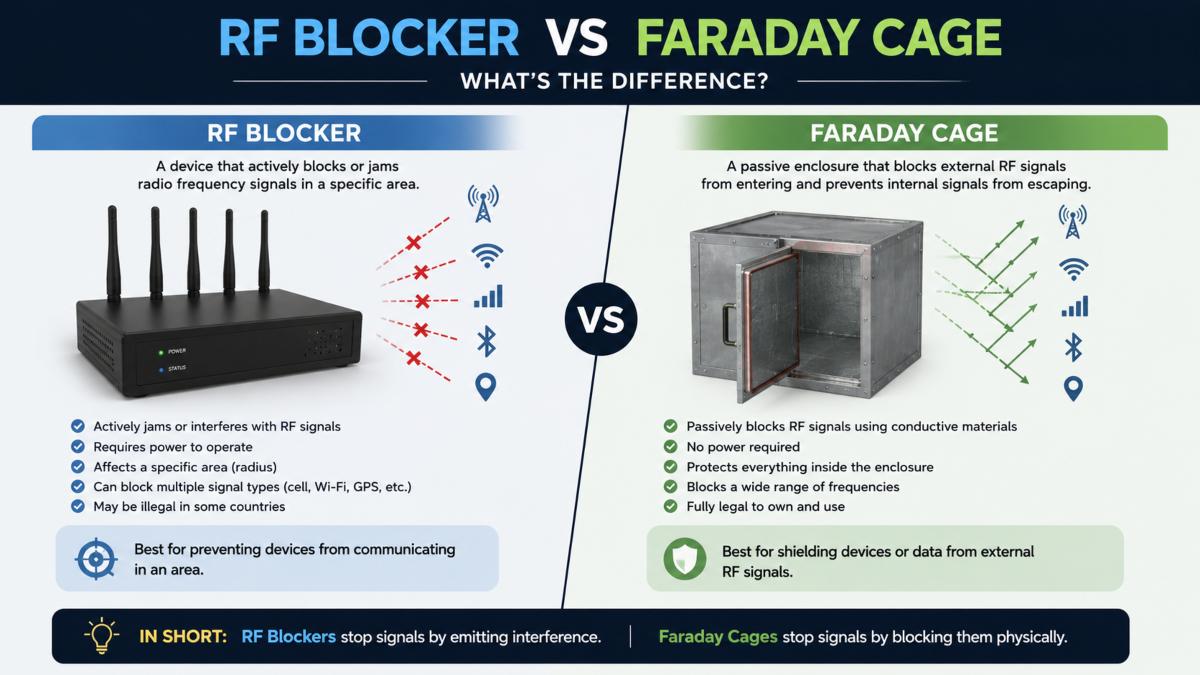
An RF blocker is a material, and a Faraday cage is a structure the cage is essentially an RF blocker built as a complete, enclosed shield rather than a single layer of fabric or mesh. Both work on the same underlying principle, using conductive material to reflect and redirect radio frequency signals, but a Faraday cage is designed to fully surround its contents on every side, which is what allows it to block signal far more completely than a garment, pouch, or curtain that only covers part of a surface. A phone pouch lined with conductive fabric is technically a small-scale Faraday cage, whereas a single RF-blocking shirt or panel is not, as it leaves most exposure angles uncovered.
The practical difference shows up in performance: a properly sealed Faraday cage can block the vast majority of signal reaching whatever is inside it, because there’s no exposed path for radio waves to enter. At the same time, partial products like clothing or single fabric panels reduce signal only from the direction they cover. Neither approach is “better” in an absolute sense the right choice depends on whether the goal is full signal isolation for an object or a reduction in exposure across an area a person moves through.
 RF Shielding vs Signal Blocking Terminology
RF shielding and signal blocking describe the same physical effect and are often used interchangeably in product descriptions. However, shielding tends to imply a more engineered or complete barrier, while blocking is used more loosely to refer to any product that reduces signal. A regulatory body in consumer products standardizes neither term, so two products described with different language one as “RF shielding fabric,” another as “signal blocking fabric” could have identical construction and performance. Rather than relying on which term a product uses, the more reliable comparison points are the conductive material used, the frequency range it’s been tested against, and whether the design fully encloses its target or only partially covers it.
The clearest way to evaluate an RF blocking product is to look past the label and check three things: what conductive material it uses, what frequency range it’s actually been tested against, and how much of the target it covers. A garment or accessory that meets those three criteria will function as described; one that doesn’t specify any of them is difficult to evaluate beyond marketing language.
For anyone weighing regular exposure long hours near Wi-Fi routers, frequent air travel, or extended screen time near cellular devices the practical options generally fall into a few categories. For full enclosure of a device, a Faraday phone pouch is built to fully block signal to and from a phone rather than partially cover it.
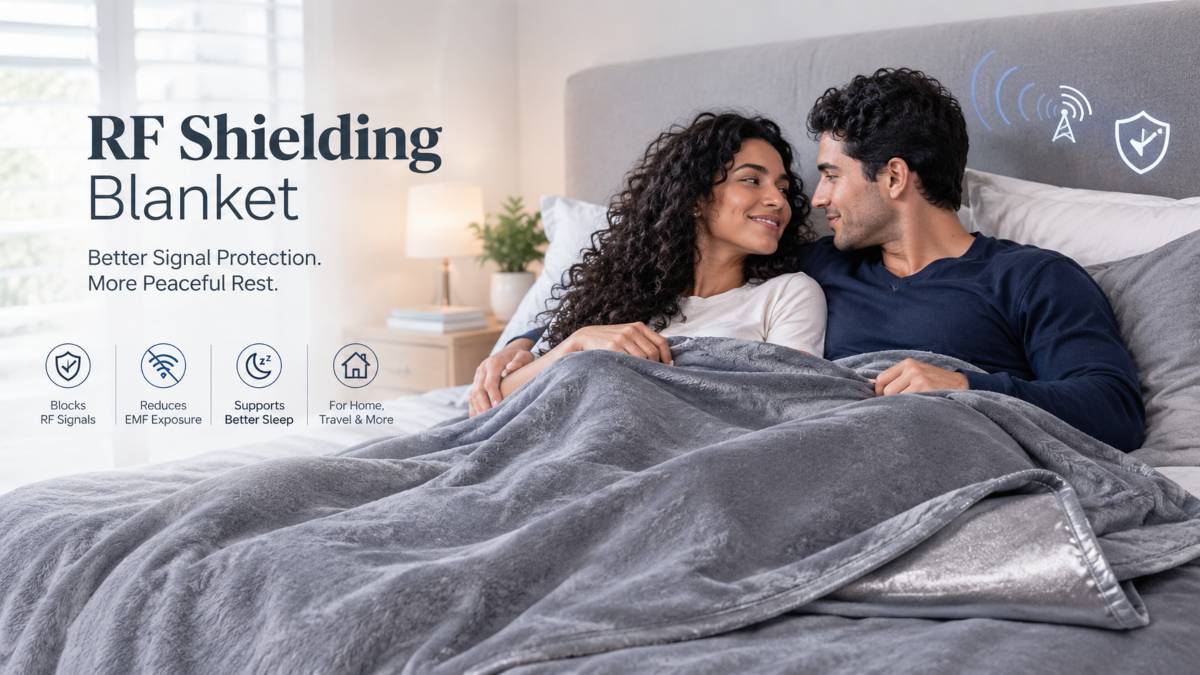
For ongoing wearable coverage, the signal-shielding beanie and signal-shielding hat use the same conductive-fiber construction described throughout this page for daily wear. For home use, the signal-shielding baby blanket, large blanket, and X-Large blanket extend coverage to a crib, bed, or larger seating area depending on the size needed.
Each product is woven with silver rather than coated, and tested to document actual signal attenuation rather than relying on the fabric label alone. Checking the linked lab test data on each product page is the most reliable way to confirm what a given garment, pouch, or blanket is actually rated to block before making a decision.
If there’s one thing worth carrying away from all of this, it’s that “RF blocker” is a construction claim, not a marketing label the material, the weave, and the tested frequency range determine whether a product actually does what it says. Before buying anything described as RF blocking, the fastest way to distinguish a functional product from a vague one is to ask for the specific conductive material used and the frequency range it’s been tested against; if a seller can’t answer either question, that’s the clearest signal to look elsewhere.
RF blocking fabric isn’t selective by signal type it blocks radio frequency broadly, so a conductive fabric that attenuates cellular signal will have a similar effect on Wi-Fi and Bluetooth, since both fall within the same general radio frequency range. The main variable isn’t which signal type it’s blocking, but the frequency band each signal operates in and whether the fabric has been tested at that frequency.
This depends entirely on construction. Fabric in which the conductive fiber is woven into the material throughout rather than coated onto the surface afterward holds up far better to washing because there’s no surface layer to crack, flake, or wear away over repeated cycles. Coated fabrics tend to lose conductivity faster with washing, which is why checking whether a product is labeled “woven” versus “coated” is worth doing before assuming machine-washability equals long-term performance.
Yes, a simple field test is to place a phone inside or under the product and call it from another phone; if the call fails to connect or drops signal noticeably, the material is blocking a meaningful amount of RF. This isn’t a precise measurement, but it’s a practical way to confirm a product is doing more than the label claims, and it works for pouches, blankets, or any product designed for full or near-full coverage.
When a phone is fully enclosed in something blocking its signal a sealed pouch, for instance it will typically search for a network connection, which can increase battery drain while enclosed. This effect is specific to full-enclosure situations rather than partial coverage, such as clothing, since a phone in a pocket under an RF-blocking garment still has open signal paths and won’t be actively searching in the same way.
There’s no single industry-wide minimum, but effectiveness scales with the percentage of conductive fiber in the weave fabric with a higher silver content by weight generally attenuates more signal than a lower-content blend at the same thickness. This is why lab-tested attenuation figures, rather than the presence of silver alone, are the more reliable way to compare two products claiming to use the same material.