iPhone EMF Radiation Explained | SAR by Model and Guide
Every iPhone emits EMF radiation in the form of radiofrequency (RF) signals from its Wi-Fi, cellular, and Bluetooth antennas, and…
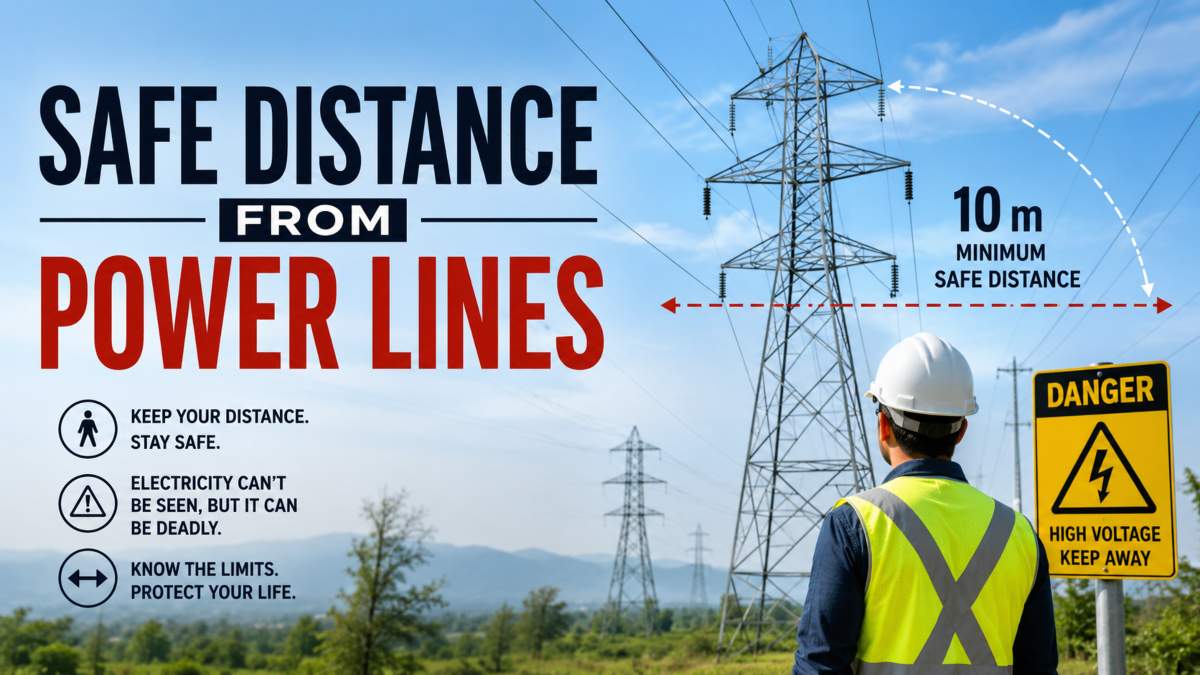
For most homes, a safe distance from power lines is generally considered to be 100 to 200 feet from large high-voltage transmission lines, though the exact figure depends on the line’s voltage and how it’s built. There’s no single legal number in the United States the minimum safe distance depends on the line’s voltage level and local regulations, with general guidance suggesting a buffer of roughly 100–200 feet for large transmission lines rated 110kV and above.
At around 300 feet, electromagnetic field (EMF) levels from these lines typically drop to about the same range produced by ordinary household appliances. This guide breaks down what “safe distance” actually means, how it changes by voltage type, what to check before buying a home near power lines, and how to measure your own exposure if you’re unsure.
A “safe” distance from power lines isn’t a fixed number it’s the point at which the electromagnetic field (EMF) from the line drops to a level most health agencies consider low-risk for everyday living. That point shifts depending on the line’s voltage, its height, how many wires are bundled together, and even the local terrain, which is why you’ll see such a wide range of figures cited across different sources. In practice, most guidance points to somewhere between 100 and 300 feet for larger transmission lines, with smaller neighborhood distribution lines requiring far less clearance.
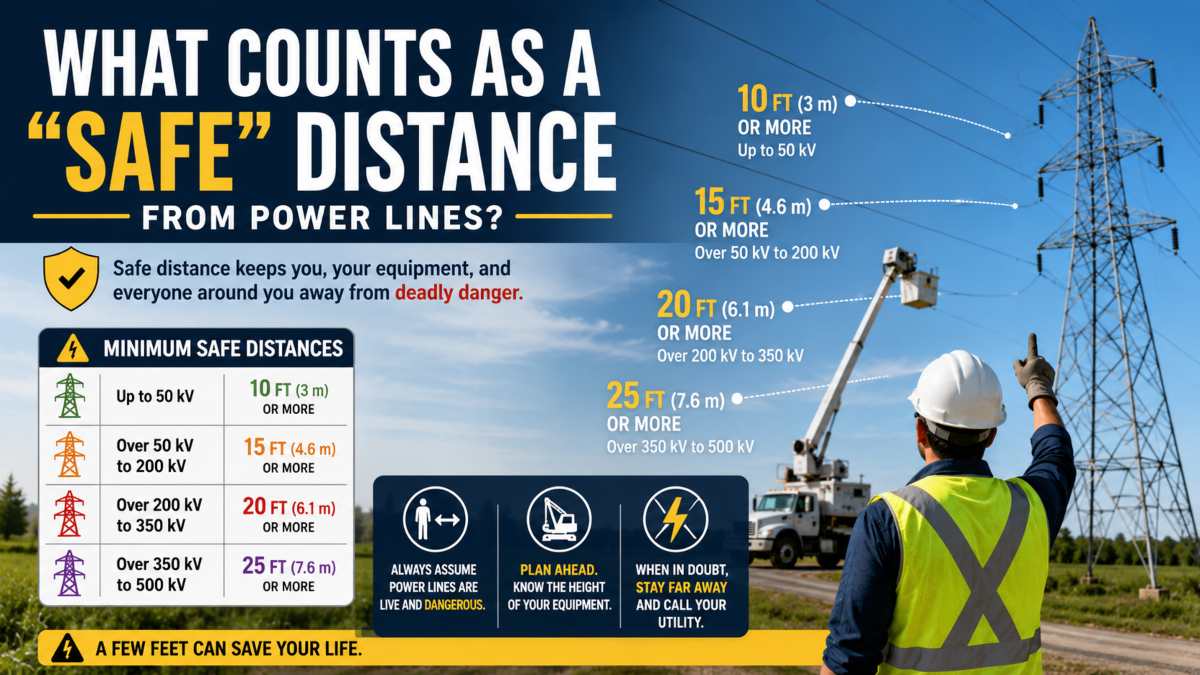 How Distance Affects EMF Exposure
EMF exposure from power lines follows a simple pattern: the field is strongest directly under or near the line and weakens quickly as you move away from it. This isn’t a straight-line drop-off magnetic field strength typically falls off with roughly the square of the distance, meaning doubling your distance from the line reduces exposure far more than proportionally. That’s why even a modest increase in distance, say from 50 feet to 150 feet, can make a meaningful difference in the field strength reaching a home, while distances beyond a few hundred feet tend to bring readings close to background levels found in a typical house.
For most power lines, EMF measurements typically drop below 2 milligauss (mG) once you’re about 500 feet away. At this range, the field has usually decreased to a level comparable to everyday background exposure inside most homes—a threshold many health organizations, like the World Health Organization and EPA, consider low-risk for residential settings.
In practical terms, reaching the 500-foot mark nearly always ensures EMF readings are at or below what you’d encounter from common household devices. This is one reason some buyers and homeowners use 500 feet as a target distance if they’re especially concerned about minimizing electromagnetic exposure.
The U.S. has no federal standard setting a required safe distance for homes near power lines, which is part of why guidance varies so widely from one source to the next. Voltage is the biggest variable: a small residential distribution line carries a much weaker field than a high-tension transmission line strung between tall steel towers, so a distance that’s low-risk near one type of line may not be near the other.
Local geography, whether the line is overhead or buried, and nearby infrastructure like transformers can all shift the actual reading at a given property. Because of this, most guidance treats published distances as general starting points rather than guarantees and recommends on-site measurement with an EMF meter for anyone who wants a precise answer see our guide on how to measure EMF radiation at home for step-by-step instructions.
Safe distance guidelines shift significantly depending on a power line’s voltage, since higher-voltage lines generate stronger electromagnetic fields that extend further before dropping to background levels. As a general reference point, most guidance suggests roughly 100 to 200 feet from large transmission lines rated 110kV and above, while lower-voltage residential lines require far less clearance. Below is how that guidance typically breaks down by line type.
The power lines running along most residential streets the ones on wooden utility poles rather than tall steel towers carry distribution-level voltage, typically under 35kV. These lines produce a much weaker magnetic field than transmission lines, and that field falls off quickly with distance, often reaching background-level readings within a few dozen feet. For most homes, the line running down the street isn’t the primary EMF consideration; it’s proximity to a transformer, a substation, or a larger transmission line nearby that tends to matter more. Power lines are just one entry on a much longer list of sources of EMF radiation found in and around most homes.
High-tension lines, including common transmission voltages like 132kV, sit at the upper end of the concern range because they carry far more current over longer distances on tall towers. For lines in this voltage class, a buffer of 100 to 200 feet is a commonly cited starting point for reducing long-term exposure. However, the actual field strength at any given distance depends on the specific line configuration, how many circuits share the towers, and local geography. Homes situated directly beneath or immediately adjacent to 132kV or similar high-tension lines will generally see meaningfully higher readings than those set back even a modest distance.
The distinction between transmission and distribution lines is the single biggest factor in how far away is “safe.” Transmission lines the high-voltage lines strung on large steel towers that move electricity over long distances between substations carry the strongest fields and warrant the greatest distance guidance. Distribution lines the lower-voltage lines on standard utility poles that deliver electricity into individual neighborhoods and homes carry weaker fields that diminish over a much shorter range. A simple way to think about it: the taller and larger the supporting structure, the more voltage the line is likely carrying, and the more distance matters.
The safe distance to live from overhead power lines generally falls between 100 and 300 feet for large transmission lines, with the exact figure depending on voltage, line height, and local conditions. This range is a widely cited starting point rather than a hard rule, since no U.S. federal agency mandates a required setback distance for residential properties near power lines. For homeowners evaluating a property, the goal isn’t finding one universal number but understanding where a given line falls on the voltage spectrum and what that typically means for exposure at various distances.
For homes near large transmission lines, a distance of roughly 100 to 200 feet is commonly referenced as a reasonable buffer, with EMF readings at that range typically approaching safe EMF levels similar to those found near ordinary household appliances. Homes near smaller neighborhood distribution lines need far less separation, since those lines carry a fraction of the voltage and their fields diminish within a much shorter span. The clearest way to gauge an individual property is direct measurement, since two homes at the same distance from different lines can show meaningfully different readings depending on voltage, circuit configuration, and whether other electrical infrastructure like transformers sits nearby.
Research on long-term proximity to power lines has produced mixed results. Most large studies have found no consistent link between living near power lines and increased cancer risk overall. However, some research has pointed to a possible association between elevated magnetic field exposure and childhood leukemia, with that association appearing to weaken at greater distances. The underlying biological mechanism for this potential link hasn’t been established, which is a key reason major health bodies stop short of setting a strict required distance and instead rely on general exposure guidelines. For homeowners with young children or heightened concern, that uncertainty is often the deciding factor in favoring greater distance where it’s practical, even without a firm regulatory requirement behind it.
If you’re considering a house near power lines, the most important thing to check before buying is the voltage of the nearest line and its distance from the property, since those two factors determine whether the home falls within a typical low-exposure range or warrants closer evaluation. A house near a small residential distribution line on a standard utility pole is a very different situation than one near a large transmission line on steel towers, even if both technically sit “near” power lines. Knowing which type you’re dealing with and getting an actual distance measurement rather than a visual guess is the foundation for making an informed decision.
Before making an offer on a home near power lines, it’s worth getting clear answers to a few key questions:
A local utility provider can typically confirm the voltage rating for a specific line, and that single data point can clarify actual exposure more than distance alone.
Families with young children often weigh power line proximity more heavily than other buyers, largely because some research has pointed to a possible association between elevated magnetic field exposure and childhood leukemia, even though the overall body of evidence on power lines and cancer risk remains mixed and inconclusive.
That uncertainty doesn’t mean a home near a distribution line is a concern it’s a much weaker field than what’s discussed in that research but it’s a reasonable factor to weigh more carefully when the home sits close to a larger transmission line. For buyers who want more than general guidance, an on-site EMF reading in the areas kids spend the most time, like bedrooms and yards, gives a concrete number to base the decision on rather than relying on distance estimates alone.
The most reliable way to measure EMF levels at home is with a gaussmeter, a handheld device that reads magnetic field strength in milligauss (mG) or microtesla (µT) at any point you place it. Distance guidelines are useful starting points, but they’re general averages an actual meter reading tells you what’s happening at your specific property, accounting for your home’s exact distance from the line, its voltage, and any other electrical infrastructure nearby like transformers or buried service lines.
Many EMF-conscious guidelines treat a reading of around 0.5 mG or lower as a reasonable target for reduced long-term exposure. However, this is a precautionary benchmark rather than a government-mandated limit see our full breakdown of safe EMF levels for more context.
Using an EMF meter is straightforward: walk through the areas of the home where you spend the most time bedrooms, living rooms, and any yard space close to the power line and take readings at a consistent height, typically around waist or chest level. It helps to take multiple readings at different times of day, since power line load (and therefore field strength) can fluctuate with electricity demand.
Basic consumer-grade meters are widely available and sufficient for a general household check, while more sensitive models offer finer readings for anyone doing a more thorough assessment. Comparing readings near the power line against readings in a room farthest from it gives a useful baseline for how much the line is actually contributing to the home’s overall EMF levels. For a full walkthrough, see how to measure EMF radiation at home.
Most EMF experts recommend checking your home’s EMF levels at least once a year, especially if you live near active power lines or expect local development. If there are visible changes—like new utility poles, added transformers, or a significant uptick in household power use (say, after installing a new HVAC system or pool pump)—it’s wise to take new readings sooner.
Annual checks help you spot any unexpected spikes, and occasional meter use is the best way to confirm that your home’s environment remains consistent over time. For families with young kids, more frequent monitoring can offer reassurance, particularly if your property is close to high-voltage lines or you notice major infrastructure upgrades nearby. Consistent, up-to-date readings mean you’re working with real data rather than old estimates, allowing you to catch changes before they become concerns.
A professional EMF assessment is worth calling in when a basic meter reading comes back elevated, when you’re evaluating a home purchase near a large transmission line, or when you simply want a more detailed report than a consumer device can provide. Professionals typically use more precise, calibrated equipment. They can measure across a broader frequency range, distinguishing between the low-frequency fields from power lines and other EMF sources in and around the home, such as wiring errors or nearby electrical equipment. This kind of assessment is particularly useful before finalizing a real estate purchase, since it provides documented readings rather than distance estimates, giving buyers a concrete basis for negotiating or making a final decision.
Power lines and everyday wireless devices both produce electromagnetic fields, but they operate at fundamentally different frequencies and behave in different ways. Power lines emit extremely low frequency (ELF) fields, while devices like phones, routers, and 5G equipment emit radiofrequency (RF) fields two distinct bands on the electromagnetic spectrum that require different measurement tools and different distance considerations. Understanding this distinction matters because a “safe distance” guideline for one type of source doesn’t transfer to the other see our full guide to the different sources of EMF radiation for the bigger picture.
ELF fields from power lines sit at the very low end of the electromagnetic spectrum, generally around 50 to 60 Hz, matching the frequency of the electricity running through the grid. These fields are strongest close to the line and drop off predictably with distance, but unlike RF signals, they aren’t blocked by walls, trees, or typical building materials distance is the primary factor that reduces exposure. RF fields from Wi-Fi routers, cell towers, and 5G infrastructure sit millions of times higher on the spectrum, in the megahertz-to-gigahertz range, and behave more like the signals used in radio and radar.
RF fields do interact with physical barriers and can be attenuated by certain materials, which is why shielding approaches designed for wireless RF exposure including the kind of protection covered in our guide on what blocks EMF radiation aren’t built to address, and shouldn’t be assumed to reduce, the low-frequency magnetic fields coming from power lines. In practical terms, a home near power lines and a home surrounded by wireless devices, including everyday sources like EMF from phones (including specific concerns around iPhone EMF radiation), are dealing with two separate exposure profiles, and each calls for its own distance and mitigation approach.
Reducing EMF exposure at home starts with distance and layout, since magnetic field strength from power lines drops off sharply the farther you move from the source. Beyond positioning, exposure reduction generally falls into two categories: adjustments to how a home is arranged relative to the power line, and separate approaches for how to reduce EMF in your home when it comes to the wireless RF signals that come from everyday devices rather than the line itself.
The simplest way to reduce EMF exposure from a nearby power line is to increase the distance between the line and the spaces where time is spent most, particularly bedrooms, since exposure during sleep tends to be the primary concern in most guidance. If a home’s layout allows it, positioning bedrooms and living areas on the side of the house farthest from the line, rather than the side facing it, can meaningfully lower readings in those rooms.
For outdoor space, treating the area closest to the line as a lower-use zone rather than where kids play or where time is regularly spent is a practical adjustment that doesn’t require construction or major cost. None of these layout changes affect the line itself, but they work with the physics of how magnetic fields diminish with distance to lower exposure in the rooms that matter most. For readers wondering whether enclosed shielding solutions like a Does a Faraday cage block EMF, that approach is more relevant to RF sources than to the ELF fields discussed here.
Wearable EMF radiation protection clothing, like silver-fiber shielding fabric, is designed to address wireless RF exposure from sources like phones, Wi-Fi, and 5G not the extremely low frequency (ELF) fields emitted by power lines. This distinction matters: a shielding garment tested against RF frequencies isn’t built to interact with the low-frequency magnetic fields coming from a transmission line, so it has no role in the power-line distance considerations covered earlier in this guide.
Where these products do fit in is as part of a broader approach to daily EMF exposure for someone who has already addressed power line distance through positioning and, if needed, layout changes, and now wants to also manage RF exposure from the wireless devices used throughout the day. Curious whether these products actually work? Our guide on do EMF blockers work breaks down the evidence, and how to block EMF covers the full range of practical options.
SLVR Wear’s silver-fiber EMF blocking fabric, made from lab-tested EMF blocking material, is lab-tested for wireless and 5G radiofrequency blocking. The line includes everyday EMF protective clothing like the Faraday phone pouch, EMF blocking baby blanket, EMF blocking beanie, and Signal Shielding hat, along with larger options like the EMF blocking blanket and XL EMF-blocking blanket.
For healthcare workers who spend long shifts around medical equipment and wireless devices, SLVR Wear also makes silver scrubs designed as EMF-blocking medical clothing, available as men’s scrubs and women’s scrubs in top-and-pant sets or separates. Our complete guide to medical scrubs and roundup of the softest medical scrubs cover fit, fabric, and comfort in more detail, and the black scrubs pants page has sizing specifics for that style.
Disclaimer: SLVR Wear products are not medical devices and are not intended to diagnose, treat, cure, or prevent any disease.
Yes, living 100 feet from power lines is generally considered reasonable, especially for high-voltage transmission lines. EMF levels at this distance are usually much lower than directly beneath the lines, though they depend on the line’s voltage. An EMF meter provides the most accurate assessment for a specific property.
Yes, large transmission lines can reduce property value due to visual impact and buyer concerns about EMFs. Homes near smaller neighborhood distribution lines typically experience little or no noticeable effect. Local comparable home sales provide the best measure of any impact.
Current research has not confirmed that EMFs from power lines cause illness in the general population. Some studies suggest a possible link between higher magnetic field exposure and childhood leukemia, but no proven cause has been established. Health organizations continue to monitor the evidence while recommending practical precautions where feasible.