Silver Scrubs Medical Clothing | EMF Blocking Scrubs
Every day, nurses, physicians, radiologists, and allied health professionals enter environments saturated with invisible electromagnetic fields from diagnostic equipment, wireless…
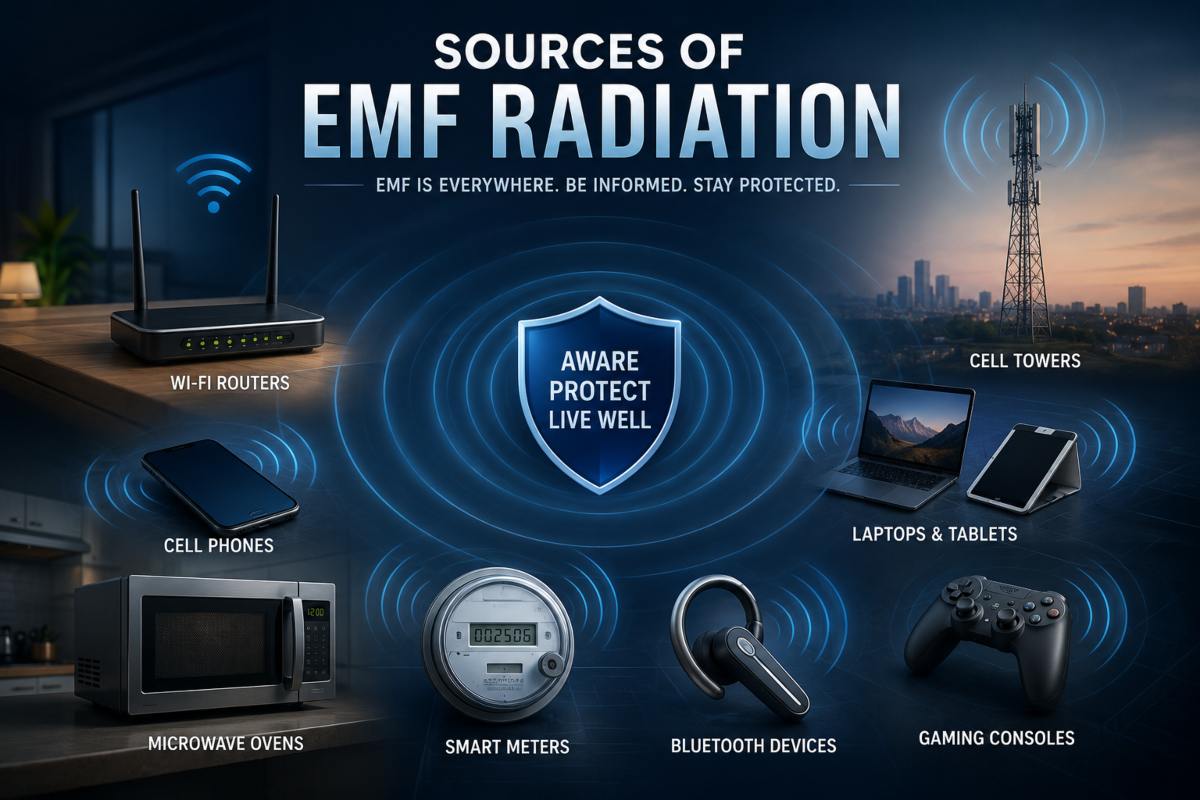
Sources of EMF Radiation: Every Device, Technology, and Infrastructure Source Explained EMF radiation comes from any device, system, or infrastructure that generates or transmits electrical and magnetic energy which, in the modern world, means sources are everywhere. From the router in your living room to the cell tower three blocks away, exposure to electromagnetic fields is continuous, layered, and largely invisible. The full picture of where EMF comes from is broader than most people expect.
It spans the wireless signals in your pocket, the wiring in your walls, and the high-voltage lines running through your neighborhood. According to the World Health Organization, man-made EMF sources now range from extremely low-frequency fields produced by power lines to the radiofrequency bands used by 5G and WiFi a spectrum that covers nearly every form of modern electrical infrastructure. This guide maps every significant source of EMF radiation, explains how each one works, and gives you the context to understand your actual environment from the devices on your desk to the infrastructure you pass every day.
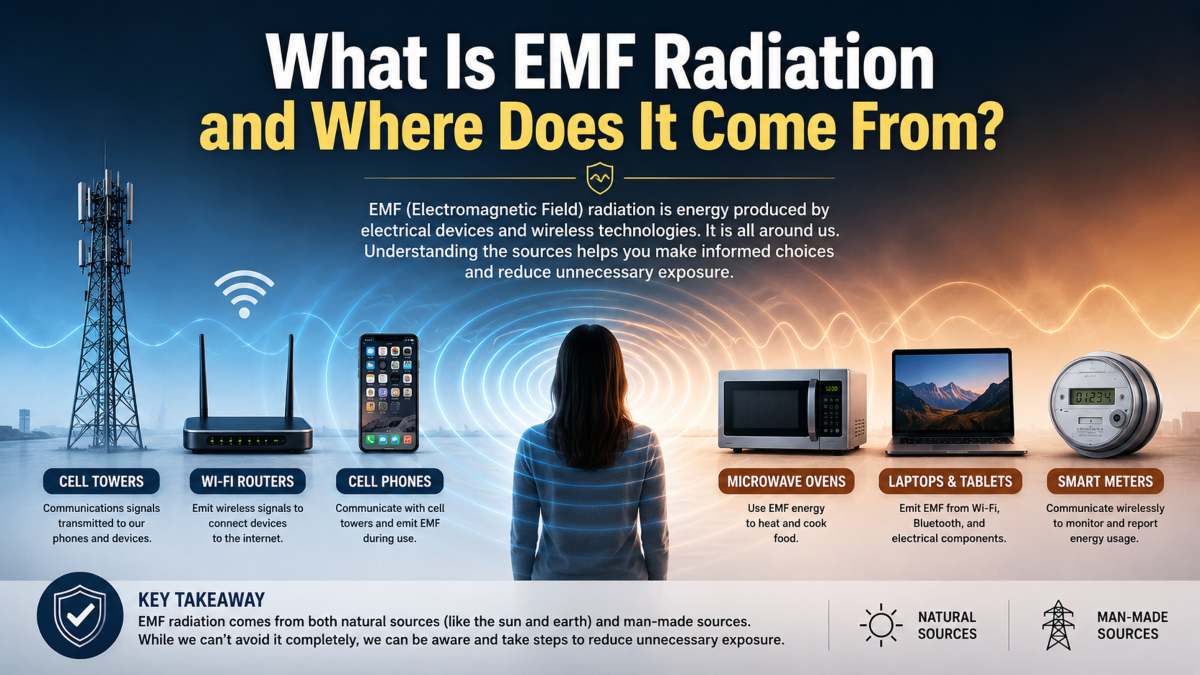
EMF radiation is energy that moves through space as a combination of electric and magnetic fields. It is produced wherever electric charges move which means virtually every powered device, electrical cable, and wireless transmitter in the modern environment is a source. For a deeper primer on the physics, see our guide to EMF radiation explained.
 How EMF Is Generated
EMF is created through three primary mechanisms. Moving electric charges generate a magnetic field around them. Alternating currents the kind that flow through household wiring and appliances reverse direction many times per second, producing oscillating fields that radiate outward from the source. Radio transmission works differently: purpose-built antennas convert electrical current into electromagnetic waves that travel through the air, which is how WiFi routers, cell towers, Bluetooth devices, and 5G infrastructure all broadcast their signals. The strength of the field depends on the power of the source, the frequency it operates at, and how far you are from it. Distance is one of the most significant factors field strength drops sharply as you move away from the source.
Not all EMF radiation behaves the same way. The electromagnetic spectrum runs from extremely low frequencies at one end up through visible light, ultraviolet, X-rays, and gamma rays at the other. The critical dividing line is ionization the point at which radiation carries enough energy to remove electrons from atoms. Ionizing EMF, which includes X-rays and gamma rays, carries that level of energy. Non-ionizing EMF does not. The sources most people encounter daily WiFi, Bluetooth, 5G, cell towers, power lines, and household devices all fall in the non-ionizing range.
The International Agency for Research on Cancer classifies radiofrequency non-ionizing radiation as Group 2B, meaning it is possibly carcinogenic a classification that reflects ongoing research interest rather than established harm, but one that has driven widespread public interest in understanding everyday sources.
Exposure to EMF is not a single event it is cumulative and constant, built from dozens of overlapping sources across the day. The smartphone in your hand, the router in the next room, the Bluetooth earbuds in your ears, and the power lines outside your window are all contributing to the same field simultaneously.
Understanding where each source sits in your environment its frequency, its proximity to you, and how long you are near it is the foundation of any informed approach to managing exposure. You cannot reduce what you have not identified. If you want to go beyond identification to actual measurement, our guide on how to measure EMF radiation at home covers the tools and methods in detail.
A Complete Source Overview Anything that generates, carries, or transmits electrical energy emits some form of EMF radiation. That includes natural planetary phenomena, the wiring inside your walls, and every wireless device you own.
EMF radiation did not begin with technology. The Earth itself is a powerful source its molten iron core generates a planetary magnetic field strong enough to deflect solar wind and orient compass needles from anywhere on the surface. The sun continuously emits electromagnetic radiation across a broad spectrum, from infrared heat through visible light and into ultraviolet frequencies. Thunderstorms produce intense bursts of extremely low frequency EMF with every lightning strike. These natural sources form the baseline electromagnetic environment in which all life on Earth has always existed.
Man-made sources of EMF radiation now span an extraordinary range of power levels and frequencies. At the low end, a Bluetooth earbud transmits at roughly 1 milliwatt. A WiFi router typically operates between 100 and 250 milliwatts. A 4G LTE smartphone can transmit at up to 2 watts. Cell towers broadcast at power levels ranging from tens of watts for small urban cells up to hundreds of watts for rural macro towers.
At the far end of the scale, high-voltage electrical transmission lines carry hundreds of thousands of volts and generate strong extremely low frequency magnetic fields along their entire length. Between those extremes sits the dense layer of devices most people live with daily: laptops, smart TVs, microwave ovens, baby monitors, smart speakers, wearables, and every other connected device in a modern home or office. The US Federal Communications Commission estimates that the average American home now contains more than 25 connected devices each a discrete EMF source contributing to the indoor ambient field environment.
Field strength and proximity are inseparable. A microwave oven generates a substantial magnetic field during operation but that field drops to negligible levels within a few feet. High-voltage power lines produce lower-frequency fields that extend much farther from the source and penetrate building materials more readily. Cell towers transmit at high power but are typically far enough away that ground-level exposure remains low compared to exposure from devices held directly against the body.
By that measure, the sources that consistently produce the highest personal exposure are the ones closest to the body for the longest periods smartphones held to the ear or kept in a pocket, laptops used on the lap, and wireless earbuds worn for hours at a time. Proximity and duration together determine real-world exposure far more than raw transmission power alone. For a closer look at one of the most significant personal sources, see our detailed breakdown of EMF from phones.
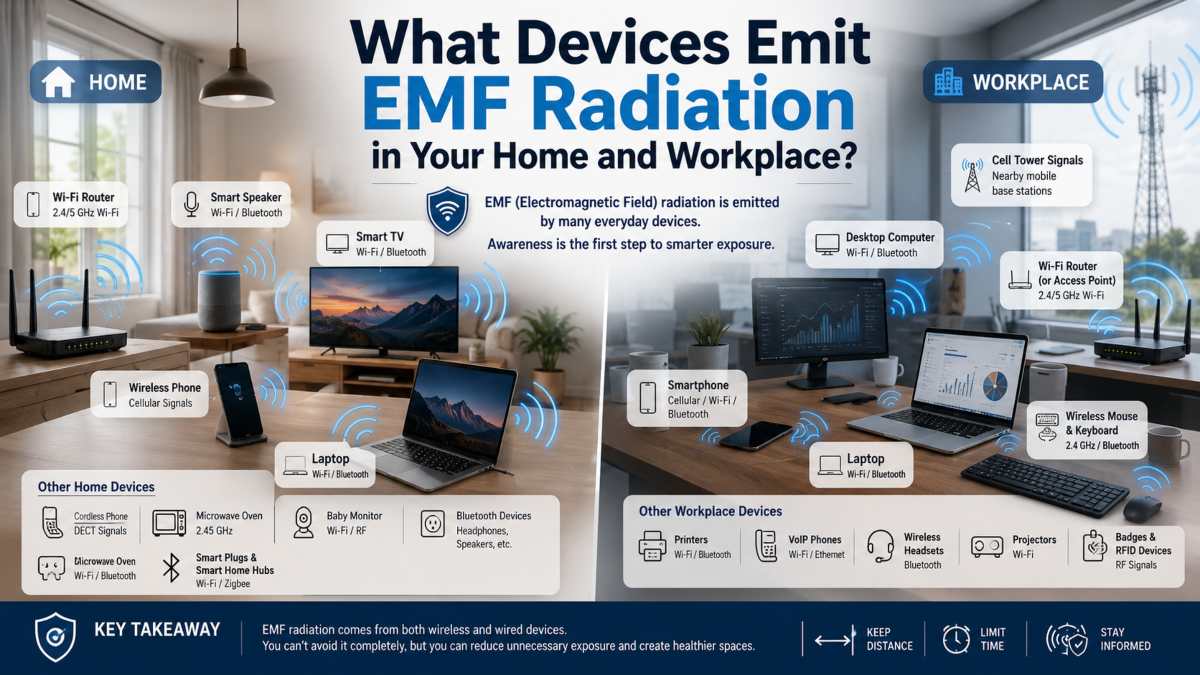
The devices that emit EMF radiation in a typical home or workplace range from the obvious smartphones and WiFi routers to the ones most people never think about, like smart plugs, baby monitors, and the laptop running on your desk all day. Nearly every powered device is a source, but the ones that matter most for personal exposure are those used in proximity for extended periods.
 Smartphones and Tablets
Smartphones are among the most significant personal EMF sources in everyday life, not because of their raw transmission power but because of how they are used. A smartphone held to the ear during a call, left on a nightstand overnight, or carried in a pocket emits radiofrequency EMF at close range for most of the day.
The FCC requires all smartphones sold in the US to be tested for Specific Absorption Rate a measure of how much RF energy the body absorbs with a legal limit of 1.6 watts per kilogram averaged over one gram of tissue. For a full breakdown of what the research says about phone-level exposure specifically, our guide on EMF from phones covers SAR ratings, proximity effects, and practical steps in detail. Tablets operate on the same WiFi and cellular frequencies and present similar proximity considerations, particularly when used on the lap or held close to the face.
Laptops emit EMF from multiple simultaneous sources: the WiFi and Bluetooth radios broadcasting wirelessly, the internal processor and circuitry generating extremely low frequency fields, and the power supply converting AC. When used on a desk they present a lower proximity concern than a phone held to the ear, but laptop-on-lap use common during remote work brings the device within inches of the body for hours at a time. Desktop computers emit similar fields from their components but are typically used at a fixed distance from the user, which reduces close-range exposure.
A smart TV maintains a persistent WiFi connection to stream content, receive updates, and support voice control features which means it continuously broadcasts radiofrequency EMF, not just when in active use. Streaming sticks and set-top boxes plugged into televisions behave the same way. Because TVs are typically positioned several feet from the viewer, RF exposure from the set itself is relatively low compared to handheld devices. The more relevant consideration is the WiFi router powering the stream, which is often located in the same room.
Microwave ovens operate at 2.45 GHz the same frequency band as most WiFi routers and generate high-intensity electromagnetic fields inside the cavity during cooking. Modern ovens are shielded to contain those fields, but measurable EMF does radiate from the door seals and vents during operation. The field drops off quickly with distance. Standing directly in front of a running microwave results in higher momentary exposure than standing a few feet away, and the field is effectively negligible beyond about 3 feet for most consumer models.
Baby monitors are a continuous source of RF EMF that operates in proximity to sleeping infants for long stretches of time which makes them among the more-discussed household sources among parents researching EMF. DECT-based monitors operate in the 1.9 GHz band and transmit continuously, whether or not sound is detected. Smart home hubs devices like Amazon Echo, Google Nest, and Apple HomePod maintain persistent wireless connections and actively listen for wake words, meaning they broadcast and receive RF signals around the clock. Parents concerned about an infant’s proximity to RF sources may also want to consider purpose-designed options, such as the SLVR Wear Signal Shielding Baby Blanket, which provides a tested RF barrier for the sleep environment.
Smartwatches and wireless earbuds are notable EMF sources, particularly because they are worn on the body. A smartwatch maintains a continuous Bluetooth connection to a paired phone throughout the day, pressing a transmitting antenna against the wrist for 12 or more hours at a stretch. Wireless earbuds place Bluetooth antennas directly at the ear canal one of the areas of closest proximity to the brain. Bluetooth Low Energy, the protocol used by most modern wearables, transmits at significantly lower power than classic Bluetooth or WiFi. Still, the combination of direct skin contact and extended daily wear makes wearables a consistent part of any honest accounting of personal EMF sources.
WiFi emits radiofrequency EMF radiation continuously by broadcasting electromagnetic signals between your router and connected devices. It is one of the most consistent sources of RF exposure in the home because, unlike a phone call or a microwave cycle, a WiFi router transmits continuously, whether devices are actively using it or not.
WiFi operates on two primary frequency bands. The 2.4 GHz band has been the standard since the earliest home routers and remains the most widely used because it travels farther and penetrates walls and floors more effectively. The 5 GHz band offers faster data speeds but has a shorter range and is absorbed more readily by physical obstacles. Most modern routers broadcast both bands simultaneously, meaning a dual-band router is effectively two RF transmitters running in parallel at all times. WiFi 6E and WiFi 7 routers add a third band at 6 GHz, extending the range of frequencies in active use within the home.
WiFi signal and the RF EMF it carries follows the inverse square law: field strength decreases proportionally to the square of the distance from the source. In practical terms, this means exposure at 3 feet from a router is roughly 9 times lower than at 1 foot, and at 10 feet it is 100 times lower than at 1 foot.
A typical home router broadcasts at between 100 and 250 milliwatts of transmit power. At 1 meter, RF power density from a standard router generally falls well within the exposure limits set by the International Commission on Non-Ionizing Radiation Protection, and it diminishes rapidly beyond that distance. Distance is the single most effective variable in reducing WiFi-related RF exposure. To understand what the established safety thresholds look like in practice, our overview of safe EMF levels provides useful context.
A common concern with upgrading to mesh WiFi systems or WiFi 6 routers is whether they produce more EMF radiation than older hardware. The transmit power of consumer routers is regulated and capped in the US, the FCC limits WiFi transmit power to 1 watt (30 dBm) for most bands. WiFi 6 and WiFi 6E routers operate within the same power limits as their predecessors. Where mesh systems differ is in the number of transmitting nodes: a three-node mesh network places three active routers throughout the home rather than one, thereby multiplying the number of RF sources, even if each unit emits no more than a standard router. More nodes means more coverage points and more simultaneous broadcast locations.
The sleeping environment is one of the most-discussed contexts for WiFi EMF exposure because the body is stationary and in proximity to fixed sources for 7 to 9 hours at a stretch. A router placed in or near a bedroom or a smartphone connected to WiFi left on a nightstand maintains active wireless communication throughout the night. Because the duration of exposure is a key variable in any assessment of EMF contact, the overnight period accounts for a meaningful portion of total daily exposure for many people. Turning off the router at night or keeping wireless devices farther from the bed are among the simplest steps to reduce WiFi-related exposure during sleep.
5G emits radiofrequency EMF radiation in the same non-ionizing range as 4G and WiFi. Still, it introduces new frequencies, new antenna infrastructure, and a fundamentally different network architecture that changes where exposure comes from and how it behaves. Understanding what is actually new about 5G is the starting point for understanding its EMF profile.
4G LTE operates primarily in frequency bands below 2.5 GHz, with some deployments reaching into the 2.5–2.7 GHz range. 5G expands the usable spectrum significantly in both directions. Low-band 5G operates below 1 GHz similar to existing 4G bands and provides wide-area coverage. Mid-band 5G, often called sub-6 GHz, operates between 2.5 and 6 GHz and delivers the combination of coverage and speed that defines most urban 5G deployments. The genuinely new territory is millimeter wave, which operates between 24 and 100 GHz frequencies without precedent in consumer mobile networks. Higher frequency does not automatically mean higher exposure, but it does mean different propagation behavior and a different infrastructure footprint.
Sub-6 GHz 5G behaves similarly to existing cellular and WiFi signals. It travels hundreds of meters from a tower, passes through walls and windows with moderate attenuation, and covers large areas from a single antenna. Millimeter wave 5G is the opposite in almost every physical respect. Its extremely short wavelengths are rapidly absorbed by air, rain, foliage, and building materials, limiting its range to roughly 100 to 300 meters under ideal conditions and far less through obstacles.
Because mmWave cannot penetrate buildings effectively, it is deployed primarily outdoors in high-density urban environments stadiums, transit hubs, dense commercial streets and requires antennas positioned at close range to function. The International EMF Scientist Appeal has specifically noted that mmWave deployment represents new exposure territory that warrants continued independent research, given the shallower tissue penetration depth and the density of infrastructure required to sustain coverage.
The infrastructure shift that accompanies 5G deployment is as significant as the frequency shift. Traditional 4G relied on large macro towers, typically positioned on rooftops or dedicated structures at height, broadcasting at high power over wide areas. 5G particularly mmWave requires dense networks of small cell antennas mounted on street furniture: utility poles, traffic lights, building facades, and bus shelters, often at head height and within meters of pedestrians.
This proximity is a meaningful variable. Even though small cells transmit at lower power than macro towers, their placement at street level and close range can produce localized exposure levels comparable to or exceeding those of a distant macro tower. The key difference is that with macro towers distance provides passive protection; with street-level small cells, that buffer is reduced by design.
The honest answer is that peer-reviewed research specific to 5G exposure is still limited relative to the speed of deployment. The bulk of the existing RF bioeffects research base was conducted on 2G, 3G, and 4G frequencies. Regulatory exposure limits in most countries including the FCC’s limits in the US were last comprehensively reviewed before 5G was deployed. The World Health Organization has acknowledged this gap and is conducting an ongoing EMF health risk assessment that explicitly includes 5G frequencies.
A 2022 review published in Environmental Research examined existing RF exposure data and found that measured 5G exposure levels in public spaces were generally below current regulatory limits but the authors noted that mmWave data remained sparse and that long-term exposure studies are not yet available. The current scientific position is not that 5G has been proven safe or harmful, but that the evidence base for its specific frequencies is still being built. For those looking to understand the current limits, our safe EMF levels guide covers the regulatory framework in detail.
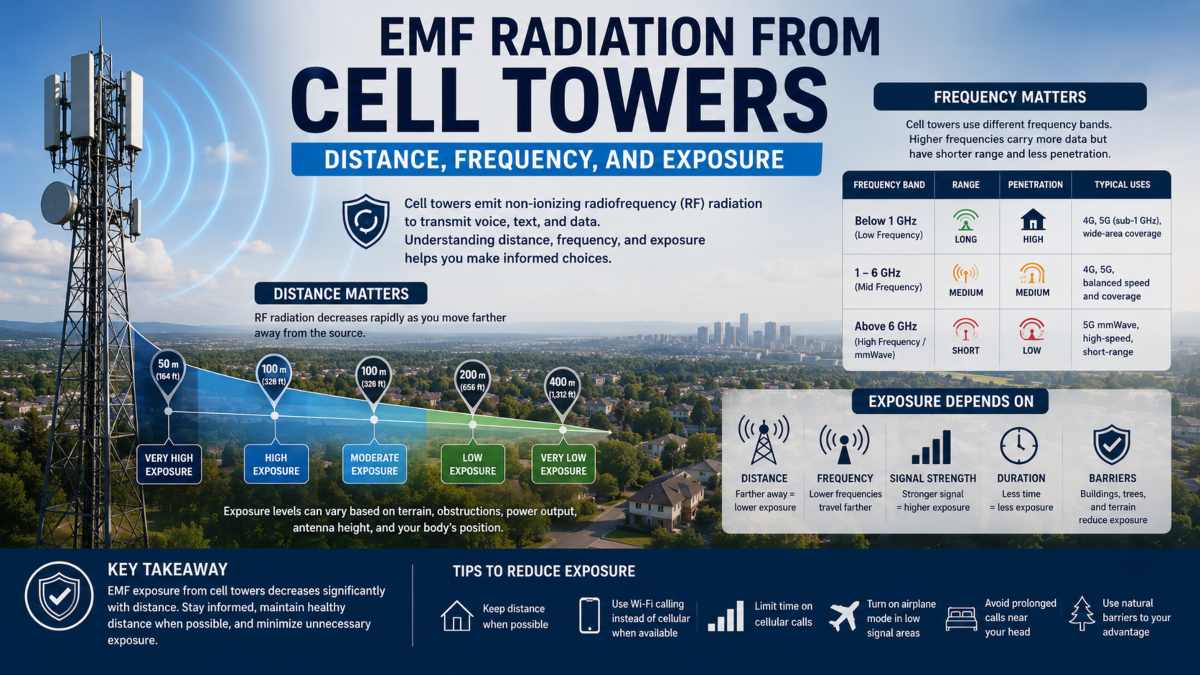
Cell towers emit radiofrequency EMF radiation continuously by broadcasting signals across large coverage areas to serve every connected device within range. Unlike handheld devices, towers are fixed, high-power sources but distance, antenna direction, and local terrain all shape how much of that radiation reaches any given point on the ground.
 How Cell Towers Broadcast RF Radiation
A cell tower converts electrical power into radio-frequency electromagnetic waves, which are then broadcast outward through directional panel antennas. Most tower antennas are not omnidirectional they are designed to concentrate signal horizontally across a coverage sector, typically dividing a tower’s broadcast area into three 120-degree sectors.
The antennas are mounted at a height and slightly angled downward toward the coverage zone, which means the strongest part of the signal beam passes through the air well above street level before reaching the ground. Towers operate across a range of licensed frequency bands depending on the carrier and generation of technology installed 700 MHz for low-band coverage, 1.9 and 2.1 GHz for mid-band 4G, and 2.5 GHz and above for 5G mid-band deployments. A single physical tower structure commonly carries equipment from multiple carriers simultaneously, each broadcasting on its own frequencies.
RF exposure from a cell tower decreases rapidly with distance in open conditions, following the inverse-square law doubling the distance from the source reduces the field strength to roughly one-quarter of its previous level. Measured RF power density directly beneath a typical macro cell tower is generally a small fraction of international exposure limits at ground level, precisely because the antenna beam is directed outward and the strongest signal passes overhead rather than straight down.
Studies conducted in populated areas consistently find that ground-level RF exposure from towers is orders of magnitude below regulatory limits at distances beyond 50 meters. A 2011 review published in Environmental Health Perspectives found that ambient RF levels near base stations in urban environments were typically thousands of times below the ICNIRP reference levels though that research predates the widespread deployment of 5G small cells at street level.
Public concern about living near a cell tower is one of the most common drivers of interest in EMF research, and the data on it is more nuanced than either dismissive or alarmist framings suggest. Measured exposure levels at residential distances from macro towers typically 100 meters or more are consistently low in absolute terms. However, the research picture becomes more complex for small-cell 5G antennas mounted at street level on residential blocks, where the reduced distance alters the proximity calculus.
A 2021 report from the Swiss Federal Office for the Environment found that 5G antenna installations produced measurable increases in ambient RF levels in nearby residential areas compared to pre-5G baseline measurements, while remaining within national limits. The distinction between being within regulatory limits and being at zero exposure is one that ongoing research continues to examine, and several national health agencies have recommended precautionary approaches for sensitive populations pending longer-term data.
In the US, the FCC maintains a publicly accessible database of all licensed antenna structures through its Antenna Structure Registration system, searchable at fcc.gov. A more user-friendly option is the crowd-sourced database at antennasearch.com, which returns a map of all registered towers and antennas within a specified radius of any US address.
For international users, OpenCelliD is one of the largest open databases of cell tower locations globally, compiled from contributor measurements. These tools return registration data tower location, height, owner, and licensed frequencies but they do not measure actual RF levels at your location. For measured exposure data, a calibrated RF meter or a professional EMF survey provides ground-level readings that registration databases cannot. Our step-by-step guide to measuring EMF radiation at home covers the equipment and methodology you need to get accurate readings.
Power lines emit extremely low-frequency EMF radiation a fundamentally different type of electromagnetic field from the radio-frequency signals produced by WiFi, cell towers, and Bluetooth. Where RF radiation travels through the air as a wave, ELF fields from power lines exist as slow-oscillating electric and magnetic fields that extend outward from the line and penetrate most building materials with minimal attenuation.
The electromagnetic spectrum spans an enormous range of frequencies, and ELF and RF occupy opposite ends of the non-ionizing portion. Radiofrequency EMF used by wireless technology operates between roughly 100 MHz and 300 GHz. Extremely low frequency EMF from power lines operates at 50 or 60 Hz, depending on the country’s electrical grid standard oscillating 50 or 60 times per second, compared to millions or billions of times per second for RF.
This difference in frequency produces fields with very different physical behaviors. RF radiation diminishes quickly with distance and is blocked or reflected by many materials. ELF magnetic fields from power lines decay more slowly with distance and pass through walls, floors, concrete, and most shielding materials that would attenuate RF signals. The IARC classified ELF magnetic fields as Group 2B possibly carcinogenic in 2002, a classification that has driven ongoing epidemiological research into residential proximity to power lines for more than two decades.
Not all power lines are equal in the fields they produce. High-voltage transmission lines carry electricity at 115,000 to 765,000 volts across long distances from generation facilities to substations. These lines produce the strongest ELF magnetic fields of any civilian electrical infrastructure, measurable at significant distances from the line depending on current load and configuration. At the edge of a typical transmission line right-of-way often 50 to 100 feet from the conductor magnetic field strength can range from 10 to 100 milligauss depending on the load carried.
Neighborhood distribution lines, the lower wires strung between wooden poles on residential streets, operate at much lower voltages typically 4,000 to 35,000 volts and produce correspondingly weaker fields that drop to background levels within a short distance. The distinction matters considerably for residents trying to assess their actual exposure environment: a house near a neighborhood distribution pole faces a very different field profile than one adjacent to a high-voltage transmission corridor.
One of the defining characteristics of ELF magnetic fields is that they are not stopped by the materials that make up most buildings. Walls, roofing, floors, standard insulation, and ordinary glass offer virtually no shielding against low-frequency magnetic fields. This means that a home near a high-voltage transmission line receives measurable indoor magnetic field exposure regardless of construction type or building density between the home and the line.
A study published in the American Journal of Epidemiology found detectable elevations in ELF magnetic fields inside homes located within 50 meters of high-current distribution lines, with levels decreasing but remaining elevated at greater distances. Indoor wiring, transformers, and high-draw appliances also generate ELF fields within the home, creating a background level against which external power line fields are superimposed.
Underground power line installation is sometimes proposed as a solution to overhead line EMF exposure, and the answer is more complicated than a simple yes. Burying power lines eliminates the visual and physical footprint of overhead infrastructure. It reduces the electric-field component of EMF almost entirely the surrounding soil and conduit act as an effective shield against it. However, the magnetic field produced by underground lines is not similarly contained. B
ecause underground cables are bundled more closely together than overhead conductors spread across a tower, the geometry can actually concentrate the magnetic field near the surface directly above the cable route. At ground level above a buried high-voltage cable, magnetic field measurements can equal or exceed those found near equivalent overhead lines at comparable distances. The reduction in exposure from undergrounding depends heavily on cable depth, configuration, and distance and should not be assumed without measurement.
Bluetooth emits radiofrequency EMF radiation at significantly lower power levels than WiFi or cellular but it operates in direct contact with or millimeters from the body for hours at a time, which makes it a meaningful part of any honest assessment of daily EMF exposure. Low power does not mean zero exposure, and proximity changes the equation considerably.
Bluetooth operates in the 2.4 GHz ISM band the same frequency range used by standard WiFi. What distinguishes it from WiFi is transmit power. Bluetooth devices are classified into three power tiers. Class 1 devices, the most powerful, transmit at up to 100 milliwatts and have a range of roughly 100 meters these are typically found in industrial or specialist applications.
Class 2 devices, which cover most consumer electronics including smartphones and laptops, transmit at up to 2.5 milliwatts with a range of around 10 meters. Class 3 devices operate at 1 milliwatt or less. For context, a standard WiFi router transmits at 100 to 250 milliwatts between 40 and 100 times the power of a typical Class 2 Bluetooth device. The lower power output is a genuine distinction, but it is one that proximity partially offsets when a device is worn directly on or in the body.
Classic Bluetooth and Bluetooth Low Energy are two distinct protocols that share a frequency band but differ substantially in how they transmit. Classic Bluetooth maintains a continuous connection and is used for applications that require sustained data throughput audio streaming being the primary example.
Bluetooth Low Energy, introduced in Bluetooth 4.0 and now standard in most wearables, fitness trackers, and smart home sensors, transmits in short, intermittent bursts rather than a continuous stream. This duty cycle brief transmissions followed by silence means BLE devices produce RF EMF in pulses rather than continuously. Peak transmit power for BLE is typically 10 milliwatts or less, and average power over time is far lower still because of the gaps between bursts. Most modern wireless earbuds use BLE for pairing and control, while Classic Bluetooth handles audio, meaning they switch between modes depending on what the device is doing.
The proximity consideration for Bluetooth devices is more significant than the power figures alone suggest. Wireless earbuds sit at the entrance to the ear canal a few millimeters from brain tissue for two, four, or eight hours a day in typical use. Hearing aids with Bluetooth connectivity are worn similarly, often by older adults for twelve or more hours daily. Smartwatches maintain a continuous Bluetooth connection pressed against the wrist throughout the day and overnight for sleep tracking.
A 2019 open letter signed by over 250 scientists and published through the International EMF Scientist Appeal specifically called attention to wireless earbuds worn close to the brain as a category warranting further safety research, citing the gap between existing RF bioeffects research conducted primarily on devices held at greater distances and the direct-contact reality of earbud use. The science on long-term close-proximity Bluetooth exposure is not settled, and the research base specific to in-ear devices remains limited relative to how widely they are now used.
Placed side by side, Bluetooth occupies the low end of the consumer RF exposure spectrum. A 4G LTE smartphone transmitting at peak power during a call produces RF fields up to 2 watts roughly 800 times the output of a Class 2 Bluetooth device. A Wi-Fi router operates at 100 to 250 milliwatts, about 40 to 100 times the power of a typical Bluetooth transmitter. A Bluetooth Low Energy wearable pulsing at 1 to 10 milliwatts sits at the bottom of the range.
In terms of raw field strength measured at a fixed distance, Bluetooth is the weakest of the three by a substantial margin. The variable that closes that gap is body placement. A smartphone producing 2 watts held a meter away delivers a very different exposure profile than a 2.5 milliwatt earbud sitting directly in the ear canal. Field strength at the source matters less than field strength at the tissue and for Bluetooth wearables, that distance is effectively zero.
When comparing sources of EMF radiation, raw transmission power alone does not determine which source exposes you the most frequency type, proximity to the body, and hours of daily contact all shape real-world exposure in ways that a simple power ranking misses. The source with the highest wattage is rarely the one that matters most to the person using it.
| Source | EMF Type | Frequency | Typical Transmit Power | Typical Use Distance |
|---|---|---|---|---|
| High-voltage power lines | ELF (Extremely Low Frequency) | 50–60 Hz | N/A (high current load) | 50–300+ meters |
| Microwave oven | RF (contained) | 2.45 GHz | 600–1,200 watts (internal) | 1–3 feet during use |
| 5G macro tower | RF | 600 MHz–6 GHz / 24–100 GHz (mmWave) | Tens to hundreds of watts | 50–500+ meters |
| WiFi router | RF | 2.4 GHz / 5 GHz / 6 GHz | 100–250 milliwatts | 3–30 feet |
| Smartphone (cellular) | RF | 700 MHz–6 GHz | Up to 2 watts | 0–12 inches |
| Laptop | RF + ELF | 2.4 GHz / 5 GHz + 50–60 Hz | 100–250 mW (WiFi) | 6–24 inches |
| Bluetooth earbuds | RF | 2.4 GHz | 1–10 milliwatts | 0–5 mm |
Power line exposure is measured differently from RF sources field strength in milligauss rather than transmit power which is why that row carries no wattage figure. The microwave oven’s high wattage is largely self-contained by its shielded cavity; the figure reflects internal cooking power, not radiated field strength at the user.
No single source tells the full story. What most people experience is overlapping, simultaneous exposure from multiple sources across the entire day and that cumulative picture looks very different from any individual source in isolation. A typical day might include a smartphone in a pocket for 10 hours, wireless earbuds in use for 3, a laptop on a desk for 8, a Wi-Fi router broadcasting continuously in the same room, and a commute past cell towers and power line infrastructure. Each source contributes its own field at its own frequency, and those fields coexist in the same environment simultaneously.
The WHO’s International EMF Project has acknowledged that cumulative exposure assessment across multiple simultaneous sources remains one of the more technically challenging areas of EMF research, precisely because real-world exposure is multi-source and continuous rather than the single-source scenarios used in most controlled studies.
When proximity and duration are applied as filters, the ranking of EMF sources shifts considerably from what a raw power comparison would suggest. Cell towers and power lines generate strong fields at the source, but distance reduces their contribution to personal exposure substantially for most people. The sources that consistently rank highest for actual body-level exposure are those worn on or held against the body for the longest periods. A smartphone used for calls, kept in a pocket, or placed on a nightstand represents high-proximity, high-duration RF exposure. Bluetooth earbuds place a transmitting antenna millimeters from the brain tissue for hours each day.
A laptop used on the lap combines WiFi RF fields with ELF fields from its internal components at close range for extended work sessions. By the metrics that matter most proximity and duration personal devices outrank infrastructure sources for most people in most situations. The tower down the street is powerful. The phone in your pocket is closer.
Reducing exposure to EMF radiation sources does not require eliminating technology it requires being deliberate about distance, duration, and the environments where exposure is highest and most sustained. Small adjustments to how and where devices are used produce meaningful reductions in daily body-level exposure. For a comprehensive overview of what actually blocks EMF and what doesn’t, our guide on what blocks EMF radiation is a useful starting point.
Distance is the most effective and immediately available tool for reducing EMF exposure from any source. Because field strength follows the inverse square law, even modest increases in distance produce substantial reductions in exposure. Moving a WiFi router from a desk where you sit for eight hours to a shelf on the opposite wall, keeping a smartphone on a table rather than in a pocket, or stepping back from a microwave during operation each of these changes reduces exposure significantly without requiring any new equipment or behavioral disruption.
The principle applies across every source category covered in this guide: the farther the source, the lower the field strength at the body. For RF sources in particular, doubling the distance reduces exposure to roughly one quarter of its previous level. That is a 75 percent reduction from a single positional adjustment.
Many of the most significant EMF sources in the home operate continuously, whether or not they are actively in use. A Wi-Fi router broadcasts at full power at 3 a.m., just as it does at noon. A Bluetooth connection between a smartwatch and a phone maintains its link whether the watch is being checked or sitting on a dresser.
Turning off or disabling sources during periods of non-use particularly during sleep removes hours of low-level continuous exposure from the daily total without affecting utility during waking hours. Routers with scheduled shutoff features, or a simple power strip with a timer, can automate overnight WiFi shutoff. Enabling airplane mode on a smartphone at night prevents cellular and Wi-Fi transmission from the device while retaining its alarm and offline functions. Given that sleep represents seven to nine hours of stationary, close-proximity time, the overnight environment has an outsized effect on cumulative daily exposure.
EMF shielding fabrics are textiles woven with conductive metal fibers typically silver that create a barrier capable of attenuating radiofrequency electromagnetic fields. The conductive fiber network within the fabric reflects and absorbs incoming RF waves, reducing the field strength that passes through to the body on the other side.
Silver-fiber shielding fabrics used in tested garments can achieve up to 99.91% EMF blockage at frequencies up to 50 GHz under laboratory conditions. This figure covers the full range of current wireless technology from standard cellular bands through 5G. In practical application, EMF radiation protection clothing functions by placing a tested, lab-verified barrier between the body and RF sources during periods of sustained exposure at a desk, during a commute, or in environments with dense wireless infrastructure. Shielding fabric does not eliminate a source; it reduces what reaches the body from sources that cannot be switched off or moved farther away.
For those in professional or clinical settings, EMF protective clothing is also available in workwear formats including silver scrubs and EMF blocking medical scrubs designed for healthcare workers who spend extended shifts in environments with dense wireless infrastructure.
Three environments account for the majority of sustained daily EMF exposure for most people, and each has its own practical approach to reducing exposure. The bedroom is the highest-priority environment because of the duration of time spent there. Moving the router out of the bedroom entirely, enabling airplane mode on all devices overnight, replacing a DECT baby monitor with a wired alternative, and keeping the phone on the far side of the room rather than the nightstand all reduce overnight exposure without meaningful lifestyle disruption.
The home office concentrates multiple simultaneous sources laptop, router, phone, smart speaker, monitor in a single room for extended working hours. Using a wired ethernet connection eliminates the need for the router to broadcast at close range, reducing one of the largest RF sources in the workspace.
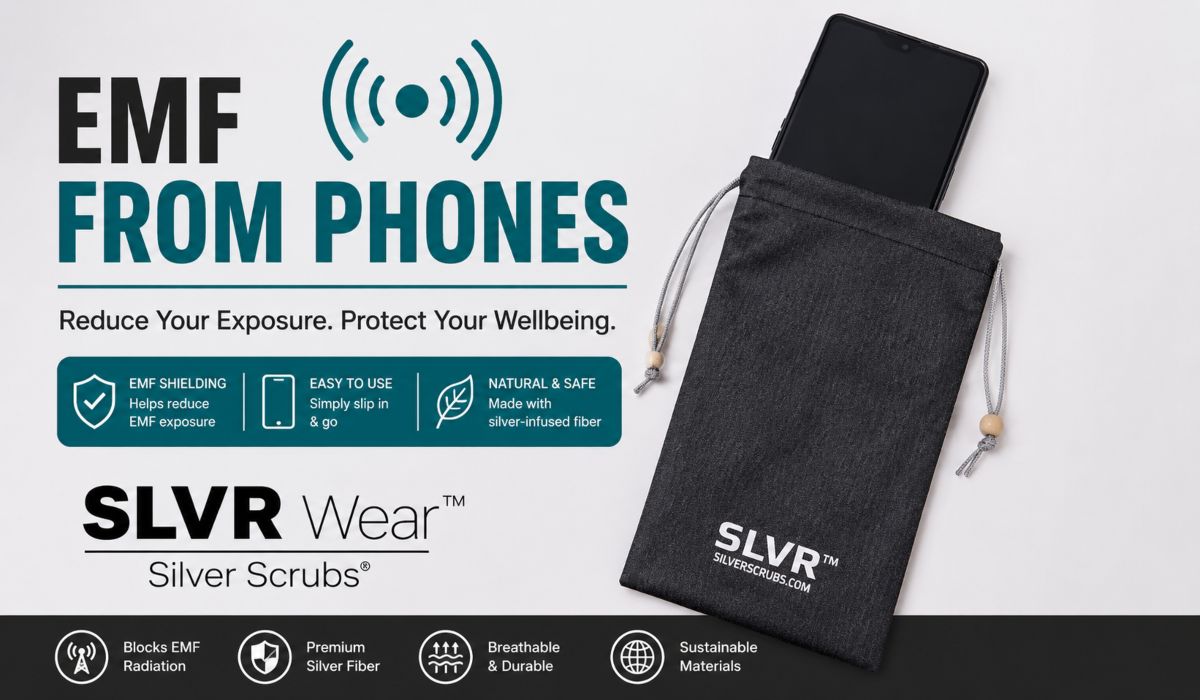
Keeping the phone at desk distance rather than in a pocket during sedentary work hours removes the closest-proximity source from direct body contact for the duration of the session. Daily carry is where personal device exposure accumulates across movement throughout the day. A phone carried in a pocket maintains close contact with the body during every call, notification, and background data sync. A Faraday phone pouch a shielded enclosure that blocks RF signals prevents the device from transmitting or receiving while stored, eliminating pocket-level exposure when the phone is not in use. For those who use wireless earbuds extensively, switching to wired headphones for longer listening sessions removes the in-ear Bluetooth source entirely during those sessions.
For most people, WiFi contributes more to daily RF EMF exposure because routers operate continuously and are located close to users. Although 5G towers transmit at higher power levels, they are usually much farther apart. In areas with nearby 5G small cells, exposure levels may be more comparable.
Power lines can produce stronger extremely low frequency (ELF) fields, but most people are not close enough to experience significant exposure. Household devices such as smartphones, laptops, and wireless earbuds are often used directly on or near the body, making them a more common source of personal EMF exposure.
The home office is usually the location with the highest concentration of EMF-emitting devices, including computers, smartphones, routers, and Bluetooth accessories. Bedrooms are also important because people spend many hours there, often near phones, chargers, and wireless devices.
Standard walls can reduce some radiofrequency (RF) signals from sources such as cell towers and WiFi networks, but they do not block them completely. ELF magnetic fields from power lines pass through most building materials with little reduction. Effective shielding requires specialized materials designed for the specific EMF type.
Yes, increasing distance is one of the most effective ways to reduce EMF exposure. RF field strength decreases rapidly as you move farther from the source. Simple actions like moving a router farther away or keeping a phone away from your body can significantly lower exposure levels.