Silver Scrubs® Medical Clothing | EMF Blocking Scrubs
Every day, nurses, physicians, radiologists, and allied health professionals enter environments saturated with invisible electromagnetic fields from diagnostic equipment, wireless…
You can reduce EMF exposure by increasing the distance from wireless devices, using wired connections where possible, and adding shielding materials, such as silver-fiber fabric, between your body and the signal source. No single method blocks all EMF, but combining a few of these approaches can meaningfully reduce your daily exposure.
EMF, or electromagnetic field radiation, comes from sources most people interact with constantly: wifi routers, smart meters, cell towers, and the phones in our pockets. The average U.S. household now has more than 20 connected wireless devices running at once, according to industry estimates which means exposure isn’t from a single source but from a constantly layered signal environment. Because of that, “blocking EMF” isn’t a single fix. It’s a set of practical adjustments: where you place your devices, how you connect to the internet, and what, if anything, you wear or use as a physical barrier.
This guide breaks down exactly How to Block EMF Exposure, what doesn’t, and how to apply it room by room, device by device so you can make informed decisions about reducing your exposure at home.
EMF exposure is contact with electromagnetic fields given off by any device that transmits or carries an electrical signal from a wifi router to the wiring inside your walls. “Blocking” EMF doesn’t mean eliminating it; it means reducing how much of that radiation reaches your body, either by increasing distance, cutting the signal path, or absorbing it with a conductive material before it gets to you. For a deeper look at what this radiation actually is and where it comes from, see EMF radiation explained.
Every wireless device works by sending information through electromagnetic waves. The strength of the field is highest closest to the source and drops off sharply with distance which is why most reduction strategies start with something as simple as moving a router out of a bedroom, rather than requiring specialized equipment. Shielding materials, wired alternatives, and device placement all work by interrupting or weakening that field before it reaches you, not by “cleaning” the air of radiation.
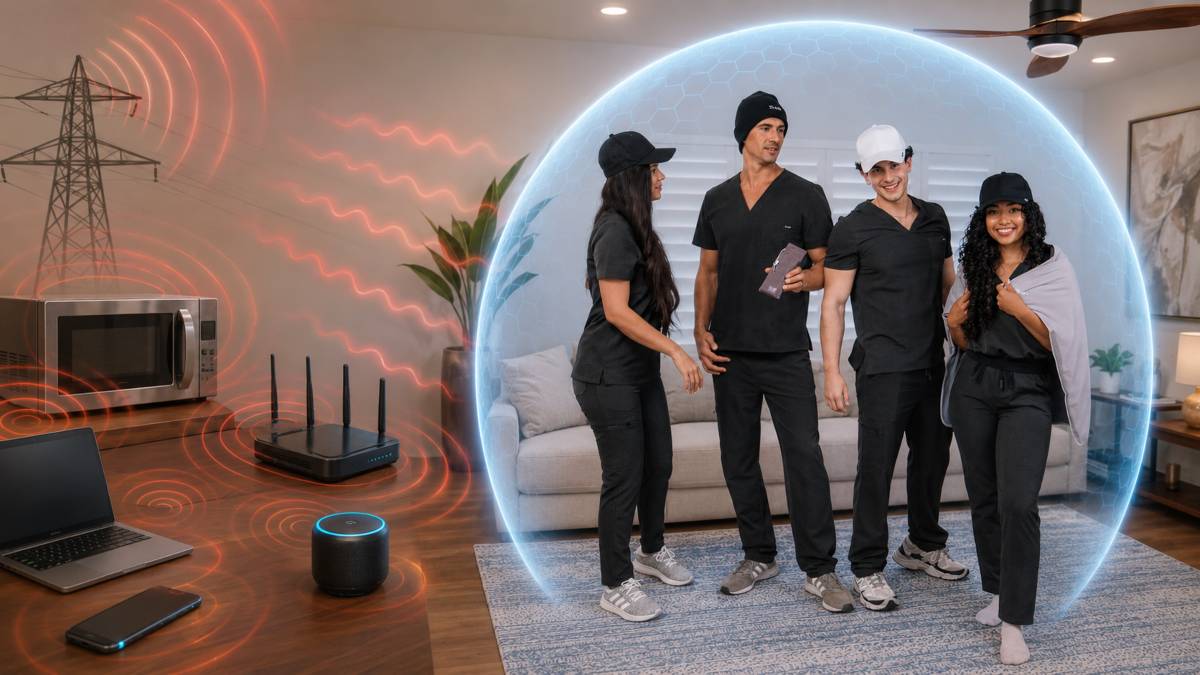 Common Sources of EMF in Everyday Life
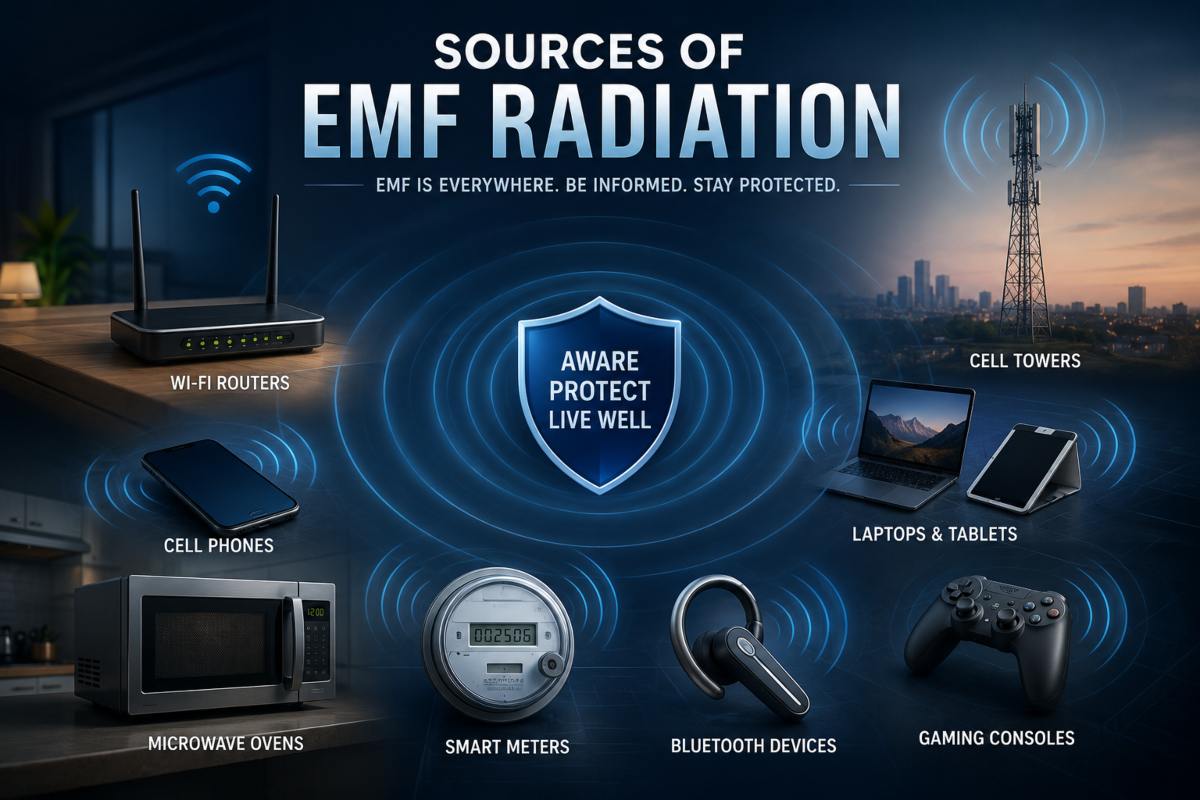
EMF-emitting devices surround most people without realizing how many there are. Wi-Fi routers, smart meters, cell phones, laptops, Bluetooth devices, baby monitors, and smart home hubs all emit electromagnetic radiation during normal operation. Cell towers and 5G infrastructure add a layer of ambient exposure outside the home, while smart meters on the exterior of a house continuously transmit data, often every few seconds. None of these sources are unusual or malfunctioning they’re simply built to communicate wirelessly, and that communication is the EMF. For a full breakdown of where exposure comes from room by room and device by device, see sources of EMF radiation.
EMF isn’t one uniform type of energy it falls into different frequency ranges, and the range determines what actually blocks it. Radiofrequency (RF) EMF is the kind emitted by wifi, cell phones, 5G, and smart meters; it travels through the air as a wave and can be interrupted by conductive materials like silver-fiber fabric or metal shielding. Low-frequency EMF, by contrast, comes from electrical wiring and appliances a different physical phenomenon that responds better to distance than to fabric-based shielding. Knowing which type of EMF you’re dealing with matters because a method that works well for one, like a signal-blocking phone pouch for RF exposure, won’t do anything for the other.
A 2020 IEEE review of shielding fabrics found that silver-fiber textiles can attenuate RF signals by more than 30 dB under lab conditions a meaningful reduction. However, real-world results vary based on fabric coverage and signal frequency. If you want to see how these numbers are actually generated, EMF radiation testing covers the methods used to measure shielding effectiveness.
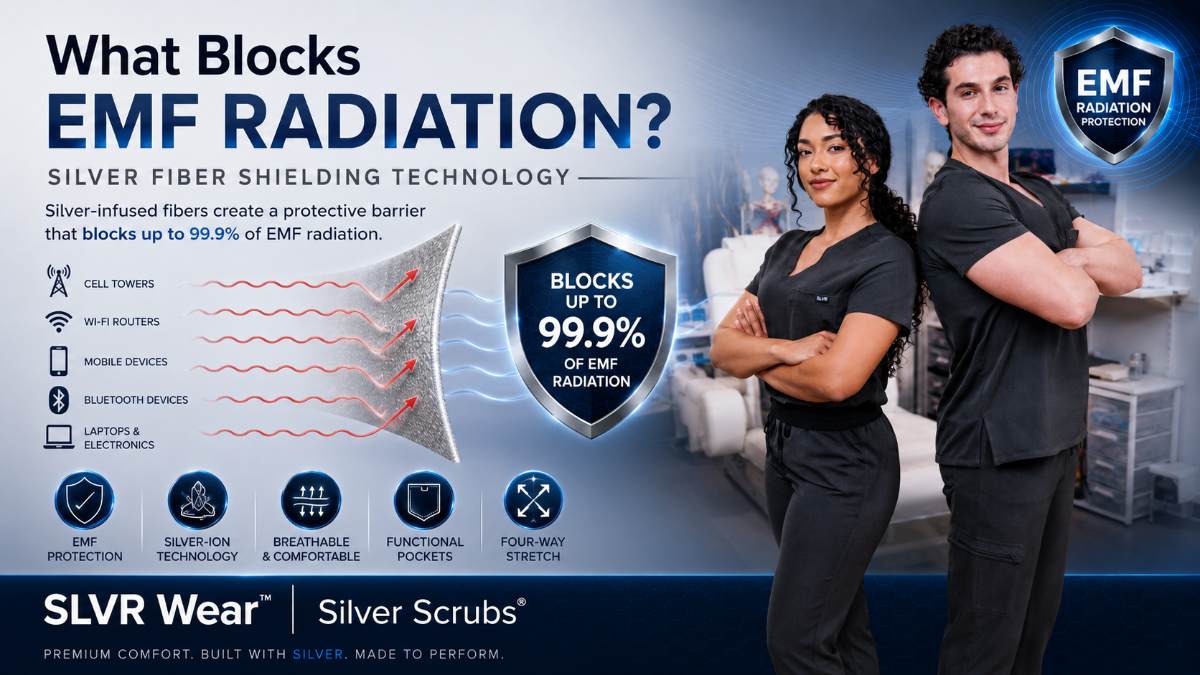
EMF waves are blocked by conductive materials metals and metal-coated fibers like silver, copper, or nickel that reflect and absorb radiofrequency energy before it passes through. The denser and more conductive the material, the more it blocks signals, which is why shielding effectiveness varies widely between a loose-mesh curtain and a tightly woven garment. For the full rundown of materials and how each one performs, see what blocks EMF radiation.
Any material that conducts electricity can interrupt an electromagnetic wave, which is why EMF shielding relies on metals rather than plastics, wood, or standard fabric. Copper, nickel, and silver are the most common choices for wearable and home shielding products, each offering a different balance of conductivity, weight, and durability. When a wave hits a conductive surface, some of it reflects off the material, and some is absorbed and dissipated as it moves through the fibers together, this creates a “shielding effect.” The tightness of the weave, the thickness of the material, and full coverage (no gaps or seams) all affect how much of the signal actually gets stopped.
Yes, silver is one of the most conductive metals available, which makes it effective at reflecting and absorbing RF radiation when woven into fabric. This has nothing to do with silver’s other known properties; its value here is purely electrical; the same conductivity that makes silver useful in electronics wiring is what allows silver-fiber textiles to interrupt wireless signals before they pass through.
Research on silver-coated and silver-infused fibers has found shielding effectiveness consistently above 30 dB across standard RF test frequencies, with performance depending on the amount of silver used and the fabric’s weave. That’s a meaningful reduction in signal strength though, as with any shielding material, results depend on the specific product’s construction, silver content, and coverage. For more on how this specific fabric technology is engineered, see EMF blocking fabric.
Shielding materials only work on the signal that reaches them they don’t extend their effect beyond the fabric itself, which is why distance is still the simplest and most reliable way to lower exposure. A router placed across the room does less than one sitting six inches from your head, regardless of what shielding you’re using elsewhere. Shielding fabric is most useful for close, sustained exposure a phone in a pocket, a laptop on your lap where distance isn’t practical. Used together, distance and shielding cover the two situations the other can’t: distance handles the sources you can move away from, and shielding handles the ones you can’t.
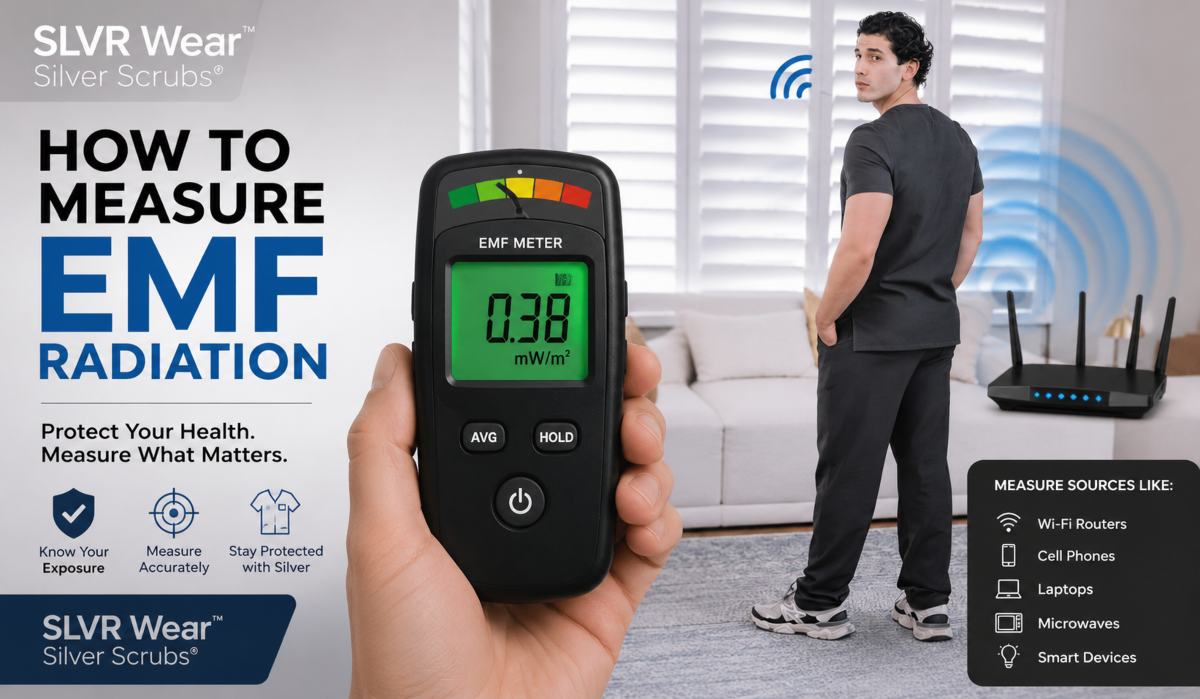
You can reduce EMF exposure at home by increasing the distance from wireless devices, switching to wired connections where practical, and limiting the time high-emission devices run near where you sleep or work. These changes cost nothing and don’t require special equipment they simply reduce the amount of signal your body is exposed to throughout the day. If you want to know exactly how much signal your home is producing before making changes, how to measure EMF radiation at home walks through the process step by step.
Every wireless device in your home router, smart meter, smart speaker, baby monitor adds to a cumulative signal environment, and the biggest factor in how much of that reaches you is proximity. Doubling your distance from a router reduces exposure by roughly 75%, a relationship known as the inverse-square law that applies to virtually all wireless EMF sources, not just Wi-Fi. That means small adjustments moving a router a few feet, keeping a phone off a nightstand produce a real, measurable drop in exposure without removing any device from your home. Understanding what counts as a reasonable target here helps too see safe EMF levels for context on what the numbers actually mean.
The bedroom is usually the highest-priority room to address, since it’s where people spend the most consecutive hours near a device. Keeping a router out of the bedroom, or at least several feet from the bed, meaningfully lowers overnight exposure given how sharply signal strength drops with distance. In the living room and home office, the same principle applies to laptops and smart speakers placing them away from where you sit for extended periods reduces close-range exposure without changing how the devices function.
Kitchens deserve attention too, since smart appliances, microwaves, and often a second Wi-Fi extender cluster in one space; spacing these out rather than centralizing them near a counter you use daily helps distribute exposure instead of concentrating it.
A few daily habits do more than most people expect. Turning off wifi at night either manually or with a timer removes one of the few sources that runs continuously for 8 hours while you’re stationary and close to it. Using speakerphone or wired headphones instead of holding a phone directly to your head reduces close-contact exposure during calls, and switching a laptop or desktop to a wired ethernet connection eliminates its wireless signal output while often improving connection speed. None of these habits require giving up a device they just change how and where it’s used.
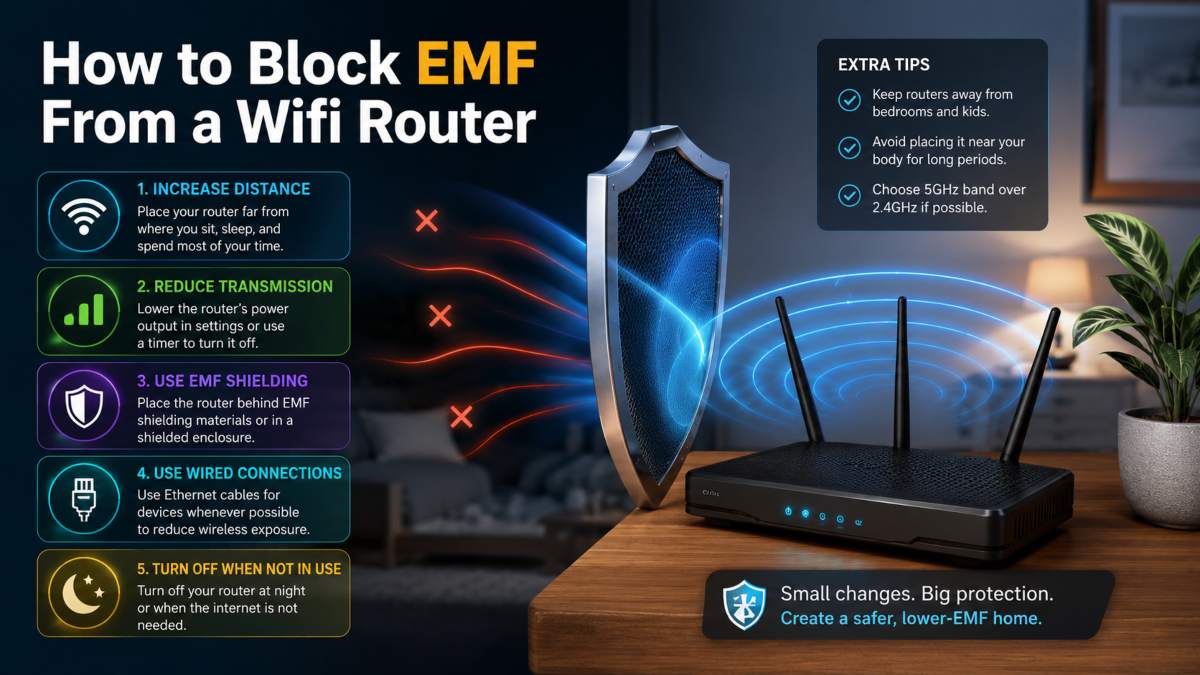
You can block or reduce EMF exposure from a wifi router by increasing the distance between the router and the areas where you spend the most time, switching to a wired ethernet connection where possible, and avoiding placement in bedrooms or workspaces. A router can’t be physically “blocked” from transmitting without disabling it, so most effective strategies focus on limiting how much of that signal reaches you.
A typical home wifi router transmits continuously at 2.4 GHz and 5 GHz, with output power generally falling between 100 and 200 milliwatts low compared to devices like cell towers, but constant, since most routers run 24 hours a day regardless of whether anyone is actively using the internet. Because the exposure is ongoing rather than occasional, small changes in placement and connection type make a proportionally larger difference than they would with a device used only briefly.
 Router Placement and Distance Strategies
Where a router sits matters more than almost any other factor in reducing its impact. Placing it in a hallway, utility room, or another space you don’t spend extended time in rather than a bedroom or home office immediately reduces close-range exposure simply by adding distance. If relocating the router isn’t an option, moving the furniture you use most (a desk, a bed) a few extra feet away can achieve a similar effect, since signal strength drops sharply with distance. Elevating the router or keeping it away from shared walls with a bedroom also helps, since dense materials like concrete or brick absorb some signal, while hollow drywall does very little to block it.
An ethernet connection eliminates a device’s wireless signal, since data travels through the cable rather than over the air making it the most direct way to reduce wifi-related exposure in a specific room or device. Wiring a desktop, smart TV, or gaming console directly to the router removes that device from the wireless signal path without requiring a router change. For situations where full wired setup isn’t practical, reducing the number of devices connected wirelessly, or using a router’s scheduling feature to disable wifi during set hours, achieves a partial version of the same result: less wireless signal running through the space you’re in.
You can reduce EMF exposure from a smart meter primarily by increasing distance and by installing shielding between the meter and the interior wall it’s mounted on, since the meter itself typically can’t be removed or disabled. Unlike a router, a smart meter is usually installed by the utility company, which means most reduction strategies focus on what happens on your side of the wall rather than the device itself.
Smart meters transmit data in short bursts rather than continuously. Each transmission typically lasts only a few milliseconds. However, the frequency of those bursts varies by utility and meter model, with some transmitting every few seconds and others at longer intervals. Because the meter is usually mounted on an exterior wall, the interior space most affected is the room directly on the other side often a bedroom, kitchen, or home office in many house layouts.
The most direct way to address a smart meter’s signal indoors is placing a shielding barrier on the interior wall closest to where it’s mounted, which interrupts the signal before it reaches the room. Conductive paint, metal mesh panels, or silver-fiber wall coverings can all serve this purpose, functioning the same way shielding fabric does reflecting and absorbing the signal rather than letting it pass through unimpeded.
If the affected room is a bedroom or another space used for extended periods, rearranging furniture so the bed or desk sits on the far side of the room, away from the shared wall, adds distance beyond any shielding in place. For renters or anyone unable to modify walls, a smaller shielding panel placed directly behind furniture positioned against that wall offers a partial version of the same effect.
You can block 5G EMF using the same conductive shielding principles that work for other RF signals distance, wired connections, and silver or metal-fiber materials though 5G’s use of higher frequencies means shielding effectiveness can vary more depending on the specific band involved. There’s no separate method required for 5G alone; it responds to the same physics as wifi or cell signals, just across a wider frequency range. For a closer look at how 5G exposure compares to other wireless sources, see 5G EMF radiation.
5G isn’t a single frequency it spans three distinct bands, each with different behavior. Low-band 5G operates below roughly 1 GHz and travels long distances while effectively penetrating walls, similar to older cellular signals. Mid-band 5G, generally between 1 and 6 GHz, is the most common band used for everyday 5G service and offers a balance of speed and coverage. High-band 5G, also called mmWave, operates at 24 GHz and above and delivers the fastest speeds, but only over very short distances, since these higher frequencies struggle to penetrate walls or even rain. This range matters for shielding purposes because a material effective against low-band signals won’t necessarily perform the same way against mmWave frequencies, and vice versa.
Distance remains the most reliable way to reduce 5G exposure, just as it is with Wi-Fi or smart meters moving away from a 5G-enabled router, hotspot, or cell antenna sharply reduces signal strength the farther you get from it. Because mmWave 5G has such limited range and poor wall penetration, exposure from that specific band is typically only significant in very close proximity, such as standing directly next to a small-cell antenna.
For phones and personal devices operating on low- or mid-band 5G, the same tools that reduce general RF exposure apply: wired connections where possible, airplane mode when a device isn’t in use, and shielding fabric or a signal-blocking pouch for a phone carried on the body. Because 5G spans such a wide frequency range, shielding materials with broad-spectrum coverage rather than those tested only at a single frequency offer more consistent protection across all three bands.
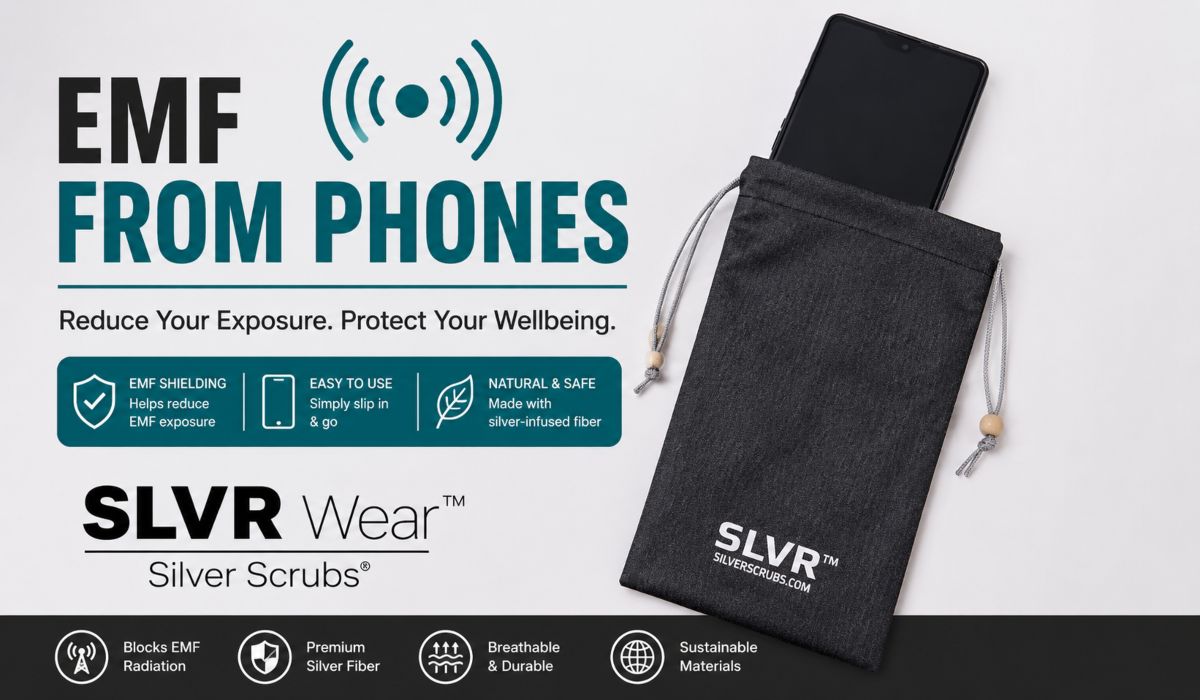
Yes, airplane mode reduces EMF exposure by disabling the radios that connect your device to cellular networks, which is typically the largest single source of RF emission from a phone. It doesn’t eliminate exposure, though, since wifi and Bluetooth often remain available to turn on separately even while airplane mode is active. For a broader look at how much a phone emits day to day and how that compares to other sources, see EMF from phones.
Airplane mode was originally built to shut off every radio on a device cellular, Wi-Fi, Bluetooth, and, in some cases, NFC all at once, cutting off transmission entirely. On most modern smartphones, that’s changed: enabling airplane mode reliably disables the cellular radio, but wifi and Bluetooth can usually be switched back on independently, since so many people want in-flight wifi or wireless headphones.
That means a phone in airplane mode with Wi-Fi or Bluetooth manually re-enabled is still emitting an RF signal from those connections just not from the cellular antenna. For airplane mode to meaningfully reduce EMF exposure, wifi and Bluetooth need to be checked and turned off separately, not assumed to be included automatically. Cellular signal is generally considered the most significant reduction, since a phone actively searching for a cell tower particularly in an area with weak reception increases its transmission power to maintain the connection, and airplane mode removes that source entirely. For situations where a phone has to stay on and close to your body regardless, a Faraday Phone Pouch offers a shielding-based alternative.
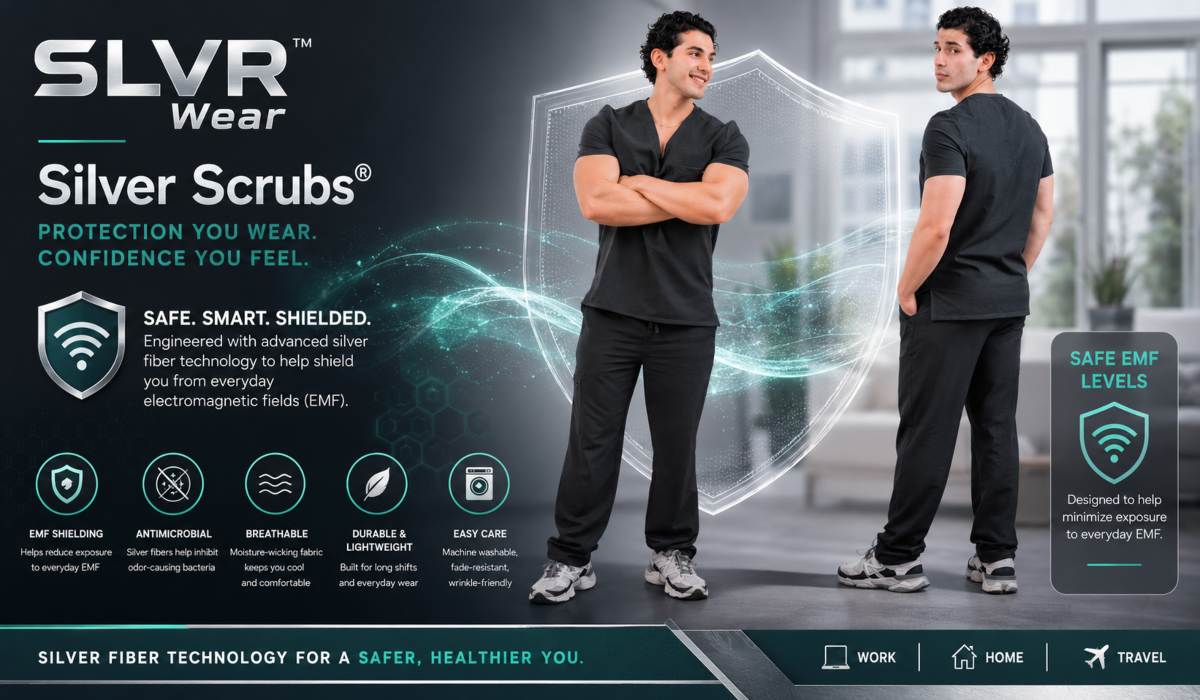
EMF-blocking clothing works by weaving conductive silver fibers directly into the fabric, creating a physical barrier between your body and wireless radiation from phones, Wi-Fi, and other RF sources. It’s one option among several for reducing exposure not a replacement for distance or wired connections, but a practical addition for situations where a phone, laptop, or wireless device has to stay close to your body. For the full picture of how this category of clothing works and where it fits into your routine, see EMF radiation protection clothing.
Silver-fiber fabric functions the same way any conductive shielding material does: the metal fiber reflects and absorbs RF energy before it reaches the skin, rather than blocking it through any chemical or biological process. The amount of protection depends on how much silver is woven into the fabric and how tightly it’s constructed a garment with a higher percentage of silver fiber in a dense weave will generally shield more effectively than a loosely woven one with less silver content.
SLVR Wear™ Silver Scrubs® line, for example, uses a 35% silver fiber weave tested to 50 GHz with up to 99.91% EMF blockage in lab conditions figures that apply specifically to the scrubs fabric construction and aren’t representative of every silver-fiber product on the market. The yarn is also OEKO-TEX® Standard 100 certified, meaning it’s been independently tested for harmful substances, which matters for anything worn directly against the skin for extended periods.
Shielding apparel is most useful in situations where keeping a distance from a device isn’t practical a phone carried in a pocket, a laptop resting on your lap, or a workday spent near a Wi-Fi router that can’t be relocated. Rather than replacing the habits covered earlier in this guide, it fills the gap those habits can’t: the moments when a wireless source has to stay physically close to your body.
For anyone who’s already made the easy adjustments router placement, wired connections, airplane mode and is looking for an additional layer, shielding apparel is one option to consider alongside those changes. Curious whether these products actually perform as claimed? Do EMF blockers work? breaks down the evidence behind shielding materials in general.
No, Completely blocking EMF in everyday life isn’t practical because wireless signals from nearby Wi-Fi networks, cell towers, and other devices are always present. The goal is to reduce exposure using distance, wired connections, and shielding materials rather than eliminate it.
The simplest step is to move farther away from your Wi-Fi router, especially in bedrooms and workspaces. You can also turn off Wi-Fi at night and use wired Ethernet connections for stationary devices to reduce RF exposure with minimal effort.
Yes, EMF-blocking clothing made with silver-fiber fabric can reduce RF exposure, but effectiveness depends on the fabric’s quality, silver content, and coverage. It works best as part of a broader EMF reduction strategy, not as a complete solution.
Disclaimer: SLVR Wear™ products are not medical devices and are not intended to diagnose, treat, cure, or prevent any disease.