Silver Scrubs Medical Clothing | EMF Blocking Scrubs
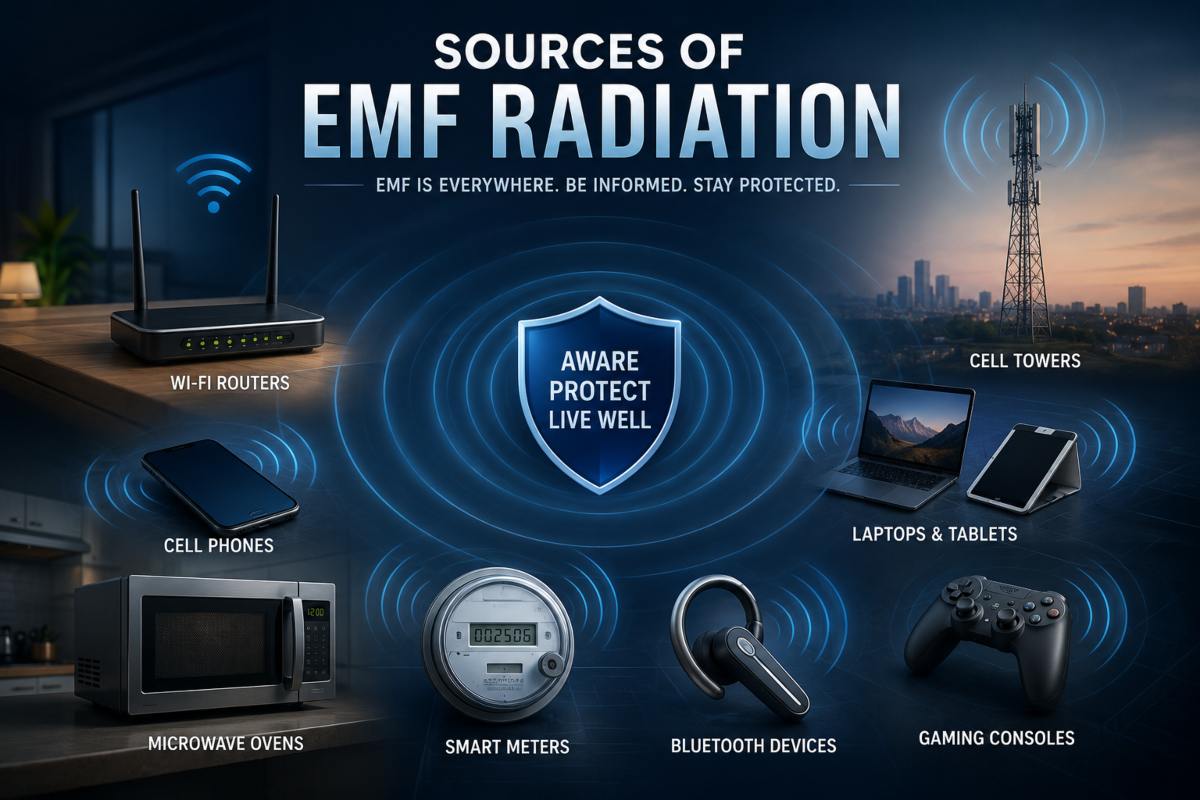
Every day, nurses, physicians, radiologists, and allied health professionals enter environments saturated with invisible electromagnetic fields from diagnostic equipment, wireless…
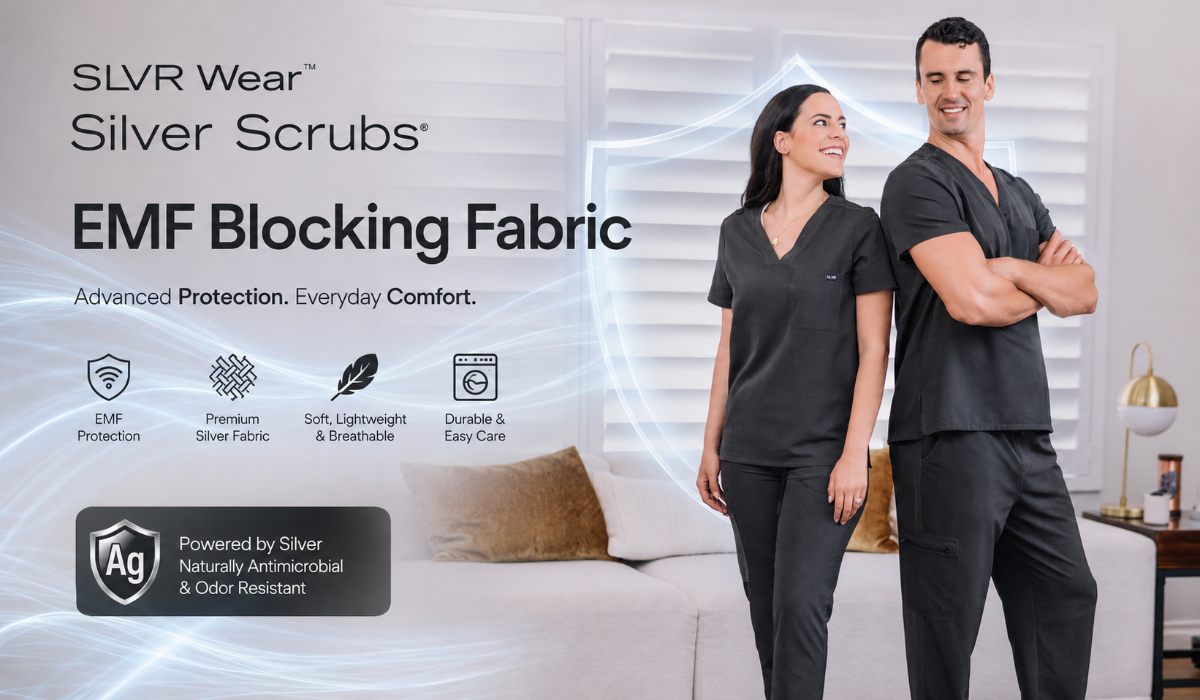
EMF blocking fabric is a textile engineered with conductive fibers most commonly silver to intercept and redirect electromagnetic radiation before it reaches the body. Unlike standard cloth, the metallic threads form a continuous conductive network throughout the weave, functioning on the same physical principle as a Faraday cage: electromagnetic signals strike the fabric, induce a current in the silver fiber lattice, and are blocked rather than passed through.
The result is measurable, lab-verifiable shielding not a coating, not a treatment, not a marketing claim.
This guide covers everything worth knowing about EMF blocking fabric: how the material actually works, why silver-fiber is the standard, what the performance specs mean, and how to evaluate any fabric before you buy. Whether you’re looking at EMF radiation protection clothing, blankets, or accessories, the material science is the same and understanding it is the only reliable way to separate genuine shielding textiles from products that simply look the part.
EMF blocking fabric is any textile engineered with electrically conductive fibers woven directly into its structure, giving the material the ability to intercept, attenuate, and redirect electromagnetic radiation. The fabric doesn’t absorb EMF the way insulation absorbs sound it conducts it, redirecting the signal away from whatever the fabric surrounds or covers.
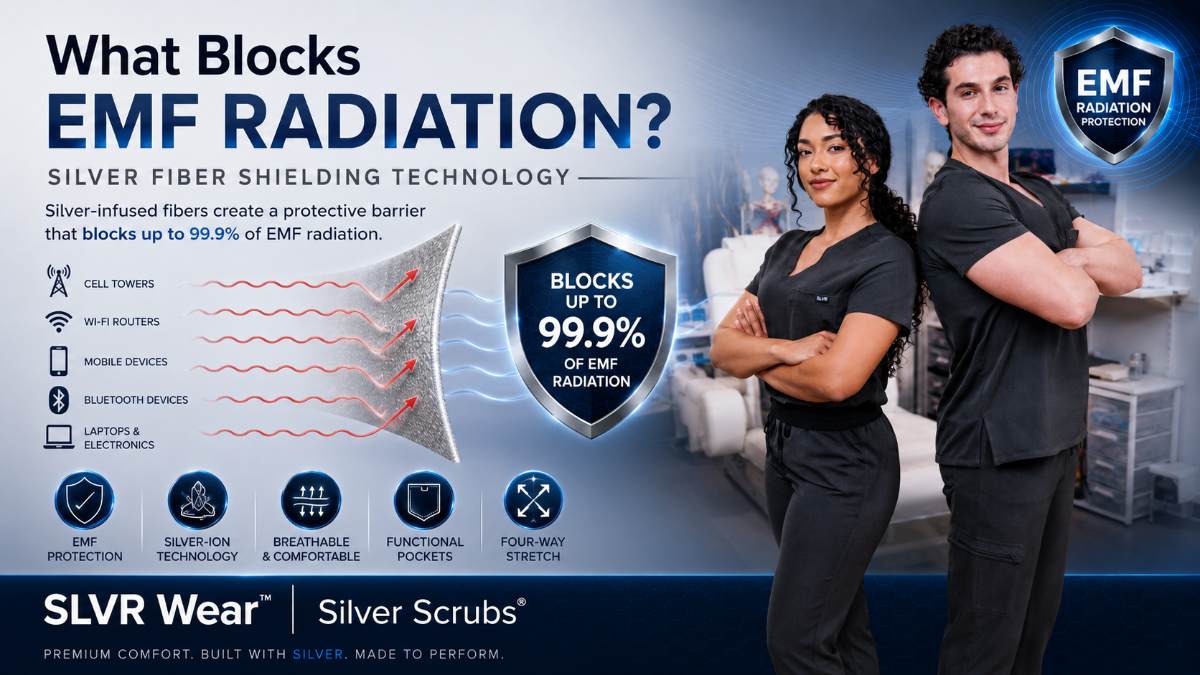
The category includes several conductive materials, but silver-fiber has become the dominant standard in high-performance shielding textiles. Silver carries the highest electrical conductivity of any natural element, which means silver-fiber fabric requires less material to achieve meaningful shielding than alternatives like copper or stainless steel thread. A well-constructed silver-fiber textile at 35% silver content can achieve up to 99.91% EMF blockage across frequencies up to 50 GHz a performance range that covers WiFi, Bluetooth, and 5G millimeter-wave bands simultaneously.
What separates genuine EMF blocking fabric from standard textile is that the shielding function is structural, not superficial. The silver is woven into the cloth itself, not applied as a finish or coating. That distinction matters because coatings degrade the conductive layer washes off, wears away, or cracks over time. Woven silver-fiber retains its shielding properties wash after wash because the conductive element is the fabric, not something sitting on top of it.
 How Shielding Fabric Works: The Faraday Principle Explained
The physics behind EMF blocking fabric is the same principle Michael Faraday demonstrated in 1836: a continuous conductive enclosure redistributes electromagnetic charge across its surface, preventing the field from penetrating the interior. When silver-fiber threads are woven tightly enough and distributed evenly throughout a textile, that textile behaves like a flexible, wearable version of a Faraday cage.
When an electromagnetic wave a WiFi signal, a 5G transmission, a microwave-frequency emission makes contact with silver-fiber fabric, the wave’s energy induces a small electrical current in the conductive silver lattice. That induced current generates an opposing electromagnetic field that cancels the incoming signal. The result is that the wave doesn’t pass through. It’s redirected along the surface of the fabric and dissipated rather than transmitted.
The key variable is continuity. A Faraday cage only works when the conductive mesh has no gaps larger than the wavelength of the signal it’s blocking. This is why thread count, weave density, and silver content percentage are the specifications that matter most in any shielding fabric not marketing language, not brand claims. The physics require a specific minimum of conductive coverage, and any fabric worth evaluating should have lab data to confirm it meets that threshold.
If you’re researching what blocks EMF radiation more broadly, the Faraday principle is the foundational mechanism across every effective shielding method fabric-based or otherwise.
Not every fabric sold as “EMF blocking” actually blocks EMF. The term has no regulated definition, which means it’s applied loosely across a wide range of products with equally wide variation in actual performance. Four material properties determine whether a shielding fabric works and whether it keeps working over time.
Silver content percentage: The conductive fiber must be present in sufficient concentration to form a complete shielding lattice. At 35% silver fiber by composition, a textile has enough conductive coverage to achieve lab-verified attenuation across the full frequency spectrum relevant to modern wireless signals.
Weave structure: The silver threads must be distributed throughout the weave not concentrated in one layer or direction. An even interlaced weave ensures consistent shielding regardless of the angle at which a signal approaches the fabric.
Frequency range coverage: A shielding fabric should be tested and rated across the frequencies it will actually encounter in use. Testing to 50 GHz confirms the fabric performs against not just legacy wireless standards but current and near-future 5G millimeter-wave frequencies.
Certification and lab verification: OEKO-TEX® Standard 100 certification confirms the yarn has been tested free of harmful substances a baseline quality indicator for any fabric making performance claims. Independent lab data on shielding effectiveness is the only reliable proof point for the EMF blocking claim itself.
A fabric that meets all four criteria silver-fiber composition, even weave distribution, 50 GHz frequency coverage, and certified lab verification is a shielding textile. One that meets fewer is a textile with silver in it. The difference matters, and reputable manufacturers will make their lab reports available.
EMF blocking fabrics work by integrating electrically conductive metallic fibers most commonly silver directly into the textile weave, creating a continuous conductive mesh that reflects and absorbs electromagnetic radiation before it can pass through. The key variable isn’t the fabric itself but the specific combination of conductive material, fiber distribution, and weave architecture that determines how much attenuation the cloth achieves.
Silver is the most electrically conductive metal on earth, with a conductivity rating of approximately 6.3 × 10⁷ siemens per meter marginally higher than copper and significantly higher than any other naturally occurring element. When silver-coated or silver-spun fibers are woven into a base textile, they form overlapping conductive pathways that mimic the function of a Faraday cage at the fabric level. Incoming electromagnetic waves induce a surface current in the silver matrix, which in turn generates an opposing electromagnetic field that cancels or redirects the original signal.
Conductivity of the fiber alone is not sufficient. The weave must be tight enough that the metallic threads form an unbroken electrical network across the entire surface area of the fabric. Any gap large enough to allow electromagnetic wavelengths to pass through creates a transmission window a point where shielding effectiveness drops sharply.
Thread count interacts with weave pattern in a meaningful way. A plain weave with a high thread count can deliver comparable shielding to a twill weave at lower count, but the plain weave will sacrifice drape and flexibility. Most high-performance EMF fabrics use a warp-knit or interlocked construction that balances conductive surface coverage with mechanical stretch. The practical implication is that two fabrics listing identical silver content by weight can produce substantially different shielding results depending entirely on how the silver fibers are distributed within the weave architecture.
Pore size the open area between fiber intersections is the structural variable that most directly correlates with attenuation across specific frequency ranges. For the frequency bands most relevant to everyday EMF exposure (900 MHz to 5.8 GHz), effective shielding requires pore dimensions well below one millimeter.
The 35% silver fiber threshold has emerged as the practical balance point between shielding performance, manufacturing cost, and fabric usability. Below roughly 30% silver content, the conductive mesh becomes insufficiently dense at standard thread counts to achieve consistent broadband attenuation across the GHz frequency range. Above 40%, the fabric becomes prohibitively expensive, less flexible, and more prone to conductivity degradation from repeated laundering.
At 35% silver fiber concentration, laboratory-tested EMF textiles routinely achieve shielding effectiveness in the range of 40–50 dB across frequencies from 10 MHz to 3 GHz meaning the fabric reduces transmitted EMF intensity by a factor of roughly 10,000 to 100,000. Independent testing by institutions following MIL-STD-285 and IEEE Std 299 protocols consistently places 35% silver-content fabrics in this performance tier. It is not a round-number convention; it reflects the density threshold at which the silver fiber network becomes self-reinforcing rather than dependent on precise alignment.
The material architecture of a compliant EMF blocking textile, in practical terms, consists of three functional layers: the silver fiber network as the primary conductive element, the base yarn (typically nylon or polyester) as structural support, and the weave pattern as the mechanism by which conductivity is maintained as a continuous surface rather than isolated threads.
Silver fabric does block EMF and it does so through a well-documented electrochemical mechanism, not a passive barrier effect. When silver fibers are integrated into a textile at sufficient density, the fabric functions as a distributed Faraday cage, reflecting and absorbing electromagnetic radiation across a broad frequency spectrum rather than simply deflecting it the way a physical barrier would deflect sound or wind.
The shielding mechanism begins at the fiber level. Each silver-coated or silver-spun thread is individually conductive, but the shielding effect does not emerge from any single thread in isolation it emerges from the network those threads form when woven into a continuous interlocked surface. When an electromagnetic wave strikes the fabric, the oscillating electric field induces a corresponding current in the conductive silver mesh. That induced current generates an opposing electromagnetic field, which destructively interferes with the incoming wave and prevents the majority of its energy from transmitting through to the other side.
This is the same operating principle as a Faraday cage, scaled down to textile dimensions. The critical distinction between silver-fiber fabric and a solid metal enclosure is that the textile’s effectiveness depends on the mesh remaining electrically continuous every thread intersection where silver fibers make conductive contact with adjacent silver fibers contributes to the network’s coherence. A break in conductivity, whether from fiber separation, oxidation, or physical abrasion, introduces a gap that degrades shielding effectiveness locally. This is why weave density and silver content percentage are engineering parameters rather than marketing variables: they determine whether the conductive network is self-reinforcing or dependent on precise alignment.
The physics also explains why highly conductive EMF protective clothing outperforms blended alternatives. A textile with 35% or higher silver content maintains enough redundant conductive pathways that localized fiber-to-fiber gaps do not collapse the overall mesh conductivity. Lower-concentration blends achieve conductivity only when threads happen to align favorably a condition that is inconsistent across the fabric surface and unstable over repeated mechanical stress.
Independent laboratory testing under IEEE Std 299 and MIL-STD-285 protocols consistently shows that high-density silver-fiber fabrics achieve attenuation in the range of 40–65 dB from 10 MHz through the mid-GHz range, with performance remaining above 30 dB in well-constructed specimens tested up to 50 GHz. A 40 dB attenuation figure means the fabric reduces transmitted electromagnetic field intensity by a factor of 10,000 meaning only 0.01% of the incident signal energy passes through. At 50 dB, that reduction factor reaches 100,000.
What the lab data also shows, and what spec sheets from less rigorous suppliers tend to omit, is the frequency-dependent attenuation curve. Silver-fiber fabric tested at a single mid-range frequency a common practice in lower-tier product certification will produce headline attenuation numbers that look strong but do not represent performance across the full spectrum.
Fabrics tested at continuous intervals from 100 MHz through 50 GHz reveal a characteristic response: attenuation is highest and most stable through the sub-10 GHz range, then begins a measurable rolloff as wavelengths approach the scale of the weave pore geometry. Fabrics with tighter weave architecture and higher silver content extend the flat-response region further up the frequency axis the physical reason why fabric construction, not just silver content alone, determines real-world performance.
A notable data point from EMC research literature: silver-fiber fabrics with warp-knit construction and ≥35% silver content have demonstrated post-wash attenuation retention above 85% after 25 standardized laundering cycles, confirming that the conductive network survives mechanical stress when the weave architecture is correctly engineered.
Silver is not the only metal used in conductive shielding textiles, but it consistently outperforms alternatives across the combination of properties that matter for fabric applications. Copper fiber achieves comparable raw conductivity copper’s electrical conductivity is approximately 5.96 × 10⁷ siemens per meter against silver’s 6.30 × 10⁷ but copper oxidizes progressively under ambient humidity, forming cupric oxide on fiber surfaces that is electrically resistive. Over time, a copper-fiber fabric’s conductive network degrades in a way silver’s does not, because silver oxide is itself a relatively good conductor. The practical result is that copper-fiber shielding fabrics show measurable attenuation loss within months of use in normal atmospheric conditions, while silver-fiber fabrics maintain conductivity stability over considerably longer service life.
Stainless steel fiber is used in some industrial shielding textiles where cost is the primary constraint. Steel’s conductivity is roughly two orders of magnitude lower than silver approximately 1.45 × 10⁶ siemens per meter which means steel-fiber fabrics require much higher fiber loading percentages to achieve equivalent shielding, making the resulting textile heavier, less flexible, and less suitable for applications requiring drape or body conformity.
Nickel-coated fabrics occupy a middle position: better corrosion resistance than copper, better flexibility than steel, but conductivity well below silver and documented skin sensitization concerns that make nickel-based textiles unsuitable for direct-contact applications. For research-grade EMF shielding where documented performance, long-term conductivity stability, and material safety are all relevant criteria, silver-fiber construction remains the only material class that satisfies all three without significant compromise.
The best EMF blocking fabric for 5G and WiFi protection is one rated to at least 10 GHz continuous attenuation a threshold that covers both WiFi bands and the sub-6 GHz 5G spectrum, while fabrics intended for millimeter-wave 5G (24–40 GHz) require specialized high-density silver constructions tested specifically at those frequencies. Choosing without checking the frequency rating is the single most common specification error buyers make.
Frequency coverage is not a marketing claim it is a measurable, laboratory-verified property expressed in the fabric’s attenuation curve. The relevant civilian frequency bands break into three tiers. WiFi 2.4 GHz is the oldest and lowest-energy band, still the dominant frequency in most home and office environments. WiFi 5 GHz delivers faster throughput and is now standard in dual-band routers. Then there is 5G, which itself spans two distinct physical regimes: sub-6 GHz deployments (600 MHz to 6 GHz) that behave like enhanced 4G LTE in terms of propagation, and millimeter-wave 5G (mmWave, 24–40 GHz) found in dense urban infrastructure and stadium deployments.
A fabric rated to 3 GHz will perform well against 2.4 GHz WiFi but begin losing attenuation effectiveness as it approaches the 5 GHz band. By the time millimeter-wave 5G frequencies are reached, that same fabric may offer negligible shielding. The reason is physical: at higher frequencies, the electromagnetic wavelength shortens to the point where even small gaps in the conductive mesh become proportionally large transmission windows. Effective coverage of the full contemporary wireless spectrum requires a tested rating ceiling of at minimum 10 GHz, and ideally 18 GHz or above for environments near dense 5G infrastructure.
A credible EMF blocking fabric spec sheet will always present attenuation data as a curve plotted against frequency in decibels (dB), not a single headline number. A fabric claiming “47 dB shielding” without a frequency axis attached to that figure is providing incomplete information. The number may be accurate at one tested point typically a mid-range frequency where the material performs best but says nothing about performance at 5 GHz or above.
The four values worth checking on any spec sheet are the tested frequency range (expressed in MHz or GHz), the minimum attenuation across that range (not the peak), the test standard used (look for IEEE Std 299, MIL-STD-285, or ASTM D4935), and the fabric’s silver content by weight or percentage. A well-constructed spec sheet from a research-grade supplier will show attenuation remaining above 30 dB from below 1 GHz through at least 10 GHz a relatively flat curve indicating that the conductive mesh density is sufficient across the full bandwidth, not just at the test lab’s preferred frequency.
Shielding effectiveness degrades over time with washing and mechanical stress, so a reputable spec sheet will also note whether post-wash attenuation data was collected. Fabrics that lose more than 5–8 dB after ten wash cycles represent a meaningful long-term performance drop.
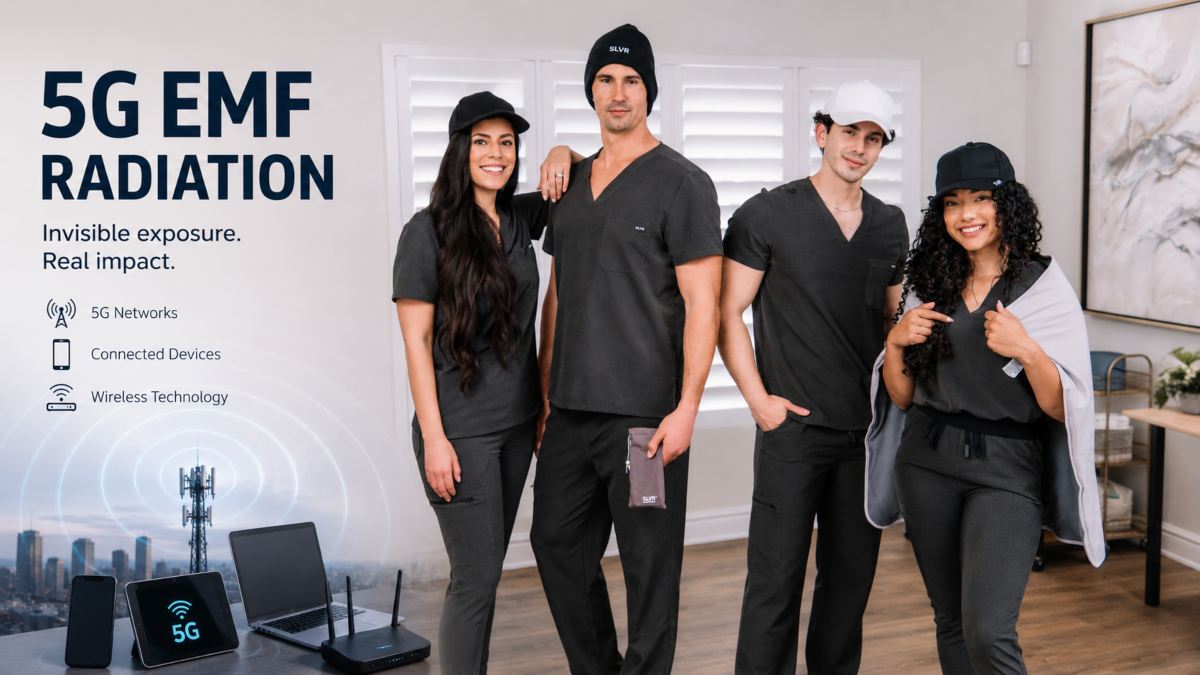
Standard EMF blocking textiles designed and certified prior to widespread 5G deployment were primarily validated against frequencies up to 3 GHz sufficient for the wireless environment of the 2000s and early 2010s but structurally inadequate for the upper sub-6 GHz band and entirely untested against mmWave. The physical mechanism that makes 5G harder to block is not signal strength but wavelength compression.
At 28 GHz a common mmWave 5G deployment frequency the electromagnetic wavelength is approximately 10.7 millimeters. At this scale, the weave geometry of a standard silver-fiber fabric becomes a meaningful variable in a way it is not at 2.4 GHz, where the wavelength is roughly 125 millimeters. Pore dimensions and inter-fiber gaps that represent a tiny fraction of the 2.4 GHz wavelength become a substantial fraction of the mmWave wavelength, reducing the Faraday-effect interference that creates shielding. Independent testing published in peer-reviewed electromagnetic compatibility (EMC) literature has consistently shown that fabrics tested only at sub-3 GHz frequencies exhibit attenuation drops of 10–20 dB when measured at 28 GHz under the same conditions.
For research applications requiring documented shielding performance against the full contemporary wireless spectrum, the minimum credible specification is a fabric with 35% or greater silver-fiber content, warp-knit or interlocked weave architecture, and independently verified attenuation data extending to at least 18 GHz. Anything short of that ceiling leaves the millimeter-wave band unaccounted for.
EMF blocking fabric is used by cutting, sewing, or wrapping it in direct contact with or as a barrier between the source of electromagnetic radiation and the area or object being shielded. Unlike passive insulation materials, the fabric only performs its shielding function when it forms a continuous conductive surface around or between the relevant surfaces, which means application method matters as much as material selection.
Garments are the most direct-contact application for EMF blocking fabric, and they work on a straightforward principle: the silver-fiber layer sits between the external electromagnetic environment and the body, attenuating incident radiation before it reaches skin level. For this to function as intended, the garment must be constructed so the conductive layer faces outward or is sandwiched between an outer shell and a comfort lining not folded inward where it would face the body without an uninterrupted external surface.
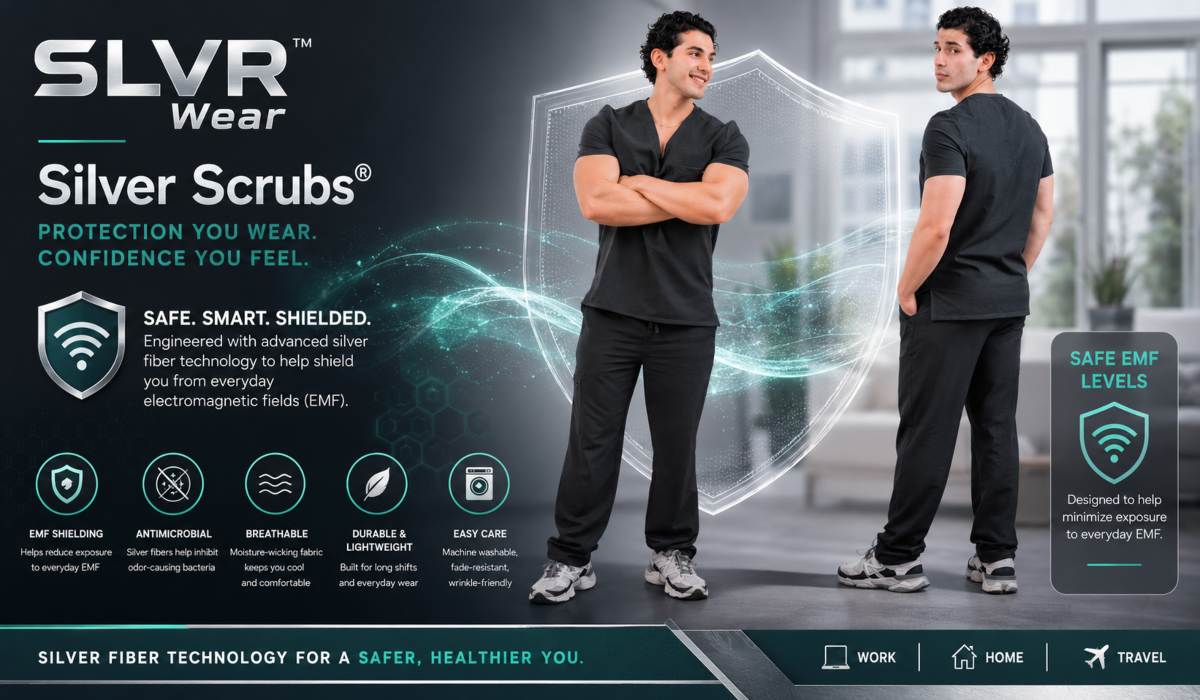
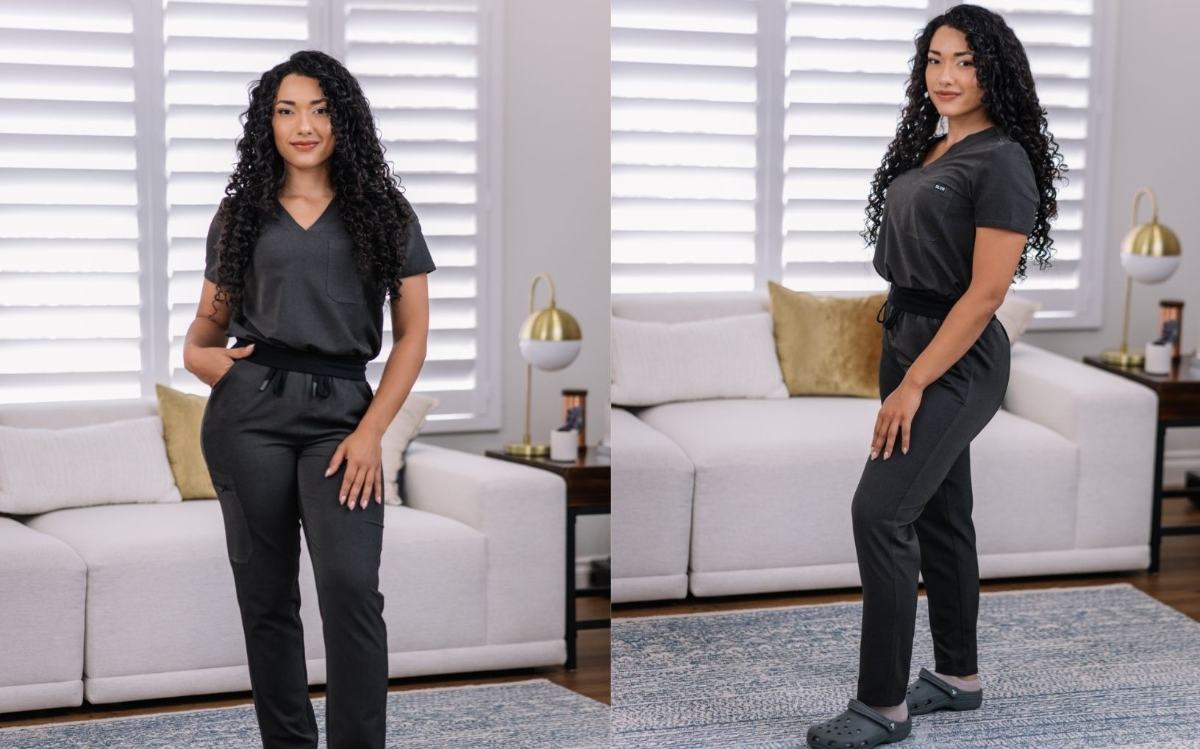
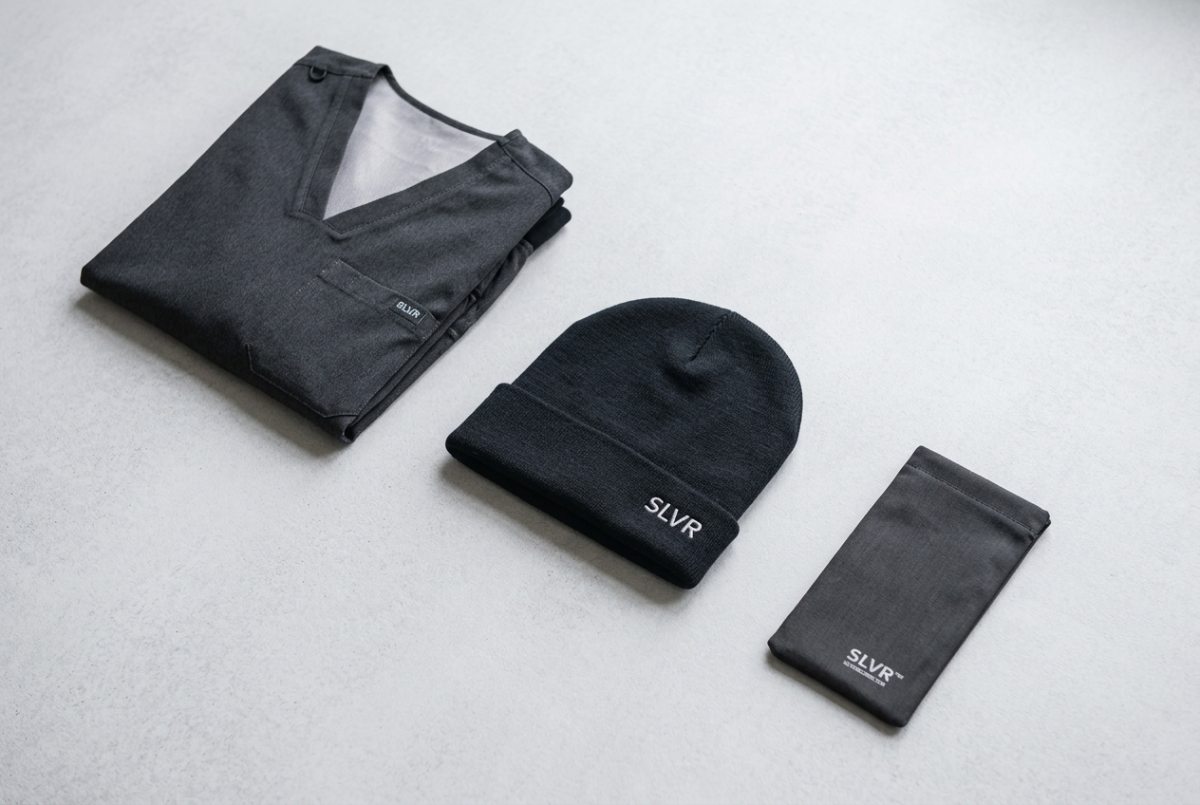
EMF blocking scrubs represent one of the most established apparel applications, particularly in research and clinical environments where personnel work in proximity to imaging equipment, wireless monitoring systems, or RF-heavy instrumentation. The construction follows standard medical scrub patterns with silver-fiber fabric substituted for or laminated onto the primary shell fabric. Coverage area is the determining factor: a scrub top provides torso and upper-arm coverage, while a full set extends protection to the lower body. For occupational applications, fit matters gaps at the wrist, collar, or waist hem represent unshielded pathways. SLVR Wear ™ offers both men’s and women’s silver scrub sets engineered specifically to minimize those coverage gaps.
Beanies and head-covering garments use the same silver-fiber textile construction scaled to smaller pattern pieces. The dome of the hat provides coverage for the top and sides of the cranium, and well-constructed versions will extend down to cover the ears and temple region where coverage gaps most commonly occur. Everyday wear items including liner garments, waistbands, and shoulder inserts follow the same logic of maximizing continuous surface area over the region of interest.
One practical construction note: silver-fiber fabric should be sewn with a stretch stitch or serger finish rather than a straight stitch wherever the garment requires any degree of flex. A rigid straight-stitch seam in a conductive textile can fracture the silver coating along the needle line under repeated movement, creating linear conductivity gaps at every seam.
For buyers focused specifically on medical-grade construction and fit standards, the complete guide to medical scrubs covers workwear construction requirements in detail including the coverage and durability considerations that apply equally to shielding scrubs.
 Home Applications: Blankets, Pouches, and Shielding Projects
EMF blocking fabric for the home functions through the same Faraday-effect mechanism as apparel but is deployed as a stationary barrier rather than a worn layer. The most common home applications are blankets, phone and device pouches, router enclosures, and window or wall panel inserts.
An EMF protection blanket is constructed from silver-fiber fabric either alone or laminated to a comfort textile on one face. When used as a wrap or drape, it attenuates ambient RF radiation reaching the covered surface the shielding side should face the dominant signal direction, which in most home environments means facing outward toward walls, windows, or ceiling-mounted devices. A blanket used flat over a surface provides meaningful attenuation in one axis; for multi-directional shielding, a wrap configuration that covers more than one face is necessary. The full blankets collection provides finished options with documented attenuation specs for home shielding applications.
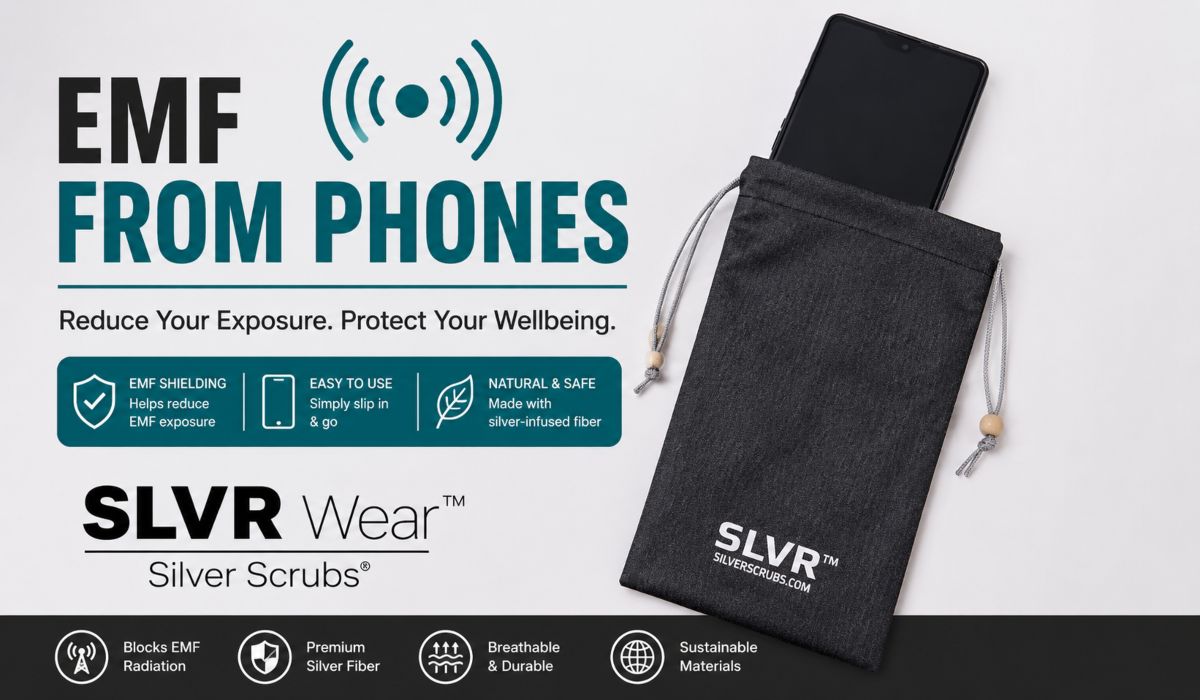
Faraday pouches for phones and small devices are among the simplest and most effective single-use applications of EMF blocking fabric. A correctly constructed pouch seamed on three sides with a fold-over or double-seam closure on the fourth creates a near-complete conductive enclosure around the device. At 40–50 dB attenuation, a phone placed inside a properly sealed silver-fiber pouch will show no incoming signal, effectively confirming the shielding is functional. This makes the pouch one of the few home applications where performance is directly verifiable without laboratory equipment.
Window panel inserts and wall-lining applications require larger fabric runs and careful attention to seam overlap. Individual fabric panels should overlap by at least 5 cm at every join, as a butted or gap-joined seam between two panels creates a linear transmission window that eliminates shielding effectiveness at that junction regardless of how well the panels themselves perform.
Silver-fiber fabric requires specific laundering practices to preserve the conductive network that makes shielding possible. The most common cause of attenuation degradation in silver-fiber textiles is not mechanical wear but chemical exposure during washing specifically, chlorine bleach, fabric softeners, and high-alkalinity detergents all react with silver at the fiber surface and progressively strip or passivate the conductive coating.
The correct protocol is cold or lukewarm water (below 40°C), a mild pH-neutral detergent with no bleach or optical brighteners, a gentle machine cycle or hand wash, and air drying rather than tumble drying. Tumble heat accelerates oxidation at fiber surfaces and can also stress the weave at seam lines. Ironing directly on silver-fiber fabric should be avoided; if pressing is necessary, a pressing cloth between the iron and the fabric surface prevents direct heat contact with the silver layer.
Research-grade silver-fiber fabrics from reputable suppliers tested under standardized wash protocols typically AATCC or ISO textile washing standards retain above 85% of initial attenuation performance after 25 wash cycles when these guidelines are followed. Fabrics washed with bleach or softener in the same test series show attenuation degradation beginning as early as the third to fifth cycle. Following care instructions is not precautionary language; it is the direct determinant of how long the fabric continues to perform to its rated specification.
EMF blocking fabric made in the USA is not a guarantee of quality on its own, but domestic manufacture does correlate with several verifiable standards traceability of raw materials, access to third-party laboratory testing under recognized US protocols, and accountability to domestic consumer protection frameworks that are more difficult to enforce on overseas supply chains. The relevant question is not simply where the fabric was made but whether the manufacturer can document what is in it, how it was tested, and to what standard.
OEKO-TEX® Standard 100 is an independent certification issued by the OEKO-TEX Association that tests textile products for the presence of harmful substances including heavy metals, formaldehyde, pesticide residues, allergenic dyes, and pH irregularities at concentrations above established safety thresholds. For silver-fiber EMF blocking fabric, OEKO-TEX® certification serves a dual function: it confirms that the silver used in the textile is not contaminated with cadmium, lead, or other heavy metal impurities common in lower-grade metallic fiber production, and it verifies that the base yarn and any finishing chemicals meet the standard’s human-ecological safety requirements.
The certification is product-specific, not company-wide. A manufacturer holding an OEKO-TEX® certificate for one fabric line is not automatically certifying every product in their catalog, which means buyers should request the certificate number and verify it against the OEKO-TEX® public database at oeko-tex.com a lookup that takes under two minutes and confirms the certificate is current, has not lapsed, and applies to the specific article being purchased. Certificates are issued for defined product categories and expire on a fixed cycle, so an older certificate displayed prominently in marketing materials may no longer reflect the current production run.
For research-grade applications where material documentation is part of procurement compliance, OEKO-TEX® Standard 100 certification at Product Class I or II is the relevant tier Class I covering products intended for skin contact, Class II for general textiles. An EMF blocking fabric used in apparel construction should carry at minimum a Class II certification, and ideally Class I if direct skin contact is a design requirement.
EMF shielding claims in the textile market exist on a spectrum from independently verified to entirely unsubstantiated, and the language used in product listings rarely makes the distinction obvious. The baseline verification requirement is a third-party laboratory test report not an in-house measurement, not a supplier attestation, and not a referenced study on silver conductivity in general. A legitimate test report will name the testing laboratory, cite the test standard (IEEE Std 299, MIL-STD-285, or ASTM D4935 are the applicable references for fabric shielding), specify the frequency range over which attenuation was measured, and report attenuation values in decibels at defined frequency intervals rather than as a single peak figure.
The laboratory conducting the test should be accredited under ISO/IEC 17025, which is the international standard for testing and calibration laboratory competence. ISO/IEC 17025 accreditation means the lab’s measurement methods, equipment calibration, and reporting procedures have been independently audited it is the difference between a result that is traceable to a reference standard and one that is not. In the United States, accredited laboratories operating under this standard are listed in databases maintained by A2LA (American Association for Laboratory Accreditation) and NVLAP (National Voluntary Laboratory Accreditation Program), both of which are publicly searchable.
A manufacturer selling EMF blocker fabric in the USA who cannot produce an ISO/IEC 17025-accredited test report on request is asking buyers to accept performance claims on faith. For procurement decisions involving research applications, that is not an acceptable evidential standard.
The right questions to ask a supplier of EMF blocking fabric made in America are specific enough that the answers cannot be fabricated without documentation. What is the silver content percentage by weight, and is that figure verified by third-party fiber analysis or stated by the manufacturer only? What is the tested attenuation range in decibels, and at which specific frequencies was that measurement taken? Which laboratory conducted the testing, and is that laboratory ISO/IEC 17025 accredited? Is an OEKO-TEX® certificate available, and does it apply to this specific fabric article rather than a different product in the same line?
Beyond technical documentation, supply chain questions matter for USA-manufactured claims. Is the silver fiber sourced and processed domestically, or is the domestic manufacturing claim limited to final fabric assembly from imported fiber? Where is the base yarn produced? These distinctions affect both the integrity of a “made in USA” designation and the traceability of the material inputs relevant considerations for procurement documentation in research or institutional purchasing contexts.
A supplier who answers these questions with specific documentation rather than general reassurances is demonstrating the kind of transparency that separates a research-grade material supplier from a commodity reseller. The questions are not adversarial; they are the standard due diligence that any buyer making a specification-critical purchase should apply, and a legitimate manufacturer will recognize them as such.
The most reliable place to buy EMF blocking fabric is directly from a manufacturer or specialized supplier who can provide independently verified attenuation data, documented silver content, and material safety certification not a general marketplace listing where those credentials are absent or unverifiable. The channel matters less than the documentation the seller can produce on request.
The choice between purchasing finished EMF blocking garments and accessories versus raw silver-fiber fabric by the meter depends almost entirely on how the material will be used and whether the buyer has the fabrication capability to construct a correctly functioning shielded item.
Raw fabric sold by the bolt or meter is the appropriate format for custom construction projects: tailored garments built to specific fit requirements, window panel inserts cut to non-standard dimensions, or institutional shielding applications where large coverage areas need to be assembled from continuous fabric runs. Buying raw fabric gives the constructor control over seam placement, overlap architecture, and layering decisions all of which affect shielding performance in the finished item.
The trade-off is that incorrect construction, including inadequate seam overlap, straight-stitch seaming on flex areas, or improper orientation of the conductive face, can substantially reduce real-world attenuation relative to the fabric’s rated specification. Raw fabric purchases are best suited to buyers with textile construction experience or access to a maker who understands the shielding requirements.
Ready-made EMF blocking apparel and accessories scrubs, beanies, pouches, and wraps produced by the manufacturer to a defined construction standard remove fabrication variables from the equation. A correctly manufactured garment maintains the conductive layer orientation, seam integrity, and coverage geometry that the fabric’s attenuation data was measured against. For buyers who want documented performance without the construction variables, finished products from a manufacturer who tests the completed article rather than the raw fabric alone represent the more reliable path to the rated specification. The premium over raw fabric reflects that construction quality assurance, and for research or occupational applications where performance documentation matters, it is generally justified.
For healthcare professionals evaluating Silver Scrubs ® options, the softest medical scrubs guide covers comfort and wearability considerations alongside shielding construction relevant for anyone who needs to wear shielding apparel across a full clinical shift.
The purchase decision for any EMF blocker fabric whether raw or finished should be gated on three categories of documentation before price or aesthetics become relevant considerations.
The first is attenuation data from an ISO/IEC 17025-accredited laboratory, citing a recognized test standard (IEEE Std 299, MIL-STD-285, or ASTM D4935) and reporting attenuation in decibels across a defined frequency range rather than at a single point. A credible result will show performance data from at least 100 MHz through 10 GHz, with the curve not just the peak available for review. Any supplier who cannot produce this document on request is asking for a specification-critical purchase decision to be made on unverified claims.
The second is material certification. OEKO-TEX® Standard 100 certification, verified by certificate number against the public OEKO-TEX® database, confirms that the silver fiber and base textile meet human-ecological safety thresholds. This is not a secondary consideration for skin-contact applications it is a baseline material safety requirement.
The third is silver content transparency. The supplier should state the silver fiber percentage by weight as a verified figure, not a range or an approximation. At below 30% silver content, shielding consistency across the fabric surface becomes unreliable at typical thread counts; at 35% and above, the conductive network achieves the redundancy needed for stable broadband attenuation. A supplier who is evasive about the specific silver content figure is typically signaling that the actual percentage would not withstand scrutiny against the performance claims being made.
SLVR Wear ™ is a silver-fiber EMF blocking apparel and accessories brand built specifically for buyers who need research-grade shielding performance in wearable and portable form. The product line covers the primary application categories medical scrubs, beanies, and Faraday phone pouches each constructed from silver-fiber fabric at 35% silver content with independently verified attenuation data available for the finished articles.
The scrubs are pattern-engineered for coverage continuity, with seam placement designed to minimize conductive gaps at the wrist, collar, and hem lines where shielding interruptions most commonly occur in off-pattern garments. Options include the men’s silver scrubs top and pants set, men’s scrub top only, men’s scrub pants only, the women’s silver scrubs top and pants set, women’s top only, and women’s pants only including options in black scrub pants for environments with specific uniform requirements.
The beanie construction extends coverage to the temple and ear region rather than terminating at the crown, addressing the coverage gap that affects most standard knit beanies adapted for shielding purposes. The Faraday phone pouch uses a double-fold closure architecture that maintains the conductive enclosure at the opening the point of failure in single-fold or snap-closure pouch designs and at 40–50 dB attenuation, a sealed device inside the pouch will show complete signal loss, providing a functional verification of shielding performance without laboratory equipment.
All SLVR Wear ™ products are manufactured with OEKO-TEX® certified silver-fiber fabric and are accompanied by third-party lab documentation. For buyers evaluating where to buy EMF blocking fabric or finished silver-fiber products with traceable performance credentials, SLVR Wear ™ represents the intersection of research-grade material specification and apparel construction quality without requiring the buyer to manage raw fabric procurement and construction separately.
Yes, silver-fiber fabric can block EMF radiation when it forms a dense conductive mesh. It works by creating a Faraday-cage-like effect that reflects and dissipates electromagnetic waves. Properly tested fabrics can achieve attenuation levels of 40–65 dB. However, performance depends on verified silver content and lab-tested quality.
For textile use, silver is considered the most effective due to its very high electrical conductivity. It provides strong shielding at lower fiber density compared to alternatives like copper or stainless steel. Copper can oxidize over time, reducing performance, while steel is less conductive. Silver also offers good durability and skin compatibility.
A simple test is placing a phone inside a sealed silver-fabric pouch and calling it. If the signal is blocked, the call will fail or go to voicemail. This indicates effective attenuation within cellular frequency ranges. For more accuracy, RF meters can measure signal reduction in decibels.
Yes, but mainly when improper washing methods are used. Harsh detergents, bleach, or high heat can damage the silver coating over time. Proper care gentle wash, mild detergent, air drying preserves most performance across many cycles. Poor care can reduce effectiveness within just a few washes.
A Faraday cage is a fully enclosed rigid metal structure that blocks all EMF signals inside it. EMF fabric uses the same principle but in a flexible textile form. When fully sealed (like a pouch), fabric can perform similarly to a cage. However, garments only provide partial, directional shielding due to open areas.