Silver Scrubs Medical Clothing | EMF Blocking Scrubs
Every day, nurses, physicians, radiologists, and allied health professionals enter environments saturated with invisible electromagnetic fields from diagnostic equipment, wireless…
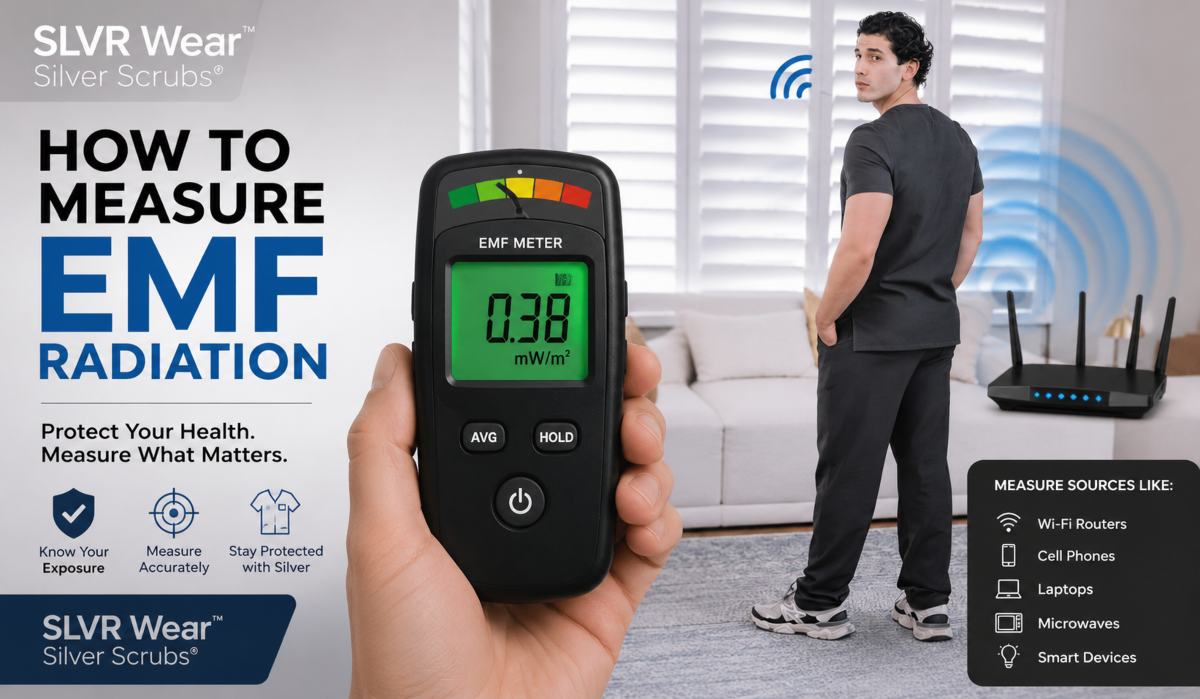
To measure EMF radiation at home, you need a handheld EMF meter a device that detects the electromagnetic fields emitted by wireless routers, smart meters, power lines, and personal electronics. Point the meter at a source, note the reading in its corresponding unit (volts per meter for electric fields, milligauss for magnetic fields, or gigahertz for radiofrequency), and compare it against internationally recognized exposure guidelines.
That’s the short answer. But if you want readings you can actually trust and act on, the process matters as much as the tool.
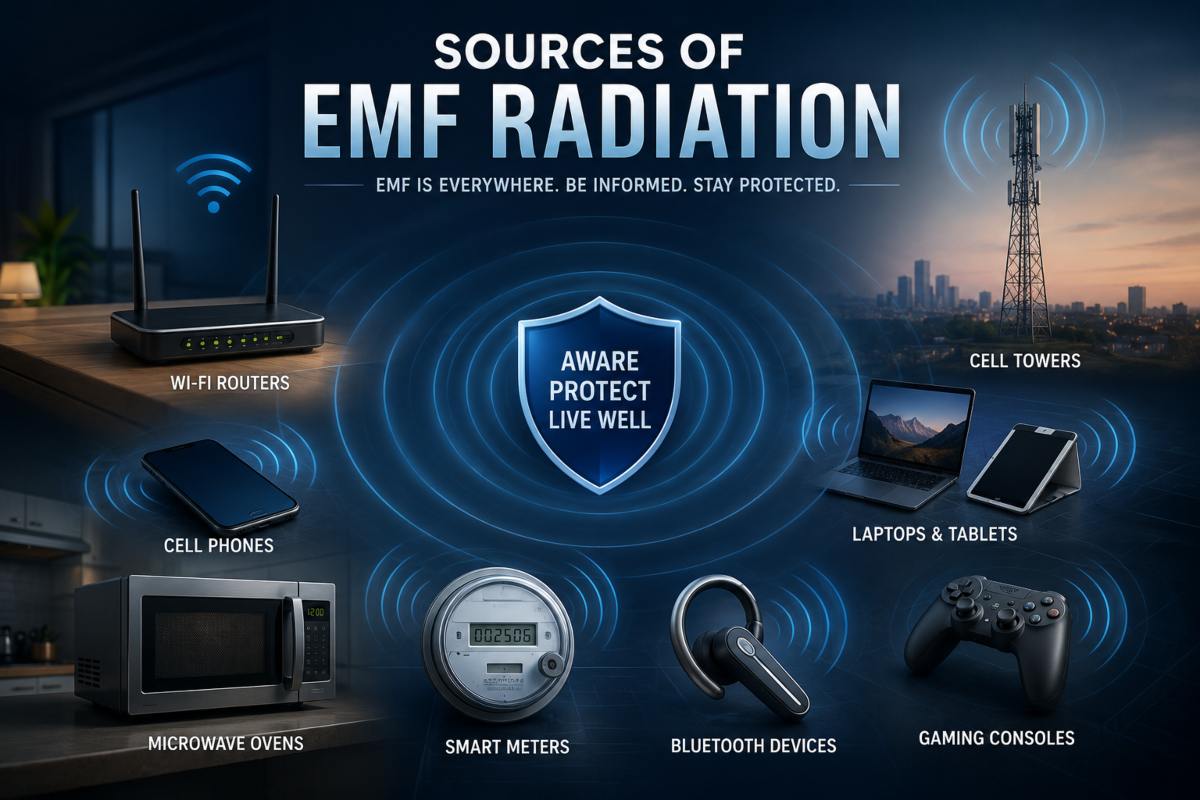
EMF is everywhere. The average home in 2024 contains more than 20 wirelessly connected devices, each continuously emitting radiofrequency radiation. Power lines, electrical panels, and household appliances add magnetic and electric field exposure on top of that. Most people have no idea what levels exist in their own bedrooms, home offices, or for parents especially in their children’s rooms. A systematic home measurement changes that. It turns an invisible concern into a number on a screen one you can compare, track, and respond to.
This guide covers everything in one place: How to Measure EMF Radiation, which instruments measure which types, how to walk through your home methodically, how to interpret what you find, and what options exist for reducing exposure once you have your baseline.
EMF stands for electromagnetic field the invisible energy field produced any time electric current flows or wireless signals transmit. It surrounds every powered device in your home, from the microwave on your counter to the router in your hallway, and it has been doing so long before most people thought to question it.
Understanding what EMF is matters now more than it did a decade ago because the density of sources of EMF in the average home has changed dramatically. Measuring it is how you move from assumption to evidence.
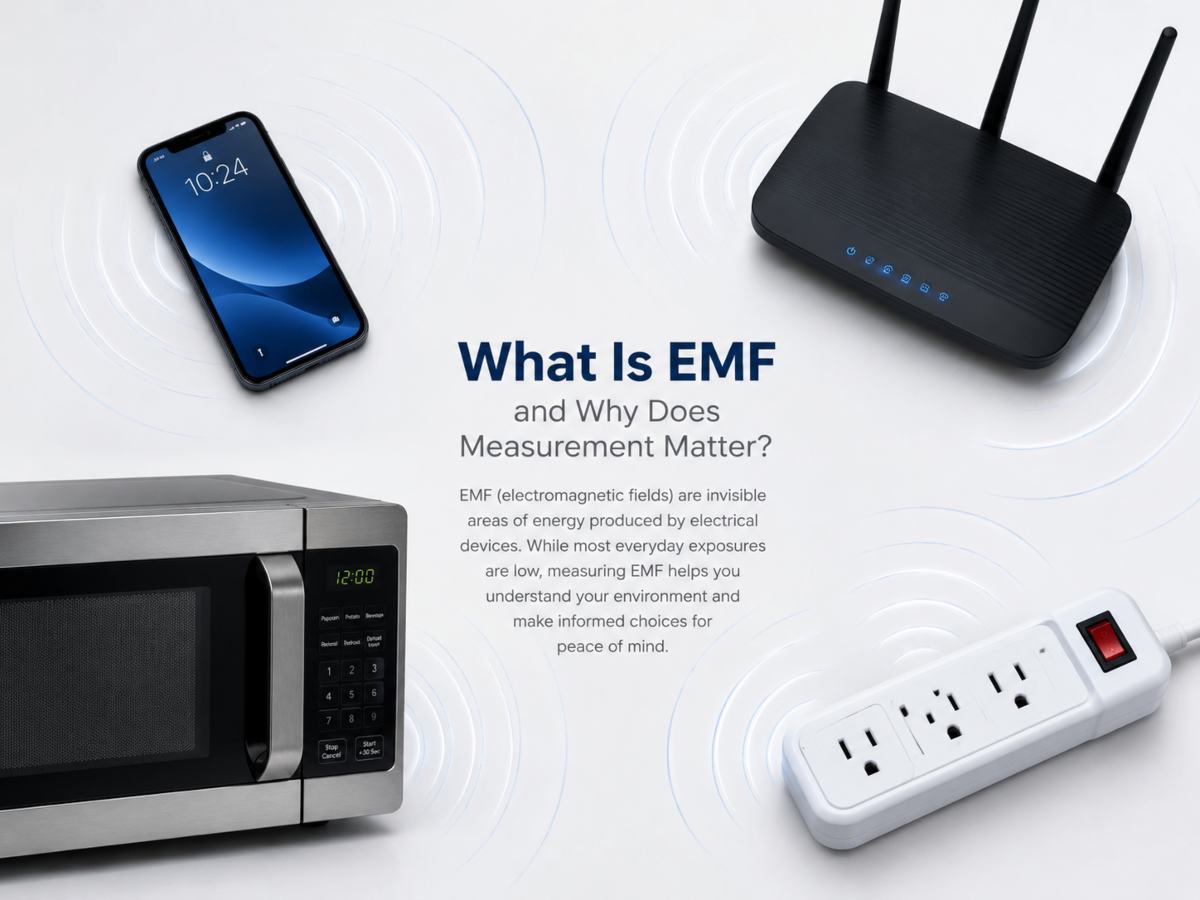 What EMF Stands For and Where It Comes From
Electromagnetic field is the full term, though EMF is used interchangeably with EMR (electromagnetic radiation) in most consumer contexts. The field itself is a combination of two inseparable components: an electric field, generated by voltage whether or not a device is actively in use, and a magnetic field, generated by current flow when a device is switched on. Together they propagate outward from the source as a wave.
EMF originates from both natural and man-made sources. The earth’s geomagnetic field is natural EMF. Sunlight is natural EMF. What has changed is the man-made layer on top of it. Power lines, electrical wiring inside walls, household appliances, wireless routers, cellular base stations, and every device connected to them all contribute to a measurable electromagnetic environment that simply did not exist at this density in previous generations.
Not all EMF is the same, and the distinction between ionizing and non-ionizing radiation is the most important one to understand before you start measuring.
Ionizing radiation the kind emitted by X-rays and nuclear sources carries enough energy per photon to strip electrons from atoms and break chemical bonds. This is the radiation with a well-established, direct mechanism for cellular damage, which is why medical imaging facilities use lead shielding and strict dose protocols.
Non-ionizing radiation sits at the lower end of the electromagnetic spectrum. It includes radiofrequency (RF) radiation from Wi-Fi, Bluetooth, and cellular networks, as well as extremely low-frequency (ELF) fields from power lines and household wiring. This is the category relevant to home EMF measurement. Its photons do not carry enough energy to ionize atoms, which is why regulatory bodies classify it differently and why the scientific conversation around long-term, cumulative exposure to non-ionizing EMF remains an active area of research rather than settled science.
The practical implication: when you measure EMF at home, you are measuring non-ionizing radiation. You are not measuring the same thing as a chest X-ray, and results should be interpreted accordingly.
Every device that runs on electricity produces an electric field due to the voltage it carries. Every device that draws current produces a magnetic field on top of that. Every device that communicates wirelessly a WiFi router, a smart speaker, a cordless phone, a baby monitor also transmits radiofrequency radiation as its primary function.
The result is that a typical modern home contains overlapping EMF fields from dozens of simultaneous sources. A 2023 analysis found that the average household in developed markets operates more than 21 connected devices, a figure that has roughly doubled since 2015. Each of those devices contributes to the ambient electromagnetic environment, and the fields do not cancel each other they stack.
Distance is the most reliable variable in this picture. EMF field strength decreases with the square of distance from the source, meaning that a device two feet away from your body produces roughly one-quarter of the field intensity of the same device one foot away. This inverse-square relationship is why measurement matters: it tells you where the highest-intensity zones in your home actually are, which is almost always different from where people assume they are.
EMF is not measured in a single unit the correct unit depends entirely on which type of electromagnetic field you are measuring. Electric fields are measured in volts per meter (V/m), magnetic fields in milligauss (mG) or microtesla (µT), and radiofrequency radiation in gigahertz (GHz) for frequency or microwatts per square centimeter (µW/cm²) for power density.
This is the source of most confusion people encounter when they first pick up an EMF meter. The device in front of them may display two or three different readings simultaneously, each in a different unit, each telling a different part of the story.
Volts per meter is the standard unit for measuring electric field strength. It expresses how much electrical force exists across a given distance specifically, how many volts of potential difference exist per meter of space.
Electric fields are produced by voltage. This means they exist around any plugged-in device that is charging, even if the device is switched off and drawing no current. A lamp plugged into a wall socket produces a measurable electric field around its cord whether or not it is turned on.
In practical home measurement, electric field readings tend to be highest near unshielded power cables, extension cords, and the backs of appliances. The International Commission on Non-Ionizing Radiation Protection (ICNIRP) sets a public exposure reference level of 200 V/m for extremely low-frequency radiation. Most household readings fall well below this threshold typically between 1 V/m and 20 V/m in living spaces though readings directly adjacent to poorly shielded wiring or older appliances can be notably higher.
The important practical point is that electric fields are relatively easy to reduce by increasing the distance and by basic shielding. They do not penetrate building materials the way radiofrequency radiation does.
Magnetic fields are measured in tesla (T) in the SI system, but for the field strengths encountered in home environments, the milligauss (mG) and microtesla (µT) are the practical units. The conversion is straightforward: 1 µT equals 10 mG.
Unlike electric fields, magnetic fields are generated by current flow meaning a device must actually be drawing power and running for a magnetic field to exist around it. This makes them dynamic: the magnetic field around a microwave is negligible when it is off and measurable when it is actively heating.
The WHO and ICNIRP reference level for continuous public exposure to extremely low frequency magnetic fields is 1,000 mG (100 µT). However, several independent research bodies, including the BioInitiative Working Group, have advocated for more conservative precautionary guidelines, some as low as 1–2 mG for prolonged residential exposure. Real-world readings vary widely: a few inches from a running electric stove burner can read 200 mG or higher, while the center of a well-wired living room typically reads below 1 mG.
Magnetic fields, unlike electric fields, pass through most building materials and the human body with little attenuation. Distance remains the most effective variable for reducing exposure to magnetic field sources.
Gigahertz measures frequency specifically, how many billions of wave cycles per second a radiofrequency signal completes. It tells you where on the RF spectrum a source is transmitting, not how strong the signal is at your location.
Standard WiFi operates at 2.4 GHz and 5 GHz. Most modern smartphones operate across a range of cellular bands, from below 1 GHz to 6 GHz for sub-6 5G, and into millimeter-wave frequencies above 24 GHz for high-band 5G deployments. Bluetooth typically operates at 2.4 GHz. Microwave ovens use 2.45 GHz internally close enough to WiFi frequencies that leakage, when it occurs, falls in a detectable range.
When measuring RF radiation for exposure purposes, frequency alone is not the relevant figure. What matters for understanding field intensity at a given location is power density, expressed in microwatts per square centimeter (µW/cm²) or milliwatts per square meter (mW/m²). A high-frequency source that is far away or low-powered may produce a lower power density reading at your location than a nearby lower-frequency source. ICNIRP’s general public reference levels for RF power density vary by frequency but reach up to 10,000 µW/cm² in certain bands. This figure consumer-grade RF meters help contextualize against actual residential readings, which typically range from 0.001 µW/cm² to 10 µW/cm² in standard home environments.
The three unit categories V/m, mG, and GHz do not share a single scale. They measure fundamentally different properties of different types of fields, which is why trying to compare them directly produces confusion rather than insight.
Think of it this way: volts per meter tells you the intensity of the electric push in a given space. Milligauss tells you the strength of the magnetic pull from current-carrying sources. Gigahertz tells you the oscillation frequency of wireless signals, while µW/cm² tells you how much RF power is landing on a given surface area at your location.
What they share is their relationship to distance. All three field types obey the inverse square law double your distance from a source and field intensity drops to roughly one-quarter. This single principle unifies the practical response to readings across all three unit types, regardless of which unit the meter is displaying.
A useful mental model for home measurement: treat electric field readings (V/m) as your wiring and appliance proximity indicator, magnetic field readings (mG) as your current-load and appliance-usage indicator, and RF power density (µW/cm²) as your wireless device and infrastructure indicator. Together, the three readings give you a complete picture of the electromagnetic environment in any given room.
An EMF meter measures the strength of electromagnetic fields in the space around it detecting electric fields, magnetic fields, radiofrequency radiation, or some combination of all three depending on the type of meter you are using. What a specific meter measures, and how accurately it does so, depends entirely on the sensors built into it.
This distinction matters because the word “EMF meter” is used loosely in consumer markets to describe instruments that can vary enormously in what they actually detect.
A well-specified EMF meter contains at least one of three distinct sensor types, and understanding what each one detects determines whether the tool you have is the right one for the source you are trying to measure.
An electric field sensor detects the electric field surrounding any wire or device with an electric potential. It displays its reading in volts per meter (V/m) and responds to sources whether they are actively drawing current or not. This sensor is most useful for assessing exposure near household wiring, extension cords, power strips, and the backs of large appliances.
A magnetic field sensor also called a gaussmeter or magnetometer in more precise contexts detects the field generated by current actually flowing through a conductor. It displays readings in milligauss (mG) or microtesla (µT) and only registers a significant reading when a device is powered on and running. This sensor is the one to use for measuring proximity to running appliances, electrical panels, and power lines.
A radiofrequency sensor detects the oscillating electromagnetic waves emitted by wireless communication devices. It typically displays power density in microwatts per square centimeter (µW/cm²) and responds to WiFi routers, smartphones, smart meters, cellular towers, Bluetooth devices, and cordless phones. Of the three sensor types, the RF sensor is the one most relevant to the wireless-dense environments most people live in today.
Many consumer-grade meters marketed as “3-in-1” combine electric field and magnetic field detection in a single unit but omit RF sensing entirely, or include a basic RF sensor with a narrow frequency range that misses 5G bands above 6 GHz. Before purchasing or relying on any meter for a home assessment, confirm which sensors it actually contains and what frequency range each covers.
The axis count of an EMF meter describes how many spatial planes it measures simultaneously, and it has a direct effect on the reliability of your readings.
A single-axis meter contains a single sensor oriented in a single direction. To capture the true field strength at a given location, you would need to rotate it through all three spatial planes and manually combine the results. In practice, most people do not do this, which means single-axis meters routinely underreport field strength by a significant margin in some orientations, by as much as 50-70 percent compared to the actual peak field at that location.
A tri-axis meter contains three sensors oriented at right angles to each other, measuring all three spatial planes simultaneously and combining the results into a single composite reading. This is the standard approach in professional EMF assessment and produces results that do not depend on how you hold the device. For a home measurement intended to produce actionable, comparable data, a tri-axis meter is the correct tool.
The practical difference shows up most clearly when measuring near sources that emit fields in complex, non-uniform patterns which describes most real-world sources including routers, electrical panels, and appliances. A single-axis meter pointed in the wrong direction near a router can read near zero while the actual field at that location is several times higher. Tri-axis meters eliminate that variable.
The trade-off is cost. Reliable tri-axis meters with broad frequency coverage typically start at $150 to $300. Single-axis meters are available for under $30. For a one-time home survey where accuracy matters, investing in a tri-axis instrument yields more trustworthy data.
The terms EMF meter and EMF reader are used interchangeably in consumer contexts and, for practical purposes, describe the same category of instrument. Both refer to handheld devices that detect and display electromagnetic field measurements in real time.
Where a distinction occasionally appears is in how the device presents its output. A meter, in the stricter sense, displays a calibrated numerical reading in recognized units V/m, mG, µW/cm². A reader may refer to devices that use LED bars, audio tones, or simple high/medium/low indicators rather than precise unit-based displays. The latter category is popular in paranormal investigation contexts. It is not suitable for a serious home EMF assessment because it provides no data to compare against published guidelines or to track over time.
For the purposes of measuring EMF radiation at home and arriving at readings you can act on, the instrument you want displays numerical values in standard units. Whether the product is marketed as a meter, a reader, or a detector is less important than whether the specification sheet tells you which sensors it contains, what frequency ranges they cover, and whether the unit is tri-axis or single-axis.
One additional instrument worth distinguishing is the spectrum analyzer, a professional-grade tool used in RF engineering that simultaneously maps signal strength across a full range of frequencies. Spectrum analyzers provide far more granular RF data than consumer EMF meters but cost significantly more and require technical knowledge to interpret. For residential measurement purposes, a quality tri-axis meter with broad RF coverage handles the vast majority of what a homeowner needs to assess.
The right EMF measurement equipment depends on what you are trying to detect and the level of precision you need. For most homeowners, a quality tri-axis meter covering both ELF and RF frequency ranges is sufficient to conduct a thorough, actionable home assessment no professional-grade instrumentation required.
What follows is a clear breakdown of the available options, what each one is actually capable of, and where each one falls short.
Consumer EMF meters have improved considerably over the past several years, and a well-chosen entry-level instrument can produce reliable, comparable data for residential use. The key is knowing which specifications actually matter and which are marketing noise.
The first specification to confirm is sensor type coverage. A meter that detects only ELF magnetic fields the most common configuration in the lowest price tier will miss radiofrequency radiation entirely, so it will not register your WiFi router, smartphone, or smart meter. For a complete home picture, look for a unit that explicitly covers both ELF/EMF (typically 5 Hz to 2,000 Hz) and RF (at minimum 50 MHz to 3.5 GHz, though 8 GHz coverage or higher is preferable for 5G sub-6 environments).
The second specification is axis count. As covered in the previous section, tri-axis measurement eliminates orientation error. It produces readings that reflect actual field strength rather than the angle at which you happened to hold the device. This single feature separates instruments that produce useful data from those that produce variable, hard-to-interpret readings.
Beyond those two criteria, look for a unit with a numerical display in standard units (V/m, mG, and µW/cm²), a data hold function so you can record peak readings without transcribing in real time, and a measurement range broad enough to capture both very low and elevated readings without constantly switching modes. Audible alert thresholds, while not essential, are useful for quickly scanning large spaces.
Reliable tri-axis meters meeting these criteria are available from several manufacturers at prices between $150 and $350. Units below $50 should be treated with skepticism at that price point, sensor quality, calibration accuracy, and frequency range coverage are almost always compromised.
Professional EMF measurement equipment is used in occupational health assessments, telecommunications compliance testing, and research environments that require regulatory-grade accuracy and traceable calibration. The instruments in this category differ from consumer meters not just in price but in fundamental measurement methodology.
Professional electric field probes are isotropic meaning they measure field strength equally regardless of orientation, the professional equivalent of the consumer tri-axis approach and are typically calibrated against national standards traceable to bodies such as NIST in the United States or PTB in Germany. Magnetic field probes at this level use precision Helmholtz coils or Hall-effect sensor arrays and can resolve readings to fractions of a milligauss. RF measurement at the professional level often involves calibrated antennas paired with spectrum analyzers that map signal density across a full frequency sweep rather than a single broadband reading.
Selective radiation meters a mid-tier professional instrument are particularly useful for identifying which specific frequency band is contributing most to a high RF reading. Where a consumer meter tells you the total RF power density at a location, a selective radiation meter tells you whether that reading is coming from a 2.4 GHz WiFi network, a 700 MHz cellular signal, or a 3.5 GHz 5G band. This level of source attribution is unnecessary for most homeowners, but it becomes relevant if you are trying to make specific infrastructure decisions or conduct a pre- and post-mitigation comparison.
Professional assessments using this equipment are available through electromagnetic field consultants and some building biology practitioners. For homeowners with elevated readings who want an independent, traceable measurement report, engaging a qualified assessor with professional instrumentation is the appropriate next step beyond consumer metering.
A standard multimeter or voltmeter can measure voltage and current in a circuit, but it cannot measure the radiated electromagnetic fields that consumer EMF meters detect. The distinction is a fundamental one.
A multimeter is a contact instrument it measures electrical properties at the points where its probes touch a conductor. It will tell you the voltage across a battery terminal or the current flowing through a wire when it is directly connected to it. It will not detect the electric or magnetic field radiating outward from that wire into the surrounding space, which is what EMF measurement is concerned with.
The one narrow exception is measuring the electromotive force (EMF) of a battery or electrochemical cell, where EMF is being used in its original physics sense the voltage potential of a source under no-load conditions. In that specific circuit measurement context, a multimeter connected across the terminals of a battery with no current flowing does yield the cell’s EMF in volts. This is a standard experiment in physics education and is entirely different from measuring radiated electromagnetic field emissions from devices.
For anyone arriving at this guide from a search about measuring battery EMF in a circuit context: a multimeter set to DC voltage, connected to the battery terminals with no load attached, will give you the open-circuit EMF reading you are looking for. A potentiometer method provides greater precision for cell EMF measurement in laboratory settings. For everything else WiFi routers, power lines, appliances, smart devices a multimeter is not the right tool and will not produce meaningful readings.
Smartphone apps marketed as EMF detectors or radiation meters are widely available on both iOS and Android platforms, and the honest answer about their accuracy is that it depends entirely on the type of field they claim to measure and whether your specific phone model has the hardware sensor required to measure it.
The one sensor that most modern smartphones do contain is a magnetometer the same component used for digital compass functionality. An app that uses the magnetometer to detect magnetic field variations is working with real hardware and can, in principle, detect strong magnetic field sources in proximity. Independent testing has found that magnetometer-based apps can correlate with professional instrument readings when used very close to high-field sources such as running motors or electrical panels, though with meaningful variance in absolute accuracy.
What smartphone apps cannot do is measure electric fields or radiofrequency power density with any reliability. Smartphones do not contain electric field sensors. While they contain RF transceivers, those are transmit-and-receive components designed for communication, not calibrated measurement antennas, and apps that claim to use them for RF power density measurement are not producing data that corresponds meaningfully to the field environment around the device.
The practical conclusion is this: a magnetometer-based app on a phone with a known-quality compass sensor can serve as a rough directional indicator for locating strong magnetic field sources useful for a preliminary scan before investing in a dedicated meter. It is not a substitute for calibrated measurement equipment and should not be used to generate readings for comparison with exposure guidelines or to track over time. For a serious home assessment, there is no shortcut around a dedicated instrument with documented sensor specifications.
To measure EMF radiation at home, move through your living spaces systematically with a calibrated tri-axis meter, taking readings at consistent distances from each source and recording them in a log you can reference over time. The process takes two to three hours for a thorough first pass and produces a complete picture of where the highest-intensity zones in your home actually are.
The method below assumes you have a tri-axis meter with both ELF and RF sensing capability. If you are working with a single-axis meter, rotate it through all three orientations at each measurement point and record the highest reading you obtain in each position.
Before you take a single reading, set your home to its normal operating state. This is the most commonly skipped step and the one that undermines the usefulness of a home measurement the most.
Normal operating state means every device that is typically on during the hours you spend at home should be on: WiFi router, smart TV, desktop or laptop computers, cordless phone base stations, baby monitors, smart speakers, and any active appliances. The magnetic field readings you capture from the kitchen, for example, will be meaningless if the dishwasher and refrigerator compressor are both off when you take them. You are measuring the electromagnetic environment you actually live in, not a controlled laboratory minimum.
Prepare a floor plan sketch even a rough hand-drawn one with each room labeled and major appliances and devices marked. This becomes your measurement map. Number each measurement point before you start, rather than recording locations narratively as you go. A simple grid works well: kitchen point 1 through 5, bedroom point 1 through 4, and so on.
Set your meter to its logging or peak-hold mode if available. Decide in advance on three standard measurement distances you will use consistently at every source: directly adjacent (approximately 6 inches), at typical use distance (12 to 18 inches, representing where your body would normally be relative to that source), and at one meter. Recording all three distances at each source gives you data that is both accurate and comparable across locations and devices.
Finally, take a baseline reading in the geographic center of each room before approaching any specific source. This ambient reading establishes how much field is present in the combined environment and provides a reference point against which individual source readings become meaningful.
The WiFi router is typically the highest sustained RF source in a home, and it is almost always underestimated in home EMF assessments because its placement on a shelf, mounted on a wall, tucked behind a television is rarely thought of in terms of proximity to where people spend time.
Position your meter at the three standard distances you established during preparation and record both the RF power density reading (µW/cm²) and the ELF magnetic field reading (mG) at each distance. Routers produce both: the RF reading reflects the wireless signal transmission, and the magnetic field reading reflects the power supply inside the unit.
Move through the same protocol for each smart device in the home smart speakers, streaming devices, smart thermostats, smart doorbells, and any home automation hubs. These devices often transmit continuously on WiFi, Zigbee, or Z-Wave frequencies even when not in active use. The cumulative RF load from a home with 10 or more smart devices can be considerably higher than that of a home with the same floor plan but a single router and no ancillary wireless devices.
One finding that consistently surprises people during home assessments is how sharply RF readings drop with distance. A router that reads 200 µW/cm² at six inches will often read below 5 µW/cm² at two meters. Recording the one-meter reading at your router and comparing it to your ambient room baseline tells you how much that single device contributes to the overall RF environment in the spaces you occupy most.
Measuring EMF from a cell phone requires accounting for the fact that a smartphone’s emission profile is not static it varies significantly depending on whether the phone is actively transmitting, in standby, connected to WiFi versus cellular, and how strong the signal it is trying to reach actually is.
For a representative measurement, test the phone under three distinct conditions. First, with the phone in airplane mode: this establishes a near-zero baseline confirming your meter is reading the phone rather than ambient sources. Second, with WiFi enabled and the phone actively loading a webpage or streaming: this captures the WiFi transmission peak. Third, with WiFi off and cellular data active while streaming: this captures the cellular transmission peak, which is typically the highest reading you will obtain from the device.
Hold the meter at the three standard distances and record the RF power density reading at each. Pay particular attention to the 6-inch reading this approximates the field intensity at the phone’s surface during active use, which is the exposure scenario most relevant to how people actually interact with their devices throughout the day.
Signal environment matters more than most people realize. A phone in an area of poor cellular coverage transmits at higher power to maintain its connection to the nearest tower. A 2021 study published in the journal Electromagnetic Biology and Medicine found that phones operating at low signal strength transmitted at power levels up to 10,000 times higher than those in areas of strong signal coverage. If your home has areas of weak cellular reception, those locations are worth flagging in your measurement log. If you’re concerned about cellular RF exposure from a carried device, a Faraday phone pouch eliminates the transmission field when the phone is stored inside it.
Power lines are a source of extremely low-frequency (ELF) magnetic fields, and unlike the RF sources inside your home, their field strength does not change when you turn off or move anything. The measurement process is therefore about mapping the gradient how field strength changes with increasing distance from the line rather than comparing on and off states.
Begin your power line assessment outdoors, directly beneath or as close as safely accessible to the nearest line, and take magnetic field readings (mG) at that point. Then move away from the line in consistent intervals 10 feet, 25 feet, 50 feet, 100 feet recording the reading at each distance. This produces a distance-decay curve that tells you at what point the power line’s contribution to the magnetic field environment becomes negligible relative to your home’s internal sources.
For overhead distribution lines the standard residential street lines meaningful field elevation above ambient typically extends 50 to 100 feet from the line, depending on the current load the line is carrying at the time of measurement. High-voltage transmission lines, which are the large tower-mounted lines typically found along highway corridors rather than residential streets, can produce elevated readings at considerably greater distances. Current line load varies throughout the day, with peak loads during the morning and evening hours when residential electricity demand is highest. If you want a representative measurement rather than a snapshot, take readings at the same location at three different times: morning peak, midday low, and evening peak.
For homes with underground power lines serving the property, measure inside the home near the electrical panel and along the path where service enters the building. Underground lines can produce stronger magnetic fields than overhead lines at equivalent current loads because they lack the height that distance provides.
A single measurement session tells you what your EMF environment looks like on one day under one set of conditions. A measurement log tells you whether your environment is changing and whether any steps you take to reduce exposure are producing measurable results.
The minimum useful log entry for each measurement point contains the location identifier from your floor plan, the date and time, the device operating state at the time of measurement, the distance at which the reading was taken, the reading itself in standard units, and the meter model used. Time of day matters more than most people expect power line fields vary with grid load, and cellular base station traffic (which affects how hard nearby towers are transmitting) is higher during peak usage hours.
Structure your log so that the same measurement points are recorded consistently across sessions, taken at the same time of day and under the same device operating conditions. This is what makes the data comparable. A reading of 45 µW/cm² in your home office is only meaningful in context: was the same point 45 µW/cm² six months ago before a new router was installed, or was it 8 µW/cm²?
Review your log at minimum every six months, and any time a significant change occurs in your home’s device inventory a new smart device, a router upgrade, a neighboring building’s antenna installation, or a utility infrastructure change. The goal of longitudinal measurement is not to chase a number on a screen but to maintain an accurate, evidence-based picture of the electromagnetic environment you occupy most consistently, so that any decisions about it are grounded in your actual data rather than assumption.
Once you have your readings, the next question is what they actually mean. EMF radiation levels are interpreted by comparing them against published international exposure guidelines and against the typical range of readings produced by known source types not against a single universal “safe” or “unsafe” threshold, because no such single number exists across all field types and frequencies.
What your readings tell you depends on which unit you are reading, which source produced it, and how that number compares to both regulatory reference levels and the documented typical range for that source category.
The ranges below represent typical readings taken at standard use distances approximately 12 to 18 inches under normal operating conditions. They are not limits or guidelines; they are documented real-world values drawn from building biology assessment literature and published measurement studies. Individual readings will vary based on device model, operating mode, signal environment, and building materials.
ELF Magnetic Fields (milligauss / mG) at typical use distance:
Power lines (beneath overhead distribution line): 1–20 mG, varying with load and distance. At 100 feet from a standard residential distribution line, readings typically fall below 1 mG. High-voltage transmission lines can produce readings of 10–100 mG directly beneath the line.
Electrical panel (at 1 meter): 1–3 mG in most residential installations. At 6 inches from the panel face, readings commonly reach 10–50 mG.
Refrigerator (at 1 meter): below 1 mG. At 6 inches from the compressor side: 5–20 mG.
Microwave oven (in use, at 1 meter): 1–8 mG. At 6 inches: 100–300 mG, making the running microwave one of the highest ELF magnetic field sources in a typical kitchen.
Laptop (on desk, at keyboard): 1–10 mG depending on processor load and power adapter proximity.
RF Power Density (microwatts per square centimeter / µW/cm²) at typical use distance:
WiFi router (at 1 meter): 5–100 µW/cm², varying significantly by router generation, transmission band, and whether beamforming is active.
Smartphone on cellular (at 6 inches, active data): 10–1,000 µW/cm², with higher values in weak-signal environments where the device transmits at elevated power to maintain a connection.
Smart meter (at 1 meter, at time of transmission): 1–200 µW/cm². Smart meters transmit in brief bursts rather than continuously, so instantaneous peak readings differ significantly from time-averaged readings.
Baby monitor (at 1 meter): 10–500 µW/cm² depending on technology DECT-based monitors transmit continuously at higher power than WiFi-based alternatives.
Ambient RF in a suburban home with no active devices transmitting: typically 0.001–0.1 µW/cm².
There is no single, universally adopted scale for classifying EMF readings as low, moderate, or elevated across all field types and frequencies. What exists instead is a layered landscape of regulatory reference levels, precautionary guidelines from independent research bodies, and practical thresholds developed by building biology practitioners.
For ELF magnetic fields, the Building Biology Institute which trains practitioners in residential EMF assessment uses a tiered evaluation framework for sleeping areas, where prolonged exposure is considered most significant. Their guidelines classify readings below 0.2 mG as no concern, 0.2 to 1 mG as slight concern, 1 to 5 mG as severe concern, and above 5 mG as extreme concern for sleeping environments. These thresholds are considerably more conservative than ICNIRP’s regulatory reference level of 1,000 mG and reflect a precautionary approach rather than a regulatory one.
For RF power density, the Building Biology Institute’s framework classifies readings below 0.1 µW/cm² as no concern, 0.1 to 10 µW/cm² as slight concern, 10 to 1,000 µW/cm² as severe concern, and above 1,000 µW/cm² as extreme concern in sleeping areas. Again, these sit well below ICNIRP’s regulatory ceiling, which reaches up to 1,000 µW/cm² across the frequency ranges covered by WiFi and cellular.
The practical value of understanding both scales the regulatory reference levels and the precautionary building biology thresholds is that they give you two different interpretive lenses for the same number. A reading of 50 µW/cm² in your bedroom sits comfortably within regulatory compliance while falling in the “severe concern” band under building biology guidance. Neither interpretation is objectively correct; they reflect different evidentiary standards and different risk tolerance frameworks. Knowing both is what allows you to make an informed decision about what, if anything, to do with your measurement data.
If your bedroom readings are elevated and repositioning sources is not fully practical, wrapping the bed area with an Signal Shielding Large Blanket is one approach to reducing RF exposure specifically at the sleeping position.
The two most widely referenced frameworks for EMF exposure limits are the International Commission on Non-Ionizing Radiation Protection (ICNIRP) guidelines, which govern most of Europe, Australia, and many other countries, and the Federal Communications Commission (FCC) limits, which apply in the United States.
ICNIRP published updated guidelines in 2020, replacing its previous 1998 framework. The 2020 guidelines maintain the basic approach of setting reference levels for general public exposure based on established acute biological effects specifically, preventing tissue heating from RF exposure and nerve stimulation from ELF field exposure. For general public RF exposure, ICNIRP’s reference levels range from 200 µW/cm² at 2 GHz to 1,000 µW/cm² at frequencies above 6 GHz. For ELF magnetic fields, the general public reference level is 1,000 mG (100 µT) at 50/60 Hz.
The FCC’s radio frequency exposure limits, last substantially updated in 1996 and reaffirmed in a 2019 review, set a general population limit of 100 µW/cm² averaged over 30 minutes for frequencies between 1.5 GHz and 100 GHz notably more conservative than ICNIRP at those frequencies. For frequencies below 1.5 GHz, the FCC limit varies by frequency band. In 2021, a U.S. federal appeals court ruled that the FCC had failed to adequately explain why it did not update its RF exposure limits in light of evidence submitted during its review proceeding. This ruling has kept the question of limit revision at the forefront of regulatory discussion.
What both frameworks share is an important scope limitation: they are designed to protect against acute, short-term, thermally-based effects at relatively high field intensities. They do not purport to address the question of long-term, low-level, chronic exposure the scenario most relevant to residential environments where people spend years rather than minutes in the presence of ambient EMF fields. This is why precautionary frameworks exist alongside regulatory ones, and why they tend to be considerably more conservative.
A single EMF reading is a data point. A series of readings taken consistently over time is evidence. The distinction is not academic it determines whether your measurement data is actually useful for making decisions.
EMF fields are not static. The magnetic field from a power line varies with the current load on that line, which changes hour by hour and season by season as electricity demand across the grid fluctuates. The RF power density from a cellular tower varies with network traffic, peaking during commuting hours and dropping in the early morning. Your home’s internal RF environment changes whenever you add a device, upgrade a router, or change a neighbor’s behavior that affects shared infrastructure, such as cellular repeaters or utility smart meters.
A single reading captures one moment in this fluctuating system. It may be higher than average if you measured during peak grid load or peak cellular traffic, or lower than average if you measured at 3 AM when both are at their minimum. A reading taken on the day before your utility installed a new smart meter on the exterior wall of your bedroom will tell you nothing about what your sleeping environment looks like the following week.
The practical standard among building biology practitioners is to take three or more readings at the same location at different times of day morning, afternoon, and evening and to use the average as the basis for any assessment or decision. For locations of particular concern, repeating this process across multiple days produces a more robust baseline. A 2019 review in the International Journal of Environmental Research and Public Health noted that variability in residential RF measurements of up to two orders of magnitude at the same location across different time periods is not uncommon meaning that a single reading could understate or overstate typical exposure at that location by a factor of 100.
Consistent, time-stamped measurement logs are therefore not bureaucratic record-keeping. They are the difference between knowing your EMF environment and assuming you do.
Different EMF sources require different measurement approaches because they emit different field types, transmit on different frequencies, and behave differently over time and distance. Using the same technique at your WiFi router as you would at your electrical panel will produce readings that are technically accurate but practically misleading because you would be measuring the wrong field type for at least one of them.
What follows is a source-by-source protocol for the devices and infrastructure most commonly responsible for elevated readings in residential environments.
A smartphone is one of the most complex EMF sources in the home to measure accurately because it is simultaneously a WiFi transceiver, a Bluetooth transmitter, a cellular radio operating across multiple bands, and in 5G-capable devices, a millimeter wave emitter all of which can be active at the same time and all of which transmit at variable power levels depending on network conditions.
The measurement protocol that produces the most useful data isolates each transmission mode before combining them into an overall picture. Begin by putting the phone in airplane mode to confirm that no other source is driving your ambient baseline at that location. Then enable WiFi only and run a data-intensive tas streaming video or loading a large file while holding your meter at 6 inches, 12 inches, and 1 meter, recording the RF power density (µW/cm²) at each distance. Repeat with WiFi off and cellular data active under the same loading conditions.
The cellular reading will almost always exceed the WiFi reading, often by a substantial margin. What will surprise most people is how much the cellular reading varies by location within the home. A phone placed on a desk near an exterior wall with good line-of-sight to a nearby tower may read 50 µW/cm² at 6 inches during active data use. The same phone in a basement or interior room with weak signal may read 10 to 20 times higher as the device increases transmit power to compensate for the attenuated signal path.
For 5G specifically, the measurement approach depends on which band your device and the local network use. Sub-6 GHz 5G behaves similarly to 4G LTE for measurement purposes and falls within the detection range of most quality consumer RF meters. Millimeter-wave 5G operating above 24 GHz requires a meter with extended frequency coverage to detect, and its real-world deployment in residential environments remains limited to dense urban areas. If you are in a sub-6 GHz 5G coverage area, your existing RF meter will capture it. If millimeter wave is your concern and you are in a documented mmWave deployment area, confirm your meter’s upper frequency limit before relying on its readings.
Smart meters deserve particular attention in a home EMF assessment because they are permanently installed on the exterior of the building often directly adjacent to a bedroom, kitchen, or living area wall and because their transmission behavior is widely misunderstood.
Unlike a Wi-Fi router that transmits continuously, most smart meters communicate in short, high-intensity bursts, transmitting usage data to the utility network at intervals that vary by utility and meter type, typically ranging from a few seconds to several minutes. This burst transmission pattern means that a reading taken between bursts may show near-zero RF activity from the meter. In contrast, a reading captured during a transmission event can be several hundred µW/cm² at one meter. Peak-hold mode on your meter is essential for accurately capturing smart meter readings. Without it, you are almost certainly missing transmission events and underestimating the meter’s RF contribution to the rooms on the other side of the wall.
For home appliances, the primary field of interest is ELF magnetic fields rather than RF. Refrigerators, washing machines, dishwashers, electric stoves, microwave ovens, and HVAC equipment all produce magnetic fields proportional to the current they draw, which varies with operating mode. A refrigerator compressor cycling on produces a measurable magnetic field different from that of the same unit at rest. Measure appliances during their peak operating state microwave actively heating, washing machine mid-cycle, HVAC unit actively cooling at your three standard distances, and record which operating mode you were measuring. Appliance readings taken while the unit is in standby are not representative of the field environment during use.
The microwave oven warrants a specific note. At 1 meter during active use, a microwave typically measures 1 to 8 mG in its magnetic field and, if there is any door seal degradation, can produce detectable RF leakage at 2.45 GHz. Federal performance standards in the United States limit microwave leakage to 5 mW/cm² at 5 centimeters from the oven surface a threshold rarely exceeded in a properly functioning unit, but worth checking on older appliances with worn door seals.
Power lines and electrical panels are sources of ELF magnetic fields, and measuring them correctly means measuring the correct field type at the right time because both sources carry current loads that fluctuate throughout the day.
For overhead power lines, conduct your measurement by approaching from a perpendicular direction and taking magnetic field readings (mG) at consistent intervals: at the closest accessible point, then at 25, 50, and 100 feet. Mark each measurement point and record the reading and the time. The field strength you measure at any given point is a function of the current the line is carrying at that moment, which varies with neighborhood-wide electricity demand.
A measurement taken at midday on a weekday will often be meaningfully lower than one taken at 7 PM on a winter evening when heating and cooking loads are both at their peak. For a reliable characterization of a power line’s contribution to your local field environment, two to three measurements at different times of day ideally at peak load periods will produce a more accurate picture than any single reading.
For underground power lines and buried utility cables, the relevant measurement shifts to the interior of the home along the service entry path. Buried lines produce stronger magnetic fields per unit of distance than overhead lines because the height advantage that reduces exposure with overhead lines does not exist. Measure along the wall where service enters the building, across the floor above buried lines where known, and at one meter from the electrical panel from multiple positions around the panel face.
The electrical panel itself is often one of the most overlooked sources in a home assessment. At the panel face, readings of 10 to 50 mG at 6 inches are common in residential installations. At one meter from the panel, most readings fall below 3 mG. The critical measurement for a panel is not at the face but on the other side of the wall particularly if the panel is mounted on a shared wall with a bedroom or a space with prolonged occupancy.
A panel reading taken in a utility closet at 1 meter may look unremarkable. At the same time, the same field measured from the bedroom side of the wall, at sleeping position distance, produces a materially higher reading that is far more relevant to actual exposure.
Laptops, tablets, and wearables are the EMF sources most likely to be used in direct or near-direct contact with the body for sustained periods which makes their measurement particularly relevant, even when their absolute field readings are moderate compared to those of fixed infrastructure.
A laptop produces two distinct field types that should be measured separately. The first is an ELF magnetic field from its power supply, processor, and any spinning hard drive components. This field is strongest near the bottom chassis. It varies with processor load a laptop running a demanding task, such as video rendering or a large file transfer, produces a meaningfully stronger magnetic field than the same device in sleep mode or while browsing. Measure the ELF magnetic field (mG) at the keyboard surface level, which approximates the field at the lap or desk surface where the device is used, and repeat the measurement during both light use and heavy processing load.
The second field type is RF from the device’s WiFi and Bluetooth radios. A laptop actively uploading or downloading data over WiFi while placed on a lap or resting on a desk produces RF power density readings that are relevant at very close distances, unlike a wall-mounted router, precisely because the use distance is much smaller. Measure RF at 6 inches from the keyboard deck and at 12 inches, in both idle-WiFi and active-transfer states.
Tablets follow the same dual-field protocol. For tablets used primarily on cellular data connections common in homes where WiFi coverage is uneven cellular transmission readings during active data use will dominate, and the same signal-strength dependency that affects smartphones applies: a tablet in a weak-signal area transmits at higher power.
Wearables smartwatches, fitness trackers, and wireless earbuds are the category where measurement is most technically difficult for the average consumer because the relevant exposure distance is effectively zero: these devices are worn against or in the body. Consumer RF meters are not designed to take contact measurements and will not produce meaningful readings at skin-contact distance.
The most practical approach for wearables is to measure the RF emission at 6 inches the shortest reliable measurement distance for most consumer meters and note that actual skin-surface exposure will be higher than this reading by a margin that depends on the specific device’s antenna design and transmit power. Independent testing data published by device manufacturers as SAR (Specific Absorption Rate) values is the most accessible proxy for wearable exposure levels at contact distance, and is publicly available for all FCC-certified devices in the FCC’s online equipment authorization database.
To measure the EMF of a battery or cell, connect a digital multimeter across the terminals with no load attached and read the open-circuit voltage this gives you the cell’s electromotive force directly, in volts. This use of the term EMF is distinct from radiated electromagnetic field measurement. Here, EMF means electromotive force, the maximum potential difference a source can deliver before internal resistance reduces the terminal voltage under load.
This section is for readers approaching EMF measurement from a physics or electronics context rather than a home radiation assessment context. If you arrived here looking for how to measure wireless EMF fields from devices and power lines, the preceding sections cover that in full.
A multimeter measures the EMF of a cell by reading the potential difference between its terminals when no current is flowing the open-circuit condition. When no current flows, there is no voltage drop across the cell’s internal resistance, so the terminal voltage equals the cell’s full electromotive force. This is the only condition under which a direct terminal measurement gives you the true EMF rather than a reduced loaded voltage.
The procedure is straightforward. Set your multimeter to DC voltage (V DC) and select a range appropriate to the cell you are measuring for a standard 1.5V AA cell, the 2V or 20V range depending on your meter’s available settings. Touch the red probe to the positive terminal and the black probe to the negative terminal. The reading you obtain with nothing else connected to the cell is the open-circuit EMF.
A fully charged AA alkaline cell typically reads between 1.5V and 1.65V under open-circuit conditions. A nominally 12V lead-acid automotive battery in good condition reads approximately 12.6V to 12.8V at open circuit when fully charged and rested meaning it has not been under charge or load for at least two hours, a rest period that allows surface charge to dissipate and the reading to stabilize to true EMF. A recently charged battery that has not rested will read artificially high, and a battery under load will read lower than its true EMF by an amount determined by its internal resistance and the current being drawn.
The practical limitation of the multimeter method is that it is only as accurate as the meter’s input impedance allows. A quality digital multimeter has an input impedance of 10 MΩ or higher, which draws so little current from the cell during measurement that the open-circuit condition is effectively preserved and the reading is accurate. Lower-quality meters with lower input impedance draw enough current to produce a small but measurable voltage drop across the internal resistance, resulting in the displayed reading slightly underestimating the true EMF. For most practical purposes this difference is negligible, but in precision battery characterization it is worth confirming your meter’s input impedance specification before relying on the reading.
The potentiometer method is the classical laboratory approach to measuring cell EMF with greater precision than a direct multimeter reading allows. Its advantage is that at the point of balance the null condition no current flows through the cell under test, eliminating the internal resistance error that affects loaded measurements, regardless of the measuring instrument’s input impedance.
The principle works as follows. A uniform resistance wire carries a steady current from a known driver cell, creating a linear voltage gradient along its length. A galvanometer connects between a sliding contact on the wire and the negative terminal of the cell under test. The positive terminal of the cell under test connects to one end of the wire. As the sliding contact moves along the wire, its potential changes. At the point where the galvanometer reads zero the balance point the potential at the contact exactly equals the EMF of the cell under test, because no current is flowing through the galvanometer branch. Therefore no current is flowing from the cell.
The EMF of the unknown cell is then calculated by ratio. If the balance length for a standard reference cell of known EMF is L₁, and the balance length for the unknown cell is L₂, then the unknown EMF equals the reference EMF multiplied by the ratio L₂/L₁. This ratio method cancels out the wire’s resistance per unit length and the driver current, making the result independent of those variables as long as the driver cell voltage remains stable during both measurements.
In practice, the potentiometer method is used in physics education laboratories and in precision metrology rather than field settings. Its value is conceptual as much as practical it demonstrates the principle that true EMF can only be measured under zero-current conditions. This principle also explains why the terminal voltage under load is always lower than the open-circuit EMF.
The relationship between a cell’s EMF and its internal resistance determines everything about how the cell behaves under real operating conditions, and understanding one without the other gives you an incomplete picture of a battery’s actual performance.
Every real electrochemical cell has internal resistance a property arising from the resistance of the electrolyte, the electrode materials, and the contact interfaces within the cell. When current flows through the cell to power a load, a voltage drop occurs across this internal resistance according to Ohm’s law: the drop equals the current multiplied by the internal resistance (V = I × r). The terminal voltage the cell delivers to the external circuit is therefore always less than its EMF by exactly this amount: terminal voltage = EMF − (current × internal resistance).
This relationship has a direct practical implication. Two cells with identical open-circuit EMF readings can deliver dramatically different performance under load if their internal resistances differ. A new AA alkaline cell might have an internal resistance of 0.1 to 0.3 Ω. A degraded or partially discharged cell of the same nominal type might measure the same or nearly the same open-circuit voltage but have an internal resistance of 1 Ω or more, causing its terminal voltage to sag significantly under load. This voltage sag under load is why a battery can read 1.5V on a multimeter but fail to power a device that requires sustained current the device is experiencing the loaded terminal voltage, not the open-circuit EMF.
To measure internal resistance alongside EMF, take two readings: the open-circuit voltage V₀ (the EMF), and the terminal voltage V_L under a known load resistance R_L with measurable current I. Internal resistance is then calculated as r = (V₀ − V_L) / I. A quality battery analyzer performs this measurement automatically across a range of load conditions. It reports both values, which is why battery analyzers, rather than basic multimeters, are the preferred tool for battery characterization in electronics design and maintenance contexts. For a physics practical or classroom EMF experiment, the two-reading method using a multimeter and a known resistor is sufficient and yields results accurate enough to confirm the theoretical relationship between EMF, internal resistance, and terminal voltage.
Once you have a measurement log with documented readings across your home, reducing EMF exposure becomes a practical engineering problem rather than an abstract concern. You have three variables to work with distance, duration, and shielding and the most effective approach for any given source depends on which of those variables is actually adjustable in your situation.
This section covers each lever in sequence, then explains how EMF blocking fabric works for situations where distance and duration alone cannot bring a high-reading location to a level you are comfortable with.
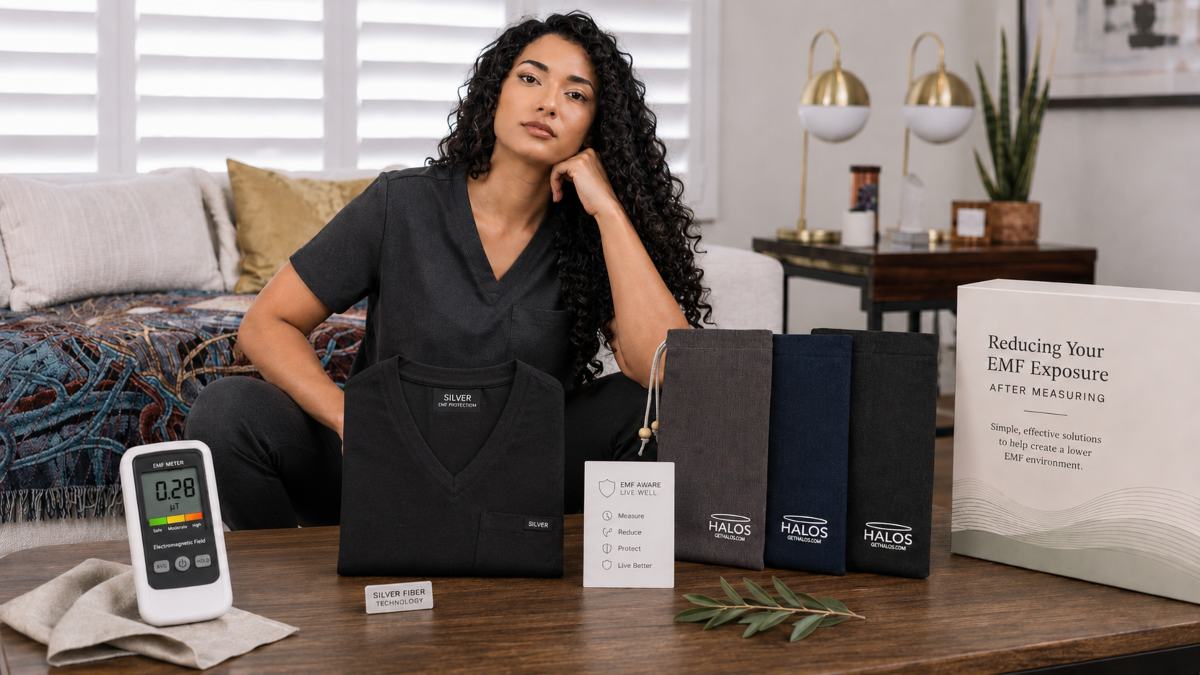 Distance, Duration, and Shielding The Three Levers
Distance is the most powerful and most immediately actionable lever available. Because electromagnetic field strength decreases with the square of distance from the source, even modest increases in separation produce substantial reductions in field intensity. A router that reads 80 µW/cm² at one meter reads approximately 20 µW/cm² at two meters and around 5 µW/cm² at four meters a 94 percent reduction from the one-meter reading achieved purely through repositioning. Before investing in any shielding solution, the first question to ask about any high-reading source in your home is whether it can simply be moved further from the spaces you occupy most.
Duration is the second lever and operates on a straightforward principle: total exposure equals field intensity multiplied by time. A high-reading source that you are near for ten minutes a day contributes far less to cumulative exposure than a moderate-reading source you sit beside for eight hours. Your measurement log, correlated with how you actually use each space, shows where the high-intensity, high-duration intersections are those are the locations where action produces the most meaningful change in your overall exposure picture. Behavioral adjustments that reduce time near identified high-reading sources are often the lowest-cost, highest-impact changes available.
Shielding is the third lever and the one that becomes relevant when the source cannot be moved and the duration cannot be meaningfully reduced. It is also the most technically specific lever effective shielding requires matching the shielding material to the field type and frequency you are trying to attenuate. A material that provides strong attenuation of RF radiation may offer minimal attenuation of ELF magnetic fields, and vice versa. Understanding what blocks EMF radiation and at which frequencies is what makes shielding decisions rational rather than speculative.
EMF shielding fabric is a textile engineered to attenuate radiofrequency electromagnetic fields through a process of reflection and absorption rather than blocking in the way a solid wall blocks physical objects. The mechanism is electromagnetic rather than mechanical: the conductive elements woven into the fabric interact with incoming RF waves, redirecting or dissipating their energy before they pass through.
The underlying principle is the Faraday cage effect the same physics that causes a metal enclosure to exclude external electric fields and RF radiation. When an electromagnetic wave encounters a conductive surface, it induces opposing currents in that surface which generate a counter-field that cancels or significantly attenuates the incoming signal. A Faraday cage does not need to be a solid metal enclosure to be effective at RF frequencies; a conductive mesh with apertures smaller than the wavelength of the target frequency provides nearly equivalent attenuation, which makes conductive fabric shielding physically viable.
The effectiveness of a shielding fabric at a given frequency is expressed in decibels (dB) of attenuation the ratio of the field intensity before the fabric to the field intensity after it. A fabric rated at 30 dB of attenuation at 1 GHz reduces the field intensity at that frequency by approximately 1,000. A fabric rated at 40 dB is reducing it by a factor of 10,000. These attenuation values are frequency-dependent: a fabric that performs at 40 dB at 1 GHz may perform differently at 5 GHz or at millimeter-wave frequencies, which is why laboratory test data across a broad frequency range matter more than a single-frequency shielding claim.
Attenuation performance also degrades with physical damage to the conductive network within the fabric. Cuts, abrasions, and conductive fiber breakage from improper washing create discontinuities in the conductive mesh, reducing shielding effectiveness. This is why care instructions for EMF shielding textiles are a functional specification, not optional guidance.
Silver-fiber EMF radiation protection clothing achieves its attenuation performance through the inherent electrical conductivity of silver the highest electrical conductivity of any element at room temperature woven directly into the textile structure as a continuous conductive fiber rather than applied as a coating or finish.
The distinction between woven silver fiber and silver coating matters for both performance and durability. A coating applied to the surface of an existing fiber can flake, crack, or wash away over time, degrading shielding performance in ways that are not visually apparent. Silver fiber that is woven into the textile structure as a constituent yarn maintains its conductivity as part of the fabric itself the conductive network is the textile, not a surface treatment on top of it.
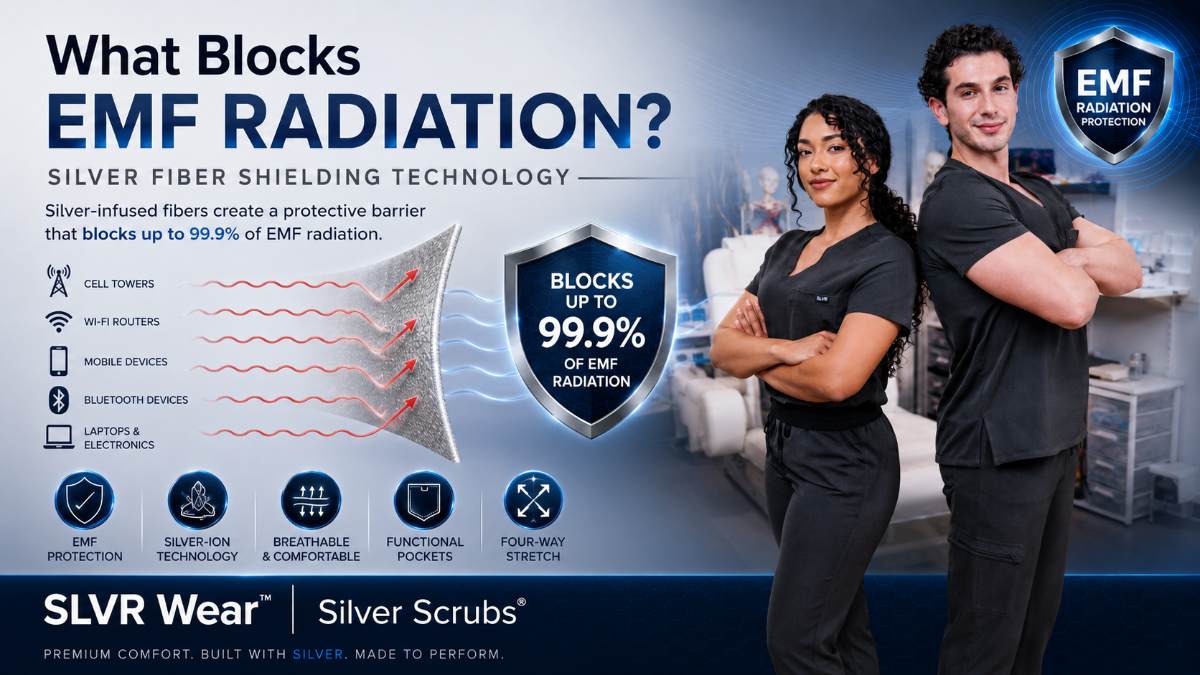
SLVR Wear silver-fiber shielding fabric uses 35% pure silver fiber woven with 59% polyester and 6% spandex. The silver content is sufficient to create the continuous conductive network necessary for effective RF attenuation across wireless frequencies. In contrast, the polyester and spandex content provides the mechanical properties stretch, recovery, durability, and washability that make the fabric viable as apparel rather than as a rigid panel.
The yarn is OEKO-TEX® Standard 100 certified, meaning it has been tested and confirmed free of harmful substances across a defined list of regulated chemicals, which matters for any textile worn against the skin. SLVR Wear’s SilverScrubs® are lab-tested to block up to 99.91% of EMF verified to 50 GHz with those specific performance claims backed by testing conducted under GJB 5792A-2021, the relevant Chinese national military standard for electromagnetic shielding textiles.
The shielding mechanism in wear is the same Faraday cage principle that governs any conductive enclosure: the silver-fiber network in the fabric interacts with incoming RF waves, inducing surface currents that generate a counter-field attenuating the signal before it passes through the textile layer. The practical result is that garments made from this fabric reduce the RF field intensity reaching the body surface beneath the fabric, across the frequencies the fabric is rated to attenuate.
EMF protective clothing and Faraday accessories are relevant when your measurement data identifies a high-RF-reading environment where you spend significant time, and where the distance and duration levers are not fully available to you.
The clearest use case is occupational. Healthcare environments, for example, are saturated with wireless infrastructure nurse call systems, patient monitoring networks, hospital WiFi, portable medical devices, and staff communication devices all operating simultaneously across a range of frequencies. For professionals who spend full working days in these environments, EMF blocking apparel worn as a standard uniform layer provides continuous RF attenuation throughout the workday without requiring behavioral change or infrastructure modification. This is the rationale behind SLVR Wear’s SilverScrubs® medical-grade scrubs constructed from silver-fiber shielding fabric, designed as a functional workwear solution for clinical environments where RF exposure is a structural feature of the job rather than an incidental one.
The second use case is situational and guided by measurement. If your home assessment produces a sustained high RF reading in a specific location a home office directly adjacent to a smart meter, a bedroom with a cellular tower line-of-sight, a workspace with dense wireless infrastructure nearby and repositioning the relevant sources is not practical, shielding at the garment level provides an exposure-reduction option that moves with you through the space rather than being fixed to one wall or surface.
An Signal Shielding Beanie Black or EMF blocking hat addresses head exposure specifically relevant for anyone spending extended hours in a high-RF environment near ceiling-mounted access points or working directly below a smart meter installation. For infants and young children in elevated-RF sleeping environments, an Signal Shielding baby blanket provides a shielding layer at the sleeping position, where prolonged exposure is most significant.
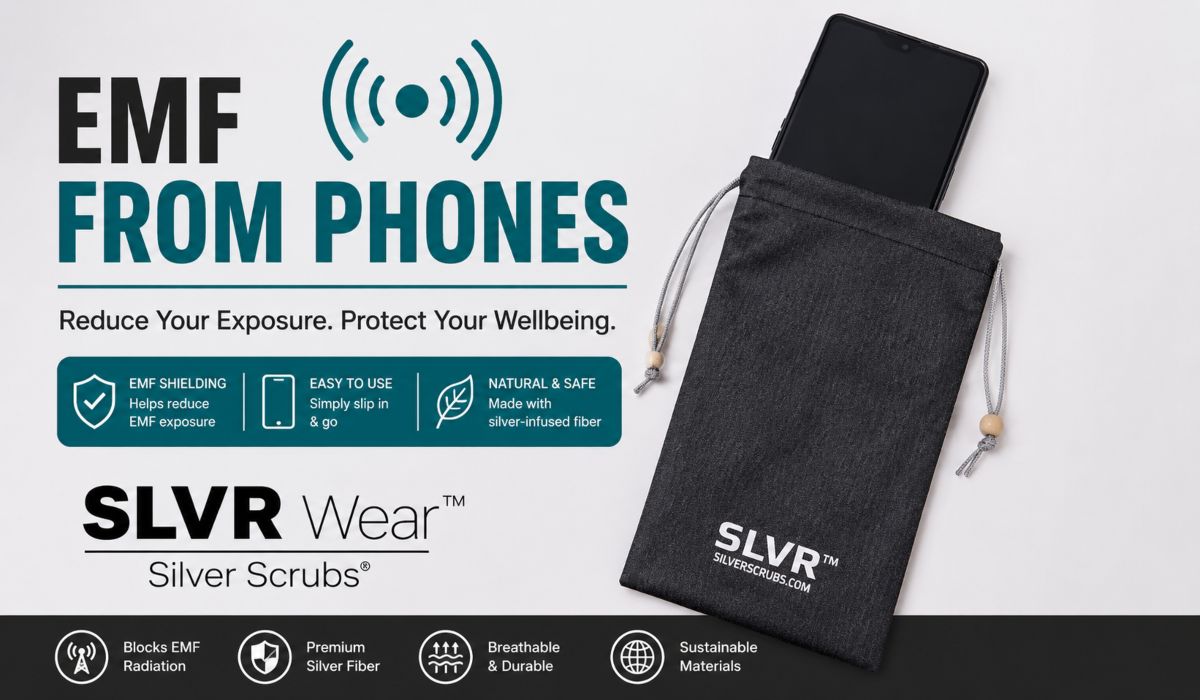
A Faraday phone pouch addresses a more specific and narrowly defined exposure scenario: the RF field produced by a smartphone during active cellular transmission when the device is carried on the body. A signal-blocking pouch constructed from shielding fabric prevents the phone from transmitting or receiving while stored inside it, eliminating the RF field the device would otherwise produce at body-contact distance. The trade-off is that the phone cannot receive calls or notifications while pouched a straightforward functional exchange that your measurement data, rather than assumption, should inform the decision about.
The rational framework for any shielding decision is the same one that should govern the entire measurement process: start with the data, identify where high intensity and high duration intersect in your actual life, and select the response that most directly addresses that intersection. Shielding is not a precaution against an imagined risk. It is a targeted technical response to a documented field environment and the measurement log you have built by this point in the guide is exactly the evidence base that makes that response considered rather than reflexive.
Yes, an EMF meter measures non-ionizing electromagnetic radiation, including electric and magnetic fields and radiofrequency signals from WiFi, phones, and power lines. However, it does not detect ionizing radiation, such as X-rays, gamma rays, or radioactive materials. Measuring ionizing radiation requires specialized devices such as Geiger counters.
A voltmeter can measure electromotive force (EMF), the voltage produced by a battery or other power source. It cannot measure electromagnetic fields radiated by WiFi routers, cell phones, or power lines. For those measurements, a dedicated EMF meter is required.
It depends on what “EMF” refers to. Electromotive force is measured in volts (V). At the same time, electromagnetic fields use different units such as volts per meter (V/m) for electric fields, milligauss (mG) or microtesla (µT) for magnetic fields, and µW/cm² for RF power density. The unit varies according to the type of field being measured.
The best approach is to use a calibrated tri-axis EMF meter and perform a room-by-room assessment under normal living conditions. Measure at different distances from potential sources and record readings at various times of the day. This method provides a more accurate picture of your typical EMF exposure.
EMF apps can provide rough magnetic field readings using a smartphone’s built-in magnetometer, making them useful for identifying strong nearby sources. However, they cannot accurately measure electric fields or RF radiation. For reliable and actionable results, a dedicated EMF meter remains the preferred tool.
Disclaimer: SLVR Wear products are not medical devices and are not intended to diagnose, treat, cure, or prevent any disease.