iPhone EMF Radiation Explained | SAR by Model and Guide
Every iPhone emits EMF radiation in the form of radiofrequency (RF) signals from its Wi-Fi, cellular, and Bluetooth antennas, and…
Yes. Bluetooth devices emit RF radiation, a form of non-ionizing EMF radiation, in the 2.4 GHz band. Output is very low, ranging from about 1 to 100 milliwatts, depending on device class. A typical LTE phone can transmit at up to about 200 milliwatts.
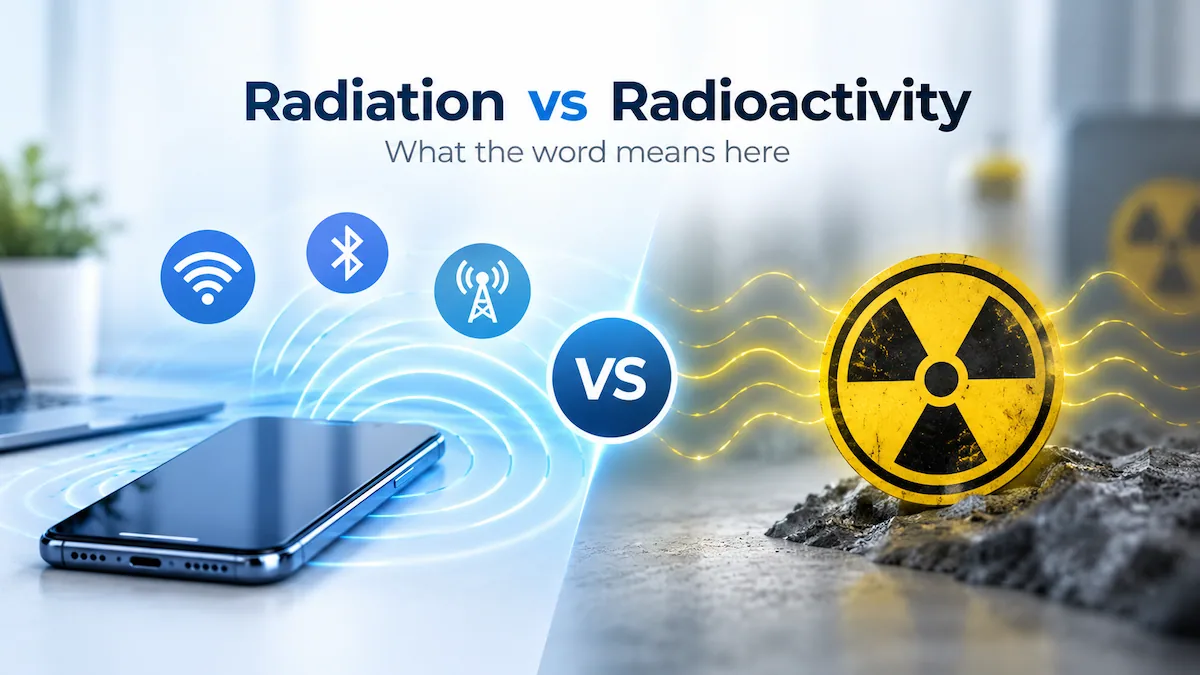
“Radiation” here means radio waves, the same kind Wi-Fi routers and phones use. It does not mean the ionizing radiation of X-rays or radioactive material. This guide covers what kind of radiation Bluetooth headphones, earbuds, and headsets emit, how much power they use, and which safety limits apply. It also covers what research has yet to settle.
Yes. Bluetooth emits radiation as low-power radio waves. It is non-ionizing RF radiation, which means it lacks the energy to break chemical bonds or alter atoms. It is not radioactive.
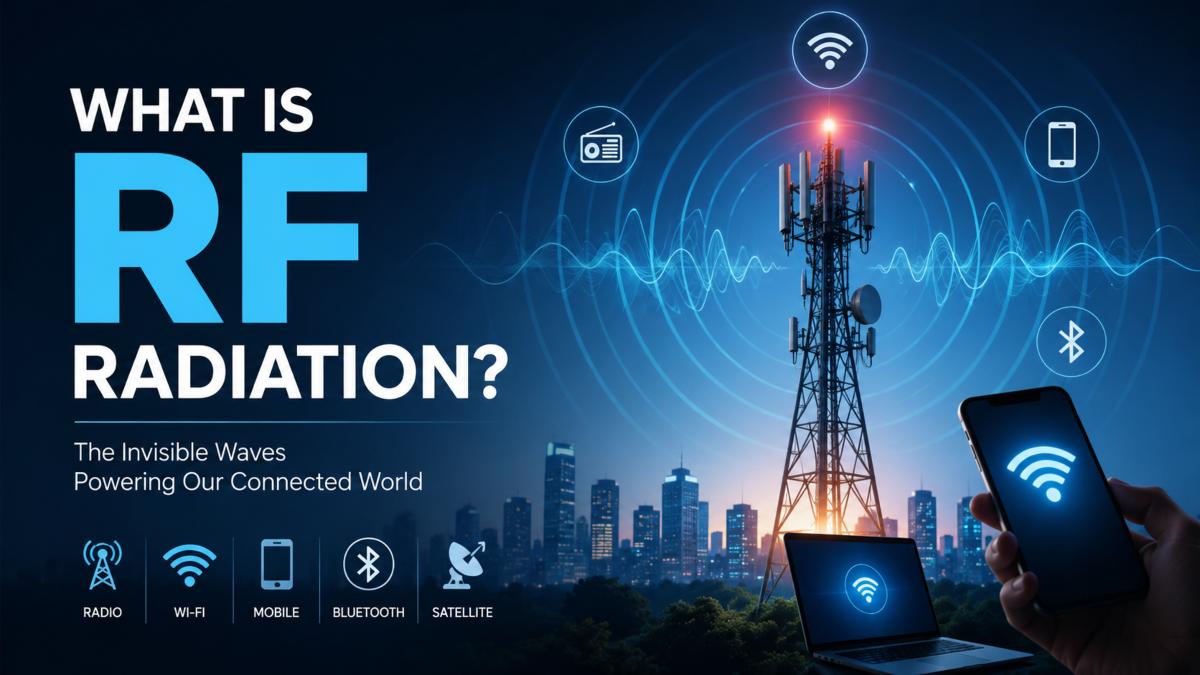
Every Bluetooth device is a small radio transmitter. When your earbuds connect to your phone, both devices send and receive radio signals between 2.400 and 2.4835 GHz. The signal carries audio, call data, or commands, so a connected Bluetooth device is always emitting RF energy.
The emission is not constant at full strength. Bluetooth devices send short bursts of data and hop across channels to avoid interference. The standard also lets devices adjust power to the link, so a device close to its paired phone can transmit at a lower level than one farther away.
“Radiation” is a broad term for energy that travels as waves or particles. It covers everything from a lamp’s light to a radio tower’s signal. For the body, what matters is how much energy each photon carries.
Radioactivity is something else. It describes unstable atoms that give off particles or high-energy rays as they decay. Bluetooth involves no radioactive material and no decay. The World Health Organization notes that RF fields cannot cause ionization or radioactivity in the body, which is why they are called non-ionizing.
Low energy per photon does not settle every safety question. It does explain why Bluetooth belongs in the same category as Wi-Fi and cell signals, not medical imaging or nuclear sources.
 What Kind of Radiation Does Bluetooth Emit?
Bluetooth emits non-ionizing radiofrequency (RF) radiation in the 2.4 GHz band. This is low-energy radio-wave radiation, in the same part of the electromagnetic spectrum as Wi-Fi and microwave ovens, far below visible light and X-rays.
Bluetooth operates in a license-free band called the ISM band, which is reserved for industrial, scientific, and medical use and shared by many consumer devices. The signal is a modulated radio wave sent in short packets, not a steady beam.
The electromagnetic spectrum runs from low-frequency radio waves up to gamma rays. Higher frequency means more energy per photon, and the line between non-ionizing and ionizing radiation falls well above anything a Bluetooth device produces.
| Type | Ionizing? | Common Examples |
|---|---|---|
| Radio waves | No | AM/FM radio, cell networks, Bluetooth |
| Microwaves | No | Microwave ovens, Wi-Fi, radar |
| Visible light | No | Sunlight, lamps |
| X-rays | Yes | Medical imaging |
Bluetooth, many Wi-Fi networks, and microwave ovens all use frequencies near 2.4 GHz. A shared frequency does not mean shared power. Ovens use far more power inside a shielded metal cavity, which is why is a microwave a Faraday cage for its own signal. A Bluetooth device uses a tiny fraction of that power and has no enclosure.
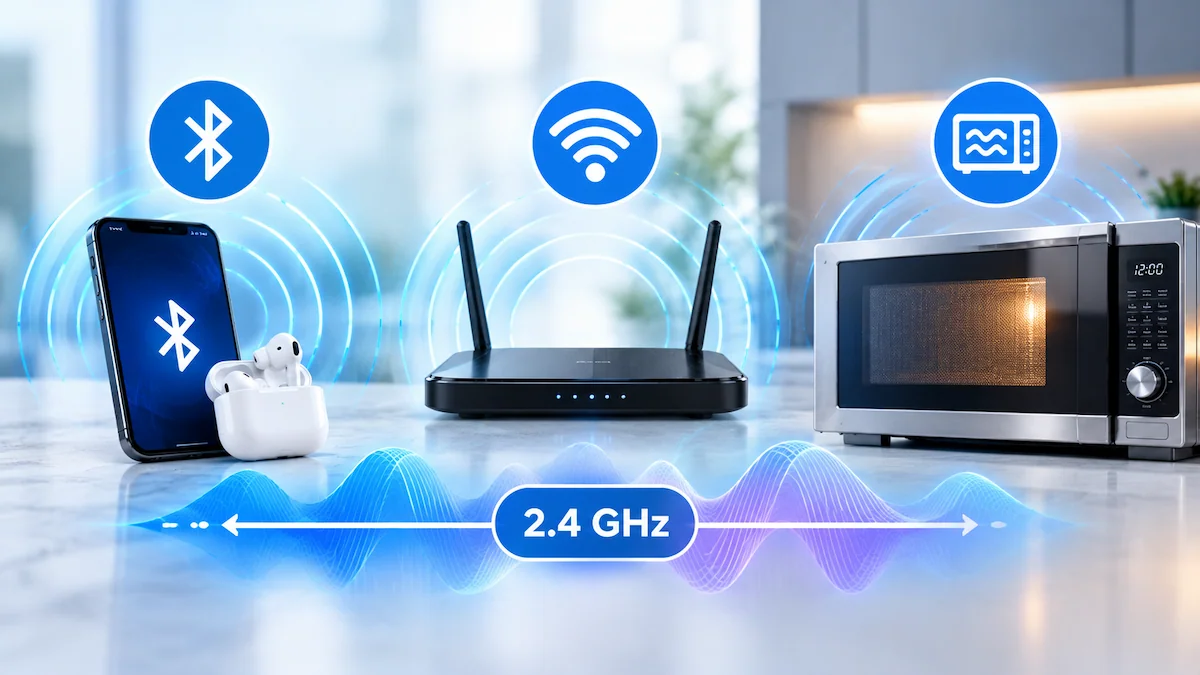 Does Bluetooth emit EMF radiation? What EMF covers
Yes. Bluetooth emits EMF radiation, specifically RF-EMF. EMF stands for electromagnetic fields, a broad term for the electric & magnetic fields produced by anything that uses electrical energy. It covers safe distance from power lines and household wiring (extremely low frequency), radio and wireless signals (radiofrequency), visible light, and X-rays. Applied to Bluetooth, the term refers to the low-power, non-ionizing RF category.
Bluetooth devices emit about 1 to 100 milliwatts (mW) of RF power, and most consumer headphones, earbuds, and headsets are built toward the low end of that range. Class 2 devices, the most common for personal audio, are capped at 2.5 mW. For comparison, an LTE smartphone can transmit at up to about 200 mW.
The Bluetooth standard defines power classes that cap how strongly a device may transmit. A higher class means more output and longer range.
| Class | Max Output Power | Typical Range | Typical Devices |
|---|---|---|---|
| Class 1 | 100 mW (20 dBm) | Up to ~100 m | Industrial adapters, some long-range speakers |
| Class 2 | 2.5 mW (4 dBm) | Up to ~10 m | Headsets, earbuds, headphones, mobile accessories |
| Class 3 | 1 mW (0 dBm) | Up to ~1 m | Short-range dongles, some mice |
| Bluetooth Low Energy (BLE) | Up to 10 mW (Bluetooth 4.x) or 100 mW (Bluetooth 5) | Varies | Fitness trackers, smartwatches, item trackers |
These are maximums, not constant outputs. A device often transmits below its ceiling.
Output power tells you how strong a transmitter can be. Exposure describes how much RF energy actually reaches your body. A 100 mW transmitter in a speaker across the room delivers little energy to you. A 2.5 mW transmitter in an earbud is much weaker but sits closer. Exposure depends on power, distance, transmission time, and antenna design. This is why regulators limit absorbed energy, not transmitter power alone.
Distance. RF energy weakens quickly as it spreads out, so a device across the room matters far less than one worn in the ear. Antenna design also matters at very close range.
Duty cycle. A Bluetooth device sends data in short packets and then pauses. The share of time it actually transmits is its duty cycle, and a lower one means lower average exposure.
SAR. Specific Absorption Rate (SAR) measures how much RF energy body tissue absorbs, in watts per kilogram. The U.S. FCC limit is 1.6 W/kg averaged over 1 gram of tissue. The ICNIRP guideline used in many other countries is 2 W/kg averaged over 10 grams.
Yes. Every Bluetooth headphone, earbud, and headset emits low-power, non-ionizing RF radiation while its radio is active. Most personal audio devices are Class 2 or Bluetooth Low Energy, so their maximum output is low. What differs between product types is placement and how long you wear them.
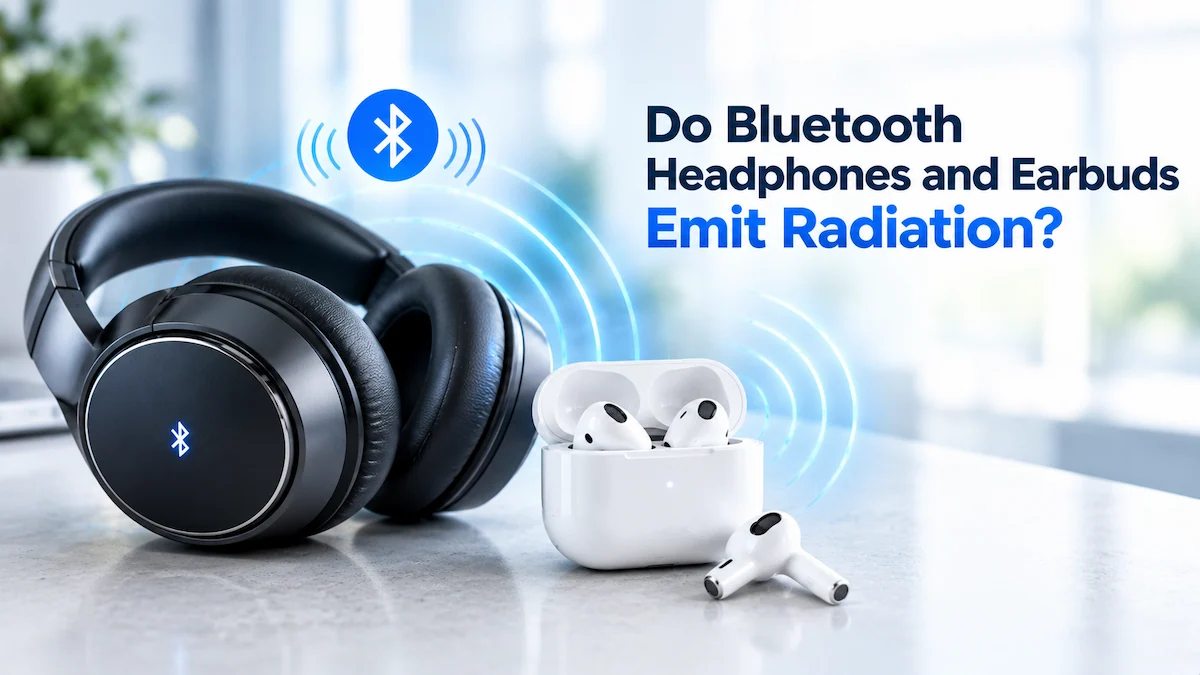 Over-ear Bluetooth headphones
Over-ear and on-ear headphones emit RF radiation from a small antenna inside the housing, usually in one earcup. The transmitter is typically Class 2 or BLE. The antenna sits near the ear but not inside it.
Earbuds emit the same kind of radiation at similar power. Their antenna sits at the ear canal opening, and people often wear them for long stretches. Every wireless device sold in the U.S. is tested before sale, so your model has a filing with measured results. The steps are in the device-check section below.
You wear a call headset or earpiece in your ear for long periods. Power is still low, typically Class 2. A headset moves your phone away from your head and replaces it with a much weaker transmitter, but the phone keeps transmitting to the network. Neither option is radiation-free.
If a device has a Bluetooth radio, it emits low-power RF radiation while that radio is active.
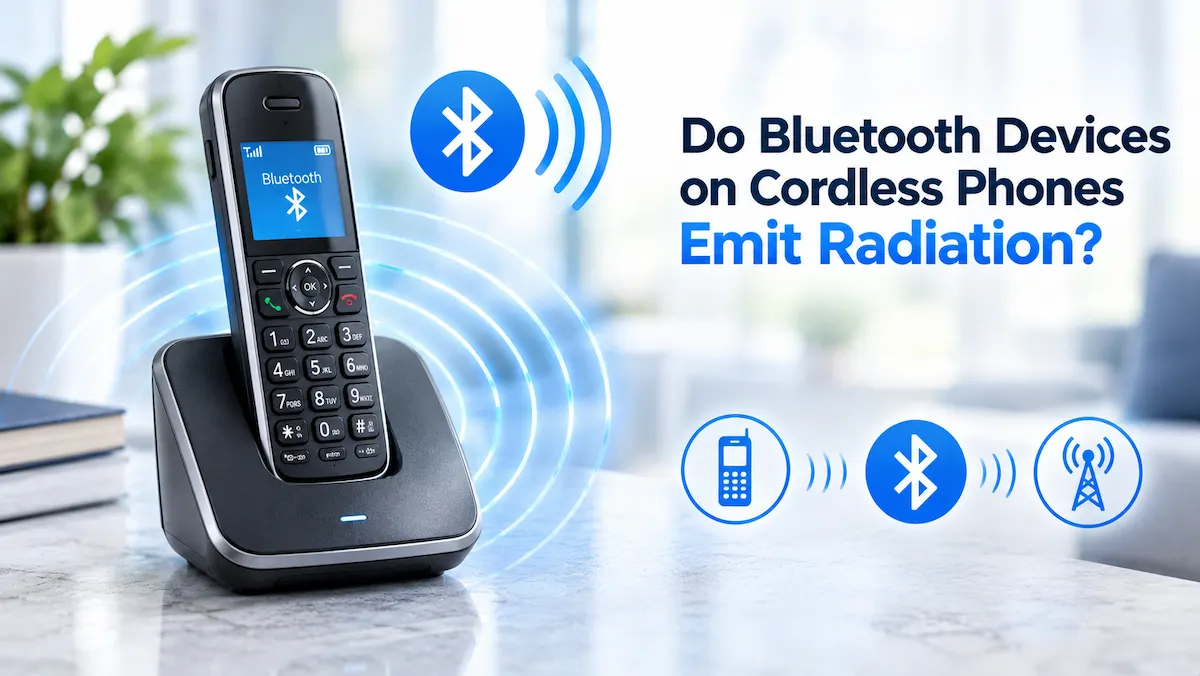
Some do, but Bluetooth is usually not the main radio in a cordless phone. A cordless handset talks to its base station using a separate standard, commonly DECT, with its own frequencies and power levels. If the system also has a Bluetooth feature to connect a cell phone, it adds a low-power 2.4 GHz link when paired. For a specific model, check its FCC ID and the frequencies listed in its test report.
 Is Bluetooth Radiation Harmful?
Current evidence does not show that Bluetooth radiation causes harm at the low power levels consumer devices use. Bluetooth is non-ionizing, and wireless devices must meet RF exposure limits before sale. Researchers still say long-term, close-to-head use is hard to study, so “no demonstrated harm” is not the same as “proven risk-free.”
Regulators do not directly limit transmitter power. They limit how much RF energy the body absorbs, measured as SAR. The FCC limit is 1.6 W/kg averaged over 1 gram of tissue. ICNIRP sets 2 W/kg averaged over 10 grams. Both include a margin below the level at which established effects occur, and they are designed to prevent tissue heating.
WHO has stated that, to date, no adverse health effects have been established as being caused by mobile phone use. Phones transmit at much higher power than Bluetooth accessories, so that finding is the closest available evidence for lower-power devices.
In 2011, the International Agency for Research on Cancer (IARC) classified RF electromagnetic fields as “possibly carcinogenic to humans” (Group 2B), based on limited evidence. That category means the evidence does not rule out a link. This does not mean RF causes cancer.
A 2024 systematic review commissioned by WHO and published in Environment International found moderate-certainty evidence that mobile phone use likely does not increase the risk of head and brain cancers, including in children. The FDA’s position is that the weight of scientific evidence has not linked cell phone use to health problems.
Most RF research involves phones, not Bluetooth accessories specifically. Two questions are harder to answer.
Long-term use. Wireless earbuds are a recent product, so data on decades of daily use doesn’t exist yet. The absence of evidence over a short period is not proof of safety over a lifetime.
In-ear placement. Device testing sets the limits, not assumptions about placement. The measured result for any specific earbud is in its FCC filing.
Four questions help sort claims.
Yes. A Bluetooth device emits far less RF radiation than a cell phone. A typical Bluetooth headset transmits at 2.5 mW or less, while an LTE smartphone can transmit at up to about 200 mW. Using Bluetooth puts the weaker transmitter at your ear, but the phone keeps transmitting to the network.
| Setup | Transmitter | Phone’s Position |
|---|---|---|
| Phone held to the ear | Phone (cellular radio) | Against the head |
| Wired headset | None | Away from the head |
| Bluetooth headset or earbuds | Bluetooth radio (2.5 mW or less if Class 2) | Away from the head |
| Speakerphone | None | Away from the head |
For the lowest head exposure on a call, wired or speakerphone puts no transmitter at the ear. Bluetooth sits between holding the phone to the ear and those two options.
A phone must reach a cell tower that can be kilometers away, so it needs far more power than a Bluetooth link that reaches a device a few meters away. It also keeps transmitting to the network whether Bluetooth is on or off. Phones raise output when the signal is weak and lower it when the signal is strong, as covered in our guide to cell tower radiation. Turning Bluetooth on or off therefore changes only a small part of your total RF output.
The simplest ways to lower Bluetooth exposure are to add distance, turn the radio off when you are not using it, and choose wired or speaker mode for long calls. Bluetooth output is already very low, so these steps make little difference. They are habits some people prefer, not requirements. For whole-home steps, see how to reduce EMF in your home.
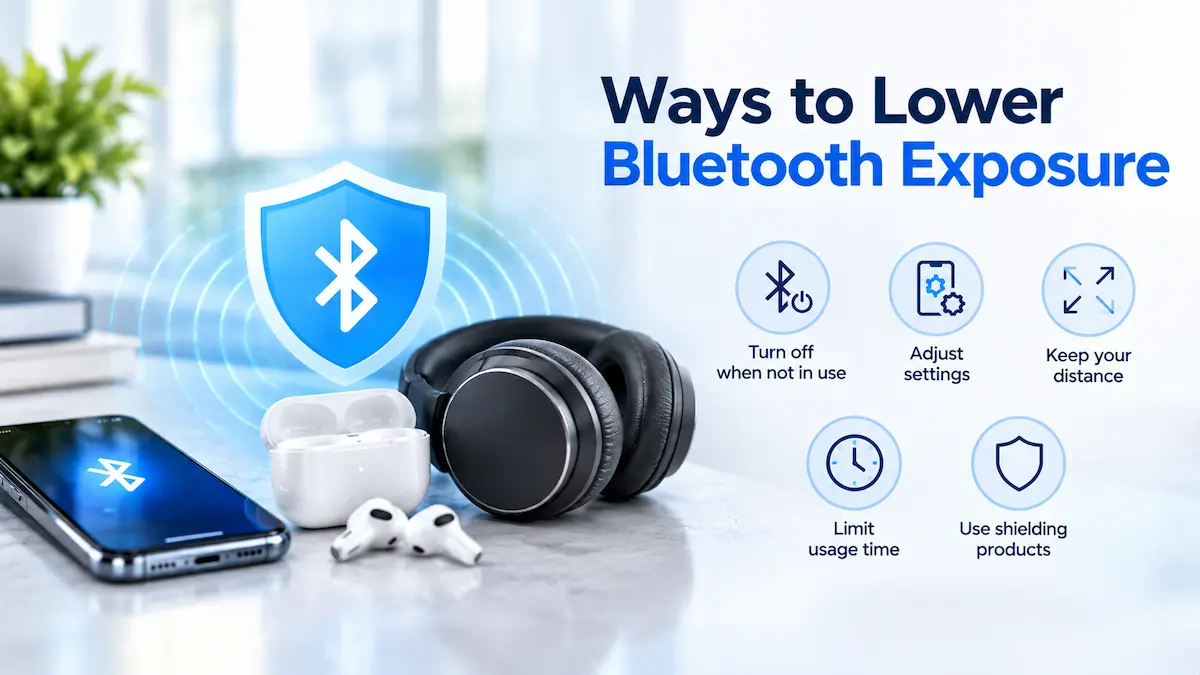 Keep distance and switch devices off when not in use
A Bluetooth speaker across the room matters far less than earbuds in your ears. A Bluetooth radio also transmits only while it is on and connected, so switching Bluetooth off on a device you are not using stops that radio.
On a long call, a wired headset or speakerphone keeps every transmitter away from your head, as the comparison above shows. For short calls the difference is small. For hours of daily calls, wired or speaker mode is the lower-exposure choice.
Airplane mode switches off your phone’s cellular radio and, on many phones, also switches off Wi-Fi and Bluetooth. You can usually turn Bluetooth back on while airplane mode stays active, so connected earbuds mean Bluetooth is running. Check the Bluetooth toggle itself to be sure. For more, see does airplane mode reduce EMF.
Yes. A Faraday pouch blocks wireless signals to the phone inside it, including cellular, Wi-Fi, and Bluetooth connections. It works because the pouch wraps the phone in conductive Faraday fabric that blocks radio signals from reaching or leaving the device. Other RF-shielding methods and EMF-blocking materials work on the same principle.
Some people want a phone that cannot transmit or receive for a period, such as in a bag overnight or during a meeting. Switching off radios in settings works for this. A signal-blocking pouch is a physical alternative that doesn’t rely on software, and it is easy to confirm because a blocked phone cannot connect.
One option is the SLVR Wear™ Faraday Phone Pouch, an RF-blocking pouch made with silver-fiber RF-shielding fabric. Because it blocks signals, a phone inside will not ring or connect until you take it out. Whether you use a pouch, airplane mode, or neither is your call. See our other RF blockers for more.
Most Bluetooth radiation myths mix up three things: whether a device emits radiation, what type it is, and how much power it uses. Bluetooth emits RF radiation; it is non-ionizing, and its power is very low. Each myth below gets one of those points wrong.
This is false. Any device with an active Bluetooth radio emits RF radiation, because that is how it sends data. “Radiation-free” claims usually mean the device is off, or refer only to ionizing radiation. The accurate statement is that Bluetooth emits very little: a Class 2 device is capped at 2.5 mW.
This is also false. Both are electromagnetic radiation, which is why the word appears in both, but they sit at opposite ends of the spectrum. X-rays are ionizing and can damage molecules. Bluetooth is non-ionizing RF and cannot ionize atoms. They share a category name and little else.
This myth confuses two radios. The signal bars on your phone show cellular reception, which is separate from Bluetooth. When cellular signal is weak, the phone raises its cellular transmit power to keep the connection. That tells you about the phone’s cell radio, not your earbuds.
You can check a Bluetooth device’s radiation data yourself using its FCC ID. The FCC’s public database holds test reports for wireless devices sold in the United States, including RF output power and, where required, SAR results. Find the ID, open the reports, and compare the numbers to the limits.
The FCC ID is a short code that identifies a device model. It is usually printed on the device, its charging case, or the packaging, and many phones list it in a regulatory menu in settings. The first three or five characters identify the company, and the rest identify the product. Enter the full code in the FCC’s Equipment Authorization Search. The documents worth opening are the RF exposure or SAR report, the test report, and the user manual.
Not every device has a SAR report. Very low-power transmitters may be exempt from SAR testing under FCC rules, and the filing then contains an RF exposure evaluation or exemption statement instead. That reflects low power, not missing data.
A SAR report gives a number in watts per kilogram (W/kg). The FCC limit is 1.6 W/kg averaged over 1 gram of tissue, and the ICNIRP guideline is 2 W/kg averaged over 10 grams. Check which averaging mass the report uses, since the two figures are not directly comparable. Compare the number with the limit, not with other devices. A result under the limit means the device passed, and it does not rank devices by safety.
The Bluetooth version, such as 5.0 or 5.3, tells you which standard a device supports, not its power class. Spec sheets often omit the class. For actual power, look in the FCC test report for conducted or radiated output power, usually in dBm. 0 dBm is 1 mW, 4 dBm is about 2.5 mW, and 20 dBm is 100 mW. The Bluetooth SIG’s public listing database shows a qualified product’s Bluetooth version.
A Bluetooth headset emits low-power, non-ionizing RF radiation. Most are Class 2 devices, which the Bluetooth standard caps at 2.5 milliwatts (mW). A smartphone can transmit at up to about 200 mW on LTE. For a specific model, the FCC filing lists measured output, which you can find using the device’s FCC ID.
Not necessarily. Both usually use low-power Class 2 or Bluetooth Low Energy radios. The main difference is placement: earbuds sit at the ear canal opening, while over-ear headphones hold the antenna in the earcup. The most reliable comparison is each model’s FCC test report, which lists measured output and any SAR results.
Current evidence does not show harm from Bluetooth at consumer power levels. It is non-ionizing, and wireless devices must meet regulatory absorption limits. A 2024 WHO-commissioned review of mobile phone use found moderate-certainty evidence of no increased brain cancer risk. Long-term use is hard to study, so “no demonstrated harm” is not “proven risk-free.”
Yes. A typical Bluetooth headset transmits at 2.5 mW or less, while an LTE smartphone can transmit at up to about 200 mW. A phone must reach distant cell towers, but Bluetooth only reaches nearby devices. Bluetooth uses a weaker transmitter in your ear, but the phone keeps transmitting to the network.
Some do, but Bluetooth is usually not the main radio. A cordless handset talks to its base station using a separate standard such as DECT, with its own frequencies and power levels. If the system also has Bluetooth, it adds a low-power 2.4 GHz link when paired. Check the model’s FCC ID for details.
It can. Airplane mode turns off the cellular radio, and on many phones it also switches off Wi-Fi and Bluetooth. You can usually turn Bluetooth back on while airplane mode stays active, so connected earbuds mean Bluetooth is running. Check the Bluetooth toggle itself to be sure.
This page draws on regulators, health agencies, and technical standards. Where a claim rests on a measured figure or a health conclusion, it is traced to the source below.