What Is RF Radiation? Frequency, Risks and Exposure
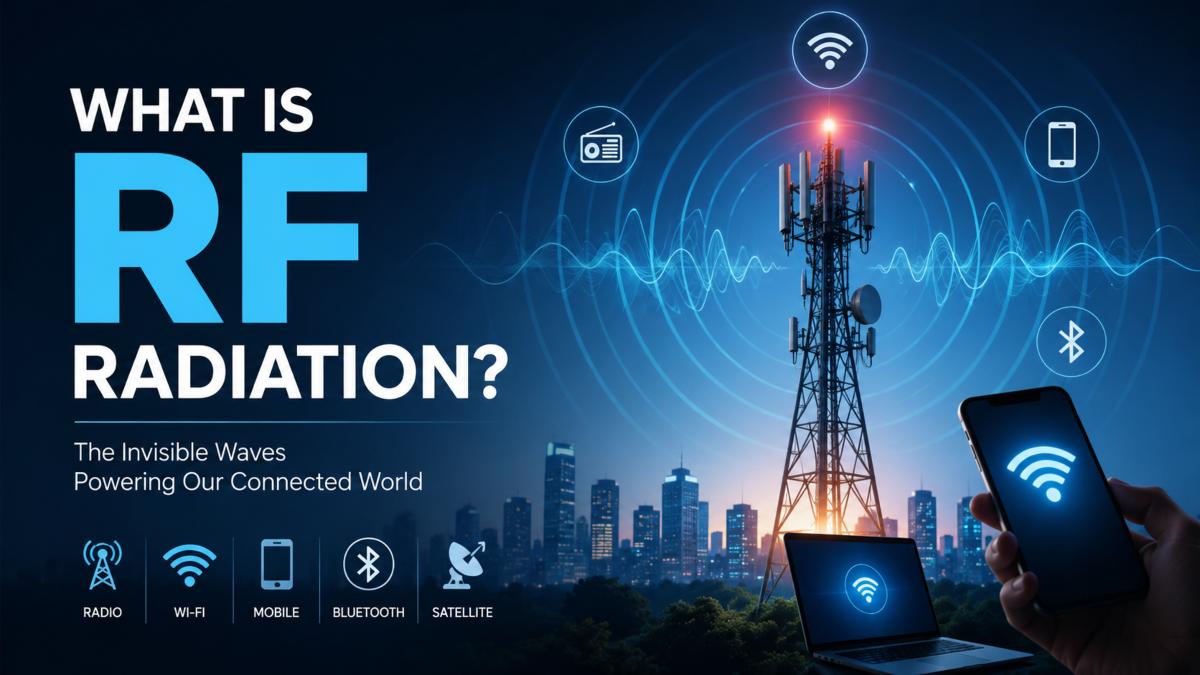
RF radiation is electromagnetic energy that travels in waves, spanning roughly 3 kilohertz to 300 gigahertz the band the FCC…
Cell towers emit non-ionizing radio-frequency radiation, which carries too little energy to break chemical bonds or directly damage DNA. In free space, signal intensity falls to a quarter when the distance doubles. Regulators such as the FCC and ICNIRP set exposure limits, and measured levels in public areas are typically well below them.
That is the short answer, but it leaves out the details people search for. This page explains how tower antennas transmit signals and how far they travel. It covers what “safe distance” can and cannot mean, how the official limits work, and what major health bodies have concluded about cell phone tower radiation. It ends with what you can do to reduce your exposure.
Cell phone tower radiation is radio-frequency energy that tower antennas send out to connect your phone to the network. It is non-ionizing, so it lacks the energy to strip electrons from atoms or directly damage DNA.
Radio-frequency (RF) radiation is energy that travels through space as a wave. In this context, “radiation” does not mean radioactivity. A tower antenna converts data into RF waves, and your phone picks them up. Your phone then sends its own RF signal back to the tower. For a broader explanation, see our guide to what is RF radiation.
Cell tower radiation is non-ionizing. Ionizing radiation, such as X-rays and gamma rays, has enough energy per photon to remove electrons from atoms. A photon at 2 GHz, a common cellular frequency, carries about 8 millionths of an electron-volt. Ionizing a molecule takes roughly 10 electron-volts or more, so the energy per photon is about a million times too low. That holds for 4G and 5G alike.
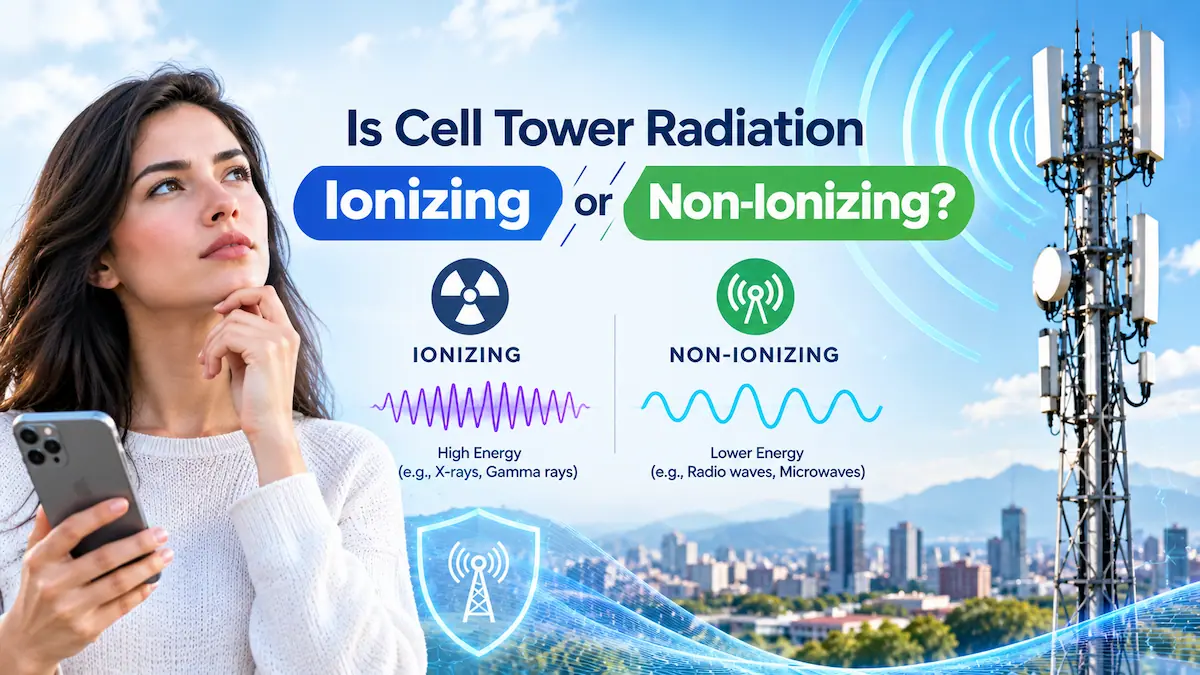 Is it microwave radiation?
Yes, in the technical sense. Microwaves are radio waves between about 300 MHz and 300 GHz, and cellular signals sit in that range. The label can mislead, though. A microwave oven concentrates energy inside a sealed metal box to heat food. A tower spreads its signal across open air, so the strength at any point is far lower.
Cell towers use licensed frequency bands that vary by country and carrier. Ofcom’s UK audits list mobile bands from 700 MHz to 3.8 GHz, used by 2G, 3G, 4G, and 5G technologies. Lower frequencies generally travel farther and pass through walls more easily. Higher frequencies carry more data but cover shorter distances.
Cell tower antennas send their signal in mostly horizontal beams aimed at the surrounding area, not at the ground below. The strength you receive depends on the antenna’s direction, transmit power, and distance.
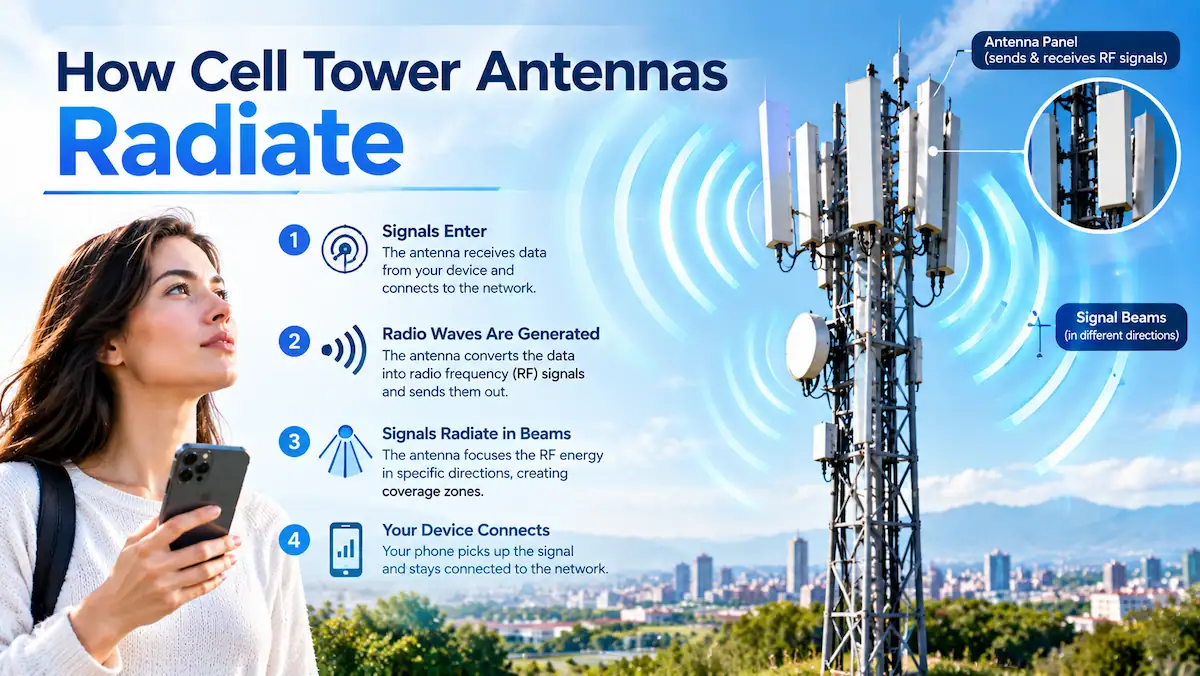 Antenna radiation pattern (why the beam is horizontal, not straight down)
A tower antenna is a tall, narrow panel built to send energy toward the horizon, where the users are. Its beam is wider sideways than it is vertically, and operators tilt it slightly downward to reach the edge of the coverage area. As a result, the beam’s strongest part passes overhead for anyone standing near the base. WHO notes that field intensity increases slightly as you move away from a base station and then decreases at greater distances.
Radiated power differs from one tower to the next because each site is sized to its job. Outdoor base stations typically transmit from a few watts to about 100 watts, and indoor ones transmit even less. Coverage area, number of carriers, and frequency bands all change the figure. No single value describes “a cell tower,” so a site’s compliance measurements or an operator’s exposure report give the real number.
5G towers radiate the same type of non-ionizing radio-frequency energy as 4G. Neither generation is automatically stronger, because exposure depends on power, antenna design, and your distance. ICNIRP’s 2020 guidelines cover 100 kHz to 300 GHz, so the exposure limits apply to 5G frequencies as well.
Usually, yes. Small cells serve a small area, so they need less power than a large macro tower. Indoor base stations transmit even less than outdoor ones. The trade-off is that small cells sit closer to people, so distance and antenna direction still matter.
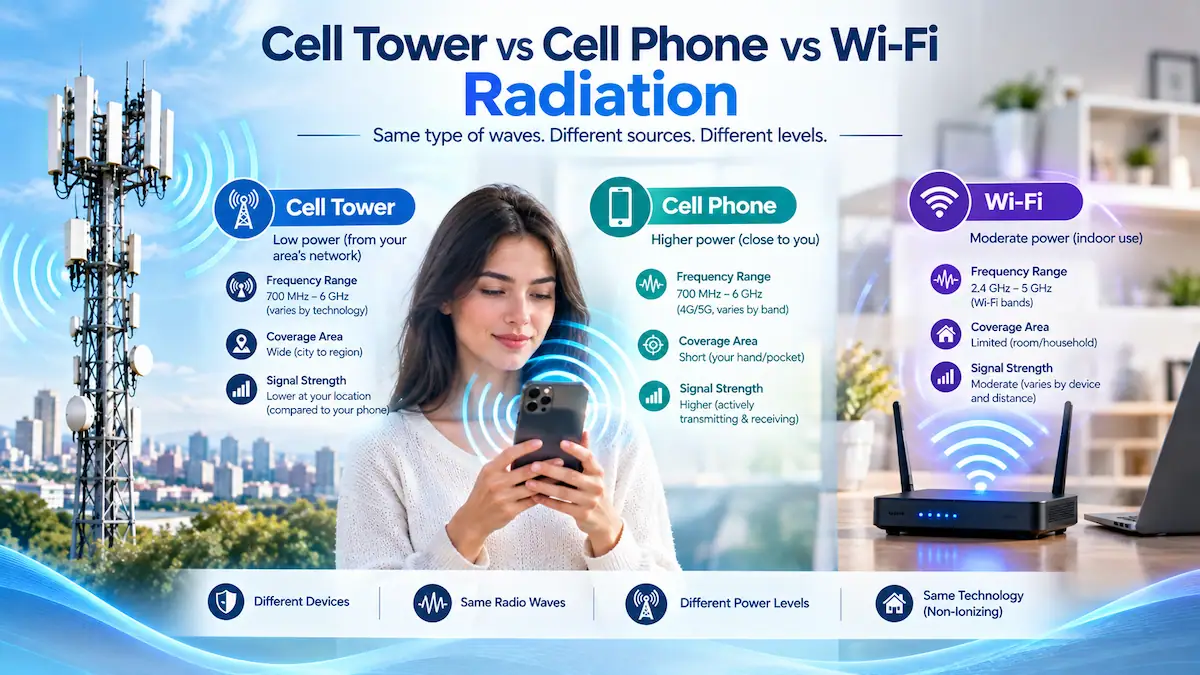
Cell towers, cell phones, and Wi-Fi routers all emit the same kind of non-ionizing radio-frequency radiation. They differ in power, in how close they sit to your body, and in how long they transmit. A tower transmits the most power but is usually far away, so your phone is usually your closest and most direct source.
| Feature | Cell Tower Antenna | Cell Phone | Wi-Fi Router |
|---|---|---|---|
| Where It Sits Relative to You | Usually far away, with antennas mounted high. | On or next to your body. | In the same room or building. |
| What Drives Its Power | Site size, coverage area, and number of carriers. | Signal quality, since the phone adjusts its power. | Router model and usage. |
WHO states that RF exposure to a mobile phone user is far higher than to a person living near a cellular base station. The table shows why transmit power alone does not predict exposure. Phones use automatic power control to reduce their transmitted power, and wireless networks generally produce lower RF signals than base stations. For handset detail, see our guides on do cell phones emit radiation.
 How Far Does Cell Tower Radiation Travel?
Cell tower radiation travels as far as a phone can still detect the signal, but its strength drops sharply with distance. Range and exposure are different measures. Range is how far a signal can be picked up, and exposure is how much energy reaches your body at a given spot.
In free space, intensity falls to a quarter each time the distance doubles. Moving ten times farther from an antenna therefore cuts the power density to one hundredth. A phone can use a much weaker signal than near the antenna, so a tower can serve users far away while exposure near the antenna stays highest.
No single radius describes a cell tower. Coverage varies with the frequency band, transmit power, antenna height, and each sector antenna’s direction. Terrain, buildings, trees, and walls further weaken the signal, so two towers of the same design can reach very different distances. For a reliable figure, use a site-specific measurement or the operator’s compliance report.
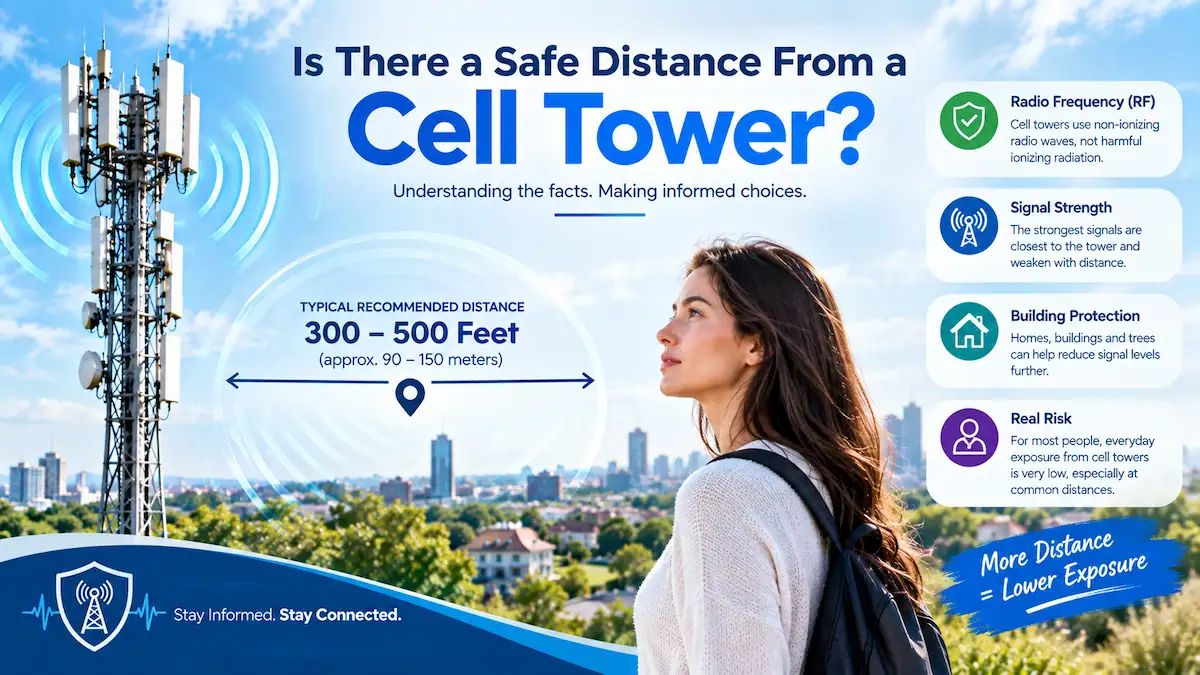
No single safe distance applies to every cell tower, because exposure depends on the antenna’s power, direction, and height, not on distance alone. Regulators set exposure limits based on where people can be, not on how far you live from a tower. Power lines are a different source with different rules. See our guide to the safe distance from power lines.
 What regulators and researchers say about distance
Exposure standards such as those from the FCC and ICNIRP are written as limits on field strength or power density, not as setback distances. For the general public, the FCC limit is 1.0 mW/cm² between 1,500 and 100,000 MHz and is lower at lower frequencies. Licensees are responsible for complying with the limits for the transmitters under their jurisdiction. Because levels depend on the site, any fixed “safe” number would be a guess. A distance claim should cite a measurement at a specific site.
The area directly below an antenna sits outside its main beam, and WHO notes that intensity rises slightly with distance, then falls. Rooftops are different. When antennas are mounted on a roof, levels are highest close to them and in front of the beam. For people on the ground, the main beam typically passes overhead.
For a home near a tower, antenna height, antenna direction, and your floor matter more than the raw distance to the mast. An antenna mounted well above your roofline and pointed away from your building contributes little. A site pointed toward your building from a similar height contributes more, and upper floors that face it sit closer to the beam than lower floors. If exposure near your home worries you, ask the carrier or the national regulator for the site’s compliance report, or request an independent measurement.
National regulators such as the FCC in the US set cell tower exposure limits using guidelines from scientific bodies like ICNIRP. They cap the radio-frequency strength allowed where the public can be, not how close a tower can stand.
 FCC limits (US)
The FCC sets maximum permissible exposure (MPE) limits in 47 CFR §1.1310, with a stricter tier for the general public. For the general public, the power-density limit is 0.2 mW/cm² from 30 to 300 MHz and f/1,500 mW/cm² from 300 to 1,500 MHz (f is the frequency in MHz). It is 1.0 mW/cm² from 1,500 to 100,000 MHz. At 900 MHz that works out to 0.6 mW/cm². Each limit is averaged over 30 minutes. One milliwatt per square centimeter equals 10 W/m², which makes the figures easy to compare with ICNIRP’s.
The International Commission on Non-Ionizing Radiation Protection (ICNIRP) publishes guidelines that many countries follow. Its 2020 update replaced the 1998 radio-frequency guidelines. For the general public above 2 GHz, the whole-body limit is 10 W/m² (1.0 mW/cm²), and it is f/200 W/m² from 400 to 2,000 MHz. Whole-body exposure is averaged over 30 minutes. Ofcom’s audits compare results with the 1998 edition, so check which version applies in your area.
Measured exposure near base stations is typically well below the limits. The UK regulator Ofcom publishes audits of sites across the country; for example, a survey taken on 5 May 2026 at five locations in Leicester (LE3). The totals across all measured bands ranged from about 0.32% to 0.64% of the ICNIRP 1998 general-public reference levels. That total includes FM radio, digital radio, and TV signals, as well as mobile bands, so the tower’s share is smaller. Ofcom notes that the results apply only to the time and equipment tested. For a specific site near you, ask the operator or regulator for its compliance report.
Major health bodies have found no convincing evidence that radio-frequency signals from cell towers harm health at levels within exposure limits. The World Health Organization (WHO) says exposure from base stations is so low that any temperature rise is insignificant. Research continues, and some scientists argue the evidence still has gaps.
WHO’s base-station fact sheet states that no convincing scientific evidence shows that weak RF signals from base stations and wireless networks cause adverse health effects. That fact sheet dates from 2006, and WHO has since commissioned newer reviews. The American Cancer Society says research generally has not found a clear connection between RF exposure from cell phones and cell towers and cancer risk. Health Canada states that, as long as exposures stay within its guidelines, there is no scientific reason to consider cell phone towers dangerous to the public.
The best current evidence does not show that it does. A WHO-commissioned systematic review published in 2024 found that exposure to fixed-site transmitters, including base stations, was not associated with childhood leukemia or pediatric brain tumor risk, regardless of modeled exposure level. That review drew on 63 human studies.
The IARC classification often appears in this debate. In 2011, the International Agency for Research on Cancer (IARC) classified RF fields as “possibly carcinogenic to humans” (Group 2B), based on an increased risk of glioma associated with wireless phone use. That classification came from phone use, which involves much higher exposure than a tower. The 2B category covers agents with limited evidence in humans and insufficient evidence in animals. It signals a hazard to keep studying, not a measured level of risk.
 What studies can and cannot show
Observational studies compare groups of people and cannot prove cause and effect. Results also depend on how well researchers estimate exposure. Some individual studies near towers have reported slightly higher overall cancer risk in higher-exposure areas, while others found no link. Critics also dispute how much weight to give the WHO-commissioned reviews. One published commentary argues they do not assure safety. The evidence is strong for the outcomes studied and still open for long-term, population-wide effects.
Some people report headaches, fatigue, or sleep problems near transmitters, and researchers take these reports seriously. The symptoms can be severe and sometimes disabling. In provocation studies, volunteers are exposed to real or sham signals without knowing which. A 2010 review of 46 blind or double-blind studies with 1,175 volunteers found no robust evidence that exposure triggers the symptoms, though it supported a role for the nocebo effect. An earlier review found no evidence that people reporting sensitivity could detect real exposure better than anyone else. Critics note that provocation studies capture only short-term effects on self-perceived symptoms. Anyone with persistent symptoms should discuss them with a doctor.
Most myths come from mixing up the type of radiation, the signal bars on a phone, and the source of exposure. Each answer is short because the sections above give the detail.
Myth: Towers emit ionizing radiation. Fact: Towers emit non-ionizing radio-frequency energy, for 4G and 5G alike.
Myth: More signal bars means more radiation at your body. Fact: It is closer to the opposite. WHO notes that using a phone in an area of good reception lowers exposure, because the phone can transmit at reduced power.
Myth: 5G is a new kind of radiation. Fact: It is the same type of non-ionizing radio-frequency energy, and the existing limits already cover its frequencies.
Myth: A tower is the main source of RF exposure for most people. Fact: The WHO states that a phone user’s exposure is far higher than that of a person living near a base station.
Tower radiation is measured as electric field strength (volts per meter) or power density (watts per square meter), then compared with the exposure limit for each frequency band. Trained engineers carry out professional surveys with calibrated equipment, and some regulators publish the results as audit reports. You can request a site’s compliance report from the operator or regulator without measuring anything yourself.
Field strength and power density describe the same thing from two angles. Field strength is the strength of the wave’s electric component at a point, and power density is the energy passing through a given area. Ofcom’s audits measure the average electric field strength over six minutes at each location and report the result as a percentage of the ICNIRP general-public reference levels, broken down by band. Results describe one place at one time, so a reading from last month may differ from one taken today.
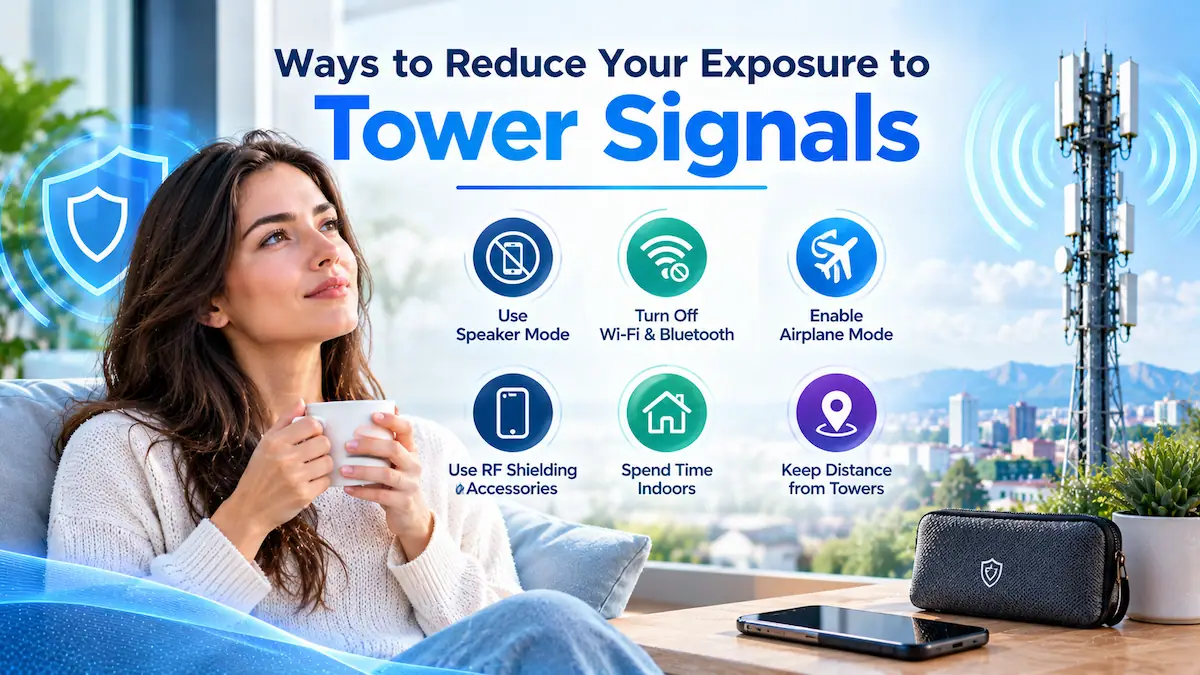
You can lower the strength of tower signals reaching you by increasing distance, choosing rooms and positions away from the antenna’s direction, and using materials that attenuate radio-frequency energy. These steps are optional, because measured exposure near towers is typically far below limits. For a full room-by-room approach, see our guide how to reduce RF exposure at home.
 Distance and orientation
Distance is the most reliable lever, because signal strength falls quickly as you move away from an antenna. Direction matters as much as distance. A room facing an antenna at a similar height typically receives more signal than one facing away, so consider moving a desk or bed from a window facing the tower to the far side of the room or to an interior room.
Buildings already reduce outdoor signals, and the amount depends on the materials. NHS England connectivity guidance notes that energy-efficient windows with a thin metallic coating typically attenuate 4G and 5G signals by 20 to 40 dB. A 20 dB loss cuts signal power to one hundredth, and 40 dB cuts it to one ten-thousandth. Heavy concrete and firewall construction can attenuate signals by 30 to 40 dB or more. Interior rooms, especially those with few windows, therefore tend to receive weaker tower signals. Real values vary with frequency, wall thickness, and openings, so treat these figures as a guide. Our guide to EMF blocking materials covers the options in more depth.
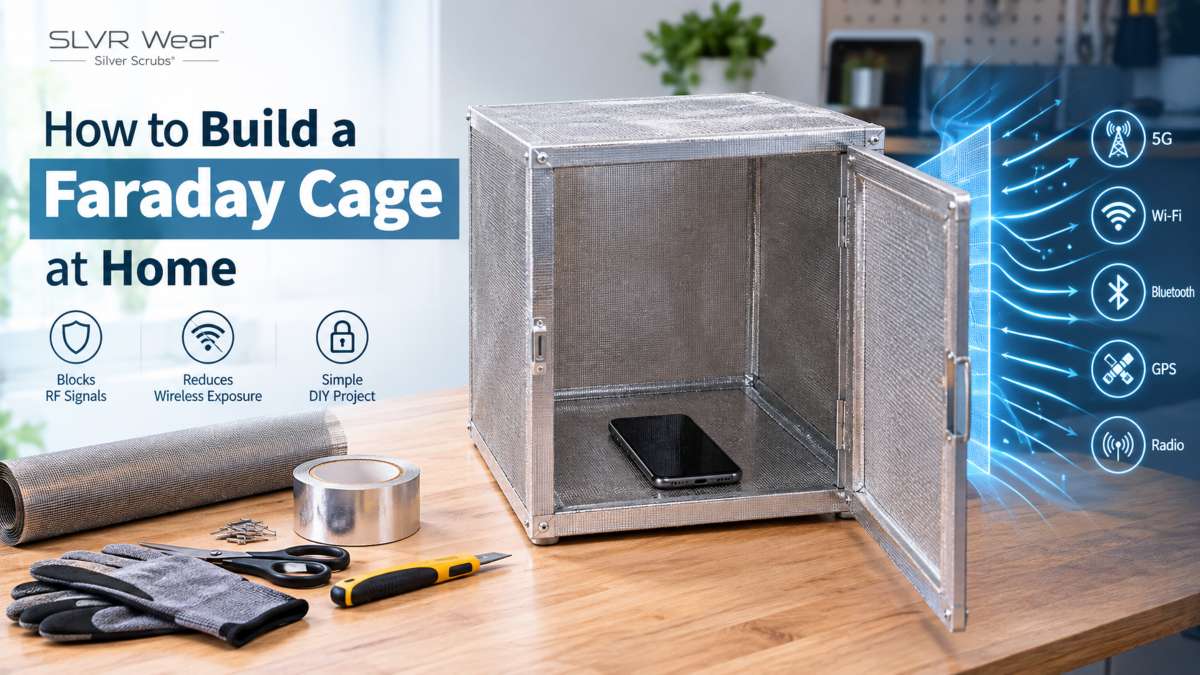
RF shielding fabric reduces the radio-frequency signal strength passing through it. Results vary by garment and product, and seams, openings, and gaps let signal through, so a whole garment performs worse than the fabric alone. RF protection fabric is not X-ray protection and is not for wear inside an MRI scanner during imaging. Treat it as one option alongside distance and placement. Read more about Faraday fabric, compare RF shielding methods, and see the lab results for what was tested. Shielding results apply to radio-frequency and wireless signals only.
If you decide an RF-blocking product suits your situation, here are your options. The Faraday phone pouch is for your phone. For a lap or a chair, there is the large RF shielding blanket or the extra-large version. The baby blanket is a soft shielding blanket for cuddles, laps, and supervised holding time with your little one.
For wear, we offer an RF protection beanie and an RF-blocking hat. MRI note: silver fibers are conductive, so remove the beanie or hat before entering an MRI scanner room. Hospital staff are surrounded by wireless monitors, mobile devices, hospital Wi-Fi, and nearby 5G and cell towers, so they can read our medical scrubs guide and our overview of RF exposure in hospitals.
This page draws on regulator documents, international health agencies, and peer-reviewed research. Exposure limits and health guidance can change, so check the original documents for the latest versions.
No. People cannot sense the radio-frequency energy levels found near towers. A review of provocation studies found no evidence that people who report sensitivity could detect real exposure better than anyone else. WHO says temperature increases from base-station exposure are insignificant. Signal bars show reception quality, not the energy reaching your body.
Current evidence does not show that it does. A WHO-commissioned 2024 systematic review found no association between exposure from fixed-site transmitters, including base stations, and childhood leukemia or pediatric brain tumor risk. Some researchers argue that long-term evidence is still limited, so studies continue.
Not by default. Both use the same type of non-ionizing radio-frequency energy, and exposure depends on power, antenna design, and your distance from the antenna.
It depends on the site. WHO describes base stations as continuously transmitting. Ofcom notes that results from one survey may not repeat on another date. A single reading is a snapshot, so look at a regulator’s audit or an operator’s compliance report for the site.
Start with your national regulator or the mobile operator, since some regulators publish site information. For example, Ofcom publishes measurement audits of base-station sites across the UK. Not every antenna sits on a free-standing tower, so the operator is the best source for a specific site.
No. Nuclear sources emit ionizing radiation, which can damage atoms and DNA. Towers emit non-ionizing radio-frequency energy, which does not.