What Is RF Radiation? Frequency, Risks and Exposure
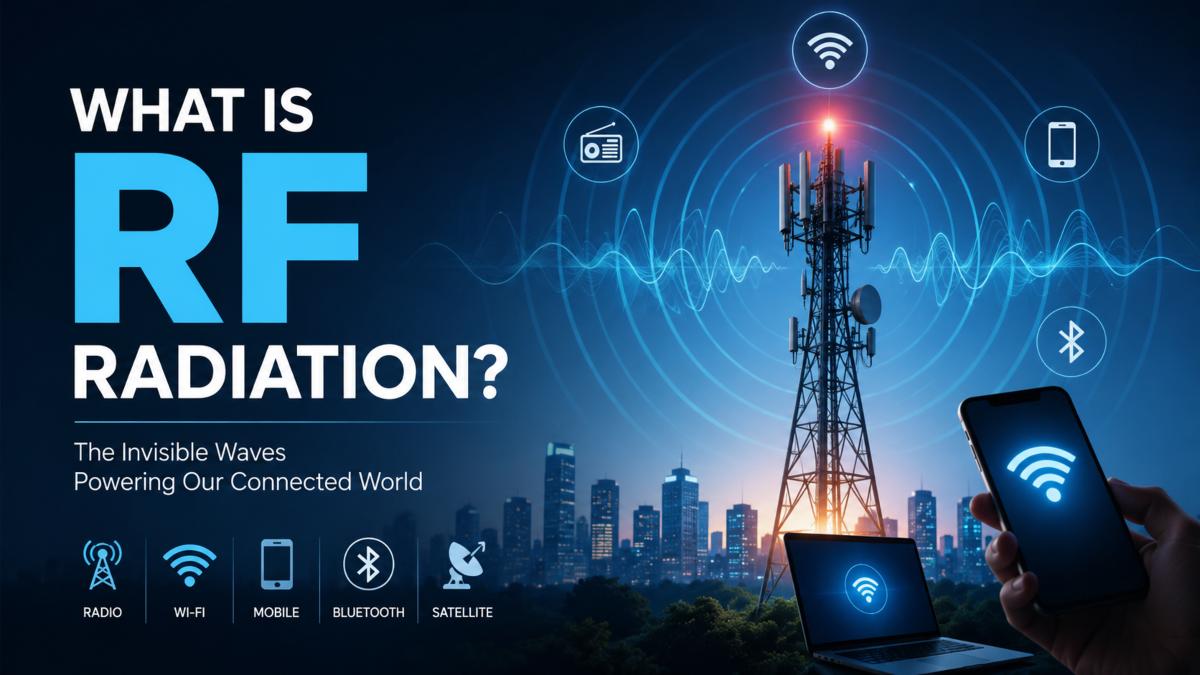
RF radiation is electromagnetic energy that travels in waves, spanning roughly 3 kilohertz to 300 gigahertz the band the FCC…
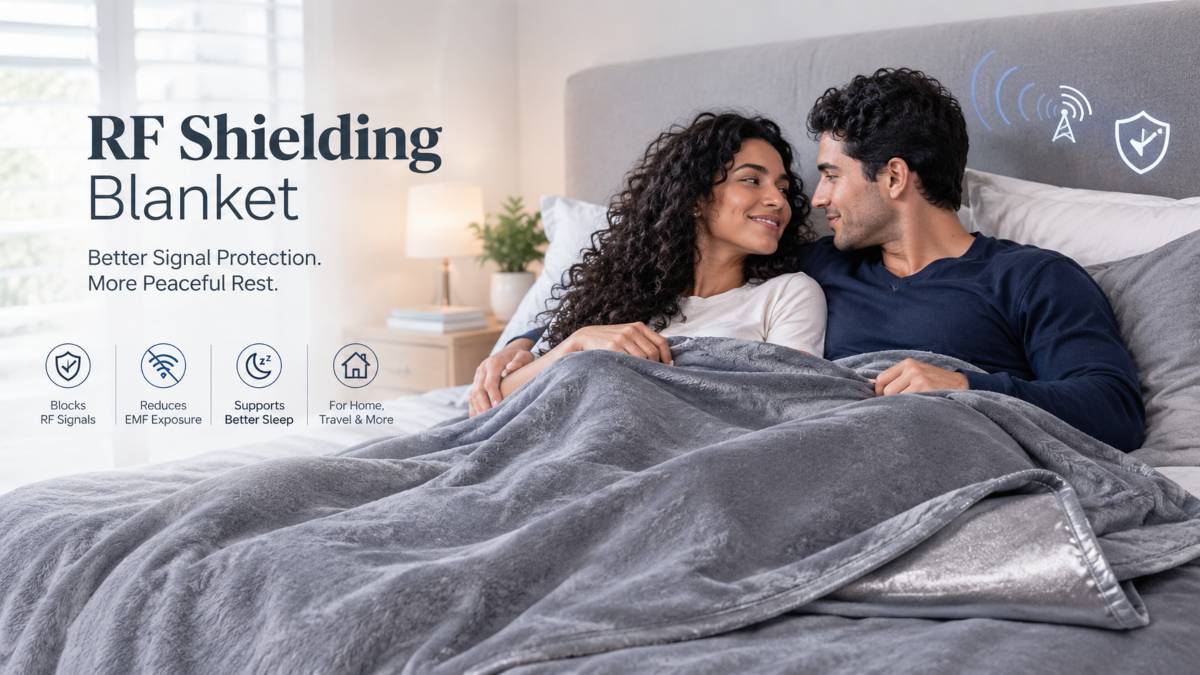
An RF shielding blanket is a fabric barrier woven with conductive material usually silver, copper, or nickel fibre that blocks or significantly reduces radiofrequency (RF) signals from passing through it. People reach for one when they want a physical break from wireless signal exposure: over a laptop while it’s on their lap, draped over a crib, or laid across a bed at night. The principle behind it isn’t new or exotic it’s the same Faraday fabric logic used in MRI suites and RF-shielded test labs, just built into something soft enough to sleep under.
It’s one type in a broader category of RF blockers, and what varies from one blanket to the next is how much signal it actually attenuates, which comes down to the conductive material used, the weave density, and how the blanket is constructed not just the label on the package.
An RF shielding blanket uses conductive fabric (silver, copper, or nickel fiber) to block or reduce RF signal exposure. It works on the same Faraday cage principle used in MRI rooms and RF test labs. Effectiveness depends on material and construction not all “RF blankets” shield equally, so material and attenuation rating matter more than marketing claims.
An RF shielding blanket is a blanket with a conductive layer typically silver-, copper-, or nickel-coated fibres woven into or laminated onto the fabric that intercepts radiofrequency signals before they pass through.
The conductive threads form a continuous mesh across the material, and when RF waves hit that mesh, they’re reflected or absorbed rather than transmitted through to the other side. This is the same shielding principle engineers use in RF-isolated test chambers, just scaled down into something you can throw over a bed or a stroller.
Shielding performance is measured in decibels (dB) of attenuation, and the relationship is straightforward. Every 10dB of attenuation blocks roughly 90% of signal strength, so a blanket rated at 20dB is cutting signal exposure by about 99%. That’s the number that actually separates a functional RF shielding blanket from a fabric that’s marketed as one.
Yes, “RF blanket,” “RF blankets,” and “RF blocking blanket” all refer to the same category of product, and the terms get used interchangeably across search and retail listings. There’s no technical distinction between them; the difference is purely in phrasing, not function. What actually separates one product from another isn’t the name used to describe it, but the conductive material and weave density behind it, which is what determines the attenuation rating discussed above.
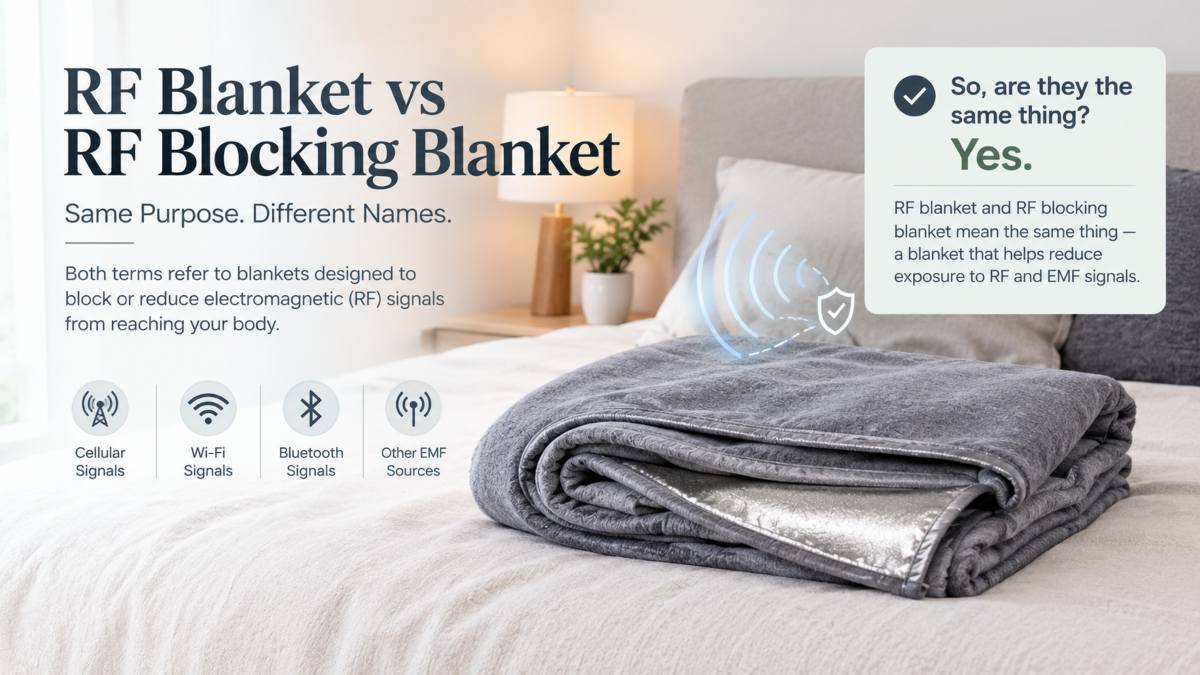 RF Shielding vs EMF Radiation Blankets Getting the Terminology Right
“RF shielding” and “EMF blocking” are often used interchangeably, but the terminology matters. RF (radiofrequency) refers specifically to the non-ionizing wireless signals emitted by phones, Wi-Fi routers, and similar devices it’s this category that shielding fabric is actually built and tested to attenuate.
“EMF” is a broader term that spans everything from RF signals to power-line frequencies to ionizing radiation, and using it loosely can create the impression that a shielding blanket protects against exposure categories it was never designed to address. When you see a product labelled a “radiation blanket for EMF,” it’s worth checking what frequency range it’s actually rated to shiel that detail tells you what the blanket does, not the umbrella term on the packaging.
An RF shielding blanket works by using a layer of conductive material to reflect and absorb radiofrequency waves before they can pass through the fabric, the same way a metal enclosure blocks a signal. It’s a physical barrier, not a filter or a software fix the shielding either intercepts the wave or it doesn’t, depending on the material and how completely it covers the source.
The shielding effect comes from metal fibres usually silver, copper, or nickel woven directly into the fabric or bonded onto it as a mesh layer. When an RF wave reaches this conductive mesh, the free electrons in the metal respond to the wave’s electromagnetic field and generate an opposing field of their own, which cancels out most of the incoming signal instead of letting it pass through.
This is why fiber type and weave density matter more than thickness or weight: a densely woven silver mesh with small gaps between threads will attenuate signal far more effectively than a loosely woven blanket with the same fabric on the label, because RF waves can pass through any gap larger than their wavelength. It’s a similar principle to why aluminum foil can block EMF in a pinch the holes in the conductive layer just need to be smaller than the wavelength trying to get through.
No RF shielding blanket blocks signal completely what it reduces signal strength by a measurable amount, expressed in decibels of attenuation. A blanket rated at 20dB is cutting incoming signal by about 99%, and one rated at 30dB pushes that closer to 99.9%.
Still, neither is creating a true zero-signal environment, since decibels work on a logarithmic scale where each additional 10dB represents another roughly 90% reduction rather than a hard cutoff. Coverage matters as much as the rating itself: a blanket only shields the area it physically covers, so a phone left half-exposed at the blanket’s edge still receives a usable signal, no matter how high the fabric’s dB rating is.
This is the same reason no blanket can compensate for other exposure sources in the room a nearby power line, for instance, isn’t affected by a blanket on the bed at all. Understanding attenuation this way is the difference between judging a blanket by its marketing claims and judging it by what it can actually deliver.
Yes, RF shielding blankets work when they’re made with genuine conductive fibre and used correctly but “working” means measurably reducing signal strength, not eliminating it. This confusion usually comes from unclear expectations about what a fabric barrier can realistically do versus what marketing language implies.
 What They Reliably Block vs What They Don’t
A properly constructed RF shielding blanket reliably attenuates the RF signals it’s designed for Wi-Fi, Bluetooth, and cellular frequencies, including signals from a nearby phone when the conductive mesh fully covers the source and has no significant gaps. This is measurable: a blanket independently tested at 30dB of attenuation is cutting signal strength by roughly 99.9%, and that reduction happens consistently as long as the material stays intact.
What it doesn’t do is block signal from a device sitting outside the blanket’s coverage, or from a source on the same side of the fabric as the receiver shielding only works on waves that actually have to pass through the mesh to reach their destination.
It also won’t hold up to damage: a tear, a worn patch, or a seam where the conductive layer doesn’t connect fully creates a gap large enough for RF waves to pass through unimpeded, which is why the fabric’s condition matters as much as its original rating.
The honest limitation of any RF shielding blanket is that it protects a specific physical are not a person or a room. Wrapping a laptop or draping a blanket over a crib reduces exposure from whatever’s underneath or wrapped inside it. Still, it does nothing about RF sources elsewhere in the room, and it can’t compensate for a phone left uncovered next to the blanket’s edge.
Anyone looking for broader coverage typically needs to combine a blanket with other steps see how to reduce EMF exposure in your home for the fuller picture. No independent, standard used testing body verifies every blanket sold under this label, so attenuation claims vary in reliability from one manufacturer to the next a rated dB figure backed by third-party lab testing is a meaningfully different claim than a number printed on packaging with no testing disclosed. Used with those limitations in mind, an RF shielding blanket is a targeted tool for reducing exposure in one specific spot, not a way to eliminate RF signal exposure.
RF shielding blankets come in a few distinct sizes and constructions, each built around a specific use case rather than a one-size-fits-all design. The core shielding material is usually the same across all of them the differences come down to size, weight, and how the blanket is meant to be positioned.
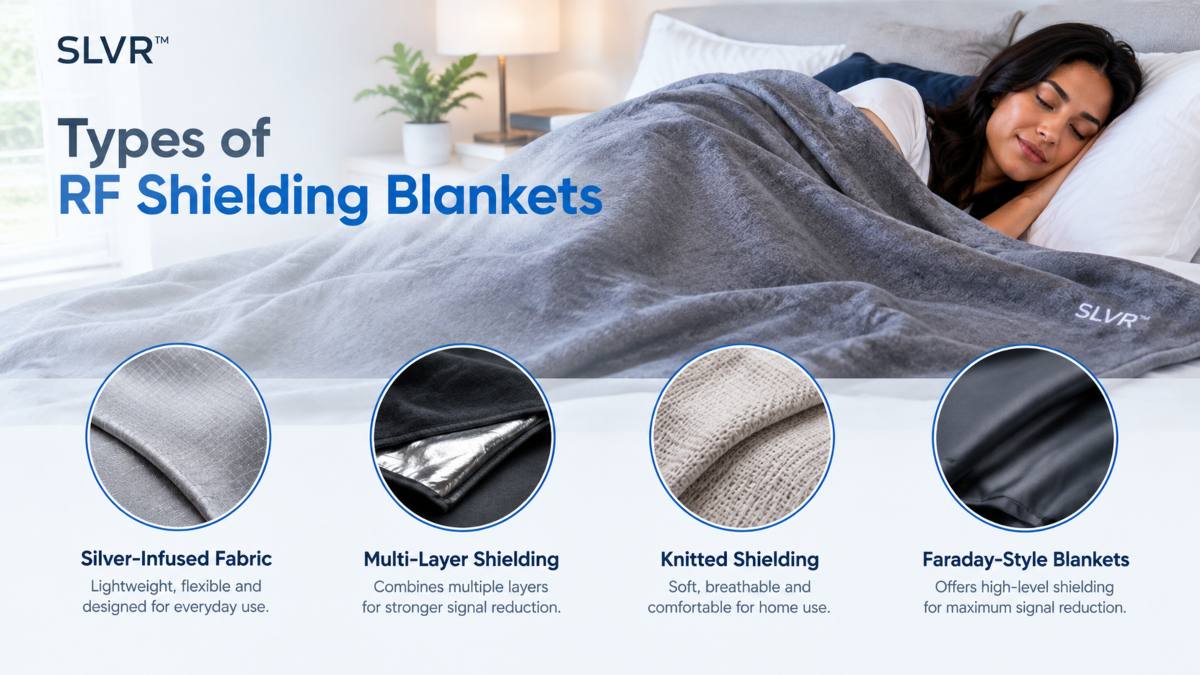 Baby & Nursery Blankets
Baby and nursery RF shielding blankets, like the SLVR Wear signal shielding baby blanket, are sized to drape over a crib, bassinet, or car seat, and they’re typically made from a lighter, softer conductive fabric than larger blankets since they need to stay breathable in close, low-airflow spaces.
Coverage is the main variable to check: a blanket that only covers the top of a crib leaves the sides exposed, so the shielding reduces signal only from directly overhead, not from a router or phone sitting at mattress level. Because these blankets sit close to a sleeping infant, weave density and breathability matter as much as the attenuation rating a tightly woven mesh that traps heat isn’t a practical trade-off, no matter how well it shields.
Full-size RF shielding blankets sold as Signal Shielding Large Blanket or Signal Shielding extra large options depending on bed size are built to cover a mattress or drape over a bed frame, and they’re generally heavier and more densely woven than baby blankets since they’re meant to shield a larger, fixed area overnight.
The trade-off with this size is weight and breathability a blanket dense enough to hit a meaningful attenuation rating, often in the 20–30dB range, is also thicker and less breathable than a standard blanket, which is why most are designed as a top layer rather than a primary blanket for warmth.
Placement affects performance more than with any other type: a bed blanket only shields what it fully covers, so a phone left on a nightstand outside the blanket’s edge isn’t affected, even with a high dB rating.
Travel and laptop RF shielding blankets are the smallest and most portable version of the category, designed to sit across a lap or wrap around a device rather than cover a fixed surface. For phones specifically, a dedicated Faraday phone pouch often makes more sense than a blanket, since a pouch fully encloses the device rather than relying on loose coverage.
For laptop protection, coverage has to be more complete than with a larger blanket draped loosely over a bed, since the laptop is a concentrated RF source at close range Wi-Fi and cellular radios sitting inches from the body and gaps around the edges matter more given the shorter distance to the source. These blankets tend to prioritize a tighter, more consistent weave over size, since a small, fully-sealed piece of conductive fabric shields more effectively at close range than a larger one with loose edges.
RF shielding blankets are used in a handful of specific situations where someone wants to reduce signal exposure to a particular device, body area, or sleeping space laptop use, pregnancy, and nighttime sleep are the three most common. Each use case has its own coverage and material considerations that determine whether the blanket actually does what it’s meant to do.
Using an RF shielding blanket for laptop use means placing a conductive fabric barrier between the device and the body, typically across the lap, to reduce RF signal reaching the user from the laptop’s Wi-Fi and cellular radios.
Because the laptop sits only inches away, the blanket needs full, gap-free coverage underneath the device to be effective a blanket that only partially covers the laptop’s underside still lets signal pass through the uncovered portion.
Some people pair a blanket with device-level settings for extra reduction turning off 5G on an iPhone or checking whether airplane mode actually reduces EMF though those are separate from what the fabric itself is doing. This is one of the more straightforward use cases to evaluate, since the source (the laptop) and the shielding target (the user’s lap) are fixed and close together, making coverage gaps easy to spot and correct.
Some people choose to use an RF shielding blanket during pregnancy to reduce personal RF exposure as a precaution, draping it over the lap or abdomen when using a phone or laptop nearby.
It’s worth being direct here: there’s no established medical guidance stating that RF exposure from everyday devices at typical levels causes harm to a pregnancy, and an RF shielding blanket isn’t a medical device or a substitute for guidance from a healthcare provider it functions the same way in this context as it does in any other, reducing signal strength by its attenuation rating within the area it covers.
People who use one during pregnancy generally do so as a personal exposure-reduction preference rather than in response to a documented health risk. That distinction matters when deciding how much weight to give the choice.
 RF Blocking Blanket for Bed/Sleep
An RF blocking blanket for bed or sleep is typically draped over the mattress or top of the bed to reduce RF signal exposure overnight, when a person stays in one place for hours at a stretch.
This is one of the more practical applications of the category, since sleep is the one time of day when someone reliably stays within a blanket’s coverage area for an extended period, rather than moving in and out of range the way they might during the day.
As with any placement, the blanket only shields what it physically covers a phone charging on a nightstand outside the blanket’s edge, or a router on the other side of a wall, isn’t affected by even a well-rated blanket on the bed itself.
The best RF shielding blanket for a given situation comes down to three factors: the shielding material and its attenuation rating, the size relative to what you’re covering, and how comfortable it is to actually use. Getting the first factor right matters most, since a blanket with a weak or unverified rating won’t perform as expected, no matter how well it fits or feels.
The material determines how much signal a blanket actually blocks, and silver-fiber weaves generally outperform copper or nickel blends because silver has the highest electrical conductivity of the three, which translates directly into stronger attenuation at the same weave density.
Look for a specific dB rating from the manufacturer rather than vague language like “blocks EMF” a blanket rated at 20dB or higher cuts signal by at least 99%. In contrast, one with no disclosed rating makes it impossible to know what you’re actually getting. Third-party lab testing, where available, is a stronger signal of real performance than an in-house number, since it removes the incentive to round a rating up.
Size should match the specific use case rather than be chosen by default a laptop blanket that’s too small to fully cover the underside of the device, or a bed blanket that doesn’t reach the mattress edges, will leave gaps that let signal through regardless of the fabric’s rating. The rule of thumb is to size up slightly for the intended coverage area: a few extra inches of overhang costs little in comfort but meaningfully reduces the chance of an exposed edge undermining the shielding.
A shielding blanket only works if you actually use it, so comfort and practicality matter as much as the technical specs. Denser weaves that maximize attenuation tend to trap more heat and breathe less, a real trade-off for anything used for extended periods, like sleep. Washability also varies significantly some conductive fibers degrade with repeated machine washing, which gradually lowers the blanket’s shielding performance over time, so checking the manufacturer’s care instructions before buying protects the investment as much as checking the dB rating does.
| Use Case | Typical Material | Typical Size | Attenuation Range |
|---|---|---|---|
| Laptop/Travel | Silver-fiber mesh | Lap-sized, compact | 20–30 dB |
| Baby/Nursery | Lightweight silver or nickel blend | Crib/bassinet-sized | 15–25 dB |
| Full-Size Bed | Denser silver-fiber weave | Mattress/bed-sized | 20–30 dB |
The most common mistake with an RF shielding blanket is assuming coverage equals protection leaving edges exposed, gaps where the fabric doesn’t fully wrap the source, or devices sitting just outside the blanket’s boundary all undermine even a high-rated blanket, since shielding only works on signal that has to pass through the mesh to reach its target.
A close second is buying based on marketing language rather than a disclosed dB rating: terms like “blocks EMF” or “radiation-free” say nothing about actual attenuation, and a blanket with no verifiable rating could be performing anywhere from negligibly to genuinely well, with no way to tell which from the label alone.
People also tend to overlook wear and washing as performance factors a blanket that’s been through dozens of wash cycles, or one with a worn seam where the conductive layer no longer connects fully, can lose a meaningful chunk of its original attenuation without any visible sign. Finally, avoid assuming a shielding blanket eliminates RF exposure: it reduces signal strength within the area it covers by a specific, measurable amount, and treating it as anything more sets up the wrong expectations for what the product can deliver.
An RF shielding blanket is a straightforward tool with a specific job: reducing RF signal exposure within the exact area it covers, using conductive fiber that can cut signal strength by 99% or more at a 20dB rating or higher. It won’t eliminate RF exposure, and it only works as well as its material, coverage, and condition allow but for someone looking to reduce exposure during sleep, laptop use, or around a nursery, that’s the kind of targeted, measurable reduction it’s built to deliver.
The practical next step is choosing a blanket sized correctly for the intended use, with a disclosed attenuation rating rather than vague marketing language, since that one detail determines whether the blanket performs as expected or simply looks the part.
Beyond blankets, SLVR Wear’s signal-shielding line also includes a beanie, a hat, and a full range of signal shielding scrubs for anyone looking to extend the same shielding principle beyond the bed or the lap.
An RF shielding blanket is a blanket made with conductive fibres typically silver, copper, or nickel woven into the fabric to block or reduce radiofrequency signals from passing through it. It works on the same principle as a Faraday cage, forming a mesh that reflects or absorbs RF waves rather than letting them transmit through to the other side.
It uses a conductive mesh layer to intercept incoming RF waves, generating an opposing electromagnetic field that cancels most of the signal before it passes through the fabric. Effectiveness is measured in decibels (dB) of attenuation, and it depends heavily on weave density a tightly woven mesh blocks meaningfully more signal than a loosely woven one made from the same material.
Yes, when they’re made with genuine conductive fibre and used with full coverage over the source, RF shielding blankets measurably reduce RF signal strength a blanket rated at 30dB, for example, cuts signal by roughly 99.9%. They don’t block the signal completely, and they only shield the area they physically cover, so a device or body part left outside the blanket’s edge isn’t protected, regardless of the fabric’s rating.
An RF shielding blanket is not a medical device, and no established medical guidance says RF exposure from everyday devices at typical levels poses a pregnancy risk. People who use one during pregnancy generally do so as a personal exposure-reduction preference rather than following documented medical advice, and it works the same way for anyone else reducing signal strength within its coverage area, nothing more.
Yes, RF shielding blankets are commonly used with laptops by placing the blanket between the device and the body, usually across the lap, to reduce exposure from the laptop’s Wi-Fi and cellular radios. Because the laptop sits close to the body, full coverage underneath the device matters more here than with larger blankets any uncovered edge still allows signal through. For phone-specific protection instead, an iPhone-focused breakdown of RF exposure covers what a blanket does and doesn’t address.
Disclaimer: SLVR Wear ™ products are not medical devices and are not intended to diagnose, treat, cure, or prevent any disease.