RF Blockers Explained | What Actually Blocks Signal
An RF blocker is a material or product engineered to block radio-frequency signals from passing through it, typically using a…
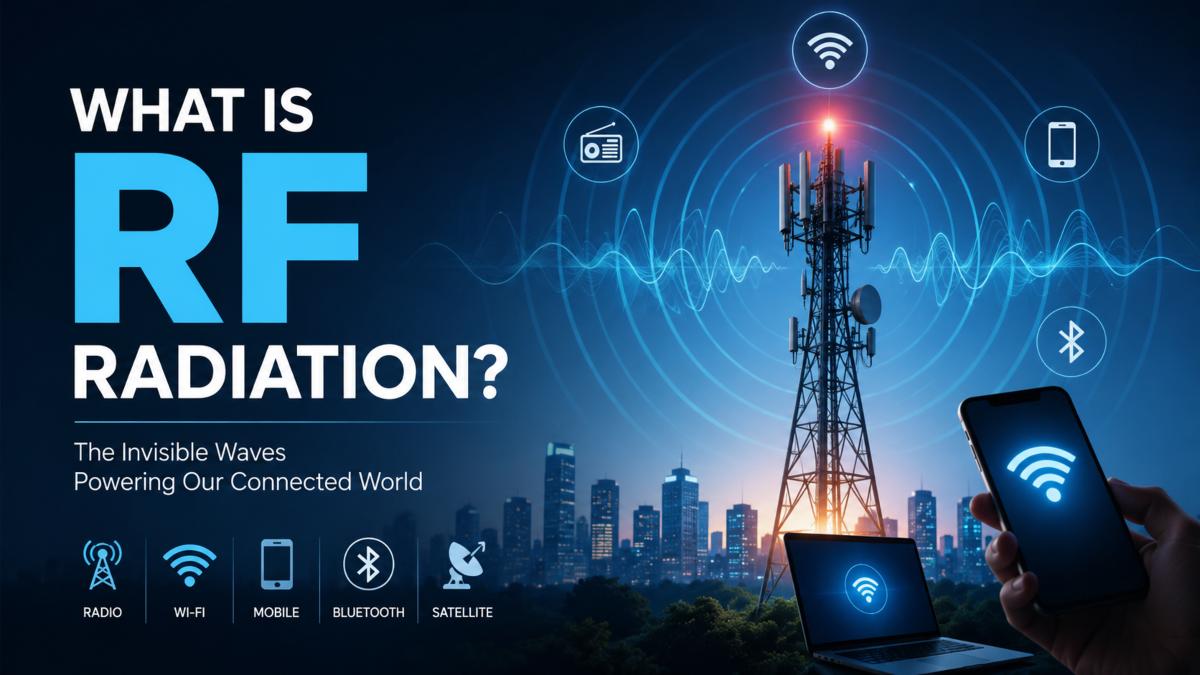
RF radiation is electromagnetic energy that travels in waves, spanning roughly 3 kilohertz to 300 gigahertz the band the FCC formally defines as the radio frequency portion of the spectrum. It sits below microwaves, infrared, visible light, and ultraviolet on the electromagnetic spectrum, distinguished by lower frequency and lower energy per wave. That lower energy is the detail most searches on this topic are really asking about, because it determines whether RF radiation can damage cells the way X-rays or gamma rays can. This page walks through what RF radiation is, how frequency and energy interact to define it, where it fits relative to other types of radiation, and what current safety research and exposure standards actually say.
RF radiation is the range of electromagnetic energy that oscillates between about 3 kilohertz and 300 gigahertz, the band the FCC formally designates as the radio frequency portion of the electromagnetic spectrum. It’s non-ionizing, meaning it doesn’t carry enough energy per photon to strip electrons from atoms or break molecular bonds the mechanism behind the cellular damage associated with X-rays and gamma rays. RF radiation exists naturally (the sun and other stars emit it). It is also generated deliberately by human technology, since its wave behavior makes it useful for carrying information over distance. It’s a subset of the broader category of EMF (electromagnetic fields), which also includes power-line and other low-frequency fields outside the RF range.
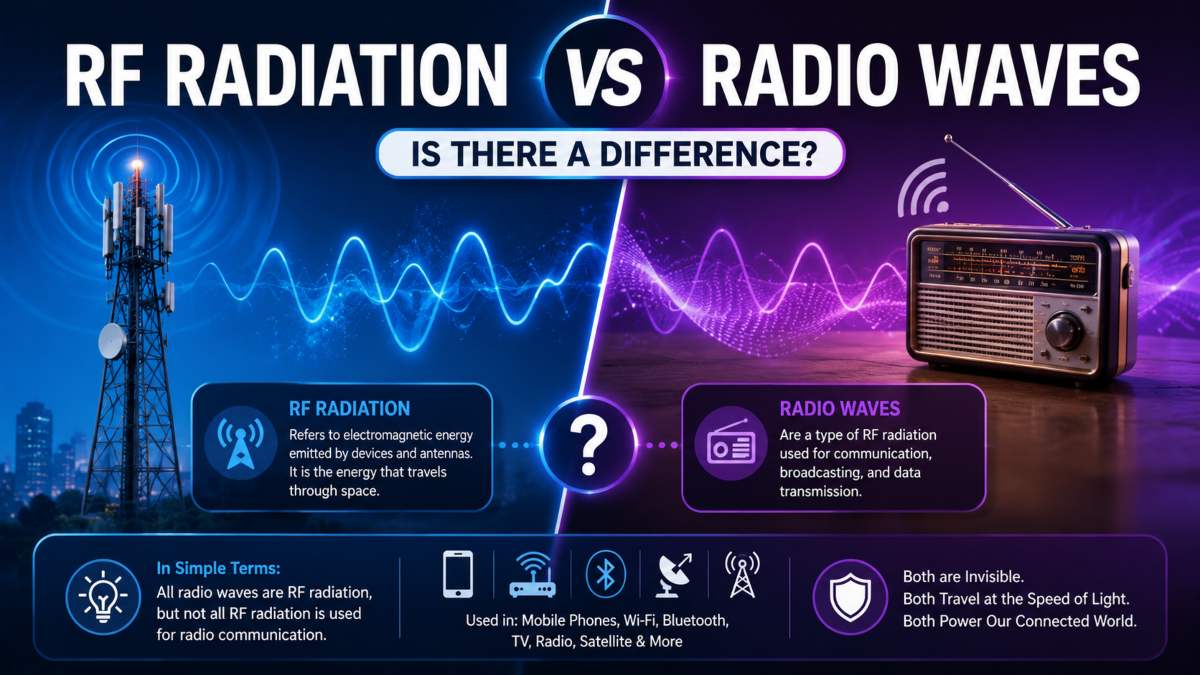
In practice, no “RF radiation” and “radio waves” describe the same physical phenomenon, just from two different angles. “Radio waves” is the term used when describing the wave itself: a form of electromagnetic radiation with a defined frequency and wavelength, propagating through space or air. “RF” (radio frequency) is the term used when describing the behavior or application of that same energy how it’s generated, transmitted, or measured in a device.
A Wi-Fi router, for example, is described as emitting RF energy when the focus is on signal strength or exposure, and as producing “radio waves” when the focus is on the physics of how the signal travels. The terms are used somewhat interchangeably in casual writing. Still, technically, RF refers to the frequency range itself, while radio waves are the physical form that energy takes within that range.
 How RF Radiation Is Measured (Hz, kHz, MHz, GHz)
RF radiation is measured in hertz (Hz), a unit that counts how many times a wave oscillates per second. One hertz equals one cycle per second a slow, low-frequency signal. Because RF frequencies run so high, they’re almost always expressed in larger units: kilohertz (kHz) for thousands of cycles per second, megahertz (MHz) for millions, and gigahertz (GHz) for billions.
A standard FM radio station, for comparison, broadcasts in the 88–108 MHz range, while most home Wi-Fi routers operate at 2.4 GHz or 5 GHz both comfortably inside the broader 3 kHz–300 GHz band that defines RF radiation as a whole. The higher the frequency, the more energy the wave carries and the shorter its wavelength, a relationship that becomes important in the next section when comparing RF radiation to other parts of the spectrum.
RF radiation follows a core physical relationship: the higher its frequency, the shorter its wavelength and the more energy it carries per wave. This relationship governs everything from how far a signal can travel to whether it can harm living tissue, which is why understanding it matters more than just memorizing the 3 kHz–300 GHz range that defines RF radiation as a category.
Frequency and wavelength move in opposite directions because they’re two ways of describing the same wave. Wavelength is the physical distance between one wave peak and the next; frequency is how many of those peaks pass a fixed point each second. Since all electromagnetic waves travel at the same speed the speed of light, roughly 300,000 kilometers per second a wave can only oscillate more times per second by making each wave shorter.
A low-frequency AM radio signal around 1 MHz has a wavelength of several hundred meters. In contrast, a high-frequency 5G signal in the tens of GHz has a wavelength measured in millimeters. This trade-off is fixed and predictable: multiply frequency by wavelength, and the answer is always the speed of light.
Every electromagnetic wave carries energy in direct proportion to its frequency, which means RF radiation sitting at the low-frequency end of the spectrum carries comparatively little energy per photon. The generally accepted threshold for ionizing radiation, the point at which a photon carries enough energy to strip electrons from atoms and break chemical bonds, is around 10 electron volts. RF radiation falls many orders of magnitude below that threshold, even at its highest frequencies near 300 GHz. That energy gap is the physical basis for classifying RF radiation as non-ionizing, a distinction covered in detail in the next section.
RF radiation occupies the lowest-frequency, lowest-energy end of the electromagnetic spectrum, placing it firmly in the non-ionizing category alongside microwaves, infrared, and visible light. Its position at the bottom of the spectrum below microwaves, infrared, visible light, and ultraviolet is what separates it physically from X-rays and gamma rays, the high-frequency radiation types capable of ionizing atoms and damaging DNA.
The electromagnetic spectrum splits into two broad categories based on one question: does a given wave carry enough energy to ionize an atom, meaning strip an electron from it and potentially break a chemical bond? Radiation that can do this X-rays, gamma rays, and the highest-energy end of ultraviolet light is classified as ionizing, and it’s this category that carries the cancer risk most people associate with the word “radiation.” Everything below that energy threshold, including RF radiation, microwaves, infrared, and visible light, is classified as non-ionizing.
The generally accepted dividing line sits around 10 electron volts of photon energy; RF radiation, even at its highest frequencies near 300 GHz, carries only a small fraction of that. Non-ionizing doesn’t mean an energy type has zero biological effect at high enough intensities heating tissue is a well-documented effect of sufficiently strong RF or microwave exposure but it does mean the mechanism behind ionizing-radiation damage, like breaking DNA bonds, isn’t physically possible at these energy levels.
| Radiation Type | Frequency Range | Approx. Wavelength | Ionizing? |
|---|---|---|---|
| RF radiation (radio waves) | ~3 kHz – 300 GHz | 1 mm – 100 km | No |
| Microwaves | ~300 MHz – 300 GHz | 1 mm – 1 m | No |
| Infrared | ~300 GHz – 400 THz | 700 nm – 1 mm | No |
| Visible light | ~400 – 790 THz | 380 – 700 nm | No |
| Ultraviolet | ~790 THz – 30 PHz | 10 – 380 nm | Partially (higher-energy UV only) |
| X-rays | ~30 PHz – 30 EHz | 0.01 – 10 nm | Yes |
| Gamma rays | Above ~30 EHz | Below 0.01 nm | Yes |
Read left to right, the table traces the same relationship covered earlier. As frequency climbs, wavelength shrinks and energy rises, until the spectrum crosses into ultraviolet and the radiation becomes capable of ionizing matter. RF radiation sits at the opposite end of that progression from X-rays and gamma rays, which is the physical reason the two are treated so differently in safety research and regulation.
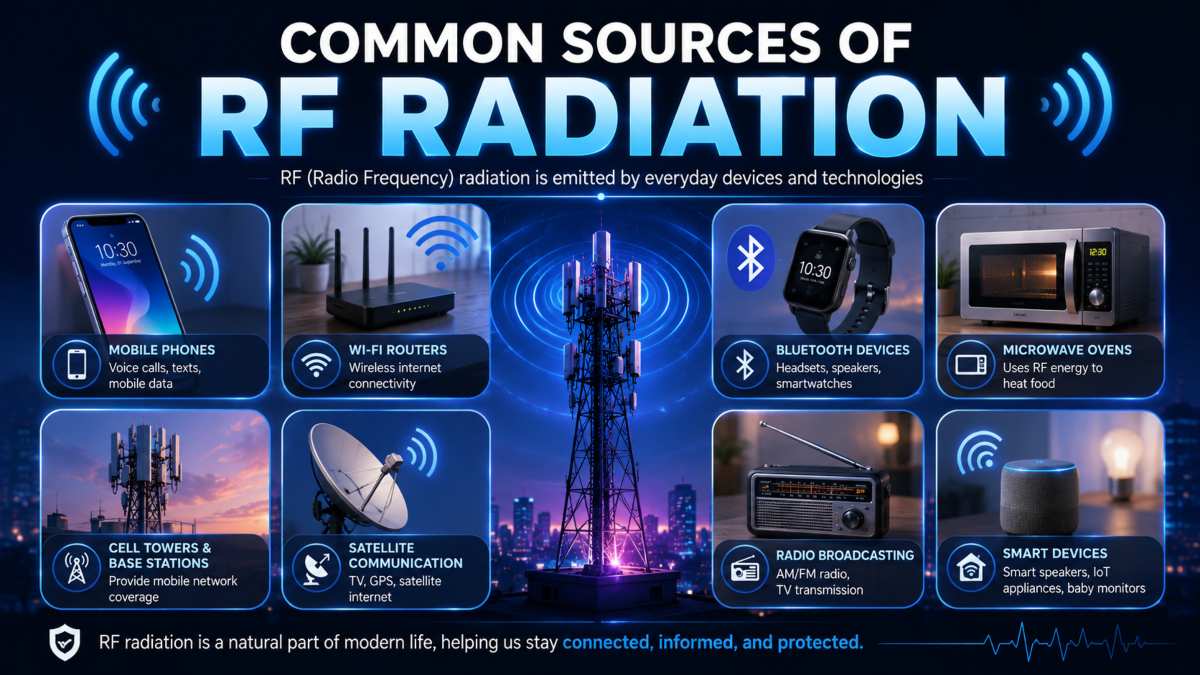
RF radiation reaches people through two broad channels: everyday wireless technology and naturally occurring sources that have existed long before any of it was invented. Nearly every wireless device in a modern home or pocket from a phone to a router to a set of Bluetooth earbuds operates by generating and receiving RF radiation deliberately, since it’s the only practical way to transmit information without a physical wire.
 Everyday Sources of RF Radiation
Cell phones are the most closely studied everyday source, largely because they’re held directly against the body during use; in the U.S., every phone sold must stay under the FCC’s public exposure limit of 1.6 watts per kilogram of absorbed energy, a threshold set with a substantial built-in safety margin. This is a common question for iPhone users specifically, since it’s one of the most widely used devices held against the body. Wi-Fi routers broadcast continuously in the 2.4 GHz and 5 GHz bands to maintain connections with nearby devices.
At the same time, Bluetooth accessories operate in the same 2.4 GHz range at much lower power, typically a fraction of that emitted by a phone or router. Cell towers transmit at higher power than any individual consumer device. Still, because exposure decreases sharply with distance, a person standing near a tower’s base is generally exposed to far less RF energy than someone holding a phone against their ear a distance principle similar to the one used for staying a safe distance from power lines. Microwave ovens use RF radiation too — specifically at 2.45 GHz though they’re shielded to contain that energy within the cooking chamber rather than emit it outward.
RF radiation isn’t a purely modern phenomenon; the sun, other stars, and even lightning all generate it naturally, and the earth’s atmosphere has always carried a low background level of RF energy from these sources. What’s changed is scale and proximity: natural RF radiation arrives diffusely from a distance, while man-made sources phones, routers, towers, radios, radar are engineered to concentrate RF energy for communication and are often used in close, sustained contact with the body. That combination of proximity and duration, rather than the existence of RF radiation itself, is what exposure research and safety standards are primarily built around; the next section covers this directly.
The short answer is that at the exposure levels covered by current safety limits, major regulatory and health research bodies have not established that RF radiation causes harm. However, they continue to actively monitor and study the question rather than treating it as fully closed. This is a case where “no proven harm at legal exposure levels” and “no ongoing research” are two different things, and the distinction matters for understanding where the science actually stands.
The World Health Organization’s International Agency for Research on Cancer (IARC) classified radiofrequency electromagnetic fields as “possibly carcinogenic to humans” (Group 2B) in 2011, a classification based on limited epidemiological evidence linking heavy, long-term cell phone use to an increased risk of glioma, a type of brain tumor. Group 2B is IARC’s weaker classification tier, reserved for cases where evidence exists. Still, it isn’t strong enough to establish a causal link the same category that includes substances like gasoline exhaust and pickled vegetables.
The FCC & the National Cancer Institute (NCI) both maintain that, as of their most recent public guidance, the scientific evidence has not demonstrated that RF radiation exposure below current federal safety limits causes cancer or other adverse health effects in humans, while noting that research is ongoing. ICNIRP (the International Commission on Non-Ionizing Radiation Protection), whose guidelines inform exposure limits used internationally, similarly bases its published limits on established thermal effects tissue heating from RF energy absorption rather than on the cancer question raised by the IARC classification.
The 2B classification itself was a call for continued research, not a final verdict, and IARC has since begun a re-evaluation of that 2011 finding as newer studies have accumulated.
Researchers and standards bodies are actively working through several open questions: whether risk differs for children, whose developing tissue and smaller head size may absorb RF energy differently than adults; whether risk also differs during other sensitive life stages, such as EMF exposure during pregnancy; whether decades-long, heavy cell phone use carries risks that shorter observation windows in early studies couldn’t capture; and whether non-thermal biological effects changes that don’t involve measurable tissue heating exist at low exposure levels, a question current exposure standards don’t fully address because they’re built around thermal effects specifically.
None of this means the evidence currently points toward harm at legal exposure levels; it means the research bodies responsible for setting those levels haven’t declared the question closed.
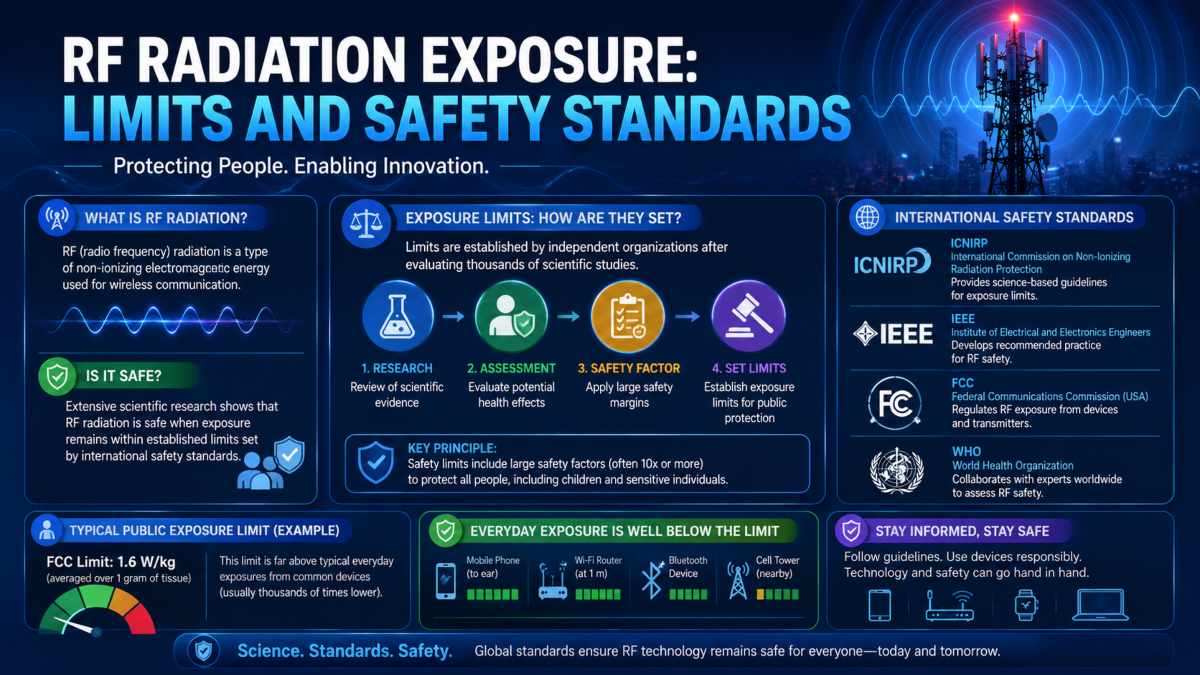
RF radiation exposure limits are set by regulatory bodies based on the point at which RF energy could cause measurable tissue heating, with a substantial safety margin built in below that threshold. In the U.S., the FCC enforces these limits; internationally, most countries follow guidelines published by ICNIRP, the International Commission on Non-Ionizing Radiation Protection, and the two sets of standards are broadly aligned in their underlying approach even where specific numbers differ slightly by frequency band.
 How Exposure Limits Are Set
The core measurement behind most RF exposure limits is Specific Absorption Rate, or SAR the rate at which a body absorbs RF energy, expressed in watts per kilogram of tissue. The FCC’s public exposure limit for cell phones is set at 1.6 W/kg, and any phone sold in the U.S. must demonstrate compliance with that limit before it can go to market, with testing conducted at the device’s maximum power output rather than at typical use.
For devices operating above 6 GHz, including many newer 5G bands, the relevant limit shifts to power density rather than SAR, since the way higher-frequency energy interacts with the body differs from the way lower-frequency energy does. These limits aren’t calculated as the exact point where harm begins; they’re set well below the threshold at which measurable thermal effects have been observed in research, which is why the FCC and ICNIRP both describe their standards as incorporating a considerable safety margin.
In practice, day-to-day RF exposure from most sources is well below the regulatory limits designed for them, largely because the power density from an RF source drops sharply with distance. A published study measuring RF exposure near 5G small-cell base stations found that even at close range about 1.3 meters from the antenna under maximum simulated traffic load measured exposure reached at most 68% of the ICNIRP general-public limit, and typical exposure at greater distances was substantially lower than that worst-case figure.
Cell towers follow a similar pattern: the FCC notes that most urban and suburban cell sites operate at effective radiated power well under their maximum permitted levels, and normal ground-level exposure near a tower’s base is far below the levels that would approach federal limits. However, the same safe-distance principle used for power lines applies.
The exception tends to be personal devices used in direct, sustained contact with the body a phone held against the head during a long call operates closer to its tested maximum SAR than a router or tower ever does at typical living distances, which is part of why device-level exposure, rather than ambient exposure from infrastructure, is where most safety guidance and ongoing research is concentrated.
Reducing RF exposure mostly comes down to one variable: distance. Since power density from an RF source drops off sharply the farther a person is from it, small, no-cost changes in how devices are held, placed, and used account for most of the practical reduction available before any product or material enters the picture at all. A broader rundown of these habits, room by room, is covered in the “how to reduce EMF in your home” section.
Distance is the most effective lever available, and it costs nothing. Using speaker mode or wired headphones instead of holding a phone directly against the head during calls moves the device’s antenna and its point of peak SAR away from the body, often by several inches, which meaningfully reduces the RF energy the head absorbs during that call.
Keeping a phone out of a pants pocket or a laptop off the lap during active use, especially when either device is under heavier load like streaming or a video call, works on the same principle: those are moments when a device transmits at higher power, and a few extra inches of distance during that window matters more than it does during idle screen time. Some people also ask whether switching on airplane mode meaningfully reduces EMF exposure, or whether how to turn off 5G on iPhone makes a practical difference both are simple settings-level changes worth understanding.
Placing a Wi-Fi router in a common area rather than a bedroom and turning off Bluetooth or Wi-Fi on devices that aren’t actively in use further reduce the number of transmitting sources near the body throughout the day. None of these habits require buying anything they’re simply about how existing devices are used.
For people who want an additional layer of reduction beyond behavior changes, silver-fiber shielding fabric is one option that’s been lab-tested to attenuate wireless signal frequencies. Woven rather than coated onto the textile, this type of fabric sometimes referred to as Faraday fabric works by physically reflecting or absorbing RF energy before it reaches the body, the same principle used in signal-blocking phone pouches designed to fully isolate a device’s signal when needed.
People sometimes ask whether more familiar household materials, like aluminum foil or copper, offer similar shielding both can attenuate RF signals to a degree. Still, purpose-built shielding fabric is engineered for more consistent, wearable performance. This is one option among several not a replacement for the no-cost habits above, but a choice some people add on top of them, particularly for extended periods of use like sleep or long workdays, or for professions covered in guides like this complete guide to medical scrubs. Brands like SLVR Wear make RF-shielding apparel and accessories built around this approach, for anyone who wants to explore it further.
RF radiation is one of the lowest-energy, longest-wavelength types of radiation on the electromagnetic spectrum, and the table below lines it up against the other major types for a quick side-by-side comparison.
| Radiation Type | Frequency Range | Approx. Wavelength | Ionizing? | Common Source |
|---|---|---|---|---|
| RF radiation | ~3 kHz – 300 GHz | 1 mm – 100 km | No | Wi-Fi, cell phones, radio broadcast |
| Microwaves | ~300 MHz – 300 GHz | 1 mm – 1 m | No | Microwave ovens, radar, satellite links |
| Visible light | ~400 – 790 THz | 380 – 700 nm | No | Sunlight, household lighting |
| Ultraviolet | ~790 THz – 30 PHz | 10 – 380 nm | Partially (higher-energy UV only) | Sunlight, tanning devices |
| X-rays | ~30 PHz – 30 EHz | 0.01 – 10 nm | Yes | Medical imaging, security scanners |
| Gamma rays | Above ~30 EHz | Below 0.01 nm | Yes | Radioactive decay, nuclear reactions |
The pattern across the table is consistent: frequency rises, wavelength shrinks, and energy per wave climbs, until the spectrum crosses into ultraviolet and radiation becomes capable of ionizing atoms. RF radiation sits at the far end of that scale from X-rays and gamma rays lower frequency, longer wavelength, and, by a wide margin, less energy per wave.
Most of the confusion about RF radiation comes down to two overlapping myths: that it’s radioactive and that “radiation” is a single category of equal danger regardless of type. Both misunderstandings tend to conflate RF radiation with ionizing radiation emitted by radioactive materials, even though the two are physically distinct.
“RF radiation is radioactive.” It isn’t. Radioactivity refers specifically to unstable atomic nuclei releasing particles or high-energy radiation, such as alpha or beta particles and gamma rays, as they decay toward a more stable state a nuclear process. RF radiation is generated electrically, by oscillating current in an antenna or circuit, and involves no atomic decay or radioactive material whatsoever.
A Wi-Fi router or cell phone doesn’t contain, produce, or leave behind any radioactive substance; it simply generates an electromagnetic wave in the RF portion of the spectrum, the same physical category as an FM radio broadcast or a baby monitor.
“All radiation is equally dangerous.” This misconception does the most damage to public understanding because it treats “radiation” as a single hazard level rather than as a term that encompasses an enormous energy range. As the earlier comparison table shows, RF radiation lies at the low-energy end of the electromagnetic spectrum, well below the roughly 10-electron-volt threshold required to ionize atoms and break chemical bonds the mechanism behind the DNA damage associated with X-rays and gamma rays. Sunlight carries more energy per photon in its visible and ultraviolet ranges than RF radiation at any frequency.
Grouping RF radiation with nuclear radiation because both share the word “radiation” is a language problem, not a physics one the two behave, and are regulated, in fundamentally different ways.
No. Radioactivity arises from unstable atomic nuclei that release particles or high-energy radiation as they decay a nuclear process. RF radiation is generated electrically, through oscillating current in a device or antenna, and involves no radioactive material or atomic decay. It’s a form of non-ionizing electromagnetic energy, not a byproduct of radioactive decay.
The FCC defines the RF portion of the electromagnetic spectrum as roughly 3 kilohertz to 300 gigahertz. This range covers everything from AM and FM radio broadcasts at the lower end to Wi-Fi, Bluetooth, and 5G cellular signals toward the middle and upper end, all classified as non-ionizing radiation.
Major health and standards bodies, including the FCC and NCI, state that current scientific evidence has not established that RF exposure below federal safety limits causes cancer or other harm. The WHO’s IARC classified RF fields as “possibly carcinogenic” in 2011, a weaker evidence tier still under active research.
“RF” (radio frequency) refers specifically to one band of the electromagnetic spectrum. “EMF” (electromagnetic field) is a broad term encompassing electric and magnetic fields across many frequencies, including RF, power-line frequencies, and other bands outside the RF range.