Safe Distance From Power Lines for Homeowners
For most homes, a safe distance from power lines is generally considered to be 100 to 200 feet from large…
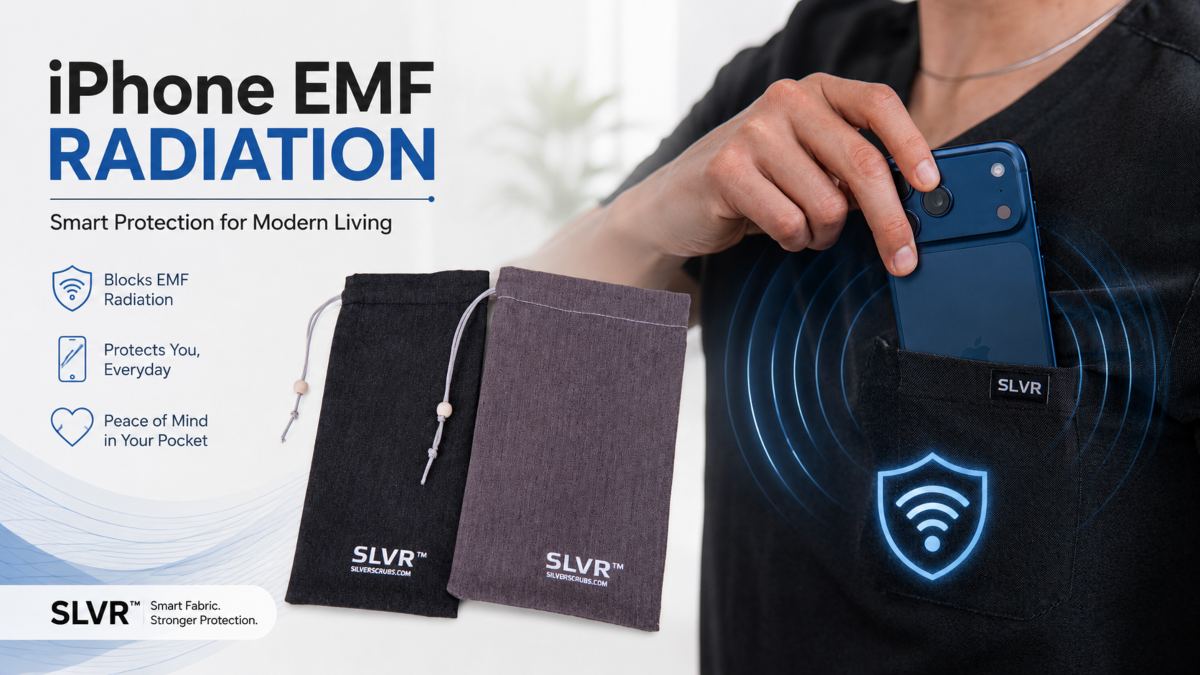
Every iPhone emits EMF radiation in the form of radiofrequency (RF) signals from its Wi-Fi, cellular, and Bluetooth antennas, and the exact amount varies by model based on antenna design and power output. This is measured using a Specific Absorption Rate (SAR) value, expressed in watts per kilogram (W/kg), which the FCC requires every phone sold in the U.S. to be tested and published before it reaches the market. iPhones are just one of many sources of EMF radiation in daily life, alongside Wi-Fi routers, smart appliances, and cell towers.
The FCC caps SAR at 1.6 W/kg for any device sold in the United States, and every iPhone from the iPhone 7 through the iPhone 17 falls under that limit though the actual value differs from one model to the next depending on antenna placement, 5G hardware, and case design. If you’ve ever searched “iPhone 15 emf” or “lowest emf iphone,” you’re likely trying to compare your specific model against others, or figure out whether newer 5G-enabled iPhones emit more than older ones.
This guide breaks down SAR levels by iPhone generation, shows you how to check your exact model’s rating and measure your iPhone EMF Radiation yourself, and walks through the available protection options including which are backed by lab testing and which are still unverified.
Yes, every iPhone emits EMF radiation specifically, radiofrequency (RF) energy, which is a form of non-ionizing electromagnetic radiation used to transmit data wirelessly. For a deeper breakdown of how this type of radiation works and how it differs from other kinds, see our guide on what EMF radiation actually is. This is the same category of energy used by radios, Wi-Fi routers, and Bluetooth speakers. It’s created any time the iPhone sends or receives a signal, whether that’s loading a webpage, receiving a text, or syncing with a smartwatch.
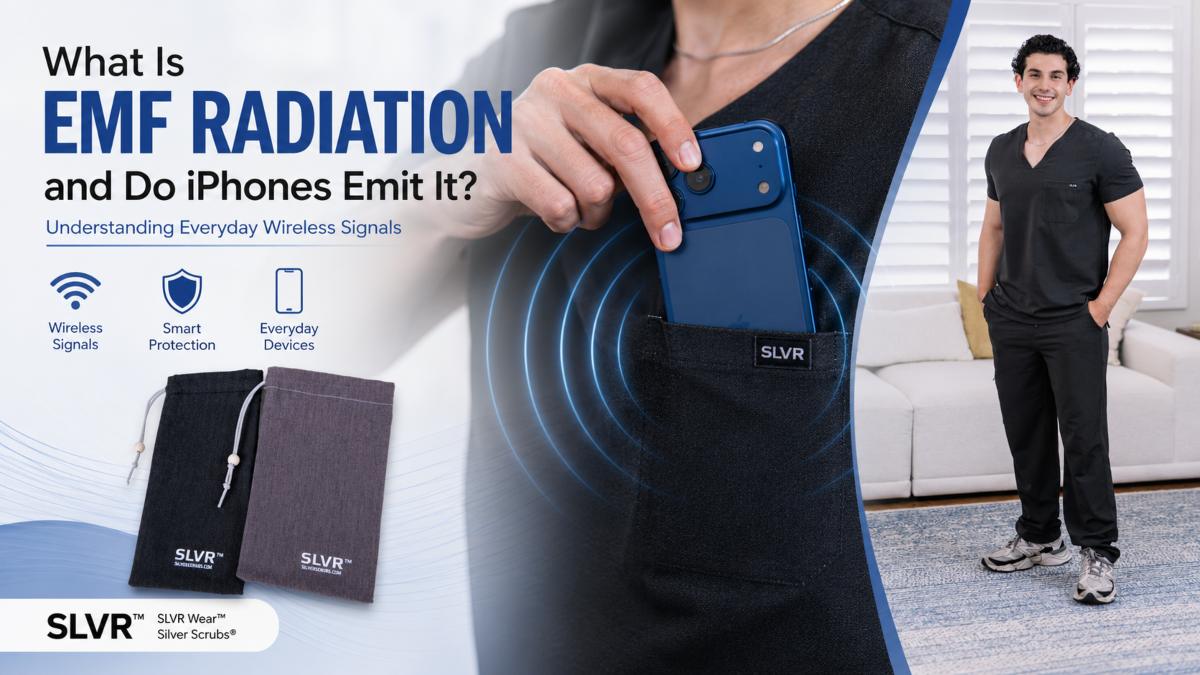 How iPhone Emit EMF Radiation(Wi-Fi, Cellular, Bluetooth)
An iPhone has multiple antennas operating simultaneously, each emitting EMF at a different frequency. The cellular antenna communicates with nearby cell towers and is generally the strongest emitter, since it needs to maintain a connection over long distances. If you want a closer look at how EMF from phones compares to other household devices, we cover that in detail separately.
The Wi-Fi antenna operates at a much shorter range and lower power, connecting to a router that’s typically just a few feet to a few hundred feet away. Bluetooth uses the lowest power output of the three and is designed for short-range connections, such as earbuds or a smartwatch. All three can be active simultaneously, which is why EMF output isn’t a single fixed number it shifts based on which radios are in use, signal strength, and how hard the phone is working to maintain a connection.
Every iPhone sold in the U.S. is tested and assigned a Specific Absorption Rate (SAR) value before it can legally reach the market. SAR measures how much RF energy the body absorbs from the device, expressed in watts per kilogram (W/kg), and the FCC sets a hard ceiling of 1.6 W/kg for any phone sold in the country. To understand how iPhone SAR values compare against general exposure guidelines, see our breakdown of safe EMF levels.
Apple publishes each iPhone model’s SAR rating in its RF exposure documentation, and testing is conducted at the device’s highest certified power level held close to the body a worst-case scenario meant to reflect maximum possible exposure rather than typical day-to-day use. This is why SAR is the standard reference point for comparing EMF output across iPhone models: it’s a regulated, third-party-verified figure rather than a marketing claim.
An iPhone emits EMF within a range set by FCC regulation, with SAR values for current and recent models typically falling between roughly 0.8 and 1.2 W/kg well under the legal limit of 1.6 W/kg. The exact figure depends on the specific model, since antenna design, 5G hardware, and internal component layout all shift how much RF energy the device outputs at peak power. For a wider look at what materials and methods actually interrupt this signal, see what blocks EMF radiation.
SAR is expressed in watts per kilogram because it measures a rate of energy absorption relative to body tissue, not a fixed amount of radiation. A higher SAR number means more RF energy is absorbed per kilogram of tissue at the point of contact, typically the head or body, depending on how the phone is tested and used. It’s important to understand that SAR is measured at a device’s highest transmission power the level it reaches when working hardest to maintain a signal, such as in a poor-reception area. In normal use, with a strong signal and Wi-Fi available, actual exposure is usually lower than the published SAR figure because the phone doesn’t need to transmit at full power.
Apple publishes SAR data for every iPhone model directly in its RF exposure documentation, accessible on the device itself via Settings > General > Legal & Regulatory > RF Exposure, or on Apple’s support site by searching the specific model name. The FCC also maintains a public database where any phone’s SAR rating can be looked up using its FCC ID, which is printed on the device’s regulatory documentation. Checking the official rating is the most reliable way to compare EMF output between models more reliable than third-party estimates, since it comes directly from the certified pre-market testing Apple is required to complete.
Every iPhone from the 7 through the 17 lineup carries a published SAR rating, and while the exact numbers shift slightly from generation to generation, all of them stay well under the FCC’s 1.6 W/kg limit typically clustering between roughly 1.0 and 1.2 W/kg. The differences between models come down to antenna placement and internal design changes rather than any dramatic shift in radiation output, so no single generation stands out as a major outlier in either direction.
| iPhone Model | Head SAR (W/kg) | Body SAR (W/kg) |
|---|---|---|
| iPhone 7 | 1.11 | 1.14 |
| iPhone 7 Plus | 1.09 | 1.10 |
| iPhone 8 | 1.14 | 1.08 |
| iPhone 8 Plus | 1.19 | 1.19 |
| iPhone 11 | 1.14 | 1.17 |
| iPhone 11 Pro | 1.16 | 1.18 |
| iPhone 12 | 1.17 | 1.19 |
| iPhone 12 Mini | 1.19 | 1.19 |
| iPhone 13 | 1.18 | 1.19 |
| iPhone 14 | 1.15 | 1.16 |
| iPhone 15 | 1.12 | 1.09 |
| iPhone 15 Pro | 1.14 | 1.16 |
| iPhone 16 | 1.08 | 1.17 |
| iPhone 16 Pro Max | 1.01 | 1.15 |
| iPhone 17 | 1.19 | 1.16 |
| iPhone 17 Pro | 1.19 | 1.19 |
Source: FCC-filed SAR test reports, compiled by everything RF.
iPhone 7–11 Series EMF Levels
The iPhone 7 through 11 Pro span the earliest 4G-only models through the first LTE-Advanced designs, and their SAR values sit in a tight band. Head SAR ranges from about 1.09 W/kg on the iPhone 7 Plus to 1.19 W/kg on the iPhone 8 Plus, with body SAR following a similar pattern between 1.08 and 1.19 W/kg. These models predate 5G hardware entirely, so their antenna systems are simpler than what came later fewer bands, no mmWave components though that doesn’t translate into a meaningfully lower SAR reading compared to newer models.
The iPhone 12 through 14 series introduced 5G connectivity, which added new antenna hardware without pushing SAR values outside the established range. If you’re curious how 5G specifically factors into overall exposure, we break it down in 5G EMF radiation explained. The iPhone 12 Mini reports the highest head and body SAR in this group at 1.19 W/kg each, while the iPhone 14 comes in lower at 1.15 W/kg head and 1.16 W/kg body. This matters because it shows that adding 5G capability didn’t require a tradeoff in RF exposure levels Apple’s antenna engineering kept every model in this generation within the same narrow band as its 4G-only predecessors.
The most recent generations show the widest internal spread of any group. The iPhone 16 Pro Max reports the lowest head SAR of any current iPhone at 1.01 W/kg, while the iPhone 17 and iPhone 17 Pro report 1.19 W/kg matching the highest values seen across the entire lineup. This jump between the 16 and 17 series reflects changes to the antenna and chip rather than a change in regulatory standards; all figures still fall comfortably under the 1.6 W/kg FCC ceiling.
Based on published FCC data, the iPhone 16 Pro Max has the lowest head SAR of any current-generation iPhone at 1.01 W/kg, with the standard iPhone 16 close behind at 1.08 W/kg. If body SAR is the priority instead relevant for anyone who carries their phone in a pocket the iPhone 15 reports the lowest figure at 1.09 W/kg. There isn’t a single iPhone that’s the lowest across every measurement type, since head and body SAR are tested separately and don’t always move in the same direction between models.
You can get a rough read on EMF exposure using an app that taps your iPhone’s built-in sensors, but for an accurate reading of ambient EMF including the signals coming from routers, appliances, and cell towers around you a dedicated EMF meter is the more reliable option. For a full walkthrough of tools and techniques, see our guide on how to measure EMF radiation at home. iPhones aren’t built with true EMF-detection hardware, so any app-based reading is an estimate rather than a lab-grade measurement.
EMF apps for iPhone generally work by repurposing the magnetometer the same sensor used by the Compass app to detect nearby magnetic field fluctuations. Some apps also reference your phone’s known SAR rating to estimate cellular and Wi-Fi exposure based on signal strength and usage. These apps are useful for a general sense of magnetic field activity near appliances, wiring, or electronics, and they’re a low-cost way to start paying attention to EMF in your daily environment. They’re not designed to detect radiofrequency (RF) radiation with precision, since that requires specialized antenna hardware an iPhone doesn’t have.
A dedicated EMF reader is purpose-built with calibrated sensors for magnetic fields, electric fields, and RF radiation three distinct types of EMF that a phone’s magnetometer alone can’t capture. This matters because RF is the category most closely associated with wireless devices such as routers and cell towers, and it requires an RF-specific antenna to measure accurately. A quality handheld meter typically reports in milligauss (mG) for magnetic fields or microwatts per square meter (µW/m²) for RF, giving a far more granular reading than an app’s simplified scale.
For anyone doing a serious home or workspace assessment, a dedicated reader is the standard tool professionals use, whereas an app is a better casual starting point. Once you’ve identified your biggest exposure points at home, our guide on how to reduce EMF in your home walks through practical next steps.
An iPhone’s magnetometer was engineered for compass accuracy, not EMF measurement, which means app readings can be affected by nearby metal objects, phone cases, or even the device’s internal components introducing noise that a dedicated meter is shielded against. Apps also can’t measure RF radiation directly, since that requires a separate antenna tuned to detect it, so any RF-related figure an app shows is typically calculated from public SAR data rather than a live sensor reading. This is why app-based EMF readings are best treated as a general awareness tool rather than a precise diagnostic useful for noticing patterns, but not a substitute for calibrated equipment when accuracy matters.
EMF protection for iPhones generally falls into three categories: passive add-ons like stickers and chips, physical barriers like screen protectors and sleeves, and signal-blocking Faraday pouches each works on a different principle and has very different levels of independent verification. For a broader comparison of protection methods beyond just phones, see “How to Block EMF.” Understanding how each one actually functions is the difference between an informed choice and a guess.
EMF stickers and chips are small adhesive or embedded devices marketed to counteract or neutralize radiofrequency exposure without physically blocking the signal. The core claim behind most of these products is difficult to verify independently, since RF radiation isn’t something a sticker can absorb, redirect, or cancel out through passive contact. There’s no publicly available third-party lab testing that confirms this category of product changes a phone’s actual SAR output or ambient RF levels. We go deeper into which EMF-blocking claims actually hold up in do EMF blockers work?
Unlike Faraday-based shielding, which is grounded in conductive-material physics that can be measured in a lab (attenuation in decibels, or percentage of signal blocked), sticker and chip products generally aren’t accompanied by that kind of testable data. Anyone comparing options should look specifically for a visible, third-party lab report before trusting a product’s protection claim.
EMF screen protectors and sleeves are designed to sit between the user and the device, typically using a thin conductive or metallic layer to interrupt some RF transmission at the point of contact. Screen protectors marketed for EMF reduction usually only cover the front face of the phone, which means they can’t address signals emitted from the back or sides of the device a real limitation, since iPhone antennas are distributed around the frame, not concentrated behind the screen.
Sleeves that wrap farther around the device offer more coverage. Still, the actual attenuation how much signal is blocked depends entirely on the conductive material used and its thickness, which vary significantly by manufacturer and aren’t always disclosed. For full-coverage options that extend beyond the phone itself, see our overview of EMF radiation protection clothing.
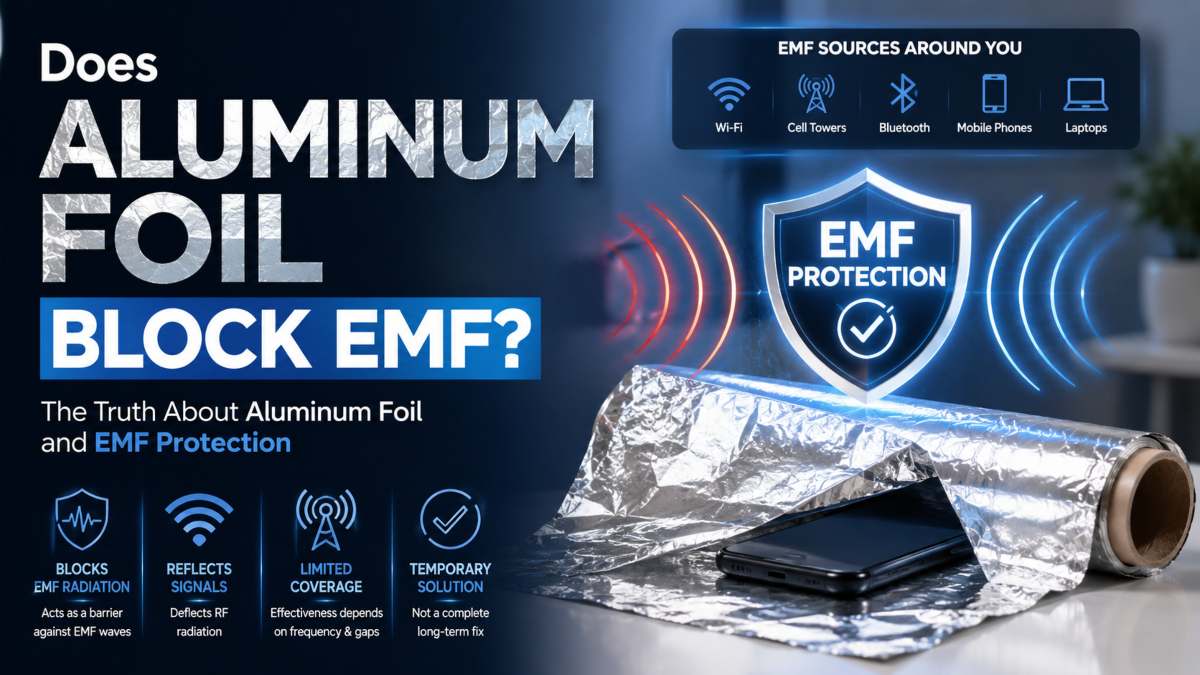
A Faraday pouch works by fully enclosing a phone in a conductive fabric typically a silver-fiber or metal-mesh weave that creates a barrier signals can’t pass through in either direction. This is based on the Faraday cage principle: when a continuous conductive layer surrounds a phone, incoming and outgoing wireless signals are blocked, which is why a phone inside a properly sealed Faraday pouch won’t receive calls, texts, or data.
For more on the physics behind this, see does a Faraday cage block EMF? The key factor in how well a pouch performs is full enclosure any gap, seam, or thin spot in the material creates a point where signal can still pass through, which is why testing at multiple frequency ranges (not just a single spot-check) is what separates a verified pouch from an unverified one. That same conductive-weave principle is what makes EMF blocking fabric effective across other products too, from phone pouches to full garments.
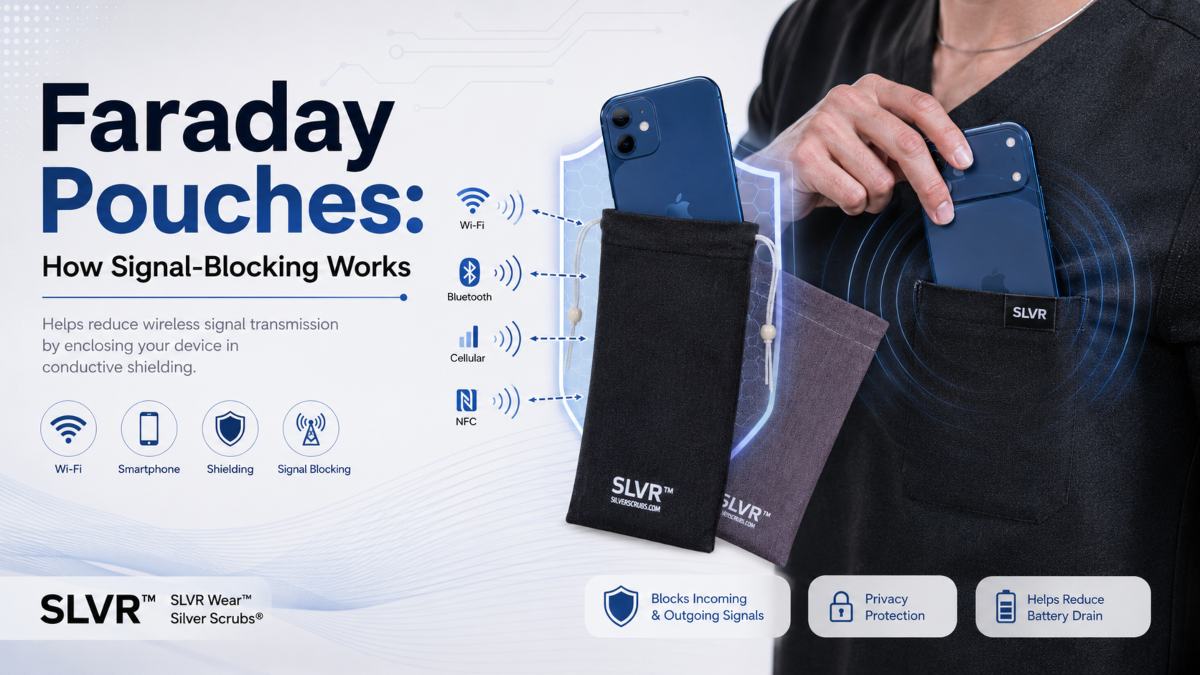 SLVR Wear ™ Faraday Phone Pouch: Tested EMF Protection
The SLVR Wear ™ Faraday Phone Pouch uses silver-fiber shielding fabric tested up to 20 GHz t to block wireless signals, giving iPhone users a fully enclosed option rather than a partial-coverage sticker or screen protector. Unlike unverified passive add-ons, the pouch’s shielding performance is grounded in lab testing at a defined frequency range the same conductive-fabric principle used in the Faraday cage section above, applied directly to a phone-sized enclosure.
The pouch is constructed from a silver-fiber woven EMF blocking material that fully encloses the phone, creating a continuous conductive barrier around the device. When an iPhone is placed inside and the pouch is sealed, incoming and outgoing wireless signals cellular, Wi-Fi, and Bluetooth are blocked by the surrounding conductive layer, the same principle covered earlier in the general explanation of how Faraday pouches work.
The fabric has been lab tested across a wide frequency range from 300 MHz up to 20 GHz, with shielding effectiveness holding above 99.9999% at every tested point. At the highest tested frequency of 20 GHz, the fabric still blocked 99.999915% of signal, confirming the pouch’s shielding doesn’t degrade meaningfully even at the upper end of its tested range.
The Faraday Phone Pouch is sized to fit iPhone models across the 7 through 17 lineup, since the shielding function depends on full enclosure rather than a model-specific fit. Because the pouch blocks signal by surrounding the entire device rather than targeting a specific antenna location, it works the same way regardless of which iPhone generation’s antenna layout is inside 4G-only models and current 5G models are shielded on the same principle. Fit is the main variable to check model to model, since newer iPhones vary slightly in size, but the shielding performance itself doesn’t change based on which model is inside.
A Faraday pouch addresses the device in your hand or pocket, but many people looking into iPhone EMF exposure are also weighing broader daily protection. SLVR Wear ™ line of EMF protective clothing uses the same silver-fiber shielding principle in wearable form.
For anyone on their feet all day near multiple wireless devices, our complete guide to medical scrubs covers how the shielding fabric performs in a healthcare setting, alongside details on the softest medical scrubs construction. The full scrub sets and individual pieces are available for both men and women.
You can also browse the full SilverScrubs®.
No, SAR values vary by model, generally ranging from about 1.01 to 1.19 W/kg for head exposure across the iPhone 7 through 17 lineup. The differences stem from antenna design and internal layout changes across generations, not from a consistent trend of newer models emitting more or less than older ones.
A higher SAR value means more RF energy is absorbed per kilogram of tissue at the device’s highest tested power level. Still, every iPhone model falls under the FCC’s 1.6 W/kg limit regardless of where it lands in that range. SAR is a regulatory compliance measurement taken under worst-case conditions, not a sliding scale of everyday risk real-world exposure depends heavily on signal strength and how the phone is used, not just the published number.
Yes, Airplane Mode turns off the iPhone’s cellular, Wi-Fi, and Bluetooth radios, which stops the device from transmitting or receiving the RF signals that make up its EMF output. As long as Wi-Fi and Bluetooth aren’t manually switched back on while Airplane Mode is enabled, the phone isn’t actively emitting RF radiation.
There’s no publicly available third-party lab testing that verifies EMF stickers or chips reduce or block a phone’s RF output. This is different from Faraday-based shielding, which relies on conductive-material physics that can be independently measured anyone evaluating a sticker or chip product should look for a visible lab report before trusting its claims.
The clearest test is functional: if a phone inside a sealed Faraday pouch stops receiving calls, texts, and data, the enclosure is blocking signal as intended. Beyond that simple check, a pouch’s shielding performance should be backed by lab testing at a defined frequency range full enclosure and tested attenuation are what separate a verified pouch from an unverified one.