What Is RF Radiation? Frequency, Risks and Exposure
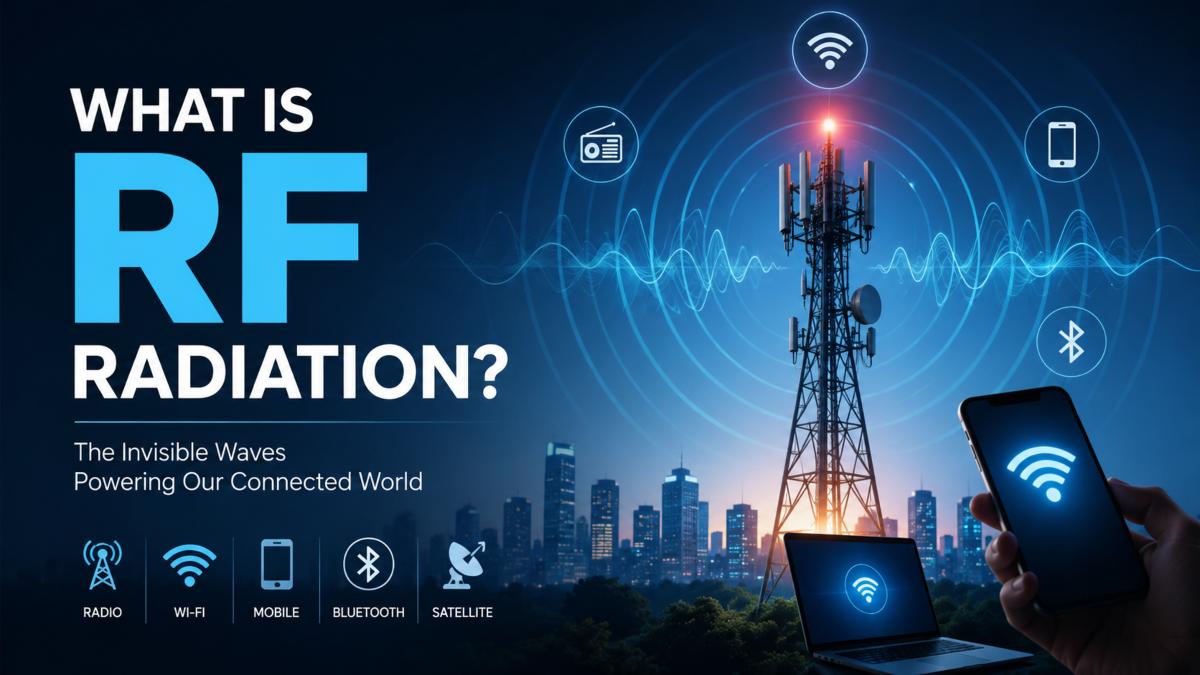
RF radiation is electromagnetic energy that travels in waves, spanning roughly 3 kilohertz to 300 gigahertz the band the FCC…
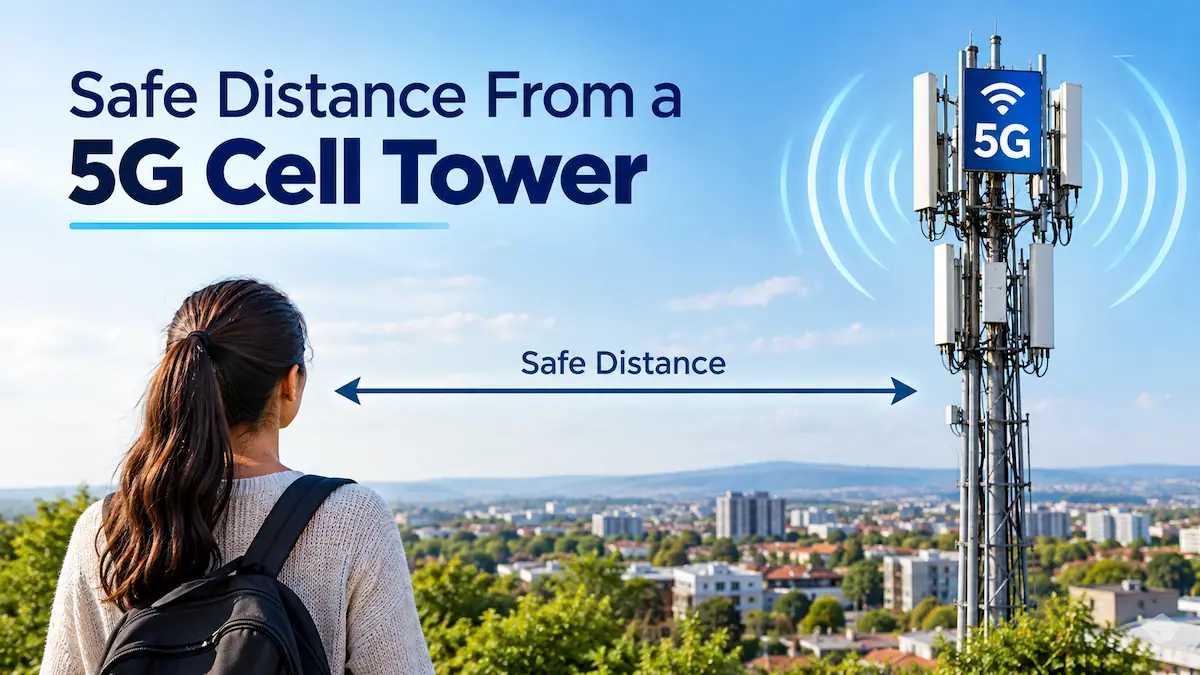
There is no single safe distance from a 5G cell tower, because exposure depends on antenna power, height, direction and frequency. Regulators set exposure limits, not limits on how far you can live from a tower. At street level, measured exposure from towers is typically a small fraction of those limits.
If a 5G tower or small cell is going up near your home or your child’s school, the useful question is not how many feet away is safe. It is how much radio-frequency RF radiation actually reaches you, and how that changes as you move away from the antenna. The FCC says its exposure limit for cell sites is many times greater than the RF levels typically found near base of a cell tower. That is why regulators check limits, not setbacks.
This guide covers cell towers and small cells. Power lines are a different source, covered in safe distance from power lines guidelines.
No fixed distance applies to every 5G tower. Federal rules ask whether exposure stays below a set limit anywhere the public can reach, and that depends on the specific antenna, not a universal number of feet.
In the United States, “safe” in this context means compliant. RF exposure anywhere the public can go must stay below the FCC’s Maximum Permissible Exposure limits, written into 47 CFR §1.1310. They are expressed as power density, not minimum distance, and are based on the thermal effects of RF energy in the body.
The FCC applies one set of limits to the general population and higher limits to people who have control over their exposure, such as tower workers. The general-population limit applies to your home, street and school. Compliance is a regulatory finding about those limits. It is not a statement about long-term health outcomes, which a later section covers.
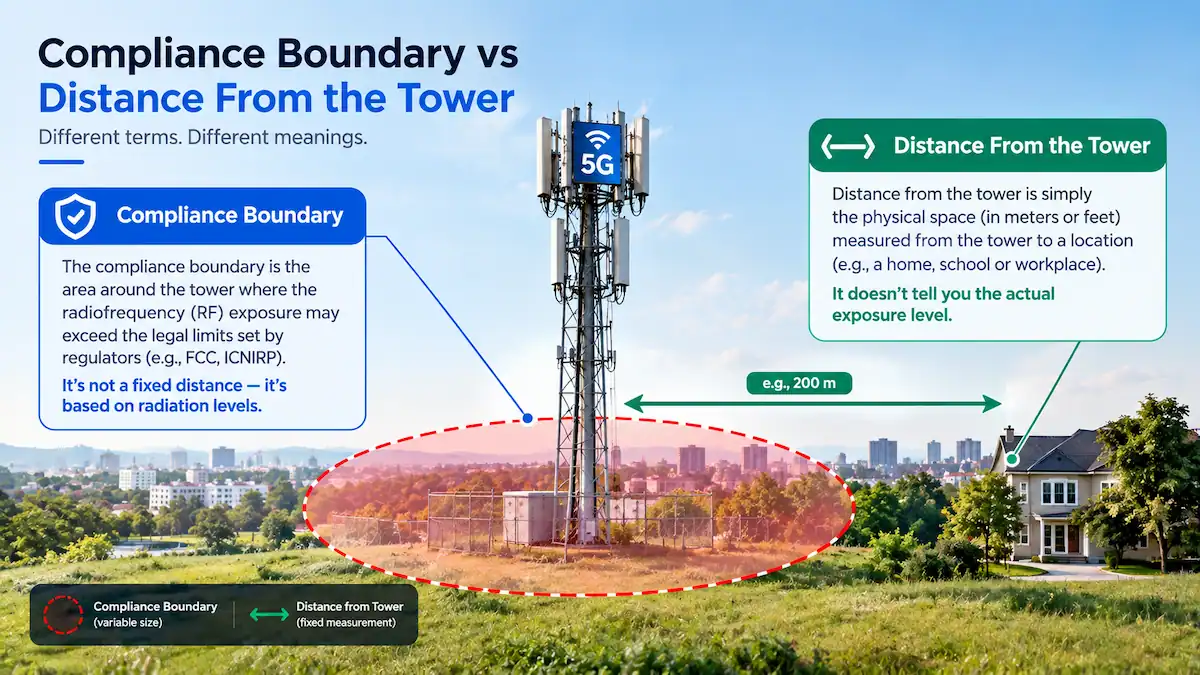
A compliance boundary is the zone around an antenna inside which exposure could exceed the limit. Outside it, exposure from the base station is below the relevant limits. The boundary is not a circle around the tower. It extends mainly in front of the antenna, in the direction it points.
The distance that matters is the straight line from the antenna to you, not from the base of the tower to your door. FCC guidance typically places cell towers 50 to 200 feet high. Take a house 100 feet from a 120-foot tower: the antenna is about 156 feet away in a straight line. A house 100 feet from a small cell on a 25-foot pole is about 103 feet away. These are examples, not typical values.
 Why No Single Number Fits Every Site
Power, mounting height, tilt, direction, frequency band and the number of antennas on a structure all change the result. A figure like “500 feet” would be too cautious for one site and meaningless for another, so regulators evaluate each installation.
One filed example shows how wide the margin can be. A compliance report for a proposed 3.7 GHz 5G site in Montgomery County, Maryland calculated exposure well below 1% of the FCC general-population limit at any distance. That is one operator’s calculation for one site, not a typical value. If a site is planned near you, ask for its RF compliance report.
5G signals can travel from a few hundred meters to several miles, depending on frequency band. But the distance a signal can be detected is very different from the distance that matters for exposure, because signal strength drops quickly as you move away from the antenna.
Signal range is how far a phone can keep a usable connection. Exposure level is how much RF energy reaches your body at a given spot. A phone can keep a connection long after a signal has weakened.
That is why signal bars do not show your exposure. A full-bar signal and a weak one can both sit far below regulatory limits. Exposure depends on antenna power, direction and your straight-line distance from the antenna.
Lower frequencies travel farther, and higher frequencies lose power faster. Commonly cited ballparks are several miles for low-band (below 1 GHz), a few miles or less for mid-band (about 1 to 6 GHz), and a few hundred meters or less for mmWave (24 GHz and above). Real range depends on antenna height, power, terrain, buildings, and weather.
That gap is why carriers use macro towers for wide coverage and place mmWave on small cells close together in dense areas. mmWave also struggles with walls, trees and some window coatings.
EMF levels from a 5G tower fall off quickly with distance. Under the standard model, doubling your straight-line distance from an antenna cuts power density to about a quarter. Measured street-level exposure is usually a small fraction of regulatory limits.
Radio waves spread out as they travel, so the same energy covers a larger area the farther you are from the antenna. This is the inverse-square law. At twice the distance, power density is about a quarter. At ten times the distance, it is about one hundredth. Very close to the antenna the pattern is more complex, which is why compliance boundaries exist.
Antennas are mounted high and aimed outward toward the horizon, so the area directly below sits outside the main beam. They also tilt only slightly downward, so the beam’s center reaches the ground some distance away. As a geometric example, an antenna 30 m up tilted 5° aims at the ground about 340 m out.
The table below is an illustrative calculation, not a measurement. It uses the far-field formula from FCC OET Bulletin 65 to show how fast power density drops along the center of one antenna’s beam.
Assumptions: one mid-band antenna (3.7 GHz), 1,000 W EIRP, the ground-reflection factor from OET 65, and a limit of 1,000 µW/cm² (1 mW/cm²). Distances are straight-line from the antenna. It ignores downtilt, walls, time-averaging and other antennas on the site.
| Straight-line distance | Power density | Share of limit |
|---|---|---|
| 10 m (33 ft) | 204 µW/cm² | 20% |
| 20 m (66 ft) | 51 µW/cm² | 5.1% |
| 50 m (164 ft) | 8.2 µW/cm² | 0.8% |
| 100 m (328 ft) | 2.0 µW/cm² | 0.2% |
| 200 m (656 ft) | 0.51 µW/cm² | 0.05% |
| 500 m (1,640 ft) | 0.08 µW/cm² | 0.008% |
Under these assumptions the limit would be reached about 4.5 m from the antenna. Ten times the power moves each distance out by roughly three times.
Field surveys of 5G sites tend to report readings well below limits. In Malta, the Malta Communications Authority took 16,618 wideband measurements. The mean reading was 0.123% of the ICNIRP general-public reference limit, and the highest at any single point was 5.35%. The UK regulator Ofcom also publishes base station audit reports as percentages of ICNIRP reference levels. Readings vary by site, so the site’s own compliance report is the best check for your address.
A macro tower covers a wide area from a tall structure, while a 5G small cell covers a short stretch of street from a pole or building wall. The small cell sits much closer to people, but it generally transmits at lower power, so its compliance boundary is usually much smaller.
Macro towers trade proximity for height. They typically stand 50 to 200 feet tall, with antennas well above rooftops. Small cells sit on utility poles, streetlights and building walls, often at roughly 20 to 30 feet. Macro antennas cover neighborhoods or more, while small cells cover a block or two.
Power, height and direction vary by carrier and equipment, so the site’s own RF compliance report is the best source.
For 5G millimeter-wave base stations, a peer-reviewed analysis in Frontiers in Public Health (2021) found a typical compliance distance of a few meters or less in front of the antenna. These antennas use beamforming to steer energy toward connected devices instead of spreading it evenly. Small cells must still meet the same FCC exposure limits as larger sites.
Three factors determine how a nearby small cell affects a window: distance from the antenna, its orientation, and whether the window falls inside the compliance boundary. Most energy exits the front, so a window on the side or back of a pole gets little, while a window level with the antenna is closest to the beam’s center. How much reaches the room also depends on the glass and walls, covered below.
A 5G tower near your home doesn’t have a single meaning. What matters is the site type, the direction and height of its antennas, and how much signal your walls and windows let through. The site’s compliance report tells you more than a map distance.
Macro towers put antennas well above homes. Pole-mounted small cells are often about 20 to 30 feet high, within a few stories of the street. Rooftop sites put antennas on the same building as the people below. The FCC applies higher limits in controlled areas, such as where workers have access, while apartments below the roof are held to the general-population limit.
Most macro and rooftop antennas are flat panels that send energy forward, so a window facing the front of a panel is closer to the main beam than one at the back or side. Height matters as much. A window level with the antenna and facing it best matches the beam’s center. A window far above, below, or behind the antenna sits outside the beam. Flat panels are directional, while cylindrical small-cell units spread energy more evenly.
Building materials weaken radio signals, and we measure that loss in decibels. Every 10 dB cuts power to a tenth, so 30 dB reduces it by about 1,000 times.
Glass shows the widest range. Peer-reviewed measurements found that a low-emissivity glass wall cut a 6.75 GHz signal by 33.7 dB and a 16.95 GHz signal by 42.3 dB. Testing by the Telecom Infra Project found about 3 dB for simple clear glass at 28 GHz. Loss rose with frequency for all ten materials in the peer-reviewed study, so mmWave typically loses more than mid-band. Actual loss depends on the building, glass and angle of the signal, so treat these as measured examples, not guarantees.
Start with the FCC Antenna Structure Registration (ASR) database. Structures must be registered if they are taller than 200 feet or near an airport, so it covers major towers. Small cells and distributed antenna systems are usually not listed. For small cells, check your city or county permit records, where carriers file applications for pole and building installs. Tower locator sites and apps such as CellMapper can fill gaps, though accuracy varies.
No U.S. federal rule sets a minimum distance you must live from a 5G tower. The federal test is whether a site meets the FCC’s exposure limits, and local governments can add setbacks only for reasons other than RF health effects.
Federal law regulates exposure, not distance. The FCC’s rules apply up to 100 GHz, which covers mmWave 5G, and a carrier must show its site meets them. Section 332(c)(7)(B)(iv) of Telecommunications Act bars state and local governments from regulating placement of wireless facilities based on the environmental effects of RF emissions, to the extent the facilities comply with FCC rules.
In practice, a city may not deny a compliant site because of perceived health effects. This is a legal rule about who decides, not a scientific finding about what distance is healthy, and some communities and advocates disagree with it.
Local governments still control zoning. A city may review proposals for aesthetics and require a design that fits the surrounding area, but it cannot regulate placement in a way that effectively prohibits wireless service. FCC shot-clock rules also give local governments 60 days to review small-cell collocations and 90 days for new facilities, and a facility is automatically approved if the deadline passes.
Local codes vary, so check what yours says about setbacks, height and notice. Then ask for the site’s RF compliance report. Concerns about siting, appearance, or placement in a public right-of-way give local officials something to act on.
No federal rule sets a minimum distance between a 5G tower and a school. The same FCC limits apply at a school as anywhere else the public can go, and local zoning boards or school districts that own the land usually make the final decisions.
The FCC treats schools as general-public areas, so a tower near one must meet the general-population limit. Compliance reports for school sites can show wide margins. An engineering study by dBm Engineering for a proposed Verizon tower beside a Pennsylvania elementary school’s playground, reported by Inside Towers, found cumulative exposure at least a hundred times below FCC limits at all publicly accessible locations. That was one applicant-commissioned report for one site.
The limits themselves are contested. In 2021 a federal appeals court sent part of the FCC’s decision to keep its 1996 limits back to the agency, saying it had not adequately explained how it addressed certain evidence, including on children and long-term exposure. Check the court opinion and the FCC’s docket for the current status.
Local governments cannot reject a compliant tower because of RF health concerns, but they keep zoning powers over height, appearance and location. A school board has a different power when a tower would sit on its own land, because then it is a landowner choosing whether to sign a lease.
That choice has gone both ways. A Virginia school board voted 8-0-1 to bar new cell towers on school grounds for five years after parents objected to proposed sites. In Georgia, a lease for a 150-foot tower between two schools passed on a routine consent agenda without notifying families. After months of parent opposition, school officials asked the board to cancel it.
Start with who decides. Is the tower on school property, where the board signs a lease, or nearby, where zoning applies? If it is a lease, ask whether it went through a public vote and what notice families received, and when it comes up for renewal.
Then ask about exposure. Request the site’s RF compliance report and where the antennas sit relative to classrooms and the playground. Ask whether the carrier will fund periodic measurements, as a Pennsylvania school official asked Verizon to do with unannounced readings. Public records requests can get these documents if they aren’t posted.
Regulators set limits to prevent known effects, mainly tissue heating, and they maintain that exposure within those limits is protective. Some scientists and groups dispute that conclusion, and large reviews of the research are still being argued over.
The FCC and the International Commission on Non-Ionizing Radiation Protection (ICNIRP) both set limits on how much RF energy people may absorb. The FCC’s are based on thermal effects. ICNIRP’s 2020 guidelines cover 100 kHz to 300 GHz and state that they protect against all scientifically substantiated adverse effects. Critics question that claim. For values and bands, see our guide to safe EMF levels.
The record on long-term, low-level RF exposure is not settled. In 2011 the WHO’s cancer agency, IARC, classified RF radiation as “possibly carcinogenic to humans” (Group 2B), a category that reflects limited evidence and does not mean a cause has been shown.
The WHO commissioned twelve systematic reviews on RF health effects, published in Environment International between October 2023 and May 2025. Findings differ by outcome, and animal results do not translate directly to people exposed to a tower’s far weaker signal. A 2025 commentary in Environmental Health argues that methodological flaws mean these reviews cannot prove safety.
What is known: tower exposure at public locations is usually measured as a small fraction of the limits. What is not settled is whether the limits capture every effect over decades. This guide takes no side. It gives you the sources so you can read them yourself.
Start with the site’s RF compliance report, which you can usually get from public records. A handheld RF meter can give you your own reading, but it shows a moment in time, not the highest exposure a 5G site can produce.
For a macro tower or rooftop site, the carrier’s RF compliance report is the most useful document. Operators file these with zoning applications. The filed report cited earlier used OET Bulletin 65 equations to calculate power density at distance and compared it to the general-population limit. A good report lists antenna height, direction, power and the calculated compliance boundary. For small cells, at least one city requires an RF engineer to certify that the facility, as installed, complies with FCC rules.
Check your city or county permit portal first, then file a public records request for the report, the antenna specifications and any post-installation measurements. Some regulators publish measurements, such as Ofcom’s base station audits in the UK. Availability varies by country.
A handheld meter shows signal strength where you stand. It cannot show the worst case. Maximum exposure from a 5G base station applies only when it beams full gain and power at the spot, which usually doesn’t happen during a short reading. Researchers at TU Ilmenau note that professionals therefore measure always-on signaling signals and extrapolate to the maximum.
Check the meter’s stated frequency range for the bands used near you. A broadband meter adds up everything it hears, including phones, Wi-Fi and other towers, so it can’t say which source produced the reading. Readings also change with network traffic and your position, so take several at different spots and times. Compare them to the FCC power-density limit as indicators. For a formal answer, hire an RF engineer who follows a standard such as IEC 62232. For step-by-step meter use, see our guide to how to measure EMF at home.
If you want less exposure from a nearby 5G site, the most effective step is to increase distance and adjust orientation, then shield the places you spend the most time. Shielding materials can block wireless signals, but only where they actually cover the path between you and the source.
In the illustrative model above, power density along the beam fell from about 20% of the limit at 10 meters to about 5% at 20 meters. Doubling distance cuts it to roughly a quarter, and the same logic applies indoors.
For a tower or small cell outside your home, spend time in rooms that face away from the antenna and keep desks, beds and seating away from windows that face it. Moving a chair a few feet from that wall costs nothing.
RF shielding materials reflect or absorb wireless signals. One type is silver-fiber fabrics, because silver conducts well. For more, see what is Faraday fabric. Common questions about aluminum foil and copper have their own answers.
Fabric is tested as a material, and the result describes the fabric alone. In use, openings, gaps and seams let some signal through. Shielding only affects the path it covers, so a blanket on a bed does nothing for a signal arriving from another direction. It also does not change how much the tower transmits.
For a flexible option, SLVR Wear™ makes an Signal Shielding large blanket from silver-fiber shielding fabric. It blocks wireless signals, including 5G, in the area it covers, and a third-party shielding laboratory independently tested it for strong signal reduction across common cell and Wi-Fi bands.
The results cover radio-frequency and wireless signals only, and extended high-frequency results are coming soon. For phones, the Faraday phone pouch is signal-blocking.
The most common mistake is treating distance as the only factor. Exposure also depends on antenna height, direction, power, and what else is transmitting nearby, so the closest tower isn’t always the biggest source.
Reading signal bars as exposure. Bars show how well your phone connects, not how much RF energy reaches you. Neither a strong nor a weak signal tells you where you stand against exposure limits.
Assuming closer always means higher. Directly beneath a tower is often not the strongest spot. WHO’s base-station fact sheet notes that field intensity increases slightly as you move away from the antenna, then decreases at greater distances. A spot farther out in the beam’s path can see more of the beam than one near the base.
Measure to the base, not the antenna. The distance that matters is the straight line from the antenna to you. A 30-meter antenna 40 meters away is about 50 meters from you in a straight line.
Ignoring the sources already in the room. WHO’s fact sheet states that RF exposure for a mobile phone user is far higher than for someone living near a cellular base station. That sheet describes older phone systems, but the principle holds: strength falls quickly with distance, and a phone is centimeters away. See whether airplane mode reduce emf.
Trusting one reading or one number. A single meter reading changes with traffic, position and time. A compliance figure depends on one set of assumptions. Use both as indicators, not guarantees.
Not in a simple way. 5G equipment can use beamforming, which focuses energy into narrow beams toward users. Researchers at TU Ilmenau expect a higher maximum exposure near a 5G base station than near conventional equipment because of that gain. Actual exposure at any spot depends on where the beam points, how much traffic the site carries and how far away you are. Both 4G and 5G sites must meet the same exposure limits.
No. The tower keeps transmitting either way. Turning off 5G changes which network your phone connects to, not what the site transmits. Steps for iPhone are in how to turn off 5G on iPhone.
Poorly, and it varies by material. Drywall and clear glass let most of the signal through, while low-emissivity glass, brick and concrete block much more. The section above on walls and windows includes measured figures.