What Is RF Radiation? Frequency, Risks and Exposure
RF radiation is electromagnetic energy that travels in waves, spanning roughly 3 kilohertz to 300 gigahertz the band the FCC…

A Faraday cage is an enclosure made of conductive material typically metal mesh, foil, or solid metal that blocks external electric fields and most electromagnetic radiation from reaching what is inside. Anything placed within a properly constructed Faraday cage, from a phone to a person, is shielded from outside radio signals, static charge, and other electromagnetic interference. At the same time, what’s inside stays largely undetectable to devices outside the cage.
The concept isn’t new or theoretical. Physicist Michael Faraday first demonstrated it in 1836. The same principle is still used today MRI rooms in hospitals are built as Faraday cages to keep outside radio interference from corrupting the imaging signal (a big part of why hospital Wi-Fi is restricted in and around certain departments). The metal body of a car does the same thing to passengers during a lightning strike.
The cage doesn’t need to be solid to work; even a mesh with gaps smaller than the wavelength of the signal it’s blocking is enough to redirect the energy around the enclosure instead of through it, which is why aluminum foil, wire mesh, and silver-infused Faraday fabric can all function as effective shielding materials depending on what they’re designed to block.
A Faraday cage is a conductive enclosure metal mesh, solid metal, or metal-infused fabric designed to absorb and redistribute external electric charge across its surface rather than letting it pass through to the interior. That redistribution is what does the shielding: as long as the enclosure fully surrounds the space and has no gaps wider than the wavelength of the RF radiation it’s meant to block, the electric field inside stays close to zero even while the outside of the cage is exposed to a strong external field.
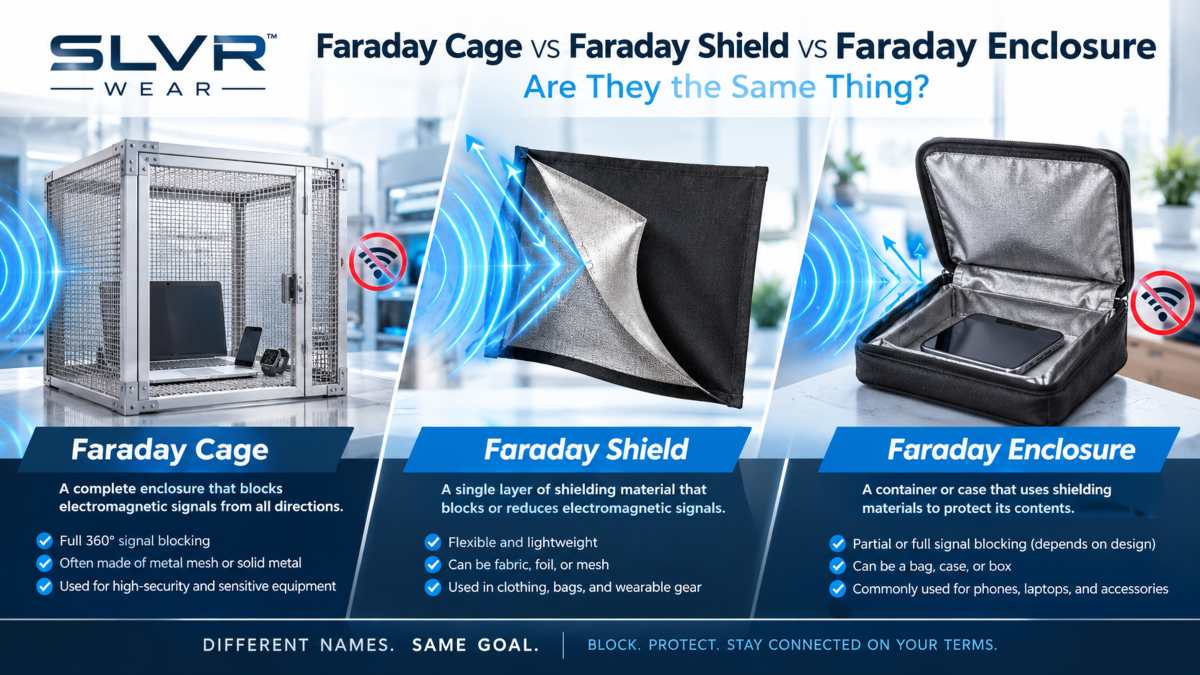
Yes, these three terms describe the same underlying concept and are used interchangeably in both scientific literature and everyday language. “Faraday cage” typically refers to a rigid or semi-rigid structure (a room, a box, a car body). At the same time “Faraday shield” and “Faraday enclosure” are often used for smaller or more flexible applications, such as a shielded pouch or a layer of conductive fabric. The physics doesn’t change based on the name any of the three works by the same principle of conductive shielding, and the choice of term usually just reflects the size or form factor of the object being described.
 Who Was Michael Faraday? (Brief Historical Context)
Michael Faraday (1791–1867) was a self-taught English scientist who began his career as a bookbinder’s apprentice before working under chemist Humphry Davy at the Royal Institution in London. He’s best known for discovering the principle of electromagnetic induction, which made modern electric generators and transformers possible.
In 1836, Faraday demonstrated that a charged conductive enclosure shields its interior from external electric fields. This experiment later gave the “Faraday cage” its name, even though Faraday himself never used that term. His broader work laid much of the groundwork for classical electromagnetism, and the principle he demonstrated nearly 190 years ago remains the mechanism used in shielded rooms, vehicles, and fabrics today.
A Faraday cage works by intercepting an external electric field with its conductive surface and canceling it out before it reaches the interior. When electromagnetic radiation hits the cage, free electrons in the conductive material shift in response, creating an opposing field that neutralizes the incoming one so the space inside the cage experiences little to no electric field, even while the outside surface is fully exposed to it.
The underlying principle is called electrostatic shielding, and it comes down to how conductive materials respond to an electric field. Metals like copper, aluminum, and steel contain electrons that move freely across the material’s surface. When an external field hits the cage, those electrons redistribute themselves almost instantly, arranging in a pattern that generates an equal and opposite field.
The two fields cancel each other out inside the enclosure, so the net electric field at the center of the cage approaches zero, no matter how strong the external field is. This is the same reason a plane can fly through a lightning strike, with the electrical charge traveling across the aircraft’s metal skin instead of through the cabin the fuselage itself functions as a Faraday cage.
A Faraday cage doesn’t need to be a sealed, solid shell to block electromagnetic radiation effectively a mesh works just as well, as long as the gaps in the mesh are smaller than the wavelength of the signal it’s designed to block. This is why wire mesh, perforated metal, and woven conductive fabric are common shielding materials: electrons still redistribute across the connected conductive surface even with small openings.
The tradeoff is wavelength-dependent. A mesh that comfortably blocks a Wi-Fi signal (typically a few centimeters in wavelength) won’t necessarily block a lower-frequency signal with a longer wavelength, which is why shielding effectiveness is usually described as a percentage at a specific frequency range rather than a single blanket claim of “blocks everything.”
A solid metal enclosure blocks a broader range of frequencies with fewer limitations, but for most practical applications bags, fabrics, phone pouches, and rooms a well-constructed mesh or woven conductive material provides shielding that’s indistinguishable from solid metal for the frequencies it’s built to handle.
 What Are Faraday Cages Made Of?
Faraday cages are made from RF blocking materials that allow electrons to move freely across their surface most commonly metals like copper, aluminum, and steel, along with metal-infused fabrics for flexible applications. The specific material matters less than its conductivity and how completely it surrounds the object being shielded; any continuous conductive surface with no significant gaps can function as an effective Faraday cage, whether that’s a solid metal box or a woven textile.
Copper is one of the most effective shielding materials because of its high conductivity see how copper blocks RF signals for a closer look which is why it’s often used in professional-grade shielded rooms and sensitive electronics testing.
Aluminum is more common in consumer and DIY applications it’s inexpensive, lightweight, and conducts well enough to block most everyday RF signals, which is why aluminum foil is the go-to material for quick, improvised shielding (we cover how well aluminum foil actually blocks RF signals in more depth separately). Steel mesh shows up frequently in construction and architectural shielding, such as reinforced rooms or vehicle bodies, because it combines conductivity with structural strength.
For wearable or fabric-based applications, textiles woven with silver fiber offer a flexible alternative to rigid metal silver is highly conductive, and when woven directly into fabric rather than coated on top, it creates a continuous conductive surface that moves and drapes like ordinary cloth while still functioning as a shield. Independent lab testing has measured shielding effectiveness in these fabrics as high as 99.91% at frequencies up to 50 GHz, depending on the weave and silver content used see the lab results for the full testing data.
Grounding is not required for a Faraday cage to block external electric fields, but it does change what the cage does with the charge it intercepts. An ungrounded cage still cancels the field inside it the electrons simply redistribute across the cage’s own surface and stay there. A grounded cage gives that charge somewhere to go, directing it safely into the earth instead of letting it build up on the cage itself.
For most everyday shielding uses, like a phone pouch or a foil-lined box, grounding isn’t necessary because there’s no meaningful charge buildup to manage. Grounding matters more in contexts involving high-voltage equipment, lightning protection, or sensitive electronics testing, where safely dissipating intercepted charge is as important as blocking it in the first place.
Faraday cages are used anywhere electromagnetic interference needs to be kept out of a space or kept from escaping it from hospital imaging rooms to consumer electronics to the walls of the vehicles people ride in every day. The core use case is always the same: create a controlled environment where outside radio signals can’t reach what’s inside, or where a signal generated inside can’t broadcast out.
 Everyday Examples You Already Encounter (Microwaves, Elevators, Cars, MRI Rooms)
A microwave oven is a Faraday cage working in reverse the metal mesh in the door and the unit’s metal walls keep microwave radiation contained inside the appliance instead of letting it radiate into the kitchen. Elevators and parking garages function as Faraday cages by accident: the surrounding metal structure is dense enough to block cell signals, which is why phone reception frequently drops the moment the doors close.
Cars work the same way during a lightning strike the metal body of the vehicle carries the electrical charge around the outside of the frame rather than through the cabin, which is why occupants are safe inside a car even when it’s struck directly (this is a different mechanism than everyday exposure from things like power infrastructure, which is why keeping a safe distance from power lines is a separate topic entirely).
Hospitals rely on the same principle at a larger scale: MRI rooms are built as fully shielded enclosures so that outside radio frequency noise can’t interfere with the extremely sensitive imaging signal the machine is reading a concern closely tied to broader RF exposure in hospital settings, including RF exposure for nurses who work near this equipment throughout a shift, which is part of why RF-shielding scrubs have become a practical option for hospital staff see our complete guide to RF-shielding medical scrubs for more.
Faraday shielding also protects electronics and data, not people. Signal-blocking bags and pouches are used to isolate phones and key fobs from RF signals, which prevents remote tracking, unauthorized data access, and relay attacks on keyless entry systems a use case that’s become common enough that many car manufacturers now recommend a Faraday pouch as a standard security measure for wireless key fobs.
The same logic applies to phones directly: it’s worth understanding how much radiation cell phones actually emit, what iPhone RF radiation levels look like specifically, and whether steps like turning off 5G on an iPhone or using airplane mode meaningfully reduce exposure. The same shielding principle extends to other devices too see our breakdown of laptop RF shielding options and to wearable fabrics, which apply the same conductive-enclosure concept to clothing and accessories designed to sit close to the body throughout the day.
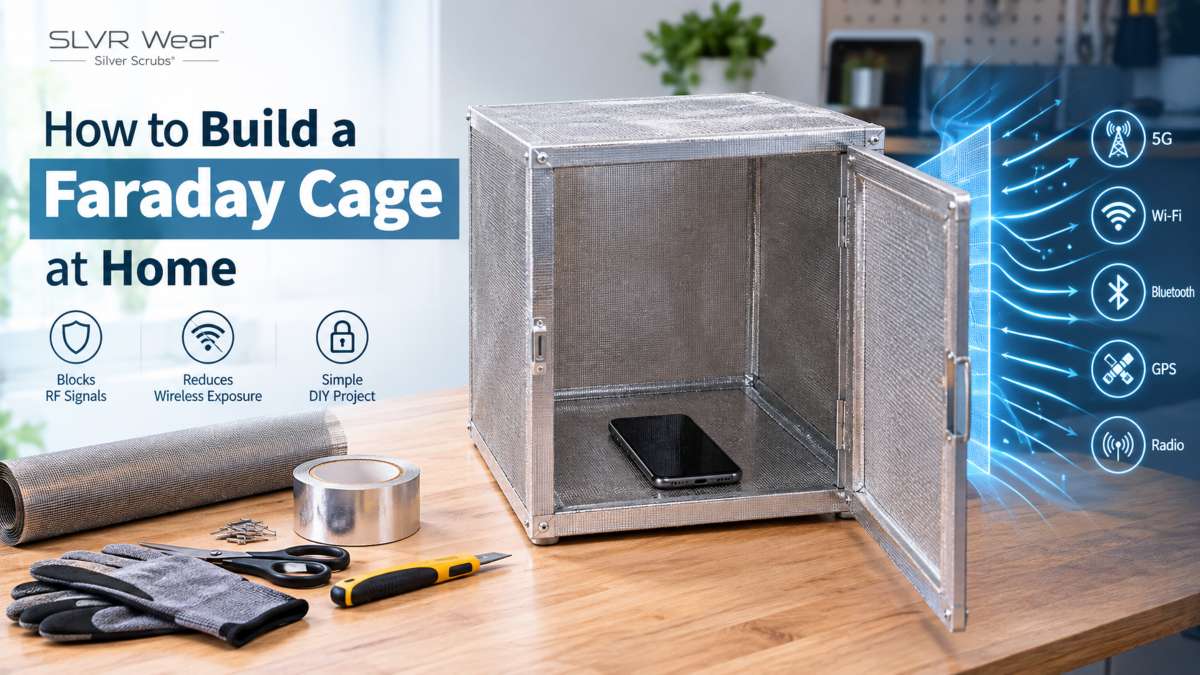
You can build a basic Faraday cage at home using conductive materials like aluminum foil, wire mesh, or a metal container, as long as the material fully surrounds what you’re shielding with no meaningful gaps. Home versions won’t match the shielding performance of a professionally built room or lab-tested fabric. However, they can still block or significantly reduce a meaningful range of everyday signals a useful complement to broader strategies for reducing RF exposure throughout your home.
 Can You Make a Faraday Cage with Aluminum Foil? (Direct Answer)
Yes, aluminum foil can function as a basic Faraday cage, but only if the object is fully wrapped with no exposed gaps, since even a small opening lets signal leak through. Multiple layers improve reliability more than a single layer does, because foil is thin and can develop tiny tears or seams that a single wrap won’t cover.
This makes foil a reasonable option for quick, low-stakes shielding tests. Still, it’s a fragile, inconsistent solution for anything that needs to work reliably foil creases, tears, and loses contact at the seams easily, creating gaps large enough for signal to pass through.
Turning a room into a functional Faraday cage means lining every surface walls, ceiling, floor, and any openings with a continuous conductive material, since the shielding only works when the enclosure is unbroken. Start by lining the walls and ceiling with conductive mesh, foil, or specialty shielding fabric, overlapping every seam by at least a few inches. This keeps the conductive surface continuous, not gapped.
Cover windows with conductive mesh or shielding film, since glass does nothing to block signal on its own. Address doors last, since they’re the hardest part to seal a door frame needs conductive gasket material or overlapping mesh at the edges to maintain contact with the rest of the shielded surface when closed. Finally, check for any penetrations, like outlets, vents, or wiring, since even a small unshielded gap in an otherwise sealed room can let enough signal through to meaningfully reduce the room’s effectiveness.
The most common failure point in a DIY Faraday cage is an incomplete seal a single uncovered seam, gap, or opening can let enough signal through to defeat the shielding, even if the rest of the enclosure is built correctly. Using materials that are too thin or prone to tearing, like a single layer of standard aluminum foil, is another frequent issue, since the material degrades with handling faster than most people expect.
Another common oversight is overlooking non-obvious entry points, such as electrical outlets, vents, or gaps around door hinges, since people tend to focus on large surfaces and forget the smaller connection points where signal can still leak in.
Finally, assuming a DIY cage blocks every type of signal is a mistake a mesh or foil setup that blocks Wi-Fi and cellular signals may do little against lower-frequency signals, since shielding effectiveness depends on how the gap size in the material compares to the wavelength of the specific signal being blocked.
The same conductive-shielding principle behind a DIY room or a wrapped block of foil is what makes wearable and portable RF blockers practical for daily use, without lining an entire room. If you want the shielding without the construction project, a few option categories cover most everyday needs:
For a phone or key fob, a Faraday Phone Pouch applies the same enclosure principle in a pocket-sized form factor. For sleep or general use around the house, signal-shielding blankets are available in a baby blanket size a relevant option for anyone weighing questions around RF exposure during pregnancy or early childhood as well as large and X-large sizes for adults.
For everyday wear, a signal-shielding beanie or signal-shielding hat extends the same fabric-based shielding to something you’d wear outdoors.
A Faraday cage is a genuinely useful piece of physics you can put to work with materials as basic as aluminum foil or as refined as silver-fiber fabric the deciding factor is always how completely the conductive surface surrounds whatever you’re trying to shield. If you’re shielding a phone or a key fob, a well-made pouch is enough; if you’re aiming for lab-grade performance, look for materials tested and rated at a specific frequency range, like fabric verified to block up to 99.91% of signal at 50 GHz, rather than taking shielding claims at face value.
A Faraday cage blocks electromagnetic interference from entering or leaving an enclosed space, making it useful anywhere a signal needs to be contained or kept out. Common applications include MRI rooms that need to stay free of outside radio noise, signal-blocking pouches that prevent key fobs and phones from being remotely accessed, and vehicle bodies that route lightning strikes safely around passengers instead of through them.
No, a Faraday cage only blocks signals with a wavelength longer than the gaps in its conductive material. So its effectiveness depends on both the signal’s frequency and the enclosure’s quality. A well-sealed mesh or fabric can block common frequencies like Wi-Fi and cellular signals very effectively, with lab-tested shielding fabrics reaching up to 99.91% attenuation at frequencies as high as 50 GHz. Still, a cage with gaps, seams, or openings will let some signal leak through, no matter how conductive the material is.
Highly conductive metals like copper and silver perform best, followed closely by aluminum and steel, which are more commonly used because they’re less expensive and easier to work with. For rigid applications, solid metal or fine wire mesh is standard; for wearable or flexible applications, fabric woven with silver fiber offers comparable shielding performance while still behaving like ordinary cloth. What matters most isn’t the specific metal, but the material’s conductivity and how completely and continuously it surrounds what you’re shielding.
Size doesn’t determine whether a Faraday cage works a small, fully sealed pouch shields just as effectively as a large room, because the shielding principle depends on complete conductive coverage, not the size of the enclosed space. What breaks a small cage’s effectiveness is the same thing that breaks a large one: gaps, seams, or openings in the conductive surface. A phone-sized pouch with no gaps will reliably block a signal, while a room-sized enclosure with a single unshielded vent can fail to do the same.