What Is RF Radiation? Frequency, Risks and Exposure
RF radiation is electromagnetic energy that travels in waves, spanning roughly 3 kilohertz to 300 gigahertz the band the FCC…
RF shielding blocks or reduces RF energy using conductive or absorptive materials, and its performance is measured in decibels (dB) of shielding effectiveness. Every 10 dB is a tenfold drop in signal power, so a 30 dB rating cuts power by 99.9% at the tested frequency. (In terms of field strength, 30 dB is roughly a 32-fold reduction.)
That number depends on the method, the frequency, and how well seams and openings are handled. This guide compares the main shielding types (metal enclosures, mesh, conductive fabric, paint, canopies, and wearables), shows how performance shifts from Wi-Fi to 5G mmWave, and explains how to choose and verify the right option. If you are new to the topic, start with what is RF radiation.
RF shielding works by placing a conductive or absorptive barrier between an RF source and the area you want to protect. The barrier reflects some energy, absorbs some as heat, and lets only a small fraction through. How much gets through depends on the material, its thickness, the frequency, and any gaps in the barrier.
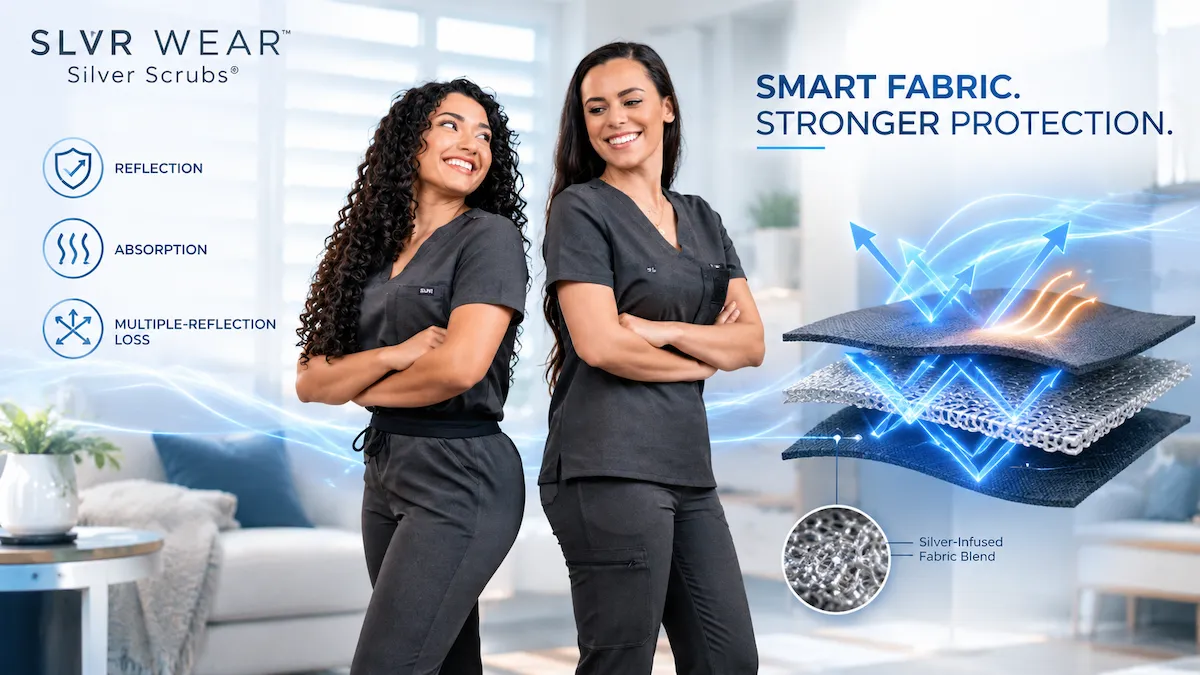
A shield attenuates RF energy through three mechanisms, and engineers add their contributions together in dB.
Reflection dominates for most conductive materials. When a wave hits a surface with electrical properties very different from air, such as copper, aluminum, or silver-coated fabric, most of the energy bounces back instead of entering the material.
Absorption covers the energy that does enter the material. As the wave travels through, it induces currents that dissipate as heat, and the signal weakens with depth. Skin depth describes the distance at which the field falls to about 37% of its surface value. Skin depth shrinks as frequency rises, so even thin conductive coatings can attenuate high-frequency signals.
Multiple-reflection loss comes from energy bouncing between a shield’s inner and outer surfaces. It matters mainly in thin or porous materials, such as light conductive fabric or thin coatings.
Total shielding effectiveness equals reflection loss, absorption loss, and a correction for multiple reflections.
 Shielding effectiveness in dB
Shielding effectiveness (SE) states how much a shield reduces signal power, in decibels. Because the scale is logarithmic, every 10 dB cuts power by a factor of ten.
| SE rating | Power reduction | Power remaining |
|---|---|---|
| 10 dB | 90% | 1/10 |
| 20 dB | 99% | 1/100 |
| 30 dB | 99.9% | 1/1,000 |
| 40 dB | 99.99% | 1/10,000 |
A rating is only meaningful with its test conditions. “30 dB” tells you little unless it names the frequency, the test method, and whether the measurement covers a flat material or a finished product. The same fabric can show very different numbers at 900 MHz and at 28 GHz.
In real installations, leakage through openings usually limits performance more than the material does. A room built from excellent conductive material is only as good as its weakest point.
RF energy slips through any opening that is a meaningful fraction of its wavelength. What matters most is the opening’s longest dimension, not its area: a long, thin slot, such as an unbonded seam, leaks far more than a round hole of the same area. As a rule of thumb, a slot of length l limits shielding to roughly 20 × log₁₀(λ / 2l) dB. At 2.4 GHz (λ ≈ 12.5 cm), a 1 cm seam gap caps shielding at about 16 dB, no matter how good the material is. The shorter the wavelength, the smaller the gap that matters, which is why high-frequency shielding demands tighter seams.
Common weak points include door edges, overlapping fabric panels, stitched seams, cable and pipe penetrations, ventilation openings, and unshielded windows. Well-made enclosures address these with conductive gaskets and overlapping seams. When evaluating any product or installation, ask how seams and closures are handled before looking at the material’s headline rating.
The main types of RF shielding are solid metal enclosures, metal mesh, conductive fabrics, shielding paints, films and foils, fabric canopies, and wearable garments. They all reflect and absorb RF energy, but they differ in attenuation, ease of installation, and how well they handle seams and openings. The right method depends on what you need to protect: a room, a device, a bed, or a person.
A solid metal enclosure offers the highest-performing RF shielding. Copper, aluminum, and steel sheet metal with properly bonded seams provide the most reliable attenuation across the widest frequency range. Electronics testing rooms are evaluated against standards such as IEEE 299 and built with bonded seams, conductive door gaskets, and filtered power and data lines.
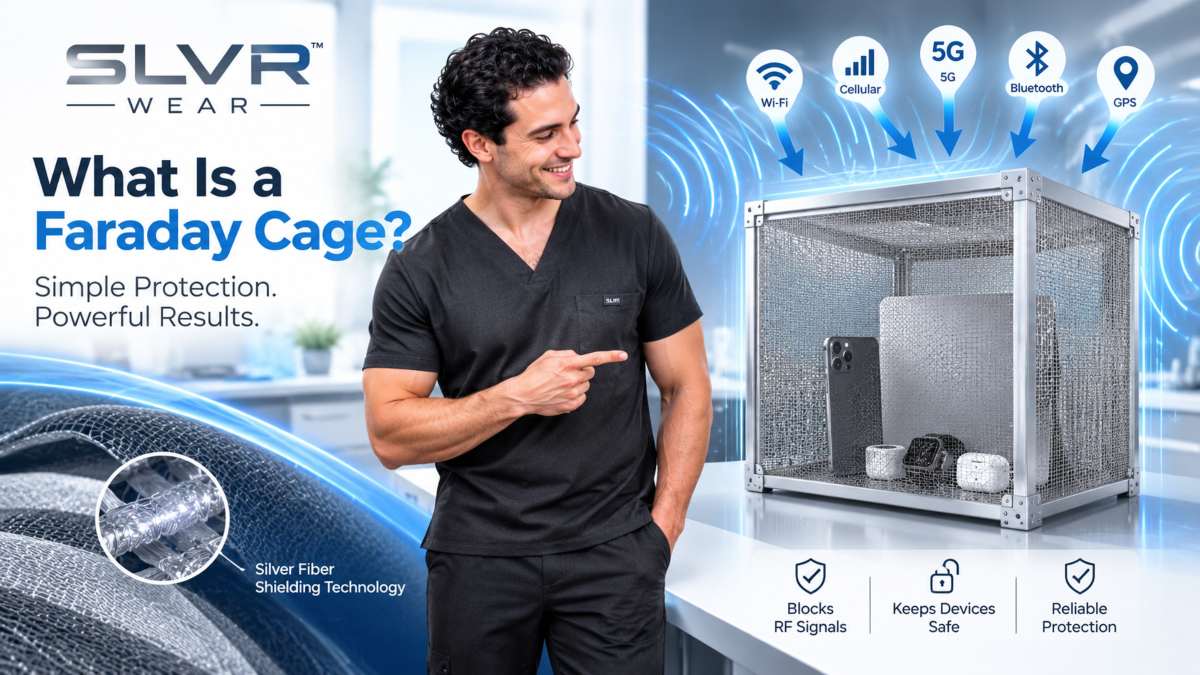
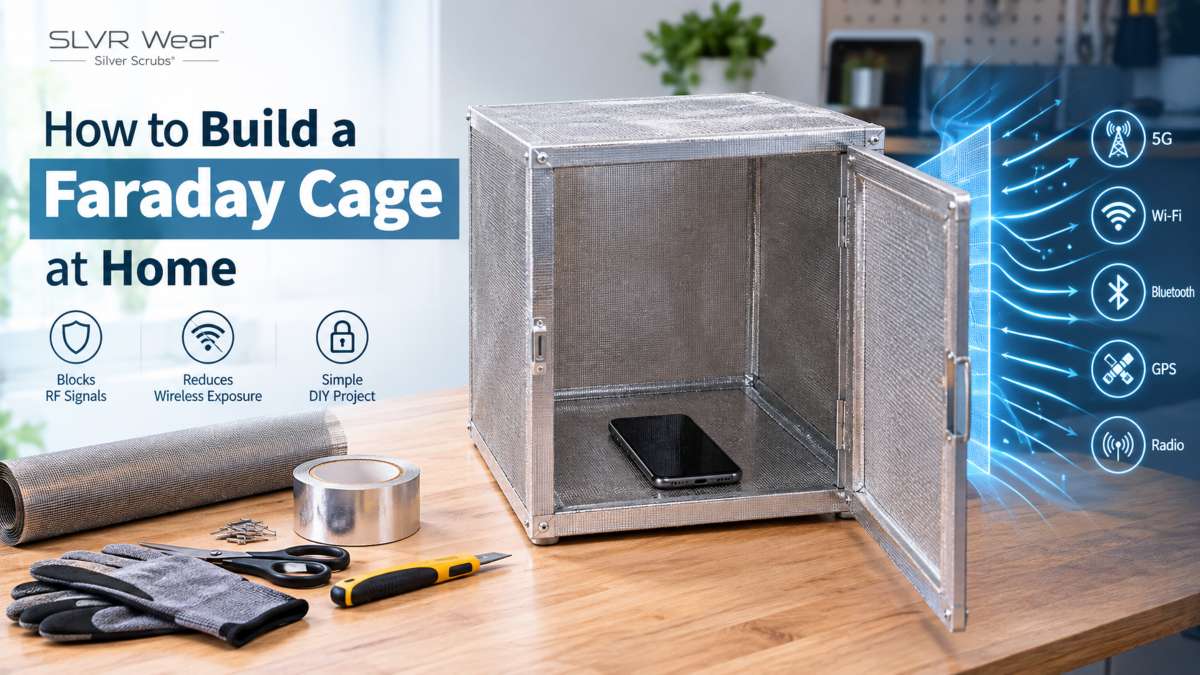
A Faraday cage is the same principle in a broader sense: a continuous conductive shell. When an external field reaches it, charges in the conductor redistribute and, together with reflection and absorption in the material, keep the field inside the shell very small. For a closer look, see what is a Faraday cage. It doesn’t need to be solid metal; a mesh cage works if the openings are small relative to the wavelength being blocked. The trade-off is cost and permanence: metal enclosures are heavy, expensive to build, and hard to retrofit.
Metal mesh is a lighter, ventilated alternative to solid sheet. Copper, bronze, and stainless steel screens attenuate RF energy while still allowing airflow and, in some cases, visibility. Performance depends on wire diameter, mesh opening size, and how well the screen is bonded at its edges.
The governing rule is that the mesh opening must be much smaller than the wavelength being blocked. A common design guideline is to keep openings below about 1/20 of the wavelength, which gives roughly 20 dB at the opening. That works out to about 6 mm at 2.4 GHz, 3 mm at 5 GHz, and about 0.5 mm at 28 GHz. Finer openings are needed for higher attenuation.
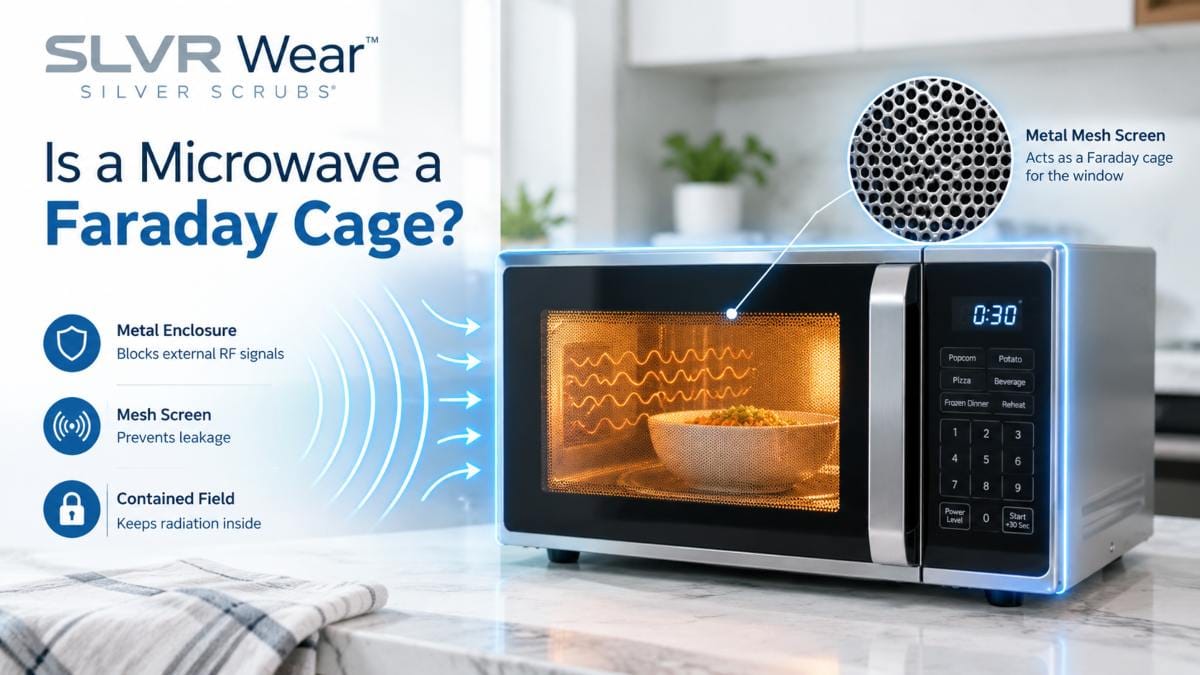
A familiar example is the metal screen in a microwave oven door, explained in our guide on whether a microwave is a Faraday cage. Mesh’s main weakness is the perimeter: a panel that is not continuously bonded to its frame leaks at the edges.
Conductive fabrics are woven or knitted textiles, usually nylon or polyester, plated or coated with silver, copper, or nickel. They bring RF shielding into flexible forms, such as curtains, bed canopies, garments, pouches, and tent-like enclosures. For a fuller explanation, see what is Faraday fabric.
Silver is the most conductive of these metals and is common in commercial products, while copper and nickel-copper blends are widely used where cost matters. Shielding effectiveness varies with construction, plating, and frequency. Published figures for flat samples are measured under ideal lab conditions, and real-world performance depends on how the fabric is stitched, folded, and closed. If durability matters, ask the seller for wash or wear test data.
Two common questions are whether copper blocks RF and whether aluminum foil does. Both are conductive and both work when the barrier is continuous, but foil tears, creases, and leaks at its seams, so it is hard to use as a reliable shield. See does copper block RF and does aluminum foil block RF.”
Shielding paints are coatings loaded with conductive particles, typically carbon, nickel, copper, or silver. You apply them to walls, ceilings, and floors with a roller or brush, then cover them with a standard topcoat. Their main advantage is that they can treat existing surfaces without construction.
Performance depends on the conductive filler, the number of coats, and application quality. Paint also doesn’t shield on its own: it needs proper grounding and treated seams around windows and doors, and it doesn’t address the openings that typically cause the most leakage.
Metalized films, adhesive foils, and conductive window laminates add shielding to glass and flat surfaces. Windows are usually the weakest point in a shielded room, so these products fill a specific gap.
The trade-off is optical. More transparency generally means a thinner conductive layer and less attenuation. Films also need careful edge treatment to prevent leakage around the frame, and they work best as a supplement to a larger shielding system.
A shielded canopy is a conductive fabric enclosure built around a bed or seating area. It sits between the room-scale and wearable approaches: a localized protected zone without treating a whole room. Its performance depends on the fabric’s rating and how the canopy closes, including the floor, entry flap, and seams.
A canopy can only protect the volume it encloses, and it is only as effective as its weakest opening. An open bottom or a loosely overlapping entry lets energy in, particularly at higher frequencies where wavelengths are short.
Wearable shielding uses conductive fabric in garments, hats, blankets, and device pouches. It is the most portable method and the least controlled: the garment moves, the body leaves openings at the neck, cuffs, and hem, and fit determines coverage.
Wearables are most predictable in closed forms such as a Faraday phone pouch, where the enclosure is nearly complete. Soft goods such as a signal-shielding blanket, hat, or beanie shield only the areas they cover. Clothing for specific settings includes RF-blocking medical scrubs. Treat any attenuation figure for a wearable as a material measurement, not a guarantee of whole-body performance.
Solid metal enclosures give the highest and most reliable attenuation, while mesh, fabric, paint, and film trade some performance for flexibility, cost, or ease of installation. No single method wins on every measure. The right choice depends on what you need to shield, the frequencies involved, and how well you can control seams and openings.
Method | Typical use | Strengths | Limitations | Gap/seam risk | Frequency suitability |
|---|---|---|---|---|---|
Solid metal enclosure | Labs, secure rooms | Highest attenuation, durable, established test standards | Heavy, costly, hard to retrofit | Low if seams are bonded and doors gasketed | Broad |
Metal mesh | Vents, display windows, cage enclosures | Airflow, visibility | Opening size caps the usable frequency | Medium to high at frame edges | Limited by opening size |
Conductive fabric | Curtains, canopies, pouches, garments | Flexible, portable, easy to cut and sew | Performance drops when stitched or folded | High at seams, closures, and overlaps | Broad as a material; finished-product results vary |
Shielding paint | Walls, ceilings, floors in existing buildings | Treats surfaces without construction | Needs grounding and topcoat; depends on application | High at windows, doors, outlets, and corners | Varies by product |
Films and foils | Windows, glass, flat panels | Fills the window gap, partly transparent | Less transparency generally means less attenuation | High at frame edges | Varies with layer thickness |
Shielded canopy | Beds, seating areas | Localized zone, no room treatment | Protects only the enclosed volume | High at entry flap and floor | Depends on fabric and closure |
Wearable | Garments, hats, device pouches | Most portable | Cannot form a sealed enclosure around a body | Very high at neck, cuffs, and hem | Material rating only |
Shielding paint and conductive fabric both cover surfaces, but they suit different jobs. Paint works best for existing walls, ceilings, or floors: you apply it with a roller and it leaves no loose edges. Fabric works better when you need a movable or removable barrier, such as a curtain, canopy, or pouch.
Paint is fixed, and its attenuation depends on coat count, application quality, and grounding. Fabric can show high attenuation as a flat sample, but stitching, folds, and closures reduce that in practice. For a room, paint plus treated windows and doors is more controllable. For a bed or small enclosure, fabric is more practical. For practical room-level steps, see how to reduce RF in your home.
Mesh is rigid, durable, and usually bonded to a frame, which makes it predictable and easier to test. It also allows airflow and light, so it suits vents and viewing panels. Fabric is lighter and easier to install but more sensitive to wear, stitching, and fit.
Mesh has a frequency limit set by its opening size: the higher the frequency, the finer the mesh must be. Fabric is a continuous coated surface, so it has no opening limit, but it loses effectiveness wherever seams and closures leave gaps. Choose mesh where structure and ventilation matter, and fabric where flexibility does.
A canopy encloses a fixed volume, so it can approach a partial enclosure if you manage the floor, entry, and seams. Clothing covers the body but cannot close fully around it. A canopy is a structure with openings, while clothing is better described as a material that partially covers. Neither should be treated as equivalent to a metal enclosure.
Structural shielding builds the barrier into the environment: a shielded room, treated walls, or a conductive enclosure. Wearable shielding places the barrier on or near a person or device. A structure can be designed, sealed, and tested as a whole, while a wearable depends on posture, fit, and the direction of the source.
Structural shielding is more predictable but costs more and is not portable. Wearables are portable but cover only part of the body. They are most dependable in closed forms, such as device pouches, and are best treated as partial or supplementary elsewhere.
Passive RF shielding blocks RF energy with a physical barrier that reflects and absorbs it, with no power source and nothing to switch on. Active approaches claim to cancel or suppress signals electronically. Nearly every shielding product in common use is passive, and active claims are much harder to verify.
Passive shielding relies entirely on the barrier’s material and geometry. A conductive layer, whether solid metal, mesh, coated fabric, or paint, reflects most incoming energy and absorbs part of the rest. Nothing in the system senses or responds to the signal, so the shield works the same way at all times and needs no electricity.
Because the behavior is fixed, passive shielding is testable. Standard methods such as IEEE 299 for enclosures and ASTM D4935 for flat materials measure attenuation in dB at stated frequencies, so you can check a claim against a repeatable procedure.
The limits are physical. A passive shield helps only where it forms a continuous barrier, so gaps, seams, and openings determine the real-world result. It also blocks wanted signals along with unwanted ones.
Active approaches borrow from noise cancellation. They claim a system can detect an incoming signal and generate a counter-signal that cancels it. Doing this reliably across a room, a moving person, or several frequencies at once is a hard engineering problem, and active systems generally need power.
For consumer products, the practical conclusion is caution. A product described as “active,” “smart,” or “frequency-cancelling” should state the exact frequencies covered, the test method, the measured attenuation in dB, and the power requirements. Without that evidence, treat the claim as unverified.
Shielding performance changes with frequency, so a material rated at one band can behave differently at another. Higher frequencies have shorter wavelengths, so they can leak through much smaller gaps. Choosing shielding for Wi-Fi, cellular, or 5G starts with knowing which band you are dealing with.
Wi-Fi uses 2.4 GHz, 5 GHz, and 6 GHz (on Wi-Fi 6E and newer devices). Cellular networks use bands from roughly 600 MHz to 2.7 GHz for 4G LTE and the lower layers of 5G. 5G also uses mid-band spectrum around 3.3 to 4.2 GHz, and millimeter-wave (mmWave) bands from 24 GHz upward. Band allocations vary by country, so confirm the bands used in your region.
Wavelength is the number that matters for shielding. It equals the speed of light divided by frequency, so a 900 MHz signal has a wavelength near 33 cm, a 2.4 GHz signal near 12.5 cm, and a 28 GHz signal just over 1 cm.
| Band | Typical frequency | Wavelength (approx.) | What matters for shielding |
|---|---|---|---|
| Low-band cellular | 600 to 900 MHz | 33 to 50 cm | Material conductivity and thickness; larger gaps tolerated |
| Mid-band cellular and 2.4 GHz Wi-Fi | 1.8 to 2.7 GHz | 11 to 17 cm | Seams and closures start to dominate |
| 5G mid-band | 3.3 to 4.2 GHz | 7 to 9 cm | Seam quality is critical |
| 5 GHz and 6 GHz Wi-Fi | 5 to 7 GHz | 4 to 6 cm | Small gaps leak; mesh openings must be fine |
| 5G mmWave | 24 to 40 GHz | 0.75 to 1.25 cm | Tiny apertures and stitch holes can leak |
Most 5G signals people encounter today are not mmWave. They sit in sub-6 GHz bands that overlap with LTE and Wi-Fi, so shielding specified across those ranges generally covers them. The difference is that 5G mid-band and 6 GHz Wi-Fi operate at higher frequencies than older LTE and 2.4 GHz Wi-Fi, so seam and closure quality matter more.
A shielding specification that says only “Wi-Fi” or only “cellular” tells you little. A reliable one names the frequency range tested and the attenuation in dB across it. For device-level steps that do not involve shielding, see how to turn off 5G on iPhone and whether airplane mode reduces RF.
With a wavelength near 1 cm, mmWave leaks through openings that would be harmless at 900 MHz, such as stitch holes, unbonded seams, coarse mesh, or a gap at a zipper. Sub-6 GHz signals, with wavelengths of several centimeters or more, are less sensitive to small gaps. In short, mmWave puts the burden on seam and aperture control, while sub-6 GHz puts it on material conductivity and overall enclosure quality.
A single material rarely delivers the same attenuation at every frequency. Skin depth shrinks as frequency rises, so absorption changes with band. A fabric or mesh with fixed openings behaves differently as wavelength approaches the opening size. Test setups also differ by band, so results from different labs aren’t always directly comparable.
This is why a single figure like “99% blocking” is not enough. Look for attenuation in dB at named frequencies, and be cautious about extrapolating from a low-frequency test to a high-frequency claim.
Public exposure limits set by bodies such as the FCC and ICNIRP include wide safety margins, and major health agencies, including the WHO, report no established adverse health effects from exposure below those limits, though research continues. People use RF shielding mainly for electromagnetic compatibility testing, device security and privacy (for example, Faraday pouches), controlled lab environments, and personal preference. This guide explains how shielding works and how to evaluate claims. It does not make medical claims.
Choose RF shielding by working backward from the source you need to block: identify its frequency, decide what you are protecting, then pick the form factor and verify the product’s test data for those exact bands. The finished product’s rating at named frequencies matters more than the material it is made from.
Start with the source. A Wi-Fi router, a cell tower, a smart meter, and a 5G small cell each transmit in different bands at different power levels. First, identify the frequency range using your device settings or your carrier’s published bands. For background on common sources, see whether cell phones emit radiation and iPhone RF output.
Distance and direction matter too. Signal strength falls quickly with distance, so a router two meters away is a different problem from a tower several hundred meters away. Write down the source, bands, distance, and direction before looking at any product.
For a room, structural methods are the most controllable: treated walls, shielded windows, and gasketed doors. For a bed or seating area, a shielded canopy gives a localized zone, as long as the floor and entry close properly. For a single device, a closed pouch or box is the most dependable form because it can enclose the object almost completely; laptop-specific options are covered in RF protection for laptops. For a person, clothing and accessories provide only partial coverage, since a garment cannot seal around the body.
RF sources and shielding needs differ in clinical settings. For more, see RF exposure in hospitals, why hospital Wi-Fi is restricted, and RF exposure for nurses.
If a product’s form factor cannot enclose what it claims to protect, no material rating will fix that.
A trustworthy shielding product states four things clearly: the tested frequency range, the attenuation in dB at named frequencies, the test standard and the lab that performed it, and how it handles seams, closures, and openings. Also check whether the number describes a flat material sample or the finished product, since a fabric can perform far worse once it is sewn into a canopy with a zipper entry. Read the full report, not just the headline figure. An example of published results is on the SLVR Wear™ lab results.
A product with no stated frequency range gives you nothing to verify. A single unlabeled figure such as “blocks 99%” says nothing about frequencies, test, or what was measured. Missing test methods, unnamed labs, and results you can’t trace to a report are all warning signs. Be equally wary of promises that conflict with physics, such as full-body protection from clothing alone, or claims that depend on power or “smart” features without published data. For more on evaluating these products, see our guide to RF blockers.
RF shielding is tested by measuring how much signal power drops when a barrier is placed between a transmitter and a receiver, and reporting the result in dB at specific frequencies. A credible result names the test method, the frequency range, and whether the sample was a flat material or a finished product.
IEEE 299 covers shielding effectiveness measurement for enclosures such as shielded rooms and cabinets. It tests the finished structure, including seams, doors, and penetrations, so results reflect real-world leakage.
ASTM D4935 does not cover the higher bands used by 5G mid-band, 6 GHz Wi-Fi, or mmWave. Materials are typically tested at those frequencies with free-space (focused-beam) or waveguide-based methods, and finished enclosures with methods such as IEEE 299 or reverberation-chamber testing. A credible report names the method used and the frequency range it covers.
A material test measures a flat sample under ideal conditions: no seams, no folds, no openings. A finished-product test measures the real item, such as a canopy, garment, pouch, or room, with all of its stitching, closures, and gaps.
A material result shows what a product could achieve, while a finished-product result shows what it does achieve. When a seller shows only a material test, treat it as an upper bound, not a guarantee.
“Lab-tested” is only meaningful when the report can be checked. A usable result includes the name of the testing laboratory, ideally independent and accredited (for example, to ISO/IEC 17025); the test method; the frequencies measured; the dB values at those frequencies; and a description of what was tested. Check the date and whether the report refers to the exact product being sold. If a seller offers a summary but no report, ask for the full document.
Shielding effectiveness varies by material, thickness, coating quality, frequency, seam construction, and whether the test covered a sample or a finished item. No generic category range is reliable, so compare products using their own test reports, with the frequency and test method stated next to each number.
The most common mistakes are ignoring seams and openings, judging a product by its material alone, forgetting that shielding also blocks your own wireless signal, and treating one dB number as if it applied everywhere.
A shield works only where the barrier is continuous. At 2.4 GHz the wavelength is about 12.5 cm, so an unsealed door edge, a loose zipper, an overlapping fabric panel, or an open canopy bottom can leak far more energy than the material itself would. Plan the seams before choosing the material: overlap panels, use conductive gaskets or tape at joins, close entry points fully, and treat windows, vents, and cable penetrations as part of the shield.
Silver, copper, and nickel conduct well, but a conductive material alone doesn’t make a finished product effective. A fabric that measures well as a flat sample can lose performance once you cut, stitch, fold, and fit it with closures. Judge the finished product, not the ingredient list.
Shielding does not distinguish between signals you want and signals you don’t. A shielded room, canopy, or pouch also cuts off your Wi-Fi, cellular, GPS, and Bluetooth reception inside. Decide beforehand which signals you can afford to lose. Any cable or antenna you add to restore connectivity becomes a new opening to manage.
A figure such as “30 dB” describes one frequency under one test condition. A result at 900 MHz says little about 5 GHz or 28 GHz, and a flat-sample result says little about a finished product. Because the scale is logarithmic, a 10 dB difference is a tenfold difference in power. Read ratings as a set: the dB value, the frequency, the test method, and what was tested.
Solid, bonded metal enclosures are the most effective RF shielding method. Copper, aluminum, or steel sheet with bonded or gasketed seams provides the highest, most repeatable attenuation across the widest frequency range. They are also heavy, costly, and hard to retrofit, so most people use mesh, conductive fabric, paint, or film instead. Results always depend on the finished installation, since seams and openings usually decide the outcome.
Not necessarily. Most 5G signals in use today sit in sub-6 GHz bands that overlap with LTE and Wi-Fi, so shielding rated across those ranges tends to cover both. Millimeter-wave 5G (24 GHz and above) has a much shorter wavelength, so small gaps, like stitch holes or loose seams, matter more. Check that a product’s test data lists the specific bands you need.
Neither is better in every case. Paint suits existing walls, ceilings, and floors, but needs grounding, a topcoat, and careful treatment of windows and doors. Fabric suits movable or enclosed forms such as curtains, canopies, and pouches, but it performs worse at seams and closures. For a room, paint plus treated openings is usually more controllable. For a bed or small enclosure, fabric is more practical.
No. A Faraday cage is a continuous conductive enclosure that surrounds a space or object. Clothing cannot form one around a person, because the neck, cuffs, hem, and fit leave openings. A rating on wearable fabric describes the fabric, not whole-body performance. Closed forms such as device pouches come closest to a true Faraday enclosure.
No universal threshold exists, since “good” depends on the frequency and what you need to block. For reference, 10 dB removes 90% of signal power, 20 dB removes 99%, and 30 dB removes 99.9%. A rating only means something alongside the frequency, the test method, and whether it describes a flat sample or a finished product.
Yes, if the phone is fully enclosed in a shielded space. Shielding blocks wanted signals along with unwanted ones, so an enclosed phone loses cellular, Wi-Fi, GPS, and Bluetooth connectivity. A partial barrier, such as a canopy with open sides, may only weaken the signal. If you only want to pause connectivity without shielding, see whether airplane mode reduces RF.