Silver Scrubs Medical Clothing | EMF Blocking Scrubs
Every day, nurses, physicians, radiologists, and allied health professionals enter environments saturated with invisible electromagnetic fields from diagnostic equipment, wireless…
There is no single universally agreed safe EMF level but there are well-established reference guidelines, and most experts use the same units, thresholds, and frameworks to define what “safe” looks like in practice. Understanding those numbers is the first step to interpreting any reading you take in your home, workplace, or around the devices you use every day.
EMF electromagnetic field radiation is emitted by everything from power lines and appliances to Wi-Fi routers, cell towers, and 5G infrastructure. If you’re new to the topic, our guide to EMF radiation explained covers the fundamentals before you dive into the numbers. EMF is measured differently depending on the field type: magnetic fields are expressed in milligauss (mG) or microtesla (µT), electric fields in volts per metre (V/m), and radiofrequency radiation in milliwatts per square metre (mW/m²). Each has its own exposure thresholds, measurement tools, and body of reference guidance.
The most widely cited framework for residential environments is the Building Biology Guidelines, developed by the Institut für Baubiologie und Nachhaltigkeit (IBN) in Germany. Unlike regulatory limits set by bodies such as ICNIRP or the WHO which are designed around short-term, acute thermal effects Building Biology guidelines are precautionary standards oriented toward long-term, low-level residential exposure. They draw a meaningful distinction that matters when you are evaluating the environment where you sleep, not just where you briefly stand.
This page explains what safe EMF levels look like across all three field types, how to read the numbers your meter produces, what the Building Biology guidelines actually say, and how to use that information to make sense of your own environment.
SLVR Wear products are not medical devices and are not intended to diagnose, treat, cure, or prevent any disease.
Safe EMF levels vary by field type, measurement unit, and the guideline framework being applied but across the most widely used reference standards, meaningful thresholds do exist, and they give you a practical baseline for evaluating your own exposure.
 Defining Safe Why There Is No Single Global Standard
The reason there is no single, universally binding safe EMF level comes down to a fundamental disagreement in how safety is defined. Regulatory bodies such as the International Commission on Non-Ionizing Radiation Protection (ICNIRP) and the World Health Organization establish exposure limits based on verified thermal effects. These limits are defined as the point at which electromagnetic field (EMF) energy is absorbed by the body rapidly enough to result in noticeable tissue heating. Below that threshold, their position is that no harm has been established.
Precautionary frameworks, such as the Building Biology Guidelines, take a different position. They set limits based on what is considered prudent for long-term residential exposure, particularly during sleep, when the body is most vulnerable to environmental stressors. The result is a significant gap: Building Biology’s “no concern” threshold for RF radiation in a sleeping area is 0.1 mW/m², while ICNIRP’s general public limit sits at 10,000 mW/m² a difference of five orders of magnitude.
Neither framework is without its critics, but for anyone assessing their home environment, Building Biology guidelines are the more conservative and more commonly applied standard.
EMF is not a single phenomenon with a single unit of measure. It encompasses three distinct field types, each generated by different sources, detected by different instruments, and assessed against different thresholds.
Electric fields are produced by voltage the presence of electrical charge and exist whenever a device is plugged in, even if it is switched off. They are measured in volts per metre (V/m) and are relatively easy to shield against with standard building materials.
Magnetic fields are generated by current electricity in motion and are produced by appliances, wiring, and power infrastructure. They are measured in microtesla (µT) or milligauss (mG), where 1 µT equals 10 mG. Unlike electric fields, magnetic fields pass through most materials, including walls, floors, and the human body.
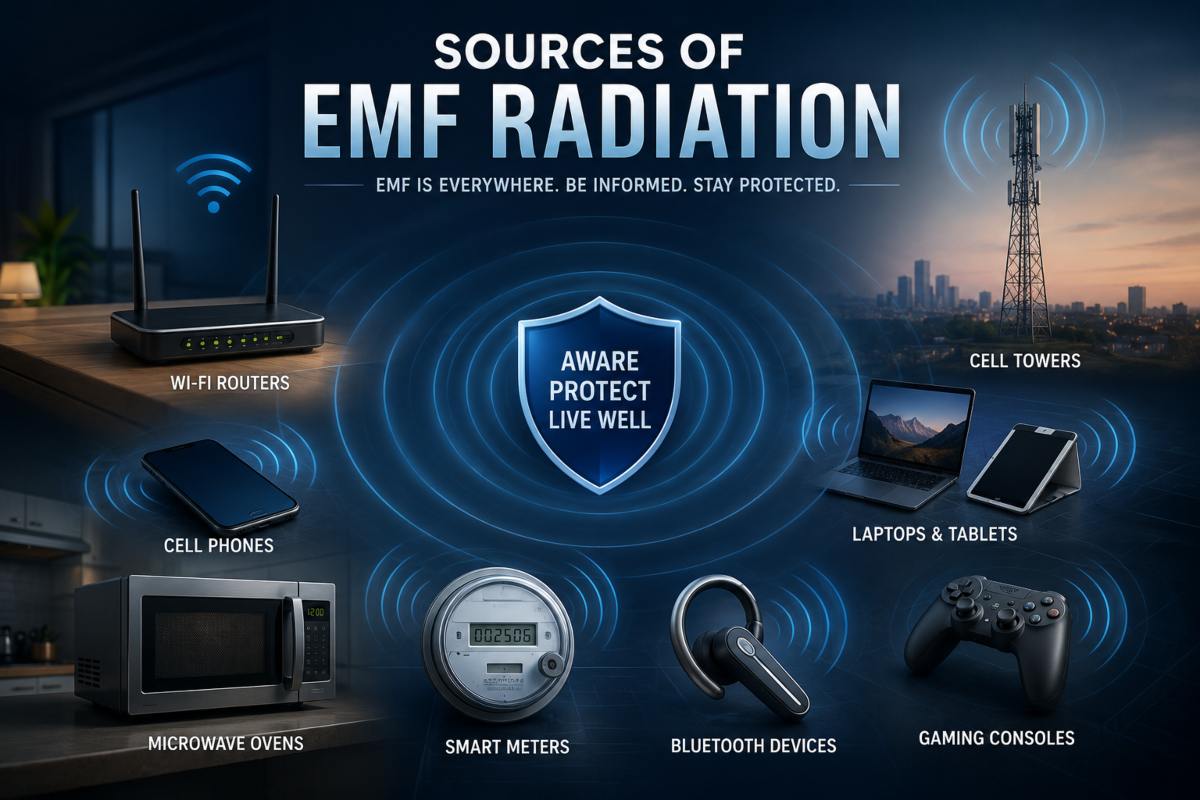
Radiofrequency (RF) radiation is emitted by wireless technologies such as Wi-Fi, Bluetooth, cell towers, and 5G networks. It is measured in milliwatts per square metre (mW/m²) or microwatts per square metre (µW/m²). It is the fastest-growing source of ambient EMF in residential environments as wireless infrastructure continues to expand.
Because each field type has distinct biological interaction mechanisms, penetration characteristics, and dominant sources, they require separate measurement tools and are assessed against distinct limits. A gaussmeter reading tells you nothing about RF levels in the same room; a broadband RF meter tells you nothing about the magnetic field from the wiring in your wall.
Applying the Building Biology Guidelines the most conservative and most referenced residential standard safe EMF levels break down as follows across the three field types.
For magnetic fields, a reading below 0.2 µT (2 mG) is considered the no-concern zone for sleeping areas. Readings between 0.2 and 1 µT (2–10 mG) are flagged for further investigation, and anything above 1 µT (10 mG) is considered a priority concern.
For electric fields, below 1 V/m is the no-concern threshold in a sleeping area, with concern escalating above 10 V/m.
For RF radiation, the no-concern threshold is below 0.1 mW/m² (100 µW/m²) in a sleeping area a standard that most urban Wi-Fi environments exceed before a single device is switched on.
These are not legal limits and they carry no regulatory authority. They are reference points developed by practitioners who assess residential environments professionally, and they represent the most commonly applied framework for answering, in plain terms, what a safe EMF level looks like at home.
For magnetic fields generated by power lines, appliances, and household wiring, safe EMF levels are measured in milligauss (mG) or microtesla (µT) and the Building Biology Guidelines place the residential no-concern threshold below 0.2 µT (2 mG) in areas where people sleep.
Extremely low frequency (ELF) magnetic fields are the type most commonly measured in homes using a standard gaussmeter. They are produced continuously by current-carrying wiring, transformers, electrical panels, and appliances and because magnetic fields pass through walls and most building materials without attenuation, proximity to the source is the primary factor driving exposure levels.
The Building Biology Guidelines divide residential magnetic field exposure into three assessment zones for sleeping areas:
The no-concern zone sits below 0.2 µT (2 mG). At this level, long-term residential exposure is considered unremarkable by precautionary standards, and no remediation is indicated.
The caution zone runs from 0.2 to 1 µT (2 to 10 mG). Readings in this range are not treated as alarming, but Building Biology assessors typically recommend investigating the source and considering whether practical distance or shielding measures are feasible.
The action zone begins above 1 µT (10 mG). At this threshold, the guidelines recommend active remediation identifying and either eliminating or shielding the source. For context, the WHO’s own ELF review concluded that residential magnetic fields above 0.3 to 0.4 µT (3 to 4 mG) have been associated with an elevated statistical signal in epidemiological research, lending additional weight to the precautionary position.
For daytime living areas, Building Biology applies somewhat relaxed threshold but sleeping areas remain the primary focus because of the duration and continuity of exposure involved.
Confusion about magnetic field measurements is one of the most common obstacles to correctly interpreting a meter reading. Gauss (G) and tesla (T) are both units of magnetic flux density. Still, they come from different measurement systems gauss from the CGS system historically used in the United States, tesla from the SI system used internationally. Most residential EMF meters sold in the US display readings in milligauss, while most European and internationally oriented instruments display readings in microtesla.
The conversion is fixed and straightforward. One microtesla equals exactly ten milligauss. So, a reading of 1 µT is equivalent to 10 mG, and the Building Biology no-concern threshold of 0.2 µT is equivalent to 2 mG. Gauss itself is rarely used in residential measurement it is simply the parent unit, where 1 G equals 1,000 mG or 0.1 mT (millitesla). For practical home assessment purposes, the only conversion you need is: µT × 10 = mG.
A gaussmeter or ELF magnetic field meter measures the strength of the alternating magnetic field at the point and moment of measurement. Most consumer-grade meters are single-axis, meaning they measure field strength along one plane at a time to get an accurate reading, you typically need to rotate the meter slowly through three orientations and note the peak value. Professional tri-axis meters capture all three axes simultaneously and display a combined RMS reading, which is more reliable for assessment purposes.
The number on your display represents the field intensity at that location, averaged over time. It does not tell you the source, the frequency, or the direction of the field only its magnitude. A reading of 3 mG in a bedroom, for example, places you in the Building Biology caution zone, but determining whether that reading comes from an external power line, an internal circuit, or a nearby appliance requires moving the meter methodically through the space and noting where the reading peaks and drops.
The practical implication is that a single spot measurement is rarely sufficient for a meaningful home assessment. Readings should be taken at mattress height in sleeping areas, at seated height at workstations, and at multiple distances from appliances then mapped against the safe EMF levels chart to determine whether any location warrants further investigation or remediation. Our complete guide How to measuring EMF radiation at home walks you through the full process, with instrument-specific guidance.
For radiofrequency radiation from Wi-Fi, cell towers, and 5G infrastructure, safe EMF levels are measured in milliwatts per square metre (mW/m²) and the Building Biology Guidelines place the residential no-concern threshold below 0.1 mW/m² in sleeping areas, a figure that most modern wireless environments exceed by a significant margin.
RF radiation behaves differently from the low-frequency magnetic fields produced by power lines and appliances. It radiates outward from a source in waves, diminishes with distance according to the inverse square law, and can reflect off surfaces meaning RF levels in an enclosed space are often higher than a straight-line distance calculation would suggest.
The Building Biology Guidelines assess RF exposure in sleeping areas across the same three-zone framework used for magnetic fields. The no-concern zone sits below 0.1 mW/m² (equivalent to 100 µW/m²). The caution zone runs from 0.1 to 1 mW/m², where the guidelines recommend source reduction where practical. The action zone begins above 1 mW/m², where active shielding or remediation is indicated.
To put these numbers in context: ICNIRP’s general public exposure limit for RF radiation in the frequency range covering most Wi-Fi and mobile signals is 10,000 mW/m² one hundred thousand times higher than the Building Biology no-concern threshold. The gap between precautionary residential guidance and regulatory limits is wider for RF than for any other EMF field type, which is why RF is the most contested and most actively researched area of the EMF safety conversation.
Measured RF levels vary considerably by source type, distance, and whether the device is actively transmitting. A Wi-Fi router measured at one metre typically produces RF levels of 0.01 to 0.2 mW/m², depending on the router’s output power and frequency band placing it at or above the Building Biology caution threshold during active data transmission. At five metres, levels from the same router typically fall below 0.01 mW/m², illustrating how sharply RF intensity drops with distance.
Smartphones present a more complex picture because the distance between the device and the body collapses to near zero during calls or when carried in a pocket. During active voice transmission, a smartphone held to the head can produce localised RF exposures of 0.5 to 2 mW/m² at the surface well within the Building Biology action zone. For a detailed breakdown of how phones specifically contribute to your daily RF exposure, see our guide to EMF from phones. Exposure varies significantly by network conditions, since a phone on a weak signal transmits at higher power to maintain its connection.
Cell tower exposure at street level is generally lower than most people expect. At 50 metres from a standard macrocell tower, ambient RF levels typically fall between 0.001 and 0.05 mW/m² below the Building Biology caution threshold in most cases. The concern with tower exposure is not peak intensity but cumulative, continuous background elevation across an entire neighbourhood, which raises the baseline against which all other RF sources are added.
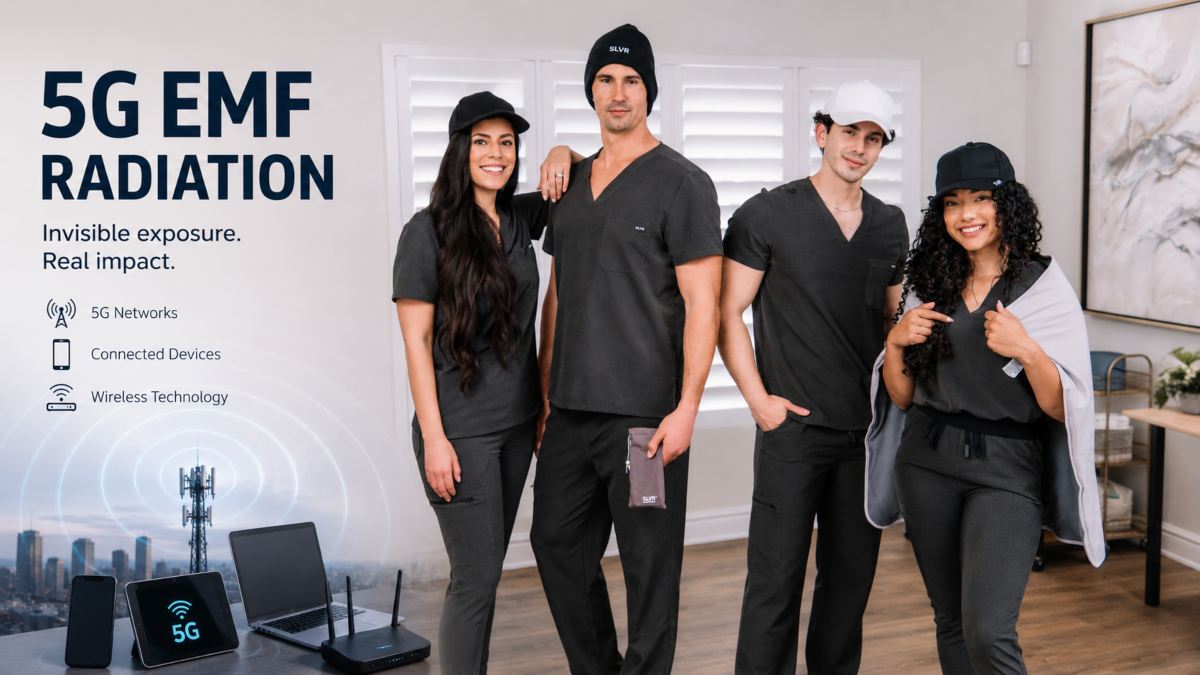
5G introduces additional variables. Sub-6GHz 5G behaves similarly to existing LTE infrastructure in terms of propagation and exposure levels. Millimetre wave (mmWave) 5G deployed in dense urban environments operates at much higher frequencies, attenuates rapidly over short distances, and is blocked by most building materials, making indoor exposure from mmWave installations generally low except in very close proximity to outdoor antennas.
RF and ELF magnetic fields are both forms of non-ionising EMF. Still, they are physically distinct phenomena that require different meters, follow different propagation rules, and respond to different shielding strategies.
ELF magnetic fields are generated at 50 or 60 Hz the frequency of the electrical grid and diminish relatively predictably with distance from the source. They pass through nearly all common materials without significant attenuation, which makes source elimination or distance the primary mitigation strategy. A gaussmeter detects them; a broadband RF meter does not.
RF radiation operates at frequencies ranging from roughly 100 MHz to 100 GHz and propagates as electromagnetic waves that carry both electric and magnetic field components simultaneously. Unlike ELF magnetic fields, RF radiation can be blocked or significantly attenuated by certain materials including metals, metallised films, and high-density silver-fiber textiles. To understand which materials are most effective and why, our guide to what blocks EMF radiation covers the physics in detail. This is the physical basis for Faraday shielding applied to both spaces and wearable products.
The practical implication for home assessment is that a complete EMF picture requires at least two separate instruments and two separate reference charts. A room that tests clean for ELF magnetic fields may still have elevated RF levels from a router in the next room, a smart meter on the exterior wall, or ambient signal from nearby infrastructure. Neither reading substitutes for the other, and safe EMF levels for one field type have no bearing on the readings or thresholds of the other.
When practitioners, building assessors, and EMF-aware consumers need a residential reference point for safe EMF levels, the Building Biology Guidelines are the standard they most consistently reach for not because they carry regulatory authority, but because they are the most rigorously developed precautionary framework specifically designed for the places people live and sleep.
The Building Biology Guidelines known in German as the Bau-Biologie Richtwerte were developed by the Institut für Baubiologie und Nachhaltigkeit (IBN) in Rosenheim, Germany. The IBN has been publishing and refining these guidelines since the 1980s, with regular updates as new frequency bands and technologies have entered the residential environment. The most current version, SBM-2015, remains the primary reference used by Building Biology practitioners internationally.
The underlying philosophy distinguishes Building Biology from regulatory frameworks in a fundamental way. Rather than asking “at what level is acute harm demonstrated?”, Building Biology asks “what level of exposure is consistent with a healthy, low-stress sleeping environment over a lifetime?” The result is a set of thresholds calibrated for long-term, low-level residential exposure the chronic condition that characterises how people actually experience EMF in their homes rather than for the brief, high-intensity exposures that regulatory limits are designed to prevent.
Building Biology assessors are trained to evaluate the full electromagnetic environment of a dwelling, including ELF electric and magnetic fields from wiring and appliances, RF radiation from wireless devices and infrastructure, and body voltage a measure of the electric field induced in the human body by surrounding electrical systems. Each field type is assessed against the SBM-2015 thresholds and assigned to one of four concern categories: no concern, slight concern, severe concern, and extreme concern.
The SBM-2015 guidelines set thresholds across four zones rather than three no concern, slight concern, severe concern, and extreme concern though, for practical home assessment purposes, the no-concern and severe-concern thresholds are the most operationally useful.
For AC magnetic fields (ELF, from wiring and appliances), the no-concern threshold in a sleeping area is below 0.2 µT (2 mG). Severe concern begins above 1 µT (10 mG). These figures apply at power-line frequency 50 Hz in Europe, 60 Hz in North America.
For AC electric fields (from wiring voltage, present even when devices are switched off), the no-concern threshold is below 1 V/m at the body in a sleeping area. Severe concern begins above 10 V/m. Electric fields are rarely the primary concern in most homes but become significant in older buildings with unshielded wiring or where extension leads run beneath mattresses.
For RF radiation (from Wi-Fi, mobile networks, smart meters, and wireless devices), the no-concern threshold is below 0.1 mW/m² (100 µW/m²) in a sleeping area. Severe concern begins above 1 mW/m². This is the field type where the gap between Building Biology thresholds and regulatory limits is most pronounced and where ambient background levels in urban environments have risen most sharply over the past decade as wireless infrastructure density has increased.
The contrast between Building Biology thresholds and the limits set by ICNIRP and adopted by the WHO is not a matter of minor calibration differences it reflects a fundamental divergence in how the two frameworks define the question they are answering.
ICNIRP’s guidelines, last comprehensively updated in 2020, set limits based on established adverse health effects specifically, the thermal effects of RF absorption and the nerve stimulation effects of low-frequency fields. For RF radiation in the frequency range covering Wi-Fi and mobile signals, ICNIRP sets a general public limit of 10,000 mW/m². For power-frequency magnetic fields, the limit is 200 µT (2,000 mG) for the general public a threshold roughly one thousand times higher than the Building Biology no-concern level.
The WHO does not set its own independent exposure limits; instead, it endorses the ICNIRP framework as the basis for national regulatory standards in most countries.
The practical consequence of this divergence is significant. A home environment that fully complies with ICNIRP limits and therefore meets the legal standard in most jurisdictions may still register as a severe-concern environment under Building Biology guidelines. This is not a contradiction; it reflects the difference between a regulatory floor designed to prevent acute harm and a precautionary standard designed to define a genuinely low-exposure residential environment. For anyone making decisions about their own home based on safe EMF levels, understanding which framework a given number comes from is as important as the number itself.
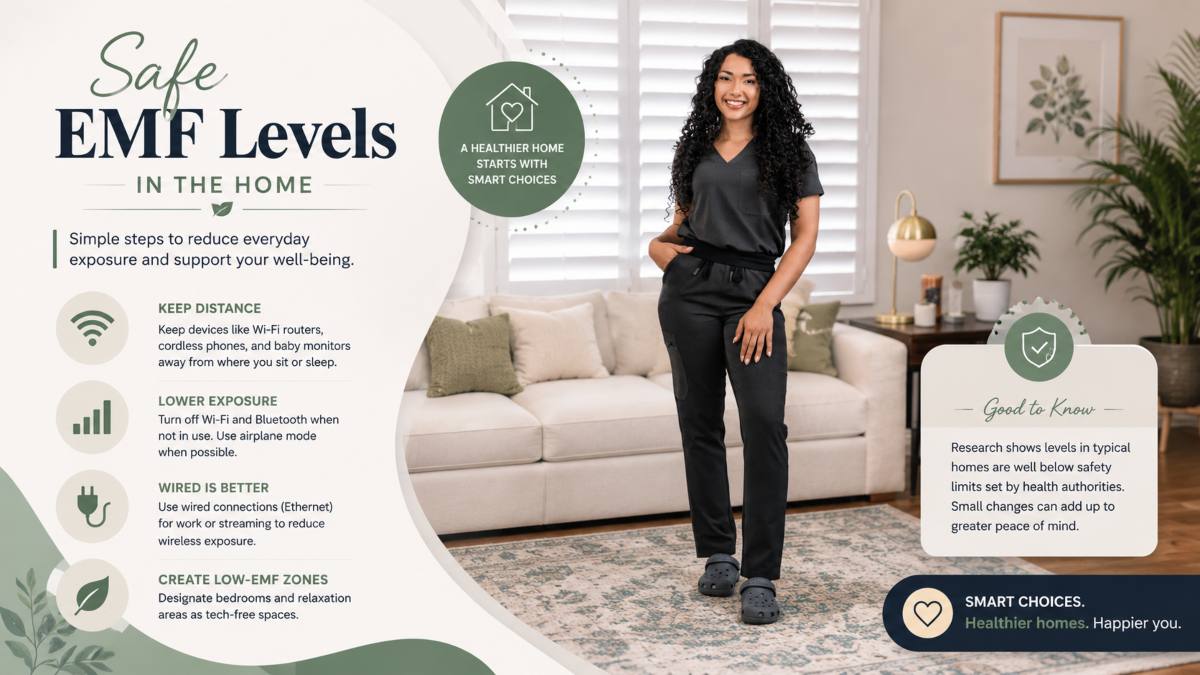
Safe EMF levels in the home are achievable in most residential environments. Still, they require knowing where the highest readings typically occur, which sources are driving them, and what target range to work toward because EMF exposure in a modern home is rarely uniform across rooms or throughout the day.
 What EMF Levels Are Typical in a Modern Home?
A typical modern home contains multiple overlapping EMF sources across all three field types. ELF magnetic fields are generated continuously by the electrical wiring running through walls, by the service panel, by appliances in use, and in many homes by current on water pipes or gas lines caused by improper grounding. RF radiation enters from both internal sources (Wi-Fi routers, cordless phones, smart speakers, baby monitors) and external ones (cell towers, neighbouring Wi-Fi networks, smart meters). AC electric fields emanate from any live wiring, regardless of whether a device connected to it is switched on.
Measured against Building Biology thresholds, a 2018 survey of residential EMF environments conducted by European building biology practitioners found that RF radiation was the field type most frequently exceeding the no-concern threshold, with a majority of assessed bedrooms registering RF levels above 0.1 mW/m² the precautionary limit for sleeping areas primarily due to ambient Wi-Fi and mobile network signal penetrating from within and outside the home. ELF magnetic field exceedances were less common but concentrated in predictable locations: near service panels, in rooms adjacent to transformer boxes, and in bedrooms where appliances or extension leads were positioned close to sleeping surfaces.
The overall picture in a modern home is one of background elevation across all field types relative to pre-wireless-era baselines, with specific hotspots driven by proximity to high-output sources.
Room-by-room variation in EMF levels is significant, and the sources driving the highest readings differ by field type.
The bedroom is the highest-priority room from an exposure standpoint not because it necessarily has the highest peak readings, but because people spend six to nine hours there daily, making it the site of the greatest cumulative exposure. Common bedroom sources include Wi-Fi signal penetrating from routers in adjacent rooms, smart meters mounted on exterior bedroom walls, and electric alarm clocks or phone chargers positioned at the bedside. A smartphone left charging on a nightstand and connected to Wi-Fi and mobile networks is a continuous RF source within arm’s reach throughout the night something we examine in depth in our article on EMF from phones.
The kitchen typically produces the highest ELF magnetic field readings in the home due to the density of high-current appliances. Induction cooktops, microwave ovens, and refrigerator compressors all generate significant magnetic fields during operation though these drop sharply with distance, and exposure duration at arm’s length is usually brief compared to in a bedroom or office environment.
The home office or living room tends to have the highest sustained RF levels because routers are typically located in these areas and devices are in continuous use. A router measured at one metre during active data transfer can exceed the Building Biology RF caution threshold; at three metres in the same room, levels typically fall within the no-concern zone.
Smart meters, where present, deserve particular attention. Mounted on the exterior of the home and transmitting at intervals throughout the day, they can produce RF spikes that penetrate interior walls and in some configurations they are positioned directly behind bedroom walls, placing a pulsed RF source within one to two metres of a sleeping area.
When using the Building Biology Guidelines as a target, the safe EMF range to work toward in sleeping areas is below 0.2 µT (2 mG) for AC magnetic fields, below 1 V/m for AC electric fields, and below 0.1 mW/m² (100 µW/m²) for RF radiation. These are the no-concern thresholds from SBM-2015 and represent the most widely accepted precautionary targets for residential sleeping environments.
In practice, achieving the RF no-concern threshold in an urban or suburban home requires active management rather than relying solely on distance. Switching the router to a wired connection for devices that support it, enabling router scheduling to power down overnight, and repositioning the router away from sleeping areas are the three changes most consistently shown to reduce bedroom RF levels below the precautionary threshold. For ELF magnetic fields, the most effective single step is identifying and removing or relocating high-current devices from the immediate sleeping area particularly anything plugged in within one metre of the bed.
For daytime living areas, Building Biology applies slightly relaxed thresholds, and the practical target shifts toward minimising peak exposures during sustained occupancy rather than achieving the stringent sleeping-area limits across the entire home. The bedroom remains the priority, because it is where the safe EMF range matters most and where the cumulative benefit of reduction is greatest.
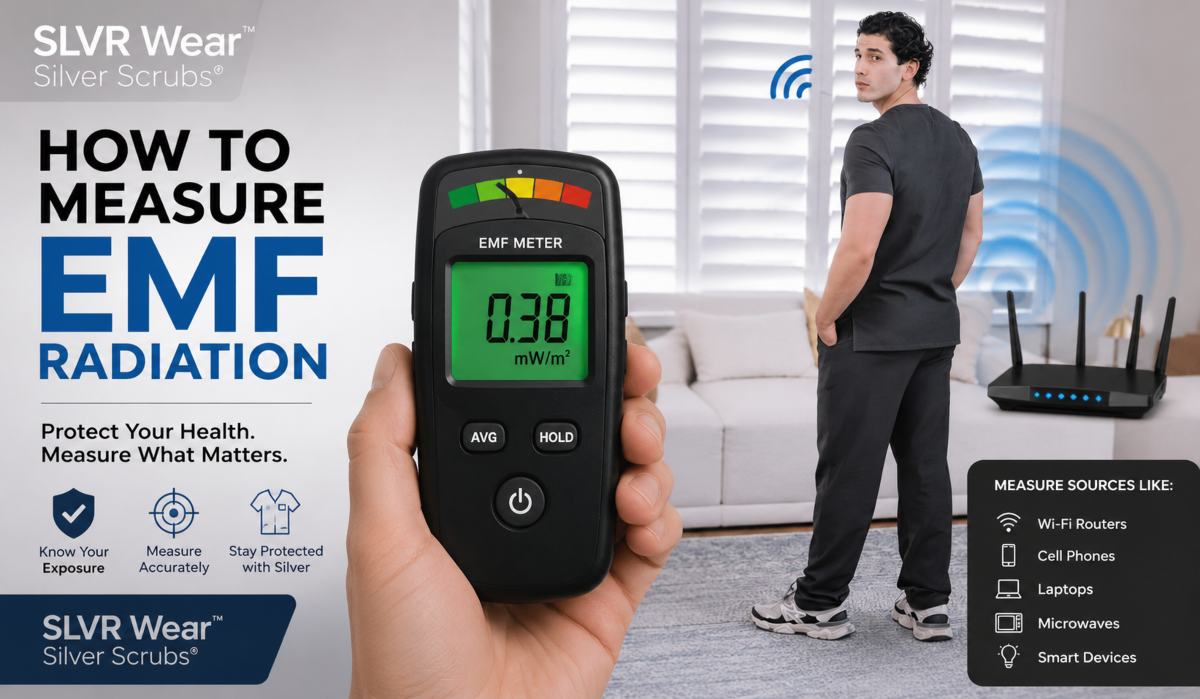
Taking an EMF reading is straightforward with the right instrument interpreting what the number means requires knowing which field type you are measuring, which unit your meter is displaying, and which reference threshold applies to the location you are testing. For a full walkthrough, see our dedicated guide on measuring EMF radiation at home.
A safe EMF reading depends entirely on the instrument in use and the measurement context. The two most common consumer instruments are the gaussmeter, which measures ELF magnetic fields and displays results in milligauss (mG) or microtesla (µT), and the broadband RF meter, which measures radiofrequency radiation and displays results in milliwatts per square metre (mW/m²) or microwatts per square metre (µW/m²).
On a gaussmeter, a reading below 2 mG (0.2 µT) in a sleeping area falls within the Building Biology no-concern zone for AC magnetic fields. Readings between 2 and 10 mG (0.2 to 1 µT) fall within the caution range and warrant further investigation. Anything above 10 mG (1 µT) in a sleeping area is considered a priority concern under the same framework.
On an RF meter, a reading below 0.1 mW/m² (100 µW/m²) in a sleeping area represents the Building Biology no-concern threshold. Between 0.1 and 1 mW/m² is the caution zone; above 1 mW/m² is the action zone. Because RF levels fluctuate with transmission activity a Wi-Fi router spikes when data is being transferred and drops when idle RF meters should be read over a sustained period rather than from a single instantaneous figure. Most quality RF meters display both a peak value and an average value; the average is more meaningful for residential assessment.
One practical detail that causes consistent confusion: many entry-level consumer meters marketed as “EMF detectors” measure only one field type, usually ELF magnetic fields, while displaying results in a way that implies comprehensive EMF coverage. A meter that lacks a dedicated RF mode with a frequency response extending to at least 8 GHz will not capture Wi-Fi, 5G, or modern mobile signals and will give a clean reading in an environment that an RF meter would flag as elevated.
Unlike product safety certifications for electrical goods, there is no single internationally recognised body that issues a formal “safe EMF rating” for residential environments or consumer products. The term appears frequently in product marketing and home assessment reports, but it refers to a threshold reference rather than a certification issued by a regulatory authority.
In practice, a safe EMF rating for a residential environment means the measured levels fall within the no-concern zone of an established guideline framework most commonly the Building Biology SBM-2015. When a building biologist issues a home assessment report and describes a room as meeting safe EMF levels, they are stating that measurements taken in that space fall below the SBM-2015 no-concern thresholds for all field types assessed.
For products shielding textiles, Faraday enclosures, and similar items performance ratings are typically expressed as attenuation values derived from laboratory testing: the percentage reduction in field intensity the material achieves under standardised test conditions, expressed in decibels (dB) or as a percentage. These figures describe shielding performance, not a regulatory safety certification. A product tested to demonstrate up to 99.91% EMF blockage has been measured in a laboratory against a specific frequency range; that figure describes what the material does, not a government-issued safety clearance. You can read more about how EMF blocking fabric is tested and what those attenuation figures actually mean.
The absence of a universal rating body means that evaluating any claim of “safe EMF levels” whether for a room, a product, or a building requires knowing which framework the assessment was conducted against, which field types were measured, and what instrumentation was used.
A methodical home assessment does not require professional equipment or specialist training, but it does require the right tools, a consistent approach, and a reference chart to interpret results against. The following process applies Building Biology thresholds as the target and covers both ELF magnetic fields and RF radiation the two field types most reliably measurable with consumer-grade instruments.
When measured EMF levels in your home exceed the safe thresholds established by reference frameworks like Building Biology SBM-2015, the practical options fall into two categories: source reduction and shielding. Both have a role, and understanding which applies to which field type determines how effectively you can bring readings down.
The first response to an elevated reading should always be source investigation, not immediate shielding. Shielding is most effective when the source is external or fixed a cell tower signal penetrating a bedroom wall, a smart meter on an exterior surface, ambient RF from a dense urban wireless environment. Where the source is internal and moveable, repositioning or removing it is simpler, cheaper, and more reliable than any shielding solution placed between the source and the occupant.
For ELF magnetic field exceedances, the most effective interventions are distance and source elimination. Magnetic fields from appliances and wiring drop sharply with distance moving a device from half a metre to two metres from a sleeping surface can reduce exposure by a factor of sixteen, consistent with the inverse square law. Where the source is fixed infrastructure a transformer vault in an adjacent building, a high-current cable running beneath the floor distance is not always achievable, and shielding becomes the relevant tool. Mu-metal and similar high-permeability alloys can attenuate low-frequency magnetic fields, though ELF magnetic shielding is technically demanding and rarely a DIY application.
For RF radiation exceedances the more common finding in modern residential environments the options are broader. Router scheduling, wired ethernet substitution for wireless-dependent devices, and repositioning of RF-emitting hardware away from sleeping areas are the highest-impact low-cost interventions. When ambient RF from external sources is the driver, EMF-blocking fabric applied to walls and windows, or used as textile barriers, offers a practical reduction pathway.
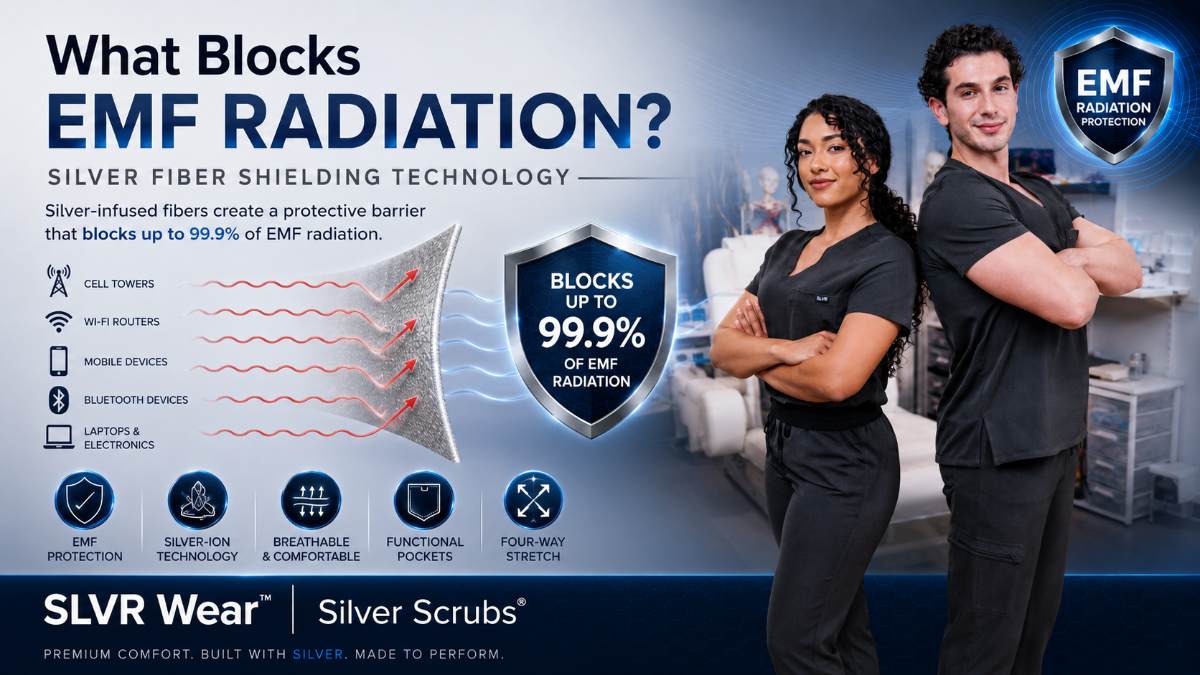
Silver-fiber shielding fabric operates on the same electromagnetic principle as a Faraday cage: conductive material intercepts incoming RF radiation, reflects or absorbs it rather than transmitting it, and reduces the signal level on the protected side of the fabric. Silver is among the most electrically conductive elements, and when woven as continuous fiber into a textile substrate at sufficient density, the resulting fabric functions as a flexible, wearable or deployable RF barrier. For a deeper explanation of the materials science involved, our guide to what blocks EMF radiation covers conductivity, weave geometry, and frequency response in detail.
The attenuation performance of any silver-fiber textile depends on the silver content, the weave geometry, the continuity of the conductive network across the fabric surface, and the frequency range being tested. These variables are why laboratory testing against a defined frequency range and methodology matters stated shielding performance figures should always be traceable to a specific test standard and frequency scope rather than treated as universal claims.
The physics of RF shielding also determines what silver-fiber fabric can and cannot do. It reduces exposure to wireless signals RF radiation from external transmitters passing through or toward the shielded area. It does not attenuate ELF magnetic fields generated by current-carrying wiring, which require a fundamentally different shielding mechanism. This distinction is relevant when selecting shielding products based on meter readings: the field type driving the exceedance determines whether an RF-attenuating textile is the appropriate choice.
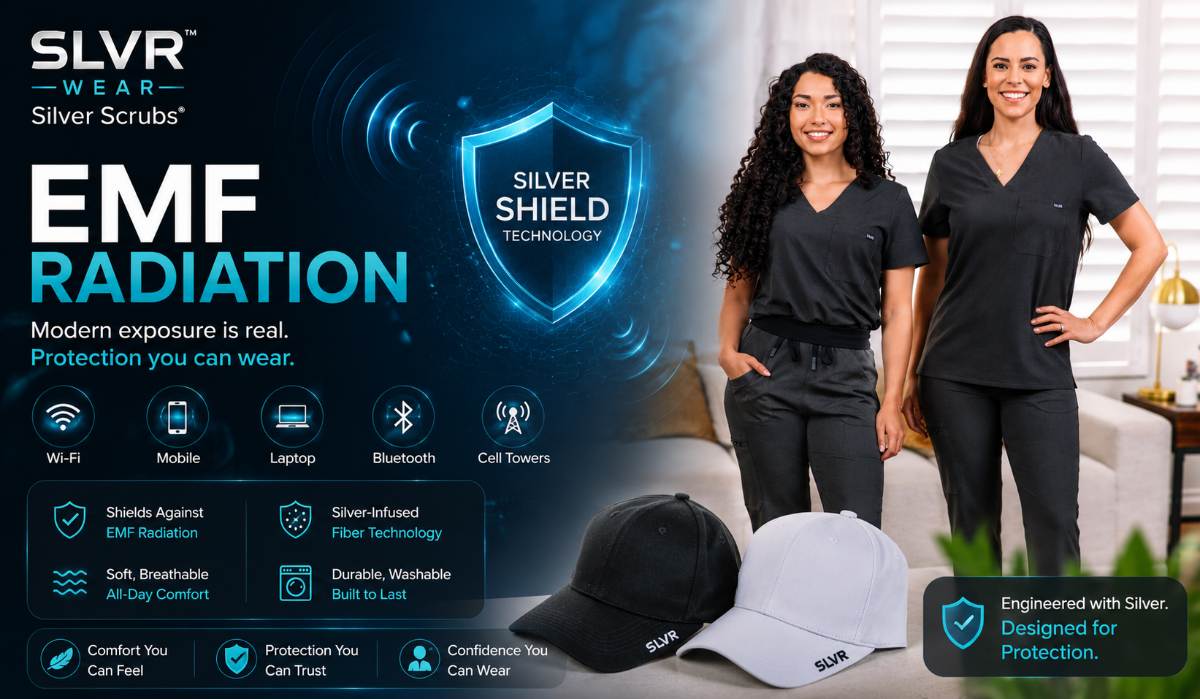
SLVR Wear products are designed for people who have identified elevated RF levels in their environment and want a practical, wearable or deployable means to reduce exposure to wireless signals during specific activities or contexts.
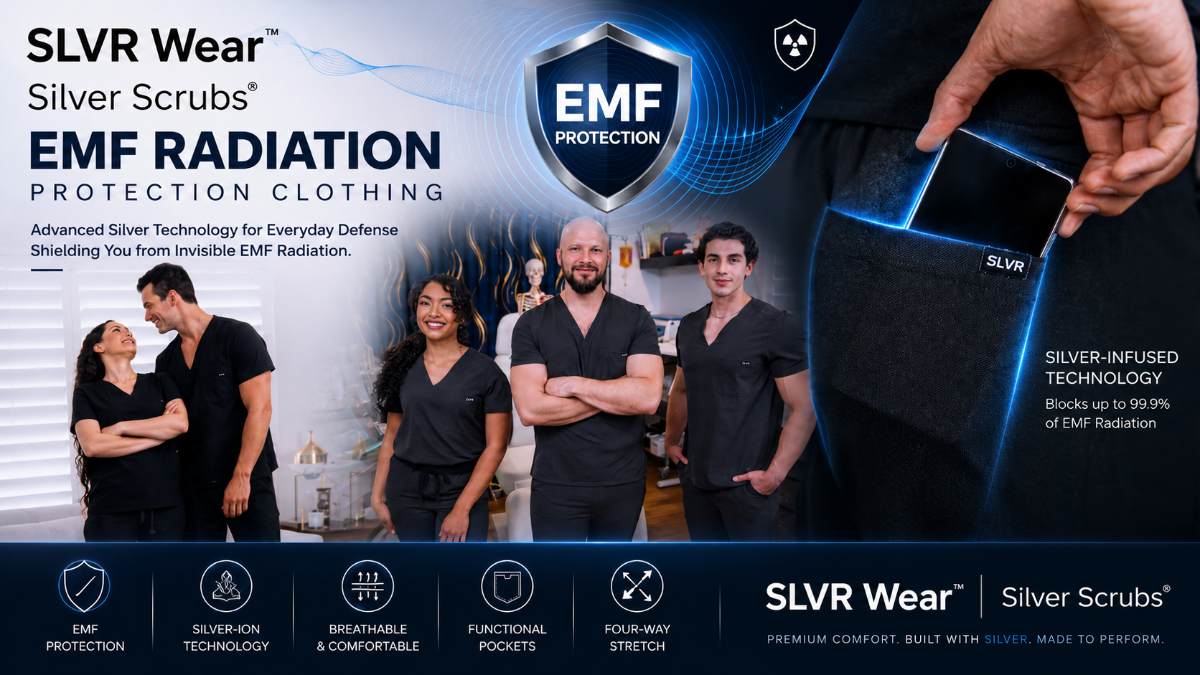
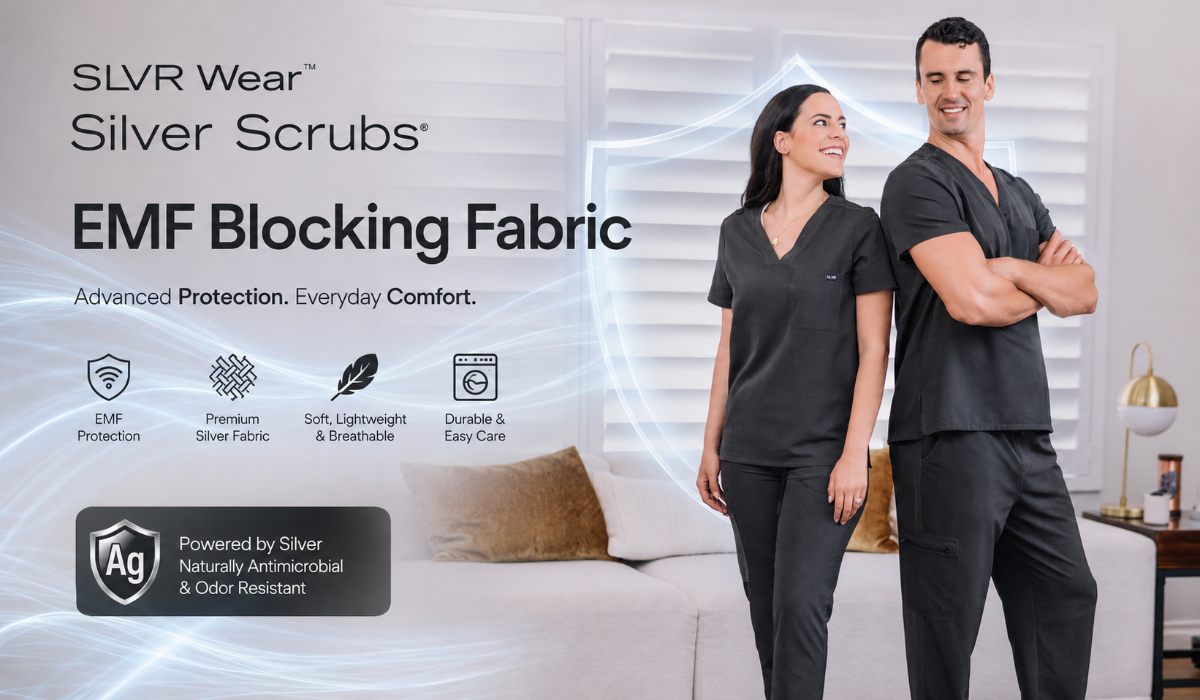
The SilverScrubs® line incorporates 35% pure silver fiber woven directly into the textile not applied as a coating using yarn that is OEKO-TEX® Standard 100 certified and tested free of harmful substances. The silver-fiber construction is what enables the fabric to function as a shielding material rather than standard apparel, and the scrubs format makes that shielding portable across different environments: a clinical setting, a home office, or any context where the wearer chooses to maintain a layer of RF-attenuating fabric between themselves and the ambient wireless environment.
If you’re also considering comfort and wearability alongside shielding performance, our guide to the softest medical scrubs addresses how silver-fiber construction compares to conventional fabrics. For an overview of the full SilverScrubs® range, our complete guide to medical scrubs covers fit, care, and material specifications in detail.
The EMF Blocking Blanket extends the same principle to a stationary context. This shielding layer can be positioned over a sleeping surface, used at a workstation, or deployed in any location where reducing exposure to wireless signals from a specific direction is the objective.
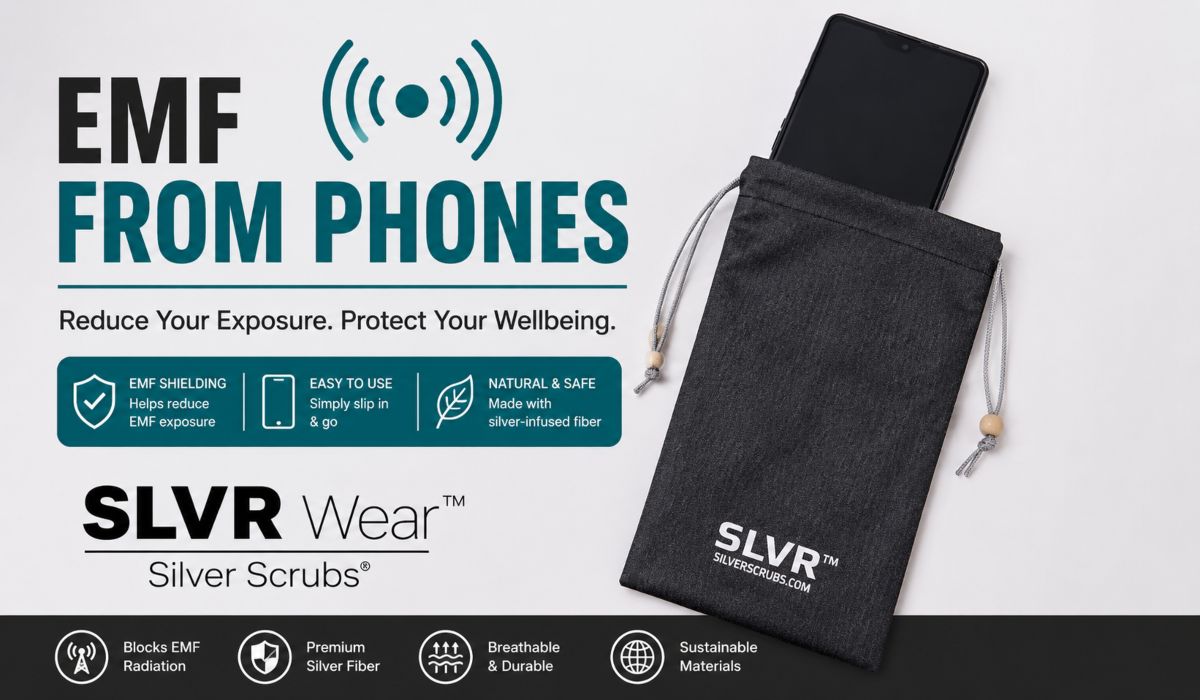
The Faraday Phone Pouch addresses the device-level source directly. A smartphone in active use is one of the highest-output RF sources in a typical home environment a point covered in detail in our article on EMF from phones. Placing the device in a signal-blocking pouch when it is not needed to be accessible eliminates that source from the immediate environment, contributing to an overall reduction in the RF levels the occupant is exposed to.
None of these products eliminate EMF from an environment, and none are substitutes for the source-reduction steps outlined above. They are one practical layer in a broader approach most useful once a home assessment has identified which field types are elevated, where the sources are, and which locations or activities represent the greatest sustained exposure. To explore the full range of EMF radiation protection clothing and EMF protective clothing options, visit the product pages for specifications and laboratory attenuation data.
According to Building Biology (SBM-2015) guidelines, AC magnetic fields below 2 mG (0.2 µT) in sleeping areas are considered a no-concern level. Readings between 2 and 10 mG suggest caution and may warrant investigation. Levels above 10 mG are considered a higher concern and may benefit from source reduction or increased distance from the source.
Building Biology guidelines recommend keeping AC magnetic fields below 2 mG, AC electric fields below 1 V/m, and RF radiation below 0.1 mW/m² in sleeping areas. These are precautionary residential targets intended for long-term exposure environments. They are significantly lower than most government regulatory limits.
The Building Biology no-concern threshold for RF radiation in sleeping areas is below 0.1 mW/m² (100 µW/m²). Levels between 0.1 and 1 mW/m² are considered slight concern, while readings above 1 mW/m² indicate increased concern. The guideline is designed for long-term residential exposure and follows a precautionary approach.
Legal exposure limits are regulatory standards designed to prevent established short-term biological effects, such as tissue heating or nerve stimulation. Building Biology guidelines are voluntary precautionary recommendations intended for long-term exposure in homes, particularly bedrooms. As a result, a home may comply with legal limits while exceeding Building Biology targets.
A safe reading depends on the type of field being measured and the guideline being used. Under Building Biology standards, magnetic field readings below 2 mG and RF readings below 0.1 mW/m² in sleeping areas fall within the no-concern range. Always ensure your meter measures the correct field type and consider average readings rather than a single momentary measurement. For step-by-step guidance on taking accurate readings, see our full guide on how to measure EMF radiation at home.
SLVR Wear products are not medical devices and are not intended to diagnose, treat, cure, or prevent any disease.