Silver Scrubs® Medical Clothing | EMF Blocking Scrubs
Every day, nurses, physicians, radiologists, and allied health professionals enter environments saturated with invisible electromagnetic fields from diagnostic equipment, wireless…
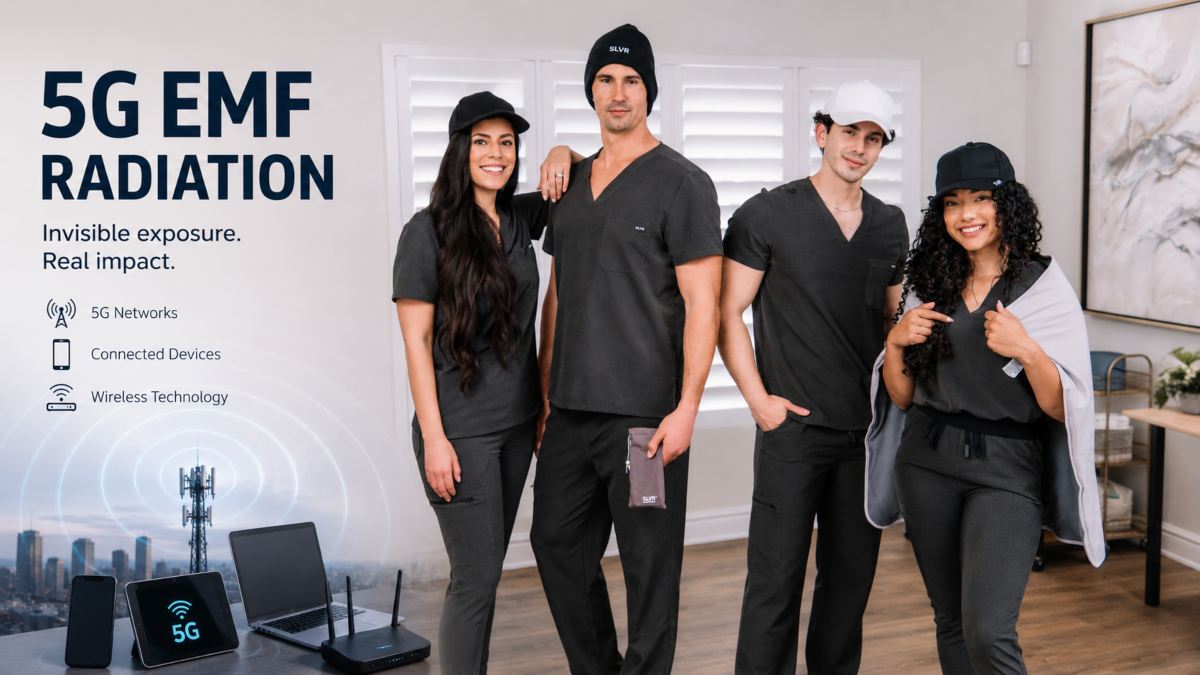
5G EMF radiation refers to the electromagnetic field energy emitted by fifth-generation wireless networks, which operate across a broader and higher frequency range than any previous cellular technology including millimeter-wave bands that reach up to 100 GHz.
Wireless signals have always been part of modern life, but 5G has changed the conversation in a meaningful way. Earlier generations of cellular technology operated primarily in frequency ranges below 6 GHz. With 5G, network infrastructure now transmits across both sub-6 GHz bands and mmWave frequencies that push into territory previously associated with scientific instrumentation and military radar. That shift in frequency range is the reason 5G EMF radiation is no longer a niche concern it’s a legitimate subject of scientific inquiry, engineering research, and growing public awareness.
For most people, exposure to wireless EMF is ambient and intermittent. For others particularly healthcare professionals who spend 8 to 12-hour shifts in environments dense with wireless devices, patient monitors, connected equipment, and mobile communications infrastructure that exposure is constant, layered, and cumulative. Understanding what 5G EMF radiation actually is, how it differs from earlier wireless signals, and what attenuation means in practical terms is the foundation for making informed decisions about exposure management.
This guide covers all of it: the physics of EMF, how 5G and EMF radiation interact differently than prior generations, how electromagnetic shielding works at the material level, and what lab-verified performance data actually tells you. No speculation, no alarmism just the science, the standards, and the facts.
SLVR Wear™ products are not medical devices and are not intended to diagnose, treat, cure, or prevent any disease.
EMF radiation electromagnetic field radiation is energy that travels through space in the form of oscillating electric and magnetic fields. Every device that runs on electricity or transmits a wireless signal produces it, and it exists across a vast continuum of frequencies, from the lowest radio waves to the most energetic gamma rays.
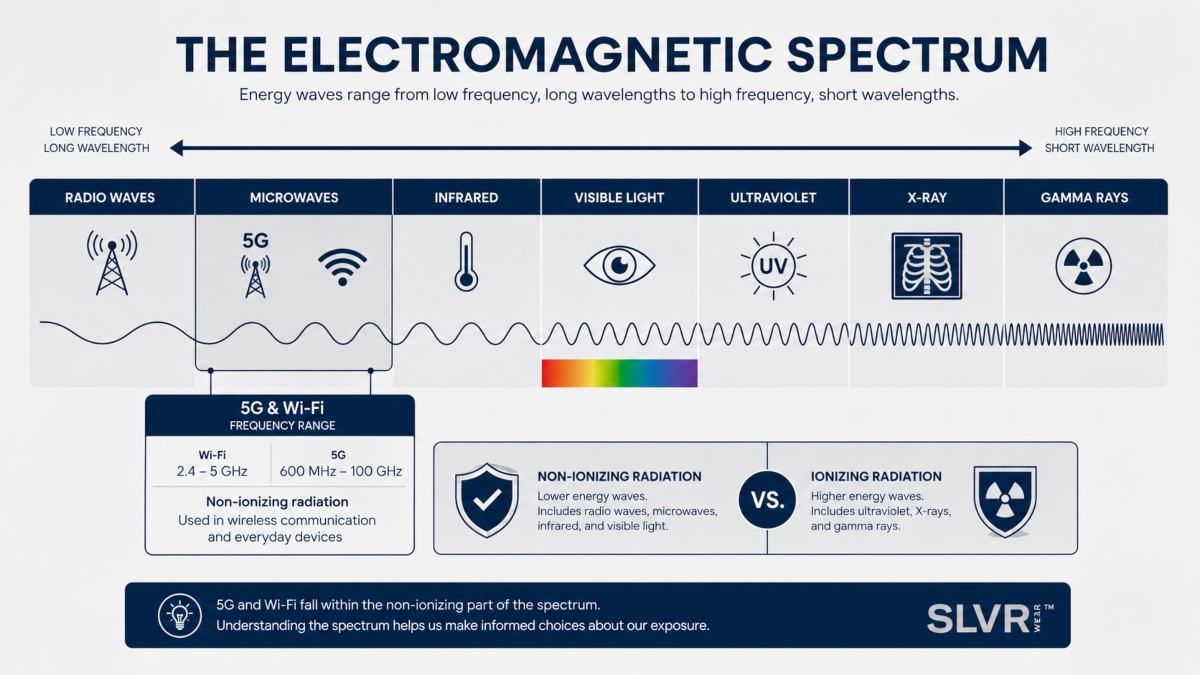
The electromagnetic spectrum is the complete range of all electromagnetic energy, organized by frequency and wavelength. At the low-frequency end sit radio waves long, slow oscillations used for AM/FM broadcasting and early cellular networks. Moving up in frequency, the spectrum passes through microwaves (where Wi-Fi, Bluetooth, and 5G operate), then infrared light, visible light, ultraviolet light, X-rays, and finally gamma rays at the highest end of the spectrum.
What separates these categories is not the type of energy it’s all electromagnetic but the frequency at which that energy oscillates and, consequently, the amount of energy each wave carries. A higher frequency means a shorter wavelength and more energy per photon. That relationship is what makes some parts of the spectrum harmless at normal exposure levels, while others are genuinely dangerous.
5G networks, depending on the band, operate between roughly 600 MHz and 100 GHz sitting firmly in the microwave and upper radio portion of the spectrum, well below the frequencies associated with biological damage from radiation. For a broader look at how the spectrum is classified and why frequency matters for everyday exposure, see our full EMF radiation explained guide.
Any device that carries an electric current generates an electromagnetic field. That includes everything from a household power outlet to a smartphone, a Wi-Fi router, a Bluetooth headset, a hospital patient monitor, or a 5G base station on a street corner.
The mechanism is straightforward: alternating current creates an oscillating electric field, which in turn generates a corresponding magnetic field. Together, these two fields propagate outward from the source as electromagnetic radiation. The frequency at which the current alternates determines where the resulting EMF falls on the spectrum.
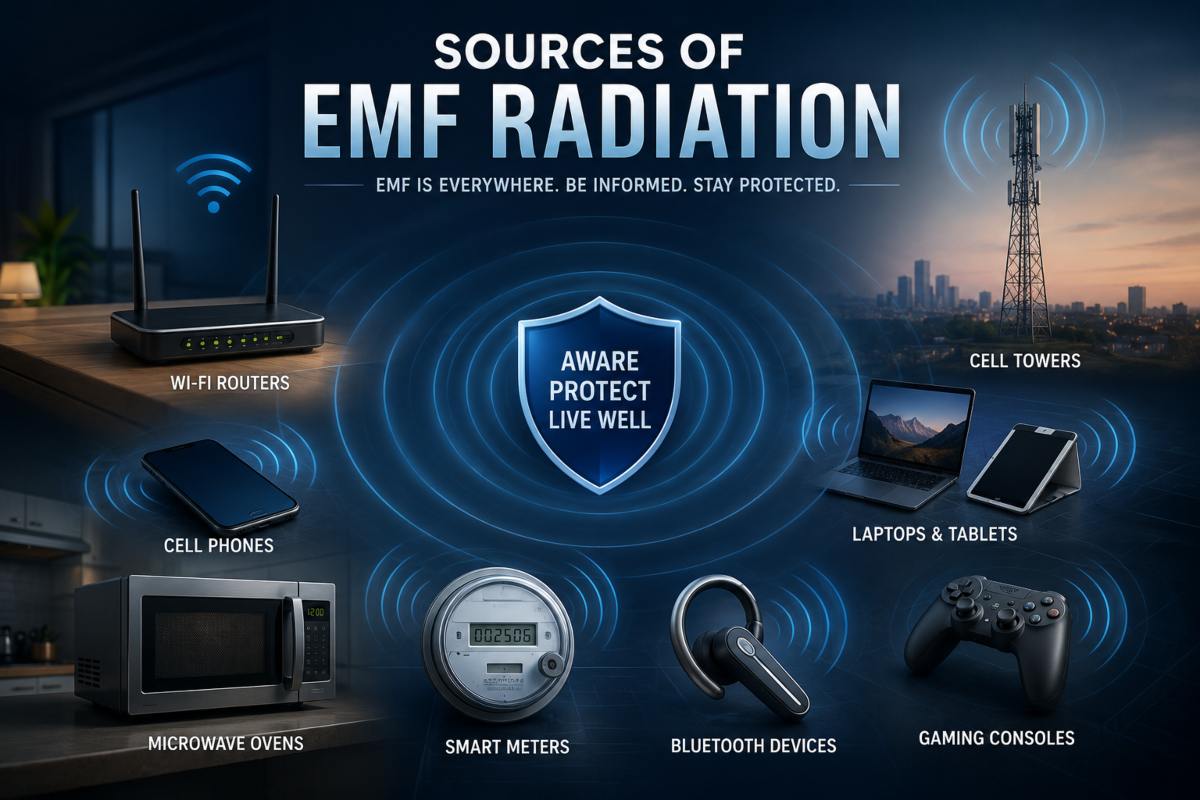
Wireless devices introduce a specific category of EMF radiofrequency electromagnetic fields (RF-EMF) because they are designed to deliberately transmit energy through space as part of their function. A Wi-Fi router isn’t a byproduct of EMF; the EMF is the signal. The same is true for every cellular device, connected wearable, and wireless medical instrument. For a breakdown of the most common everyday transmitters and where they fall on the spectrum, see our sources of EMF radiation. In environments where dozens of these devices operate simultaneously like a hospital ward or a busy clinical floor the cumulative radiofrequency environment is meaningfully more complex than in a typical residential setting.
The most important distinction in any discussion of EMF radiation is the line between ionizing and non-ionizing radiation, because these two categories behave in fundamentally different ways and carry very different implications.
Ionizing radiation X-rays, gamma rays, and high-energy UV carries enough energy per photon to strip electrons from atoms. That process, ionization, is what makes it capable of damaging DNA and biological tissue at sufficient exposure levels. This is the radiation associated with nuclear events, medical imaging equipment, and certain industrial processes.
Non-ionizing radiation, which includes radio waves, microwaves, infrared, and visible light, does not carry enough energy per photon to ionize atoms. Wi-Fi is non-ionizing. Bluetooth is non-ionizing. 5G, across all its frequency bands, is non-ionizing. The International Commission on Non-Ionizing Radiation Protection (ICNIRP), which sets the exposure guidelines followed by most regulatory agencies globally, classifies all cellular and Wi-Fi frequencies in this category.
That classification does not mean exposure is irrelevant frequency, intensity, duration, and proximity all factor into any honest assessment. For a full look at how regulatory agencies define acceptable exposure thresholds, see our safe EMF levels reference. But understanding where 5G EMF radiation falls on the spectrum is essential groundwork before evaluating shielding, attenuation, or any kind of exposure management.
 Is 5G EMF Radiation Different from Previous Generations?
Yes, 5G EMF radiation operates across a significantly wider and higher frequency range than any previous wireless generation, which changes how the signal travels, how it interacts with materials, and what shielding it requires to be effectively attenuated.
Each generation of cellular technology was built to carry more data faster than the one before it, and the primary engineering lever for achieving that has always been frequency. Higher frequencies can carry more data per second but they also behave differently in the physical world.
2G networks operated primarily in the 850 MHz to 1900 MHz range. 3G expanded into the 850-2100 MHz band. 4G LTE pushed further, covering roughly 700 MHz to 2500 MHz depending on the carrier and region. Each of these generations shared a common characteristic: their signals traveled relatively long distances, penetrated buildings and other obstacles with reasonable efficiency, and required fewer, more widely spaced towers to achieve coverage.
5G fundamentally changes that equation. While it does operate in sub-6 GHz bands that overlap with 4G territory, it also introduces millimeter-wave frequencies between 24 GHz and 100 GHz a range that no previous consumer wireless standard has used at scale. The behavior of signals in that range is categorically different from anything that came before in the context of everyday wireless exposure.
The answer is more nuanced than a simple yes or no, and the distinction matters for anyone thinking seriously about EMF exposure management.
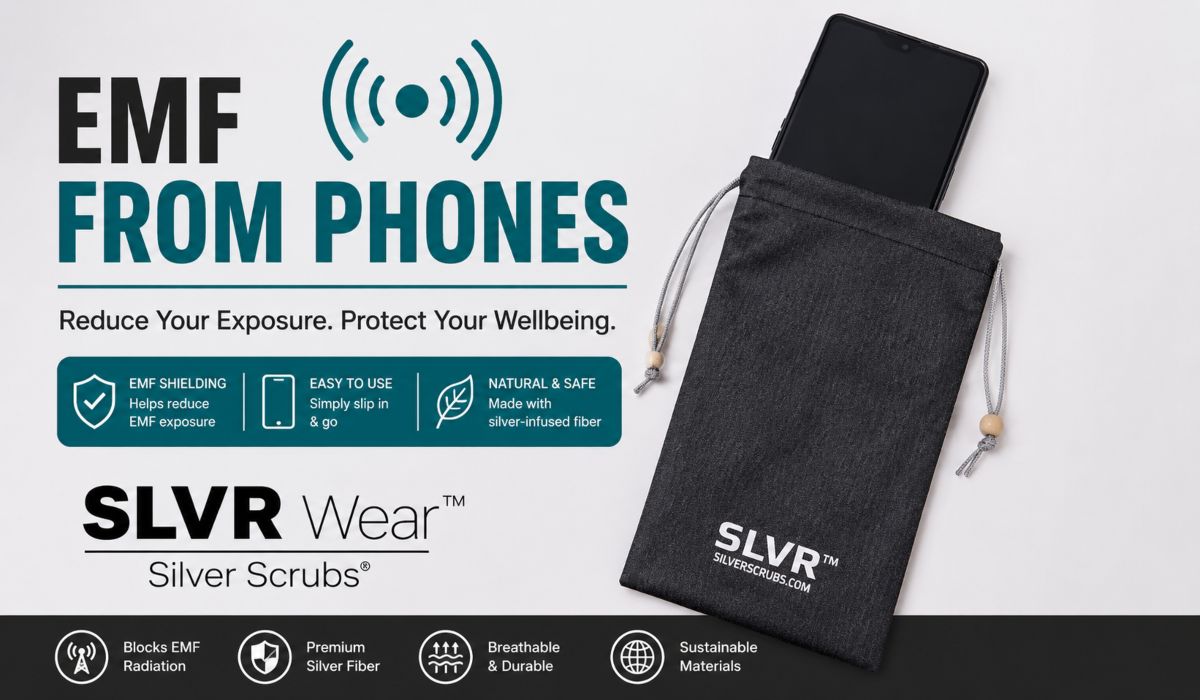
At the level of individual devices smartphones, hotspots, wearables 5G does not necessarily emit more power than 4G hardware. Regulatory bodies, including the FCC, set maximum permissible exposure limits, and device manufacturers must comply regardless of the hardware’s generation. Measured in terms of Specific Absorption Rate (SAR), many 5G handsets fall within ranges comparable to their 4G predecessors. For a closer look at how phone-specific EMF differs from infrastructure exposure, see our EMF from phones guide.
What changes with 5G is the density and distribution of the radio-frequency environment. Because mmWave signals attenuate rapidly over distance and are easily blocked by physical obstacles, 5G infrastructure requires a dramatically higher concentration of small cells and base stations to maintain coverage placed on street furniture, building facades, utility poles, and inside venues. A 2020 analysis published in the International Journal of Environmental Research and Public Health noted that 5G deployment is expected to substantially increase the density of RF-EMF sources in urban environments, even if the power output per source remains within established limits. The cumulative effect of more transmitters operating across a wider frequency range is a meaningfully more complex radiofrequency environment than previous generations created.
Not all 5G is the same, and the distinction between sub-6 GHz 5G and millimeter-wave 5G is significant enough that they behave almost like two different technologies in practical deployment.
Sub-6 GHz 5G operates in frequency bands below 6 GHz and largely inherits the propagation characteristics of 4G reasonable range, moderate building penetration, and coverage from widely spaced towers. For most users in most locations, this is the 5G they are actually connecting to.
Millimeter-wave 5G, operating between 24 GHz and 100 GHz, is an entirely different proposition. At these frequencies, signals travel shorter distances, are absorbed or reflected by a much wider range of physical materials, and require dense infrastructure to sustain coverage. The tradeoff is raw speed and capacity mmWave 5G can theoretically deliver multi-gigabit throughput in high-density environments like stadiums, transit hubs, and hospitals. That last environment is particularly relevant: healthcare facilities are among the earliest and most aggressive adopters of mmWave 5G infrastructure, precisely because the technology can support the high-bandwidth demands of connected medical equipment, imaging systems, and patient monitoring networks.
From a shielding perspective, mmWave frequencies also require materials with validated high-frequency performance. A fabric or barrier that attenuates signals effectively at 2.4 GHz standard Wi-Fi frequency does not automatically perform equivalently at 28 GHz or 50 GHz. That gap is why frequency-specific lab testing, particularly at 50 GHz and above, is meaningful rather than decorative. For a full breakdown of what shielding at these frequencies requires from a material standpoint, see our what blocks EMF radiation.
The move to higher frequencies was not arbitrary it was an engineering necessity driven by a problem that lower-frequency spectrum could no longer solve.
Radiofrequency spectrum is a finite resource. The sub-6 GHz bands that support 2G through 4G are heavily allocated across hundreds of competing uses: television broadcasting, aviation navigation, military communications, satellite systems, and cellular networks all share a relatively narrow slice of the usable spectrum. By the time global mobile data demand began doubling roughly every two years, it became clear that the existing frequency real estate could not support the bandwidth requirements of connected infrastructure at scale.
Millimeter-wave spectrum offered a practical solution: vast, largely underutilized bands capable of carrying enormous amounts of data. The engineering challenges shorter range, sensitivity to physical obstructions, and the need for denser tower infrastructure were considered acceptable trade-offs for the capacity gains. The result is that 5G pushes electromagnetic transmission into frequency territory that the previous three generations of wireless technology never approached in consumer applications, bringing with it both new capabilities and a genuinely new set of questions about long-term exposure in high-density deployment environments.
EMF radiation travels through space as oscillating waves of electric and magnetic energy, moving outward from a source in all directions at the speed of light and what happens to those waves once they leave the source depends almost entirely on frequency, distance, and the materials they encounter along the way.
When a wireless device transmits a signal, it releases electromagnetic energy that radiates outward from the antenna in a pattern determined by the device’s design. That energy does not travel in a straight line to its destination and stop it propagates spherically, spreading across an expanding wave front that weakens as it covers more area. This is why a cell tower can serve a wide geographic radius, and why your phone’s signal degrades as you move further from the nearest base station.
The inverse-square law describes the physics governing this behavior: as the distance from a source doubles, the signal intensity drops to one-quarter of its original value. That relationship holds across all wireless frequencies and is one of the most consistent and well-established principles in electromagnetic physics. It also explains why proximity to a transmitter is the single most reliable predictor of exposure intensity not the frequency, not the technology generation, but simple physical distance.
Wireless signals also interact with the medium through which they travel. In a vacuum, electromagnetic waves propagate without loss. In the real world through air, building materials, human tissue, and clothing every material the wave encounters absorbs, reflects, or transmits some portion of the signal energy, with the exact ratio determined by the material’s electrical properties and the signal’s frequency.
Three variables govern how much EMF energy reaches any given point: distance from the source, the nature of the materials between the source and that point, and the physical geometry of any obstacles in the signal path.
Distance has already been established as the dominant factor. But materials matter significantly, and their effect is highly frequency-dependent. Low-frequency signals in the range used by AM radio or early 2G cellular pass through most common building materials with minimal loss. Concrete, glass, drywall, and wood offer relatively little resistance to signals below 1 GHz. As frequency increases, that changes. Higher-frequency signals are absorbed and reflected more aggressively by a wider range of materials, which is why mmWave 5G signals can be attenuated by something as thin as a pane of glass or a human hand placed over an antenna.
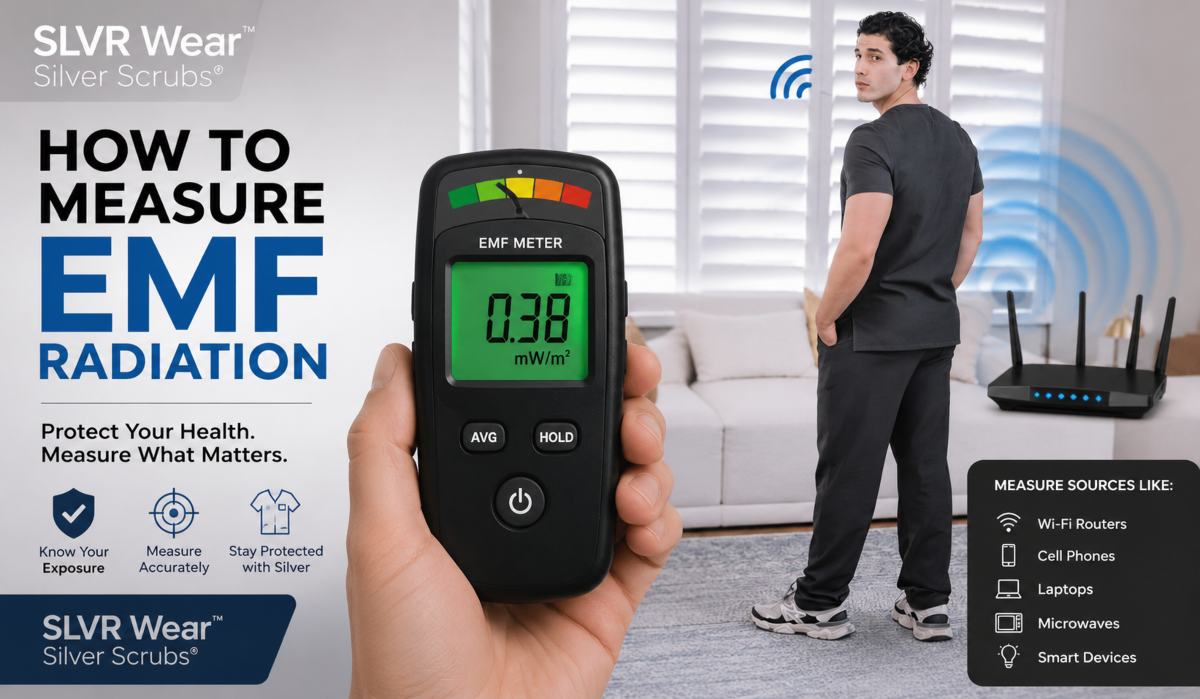
The electrical conductivity of a material is particularly relevant to shielding applications. Conductive materials metals being the clearest example interact with electromagnetic fields by inducing currents within the material itself, which effectively intercepts the incoming wave and prevents it from passing through. This is the principle behind Faraday cages, shielded cables, and conductive-fiber textiles designed to attenuate EMF. For a practical guide to measuring the EMF environment in your home or workplace, see how to measure EMF radiation at home. The higher the conductivity of the material and the more complete its coverage, the more effectively it intercepts the signal before it reaches what lies beyond.
Frequency is not just a label it determines how electromagnetic energy interacts with the physical world at a fundamental level, and the differences between low-frequency and high-frequency signal behavior are substantial enough to matter for anyone evaluating EMF exposure or shielding performance.
Lower-frequency signals have longer wavelengths. Those longer wavelengths allow the signal to diffract to bend around obstacles and corners which is why an AM radio signal can reach a receiver on the other side of a hill. They also penetrate many common materials with relatively little attenuation, which historically made low-frequency cellular bands valuable for indoor coverage.
Higher-frequency signals, by contrast, have shorter wavelengths that do not diffract as readily. They travel along more direct paths, are more easily blocked or absorbed by physical obstacles, and lose energy more quickly when they encounter materials with strong electrical or molecular absorption. Millimeter-wave signals at 24 GHz and above can be meaningfully attenuated by rain, foliage, human skin, and even the water vapor in humid air. That sensitivity to physical interaction is precisely what makes higher-frequency signals both more challenging to deploy at infrastructure scale and more responsive to shielding materials at close range.
For EMF shielding applications, this frequency-dependent behavior is critical. A material that performs well at 2.4 GHz does not automatically perform equivalently at 28 GHz or 50 GHz. Validated shielding performance at high frequencies requires testing at those specific frequencies which is why lab data covering the full 5G spectrum, including mmWave bands up to 50 GHz, is the relevant benchmark for any serious shielding claim. Our EMF blocking fabric covers exactly how SLVR777™ performs across that range.
Attenuation is the reduction in signal intensity that occurs as electromagnetic energy passes through a material or travels across distance. In the context of EMF shielding, it is the core performance metric. This number tells you how much of an incoming signal a material actually intercepts versus how much passes through.
Attenuation is measured in decibels (dB), a logarithmic unit that expresses the ratio between the signal strength before and after it encounters a material. Because the decibel scale is logarithmic, the relationship between dB values and the reduction in real-world signals is not linear. A 10 dB reduction represents a tenfold decrease in signal power. A 20 dB reduction represents a hundredfold decrease. A 30 dB reduction which many engineered shielding materials aim to achieve represents a thousandfold reduction in the power of the signal passing through.
For silver-fiber textiles tested to military-grade shielding standards, attenuation is measured across a range of frequencies to determine where the material performs, how consistently it performs, and its peak effectiveness. Silver Scrubs® by SLVR Wear™ have been lab-tested to GJB 5792A-2021 military-grade standard, achieving up to 99.91% EMF attenuation at 50 GHz a figure that covers the full operational frequency range of current 5G infrastructure, including millimeter-wave bands. That level of independently verified attenuation performance is what separates a substantiated shielding claim from a marketing assertion.
People who spend the most time in proximity to multiple simultaneous wireless transmitters have the highest daily EMF exposure and, in most cases, that means people whose occupation places them in environments with dense, continuously active wireless infrastructure.
The inverse square law established earlier in this guide makes one thing clear: distance from a transmitter is the primary determinant of exposure intensity. That principle scales directly into occupational context. Someone who spends eight hours a day seated near a single router in a quiet office occupies a very different radiofrequency environment than someone who spends the same eight hours moving through a space where dozens of wireless devices, access points, and networked instruments are transmitting simultaneously from short range.
Occupational EMF exposure is distinct from ambient background exposure in two important ways. First, it is sustained not a brief interaction with a device but an extended, repeated presence inside a radiofrequency-dense environment across a full working day, five or more days a week. Second, it is cumulative across sources. A clinical environment does not have a single EMF source it has dozens operating across multiple frequency bands simultaneously, creating a layered radiofrequency environment that no single-source measurement can adequately capture.
Regulatory bodies including the International Labour Organization and ICNIRP have long recognized occupational RF-EMF exposure as a distinct category requiring its own assessment framework, separate from the general public exposure limits that govern consumer device standards.
Healthcare professionals represent one of the most consistently high-exposure occupational groups in the context of RF-EMF, for reasons that are structural rather than incidental.
Modern clinical environments are among the most wireless-dense spaces in civilian infrastructure. Patient monitoring systems, infusion pumps, imaging equipment, electronic health record terminals, staff communication devices, and visitor and patient smartphones all transmit continuously. Hospital networks increasingly operate across multiple simultaneous frequency bands 2.4 GHz and 5 GHz Wi-Fi, Bluetooth, DECT telephony, and now 5G private networks deployed specifically to support the bandwidth demands of connected medical equipment. A 2022 review in the journal Electromagnetic Biology and Medicine noted that RF-EMF exposure levels measured in hospital environments frequently exceed those recorded in typical residential or office settings, particularly in intensive care and operating theater environments where device density is highest.
For a nurse, physician, or surgical technician working a 12-hour shift in that environment, the radiofrequency exposure profile across a single working day is qualitatively different from that of most other professions. The exposure is not occasional or ambient it is continuous, multi-source, and occurs at close range, producing the highest field intensities. EMF radiation protection clothing, purpose-built for clinical wear, is one of the few practical options for managing that exposure without changing the occupational environment.
Most published EMF safety guidelines are written around single-source exposure scenarios a person holding a phone, standing near a tower, or working adjacent to a specific piece of equipment. Those frameworks are useful as a baseline but they do not fully describe what happens when an individual is surrounded by multiple simultaneous sources across an extended period.
Cumulative daily exposure is not simply the sum of individual source measurements. The sources interact, overlap in frequency, and vary in their distance from the body throughout a shift. A healthcare worker may be within arm’s reach of a patient monitor, carrying a pager or wireless communicator, working in a room with ceiling-mounted Wi-Fi access points, and operating in a building with a 5G small cell installed on an exterior wall all simultaneously. Each source contributes to the total radiofrequency environment the body is immersed in throughout that shift.
The distinction between peak exposure from a single high-intensity source and sustained low-to-moderate exposure across multiple sources over many hours is an active area of research in occupational health. What is not in dispute is the underlying physics: cumulative time-in-field across multiple simultaneous sources produces a meaningfully different exposure profile than brief or single-source interactions, and occupational environments are where that cumulative profile is most reliably and repeatedly encountered.
Healthcare leads in RF-EMF density among civilian occupational environments, but it is not alone. Several other industries produce similarly complex radiofrequency environments through the nature of their infrastructure and operations.
Telecommunications and IT infrastructure roles network engineers, data center technicians, tower maintenance crews place workers in direct proximity to high-power transmitters and dense switching equipment for extended periods. First responders operate communications equipment continuously and work in environments where multiple agencies’ radio systems are simultaneously active. Education technology environments, particularly in schools and universities that have deployed dense Wi-Fi infrastructure across campuses, create sustained exposure for teachers and administrators who remain on-site throughout the day.
Manufacturing and logistics environments that have adopted Industry 4.0 infrastructure wireless sensor networks, RFID systems, connected robotics, and private LTE or 5G networks now generate radiofrequency environments that did not exist a decade ago. The common thread across all of these is not the presence of a single powerful source but the sustained, multi-source, multi-frequency character of the wireless environment and the number of hours per week a worker spends inside it. That combination density, duration, and repetition is what distinguishes occupational exposure as a category worth taking seriously and managing deliberately. Workers in any of these environments may also want to consider EMF protective clothing as part of a broader exposure management approach.
EMF shielding is the use of conductive materials to intercept and attenuate electromagnetic field radiation before it reaches a protected area or surface and the mechanism behind it is electrical conductivity, not chemistry, filtration, or absorption in the conventional sense.
When an electromagnetic wave encounters a conductive material, something specific happens at the physics level: the oscillating electric field component of the wave drives free electrons within the conductive material into motion. Moving electrons generate their own opposing electromagnetic field, effectively canceling or significantly reducing the energy of the incoming wave. The wave does not simply bounce off or get absorbed; the insulation absorbs heat the induced electrical response of the conductive material itself actively counteracts it.
This process is described in electromagnetic theory as the interaction between an incident wave and a conductor’s free electron density. The more conductive the material meaning the more freely electrons can move within it the more effectively this cancellation occurs. Metals with high conductivity, such as copper, aluminum, and silver, are the most effective shielding materials because they support the strongest induced electron response to an incoming electromagnetic field.
The effectiveness of that response is also frequency-dependent. At higher frequencies, the depth to which an electromagnetic wave can penetrate a conductive material before being attenuated decreases a phenomenon known as the skin effect. This means that at millimeter-wave frequencies used by 5G, even a relatively thin layer of highly conductive material can achieve significant attenuation, provided it maintains consistent conductivity across its surface.
The practical application of electromagnetic shielding depends on three material properties working together: conductivity, continuity, and coverage.
Conductivity determines how strongly the material responds to an incoming electromagnetic field. A material with poor conductivity plastic, cotton, most synthetic fibers allows the wave to pass through largely unimpeded because there are insufficient free electrons to generate a meaningful opposing field. A highly conductive material responds immediately and forcefully, inducing currents that counteract the incoming wave across the full area of contact.
Continuity matters because gaps in a conductive surface are gaps in the shield. A sheet of copper foil with a pinhole allows a disproportionate amount of signal through relative to the size of the opening, because electromagnetic energy concentrates around discontinuities in a conductor. For wearable shielding applications, this means the conductive element must be woven uniformly throughout the textile rather than applied as a coating, patch, or surface treatment that can crack, peel, or develop gaps with wear and washing.
Coverage refers to the geometric relationship between the shield and the source. A conductive material only attenuates the signals it physically intercepts. For occupational EMF shielding in a clinical environment where signals arrive from multiple directions across a full workday the coverage area of the shielding garment determines the practical scope of attenuation.
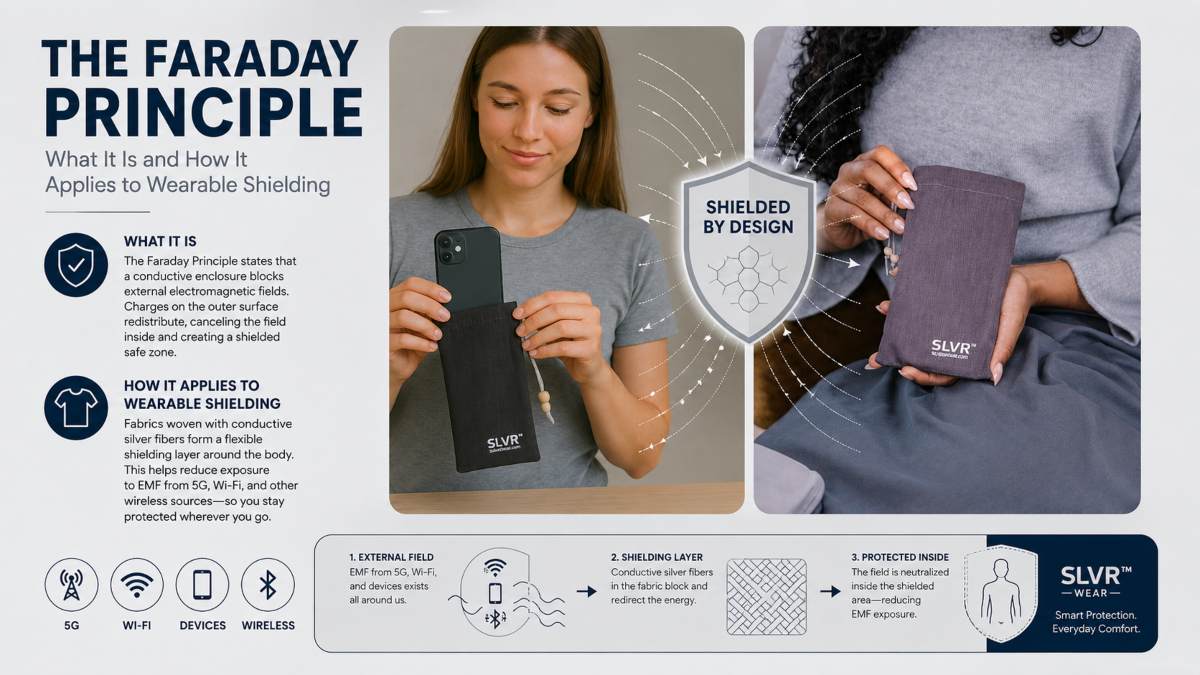
The theoretical foundation for electromagnetic shielding was established by Michael Faraday in 1836, when he demonstrated that a conductive enclosure could completely isolate its interior from external electromagnetic fields. The principle now universally referred to as the Faraday cage effect showed that free charges within a conductive material redistribute in response to an external field in a way that cancels the field’s effect inside the enclosure.
In its purest form, a Faraday cage is a fully enclosed conductive shell: a metal box, a shielded room, a grounded mesh enclosure. The more complete the conductive coverage, the more complete the shielding. This principle underlies everything from the shielded cables in hospital equipment to the signal-blocking design of the SLVR Wear™ Faraday Phone Pouch, which uses the same conductive interception mechanism to block wireless signals from reaching a device stored inside it.
Wearable shielding applies the same principle within the practical constraints of a garment. A textile woven with conductive fiber does not create a sealed enclosure in the geometric sense. Still, it does create a conductive surface layer that intercepts electromagnetic waves across the area it covers. The attenuation is proportional to the fiber’s conductivity, the weave density, and the consistency of conductive coverage across the fabric surface. When those variables are optimized as they are in purpose-engineered silver-fiber textiles the Faraday principle delivers measurable, lab-verified shielding performance in a form that can be worn throughout a 12-hour clinical shift.
 Silver Fiber as a Conductive Shielding Material Why Conductivity Is the Mechanism
Silver is the most electrically conductive element on the periodic table more conductive than copper, gold, or aluminum and it is that conductivity, exclusively, that makes silver fiber effective as an EMF shielding material in textile applications.
When silver fiber is woven into a fabric at sufficient concentration and distribution, the conductive network it creates across the textile surface enables the same electron-response mechanism that makes metal enclosures effective shields. Incoming electromagnetic waves drive electrons through the silver fiber network, generating an opposing field that attenuates the signal before it reaches the wearer.
SLVR Wear™’s Silver Scrubs® are constructed from SLVR777™ fabric a proprietary blend of 35% silver fiber, 59% polyester, and 6% spandex in which the silver is woven thread-by-thread into the textile structure rather than applied as a surface coating or treatment. That construction method matters for both performance and durability: a woven conductive network maintains its continuity through repeated washing and wear, unlike coatings or spray-on treatments.
The silver yarn used carries OEKO-TEX® Standard 100 certification, verifying that it has been tested for harmful substances. Independent lab testing to the GJB 5792A-2021 military-grade standard has verified up to 99.91% EMF attenuation at 50 GHz performance spanning the full operational frequency range of current 5G infrastructure, from sub-6 GHz to millimeter-wave bands. Full technical details on the fabric construction are available on our EMF blocking fabric.
The mechanism is conductivity. The silver is in the fabric because silver conducts. That is the complete technical explanation and it is the only one needed.
EMF shielding performance is measured by quantifying how much a material reduces the intensity of an electromagnetic signal passing through it expressed as attenuation in decibels, verified through standardized lab testing across a defined frequency range.
Attenuation is the core metric of any shielding effectiveness claim. The word itself means reduction specifically, the reduction in electromagnetic signal power that occurs when a wave passes through or encounters a shielding material. In EMF shielding contexts, attenuation is always expressed in decibels (dB), a logarithmic unit that describes the ratio between the signal’s intensity before and after it encounters the material.
The logarithmic nature of the decibel scale is important to understand because it means the relationship between dB values and real-world signal reduction is not proportional to what most people intuitively expect. A 10 dB attenuation value represents a tenfold reduction in signal power. A 20 dB value represents a hundredfold reduction. A 30 dB value represents a thousandfold reduction. Each additional 10 dB on the scale represents another order of magnitude of signal reduction, which means the difference between a 20 dB and a 40 dB shielding material is not twice the performance it is a hundredfold difference in actual signal reduction.
For practical reference: a material achieving 99% signal reduction is delivering approximately 20 dB of attenuation. A material achieving 99.9% reduction delivers approximately 30 dB. A material achieving 99.91% reduction at peak frequency the figure verified in independent lab testing for Silver Scrubs® represents attenuation performance well into the range associated with engineered shielding enclosures rather than incidental material properties.
Not all shielding effectiveness claims are created equal, and the testing standard against which a material is measured determines how meaningful the resulting data actually is. GJB 5792A-2021 is a Chinese military-grade electromagnetic shielding effectiveness standard one of the most rigorous textile shielding test methodologies currently in use and it is the standard against which SLVR Wear™ SLVR77 fabric has been independently verified.
The standard specifies both the test methodology and the frequency range across which shielding effectiveness must be measured. It uses a shielded room or a coaxial transmission-line test setup to isolate the fabric sample from ambient electromagnetic interference, ensuring that measured attenuation values reflect the material’s actual performance rather than environmental factors in the test environment. Measurements are taken at multiple frequency points across the specified range, producing a performance curve rather than a single-point figure which is critical because shielding effectiveness varies with frequency, and a material that performs well at one frequency may perform very differently at another.
Military-grade standards are the relevant benchmark for high-performance textile shielding because they were developed in contexts where shielding failure has operationally significant consequences. The testing protocols are more stringent, more precisely specified, and more reproducible than general consumer product testing frameworks, making the resulting data more defensible as a performance claim and more useful as a basis for comparing materials.
The upper boundary of a shielding test’s frequency range is not an arbitrary number it defines the ceiling of the claim. A material tested only to 6 GHz has demonstrated performance within the sub-6 GHz 5G bands and legacy cellular frequencies. Still, it has produced no data on performance in the millimeter-wave bands where 5G also operates. Testing to 50 GHz is particularly meaningful because it covers the full operational frequency range of currently deployed 5G infrastructure, including the mmWave bands between 24 GHz and 40 GHz, which are increasingly active in high-density urban and institutional environments.
Millimeter-wave frequencies present a distinct challenge for shielding materials because signal behavior changes significantly at these wavelengths. The skin effect the tendency of high-frequency electromagnetic fields to interact primarily with the surface layer of a conductor rather than penetrating its full depth becomes more pronounced as frequency increases. This means that materials with identical conductivity can produce very different attenuation results at 50 GHz compared to 2.4 GHz, and only testing at the higher frequency confirms whether the material’s conductive network is dense and consistent enough to maintain shielding effectiveness where current 5G infrastructure actually operates.
For anyone evaluating an EMF shielding textile in 2026, a lab report that terminates at 10 GHz or 18 GHz does not address the full 5G spectrum. Testing to 50 GHz does and it is the standard that makes a shielding claim relevant to the actual radiofrequency environment healthcare professionals and other high-exposure workers occupy today. See our EMF radiation blocking for a direct comparison of material types and their performance across the spectrum.
A shielding effectiveness report from an independent laboratory contains several key elements, and knowing what to look for separates a substantiated performance claim from a number presented without context.
The frequency range is the first thing to check. The report should specify the full range across which measurements were taken, and that range should be relevant to the frequencies the material is claimed to shield against. A report covering 1 MHz to 50 GHz provides meaningful 5G-relevant data. A report covering only a narrow band within the lower gigahertz range does not.
The test methodology section identifies the standard used and the test setup shielded room, coaxial fixture, or another approved method. This matters because different setups have different sensitivities and potential sources of measurement error. Recognized international or military standards provide a guarantee of reproducibility that ad hoc or proprietary test methods do not.
The performance curve typically a graph plotting attenuation in dB against frequency is the core data. Look for consistency across the frequency range, the frequency at which peak attenuation occurs, and whether the curve maintains meaningful attenuation values across the full range claimed rather than peaking narrowly and dropping sharply. A material that achieves 30 dB at a single frequency but falls to 5 dB across most of its range is a very different product from one that maintains strong attenuation across a broad spectrum.
Finally, confirm the testing body. Independent third-party laboratory verification carries significantly more weight than manufacturer self-testing. The lab results for Silver Scrubs® are independently verified and available in full on the lab results the complete data, not a summary figure presented without supporting evidence.
EMF blocking apparel is only as credible as the construction method behind it and the lab data supporting it and knowing what to look for separates genuinely engineered shielding garments from products making unverifiable claims on the back of vague material references.
The single most important structural question to ask about any EMF blocking textile is how the conductive element was introduced into the fabric. There are two fundamentally different approaches, and they produce dramatically different results in terms of shielding durability, consistency, and long-term performance.
Coated or treated fabrics apply a conductive layer typically a metallic spray, solution, or surface finish to a base textile after the fabric has already been constructed. This method is less expensive to produce and easier to apply at scale. Still, it has a critical structural weakness: the conductive layer sits on the surface of the fabric rather than being integrated into its fiber structure. Surface coatings are vulnerable to mechanical abrasion, repeated laundering, and the flexing and stretching that occurs during normal wear. As the coating degrades, so does the conductive network and with it, the shielding effectiveness. A garment that tests well when new may perform very differently after thirty wash cycles.
Woven silver-fiber construction takes the opposite approach. The conductive element silver fiber is incorporated into the yarn before weaving, so the resulting fabric contains silver thread-by-thread throughout its structure rather than as a surface treatment. Because the conductivity is structural rather than superficial, it does not degrade with washing or wear in the same way a coating does. The conductive network is the fabric, not something applied to it. For occupational use garments worn through repeated 12-hour shifts and laundered accordingly that structural integrity is not a minor detail. It is the difference between a shielding garment and a shielding garment that used to shield. The full construction methodology for SLVR777™ fabric is documented on our EMF blocking fabric.
OEKO-TEX® Standard 100 is one of the most widely recognized independent textile certification standards in the world, and understanding what it certifies and what it does not is important context for evaluating any apparel claim that references it.
The certification verifies that every component of a tested textile fiber, yarn, dye, finishing agent, and any other material used in production has been tested and confirmed free of harmful substances at levels that could pose a risk to human health. The testing covers a list of over 100 substances including regulated chemicals, pesticides, heavy metals, formaldehyde, pH value, and colorfast properties. A product carrying the OEKO-TEX® Standard 100 label has passed this battery of substance-safety tests through an accredited independent laboratory it is not a self-declaration.
For silver-fiber apparel specifically, OEKO-TEX® certification of the silver yarn addresses a legitimate question: whether the silver fiber itself poses any chemical concerns for a wearer who will be in skin contact with the garment across long shifts. The certification answers that question with independently verified data rather than a manufacturer assertion. The silver yarn used in SLVR777™ fabric carries OEKO-TEX® Standard 100 certification confirming the conductive material at the core of the shielding mechanism has passed rigorous substance-safety testing. What it does not certify is shielding performance; that requires separate electromagnetic lab testing, which is an entirely different measurement discipline.
A credible EMF shielding claim rests on a small number of verifiable pillars, and the absence of any one of them is a meaningful signal about the reliability of the rest of the brandis claims.
The claim should specify the test standard used. A recognized international or military-grade standard not a proprietary internal methodology provides a reproducibility guarantee and a defined measurement protocol that makes the results comparable and auditable. The claim should specify the frequency range tested, and that range should be relevant to the signals the product is claimed to shield against. For 5G-relevant shielding, that means testing that extends into millimeter-wave frequencies, not only sub-6 GHz bands. The claim should be tied to independently accessible lab documentation not a performance figure that exists only in marketing copy but a report from a named third-party laboratory that can be reviewed in full.
Several red flags are worth knowing. Shielding percentage figures presented without a corresponding frequency range are incomplete 99% attenuation at what frequency, tested how, by whom? Claims that reference shielding performance for product categories that have not been separately tested are unsupported extrapolations for example, blanket or beanie products require independent testing separate from scrubs data. Language that drifts from shielding and attenuation toward health outcomes, wellness benefits, or symptom relief is a compliance concern and often signals that the underlying technical substance of the shielding claim is thin. Credible shielding claims stay in the engineering lane: conductivity, attenuation, frequency range, test standard, lab verification. That is the complete vocabulary of a substantiated claim.
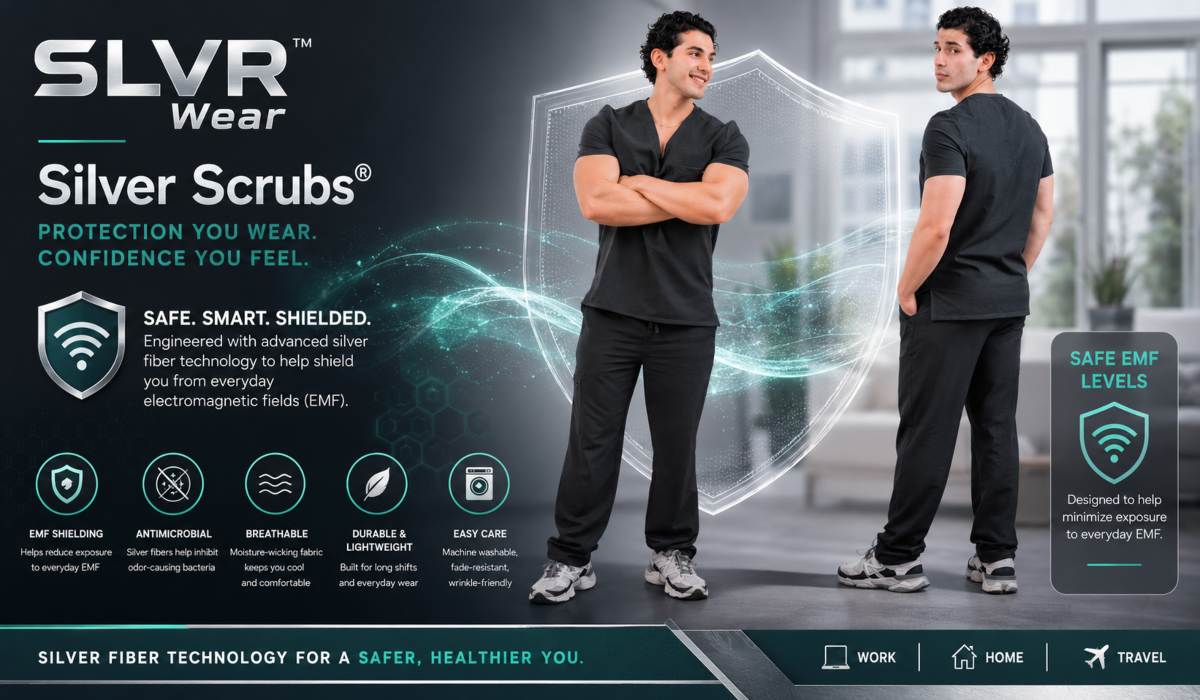
Silver Scrubs® by SLVR Wear™ are purpose-built EMF blocking medical scrubs designed for healthcare professionals who spend extended shifts in wireless-dense clinical environments. Every element of the product fabric composition, construction method, certification, and performance verification maps directly to the criteria that distinguish a credible shielding garment from an unsubstantiated claim.
The fabric, SLVR777™, is a proprietary blend of 35% silver fiber, 59% polyester, and 6% spandex. The silver fiber is woven into the textile structure thread-by-thread not applied as a coating or surface treatment ensuring that the conductive network maintaining shielding effectiveness is structural and durable across repeated laundering and professional use. The silver yarn carries OEKO-TEX® Standard 100 certification, which independently verifies that it is free of harmful substances.
Shielding performance has been independently verified through lab testing to GJB 5792A-2021 military-grade standard, achieving up to 99.91% EMF attenuation at 50 GHz a frequency ceiling that covers the full operational range of current 5G infrastructure, including mmWave bands. The complete lab results are available on the lab results for direct review. The EMF blocking fabric provides full technical detail on the SLVR777™ construction and material composition for those who want to go deeper on the engineering behind the shielding performance.
Silver Scrubs® are available for both men and women across the full SLVR Wear™ scrubs category, in a professional cut designed for clinical wear 4-way stretch, functional pockets, and all-day comfort, built into a garment that also happens to be the most rigorously tested EMF-blocking medical scrub currently available. For those also considering whole-body or area shielding, SLVR Wear™ offers additional products including the Signal Shielding baby blanket, Signal Shielding large blanket, Signal Shielding beanie, and Signal Shielding hat each independently constructed for its specific use case.
5G EMF radiation is not a mystery it is a measurable, well-characterized category of electromagnetic energy that operates according to understood physics, tested by established standards, and manageable through verified engineering approaches.
What this guide has established is a complete picture: EMF radiation exists across a spectrum, 5G extends that spectrum into higher frequencies than previous wireless generations, those higher frequencies create a denser and more complex radiofrequency environment in the spaces where 5G infrastructure is most heavily deployed, and the people most consistently exposed are those whose occupations place them inside those environments for extended periods every working day. Healthcare professionals sit at the center of that reality working in clinical environments that were already wireless-dense before 5G and are becoming more so as connected medical infrastructure continues to expand.
The physics of shielding is equally clear. Conductive materials intercept electromagnetic waves through a well-understood electron-response mechanism. Silver fiber, woven at sufficient density into a textile structure, creates a conductive surface that attenuates wireless signals across the body area it covers. That performance is not a marketing claim it is a measurable, lab-verifiable quantity expressed in decibels, tested across a defined frequency range, and meaningful only when backed by independent documentation to a recognized standard.
For healthcare professionals who want to move from understanding to action, the options are straightforward. Silver Scrubs® by SLVR Wear™ represent the convergence of every principle covered in this guide: silver-fiber construction woven thread-by-thread into a professional clinical garment, OEKO-TEX® Standard 100 certified yarn, and independently verified shielding performance of up to 99.91% EMF attenuation at 50 GHz tested to GJB 5792A-2021 military-grade standard and covering the full frequency range of current 5G infrastructure. The complete lab data is available on the lab results.
Full fabric and construction details are on our EMF blocking fabric. The EMF Education Center offers additional resources for anyone who wants to go further into the science including guides on EMF radiation, sources of EMF radiation, and safe EMF levels.
Understanding the environment you work in is the first step. Having verified options for managing your exposure within it, the second is. Both are now within reach.
SLVR Wear™ products are not medical devices and are not intended to diagnose, treat, cure, or prevent any disease.
No, 5G uses non-ionizing electromagnetic radiation, which lacks the energy to ionize atoms and damage DNA. This differs from ionizing radiation such as X-rays and gamma rays, which can affect biological tissue at high exposures.
Not necessarily from individual devices, as both 4G and 5G follow similar safety limits. However, 5G networks use more small-cell transmitters, creating a denser radiofrequency environment while remaining within regulatory exposure guidelines.
5G operates in sub-6 GHz bands for broad coverage and millimeter-wave (24–100 GHz) bands for high-speed connections. Most users primarily connect through sub-6 GHz networks in everyday use.
EMF attenuation measures how much a material reduces an electromagnetic signal. It is expressed in decibels (dB), where higher dB values indicate greater shielding effectiveness and less signal passing through.
Yes, if it contains conductive materials, such as independently tested woven silver fibers. The effectiveness depends on the fabric’s construction, shielding performance, and verified laboratory results. See our EMF radiation protection clothing for a full overview of what to look for.
A Faraday cage is a conductive enclosure that blocks electromagnetic fields. EMF shielding fabrics use the same principle by incorporating conductive fibers that reduce incoming electromagnetic signals across the covered area. The same principle applies to the SLVR Wear™ Faraday Phone Pouch, which creates a signal-blocking enclosure for stored devices.
They can be, provided the testing is performed by an independent laboratory using recognized standards. Reliable reports clearly state the testing method, frequency range, and shielding results for full transparency.