Silver Scrubs Medical Clothing | EMF Blocking Scrubs
Every day, nurses, physicians, radiologists, and allied health professionals enter environments saturated with invisible electromagnetic fields from diagnostic equipment, wireless…
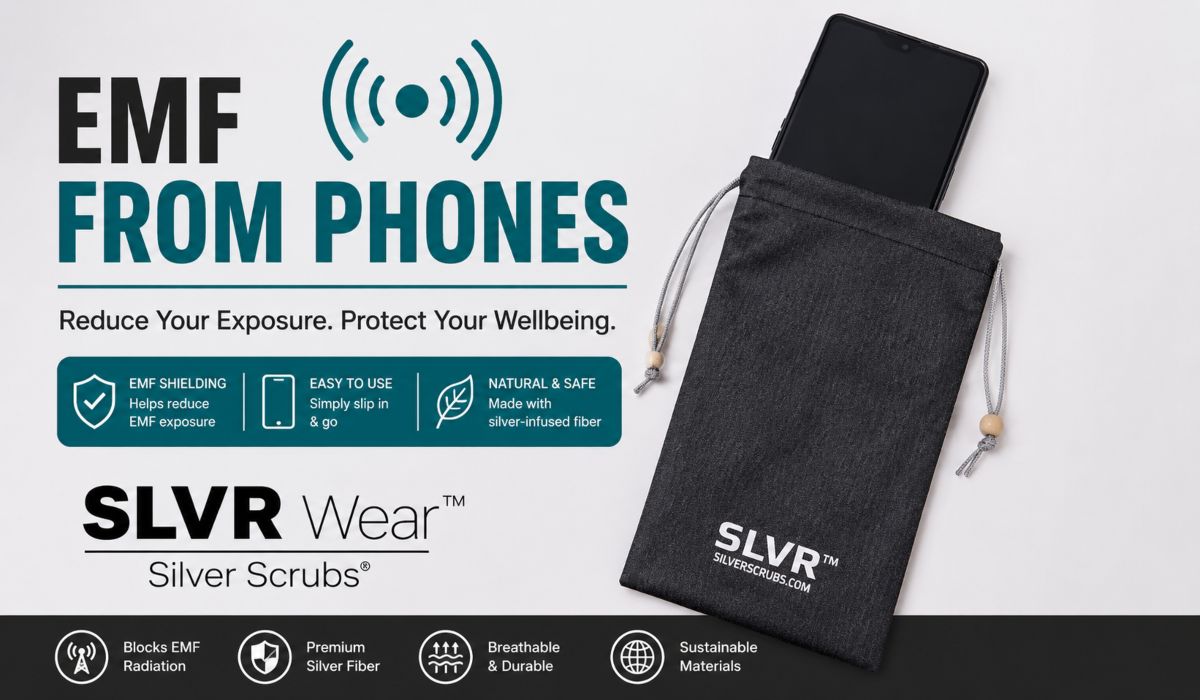
Every phone call, text, and background app sync your phone performs emits EMF non-ionizing electromagnetic radiation generated by the wireless signals your device constantly sends and receives. Understanding what that means, how far it travels, and what actually reduces your exposure is straightforward once you cut through the noise.
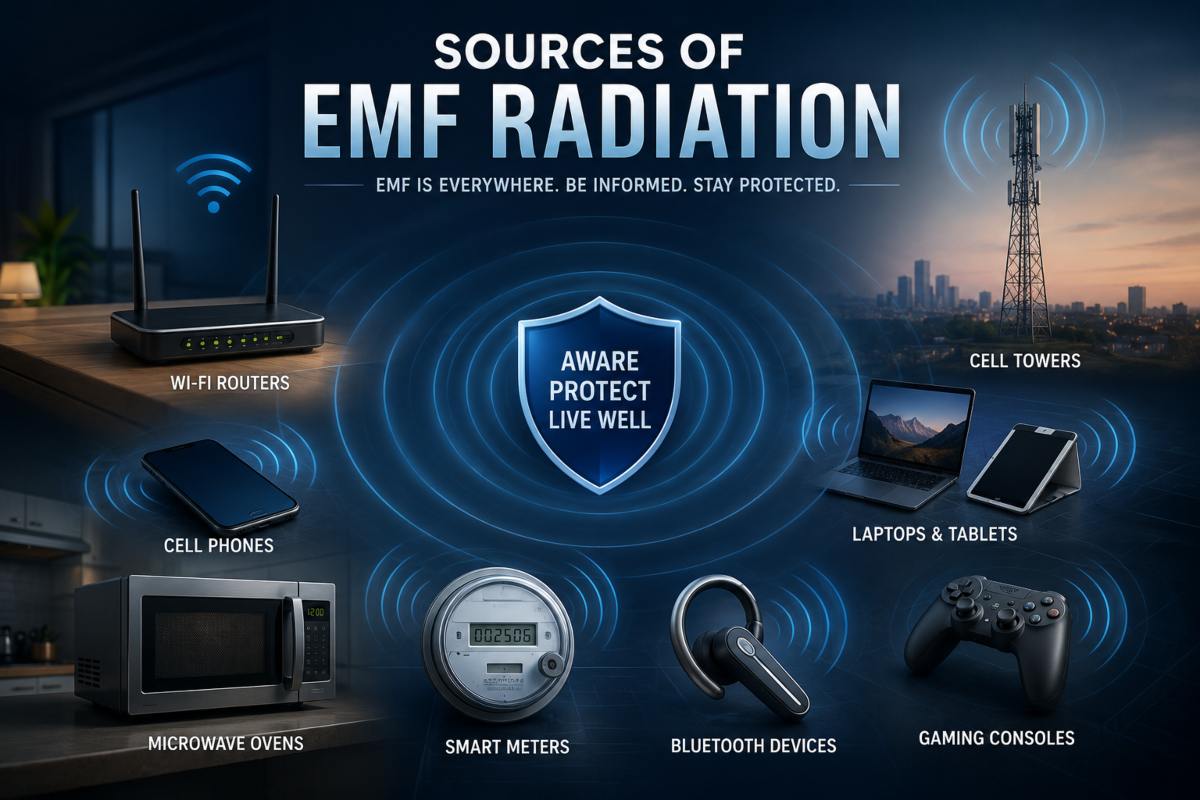
Cell phones operate across multiple frequency bands simultaneously cellular (700 MHz to 2.1 GHz), Wi-Fi (2.4 GHz and 5 GHz), Bluetooth (2.4 GHz), and, on 5G devices, millimeter-wave signals reaching up to 28 GHz and beyond. Each of these involves your phone broadcasting radio-frequency EMF in all directions, not only toward the nearest tower or router. The device in your pocket is an active transmitter, not a passive object.
What makes EMF From Phones worth understanding isn’t the signal itself it’s proximity. EMF intensity decreases rapidly with distance, following the inverse square law: double your distance from the source and exposure drops to roughly one quarter. At two inches from your body, your phone is a meaningfully different exposure scenario than at two feet. That physical reality is why carry position front pocket, chest pocket, on a desk, in a bag is more relevant to daily exposure than most people realize.
The 50 GHz upper limit tested in SLVR Wear’s lab-verified SilverScrubs® represents the current ceiling for consumer wireless frequencies, ensuring shielding performance spans the full range of signals your phone generates today and the 5G bands now being deployed. Up to 99.91% EMF blockage, verified in independent testing.
EMF blockers work by interrupting the path between the signal source and your body not by eliminating the phone’s transmission. A Faraday pouch blocks the signal reaching your phone entirely. Silver-fiber shielding fabric creates a conductive barrier between your body and the EMF emitted by your phone while it’s in use. Both approaches are grounded in the same physics: electromagnetic shielding requires a conductive material in the signal’s path. Marketing stickers applied to a phone casing are not that.
Reducing your exposure doesn’t require giving up your phone. It requires understanding that distance, carry habits, and the materials between you and your device are the variables you can actually control.
SLVR Wear products are not medical devices and are not intended to diagnose, treat, cure, or prevent any disease.
EMF from phones is non-ionizing electromagnetic radiation produced by the wireless signals your device transmits and receives during normal operation. It is not a byproduct or a malfunction it is how wireless communication works.
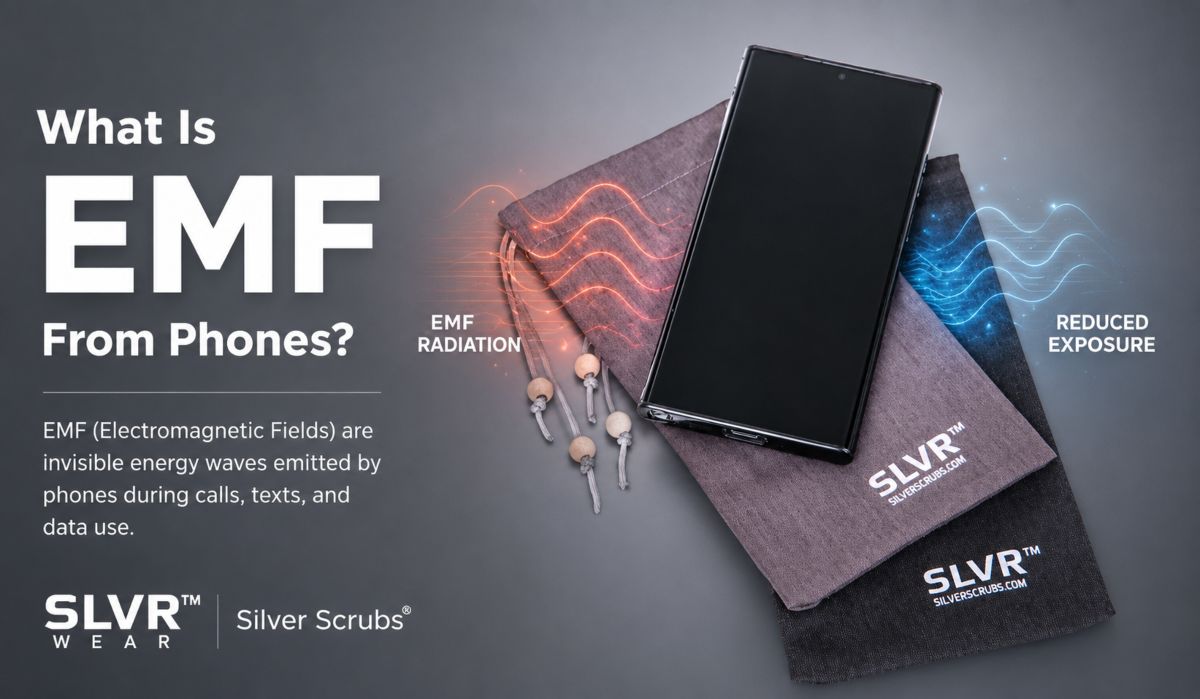 How Cell Phones Generate EMF Radiation
A cell phone generates EMF by running electrical current through an internal antenna, which converts that current into radio frequency waves broadcast outward to connect with cell towers, Wi-Fi routers, and Bluetooth devices. This process happens continuously not only during active calls. Background app refresh, location pinging, push notifications, and signal searching all trigger EMF transmission even when your screen is off. The phone is, by design, a constant low-level radio transmitter.
Not all EMF is the same, and the distinction matters. Ionizing EMF X-rays and gamma radiation carries enough energy to strip electrons from atoms and damage DNA directly. Cell phones do not emit ionizing radiation. What they emit is non-ionizing EMF: radio frequency energy with wavelengths long enough that they do not break chemical bonds at the atomic level. The ongoing scientific conversation about phone EMF concerns long-term, cumulative non-ionizing exposure not the acute cellular damage associated with ionizing radiation. Understanding this distinction separates informed concern from panic, and informed skepticism from dismissal.
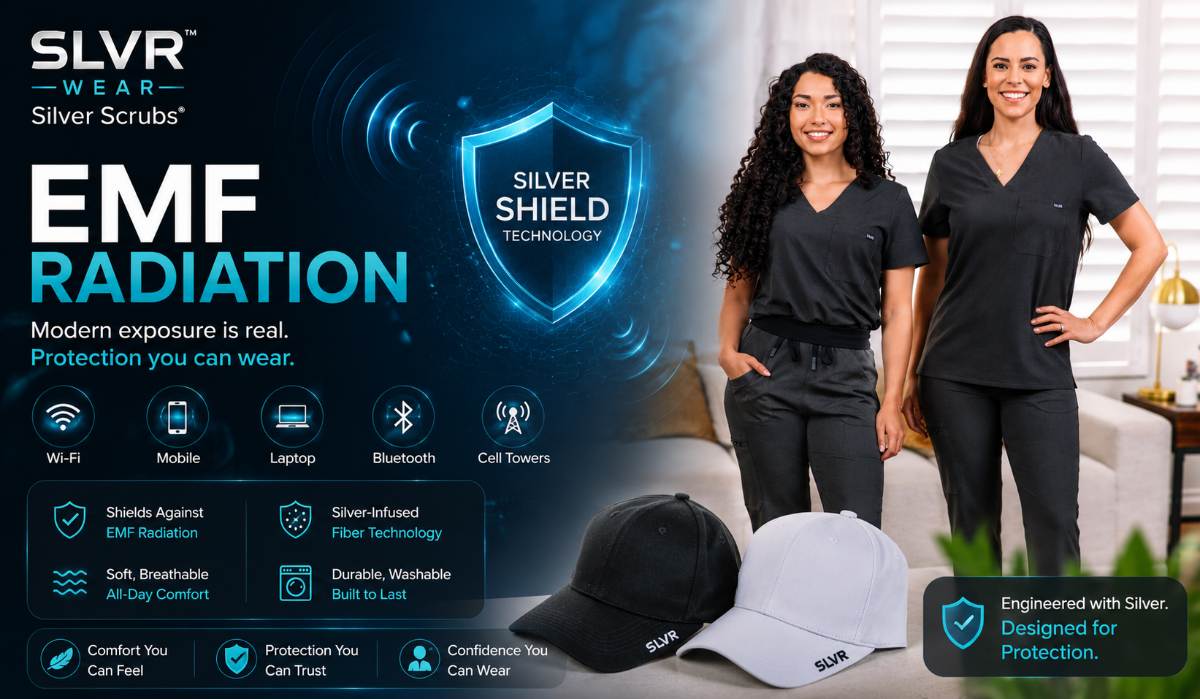
A modern smartphone is not a single-frequency device. It operates across several distinct wireless bands at once. Cellular voice and data signals range from roughly 700 MHz to 2.1 GHz, depending on the carrier and network generation. Wi-Fi operates at 2.4 GHz and 5 GHz. Bluetooth runs at 2.4 GHz. 5G millimeter wave the high-band variant being deployed in dense urban areas pushes frequencies to 24 GHz, 28 GHz, and above. SLVR Wear’s SilverScrubs® are lab-tested to 50 GHz, covering the full span of current and near-future consumer wireless frequencies. Every one of these bands represents a live EMF source radiating from the device in your hand or pocket.
Cell phones emit varying levels of EMF depending on what they are doing, which network they are connected to, and how far they are from the nearest tower. There is no single fixed output the radio is dynamic, constantly adjusting its transmission power to maintain a stable connection.
SAR Specific Absorption Rate is the standard measurement used to quantify how much radio frequency energy the human body absorbs from a phone during use. It is expressed in watts per kilogram of body tissue. In the United States, the FCC sets the legal limit at 1.6 W/kg, averaged over 1 g of tissue. In the EU, the limit is 2.0 W/kg, averaged over 10 g. Every phone sold in regulated markets must be tested and certified below these thresholds before it reaches consumers.
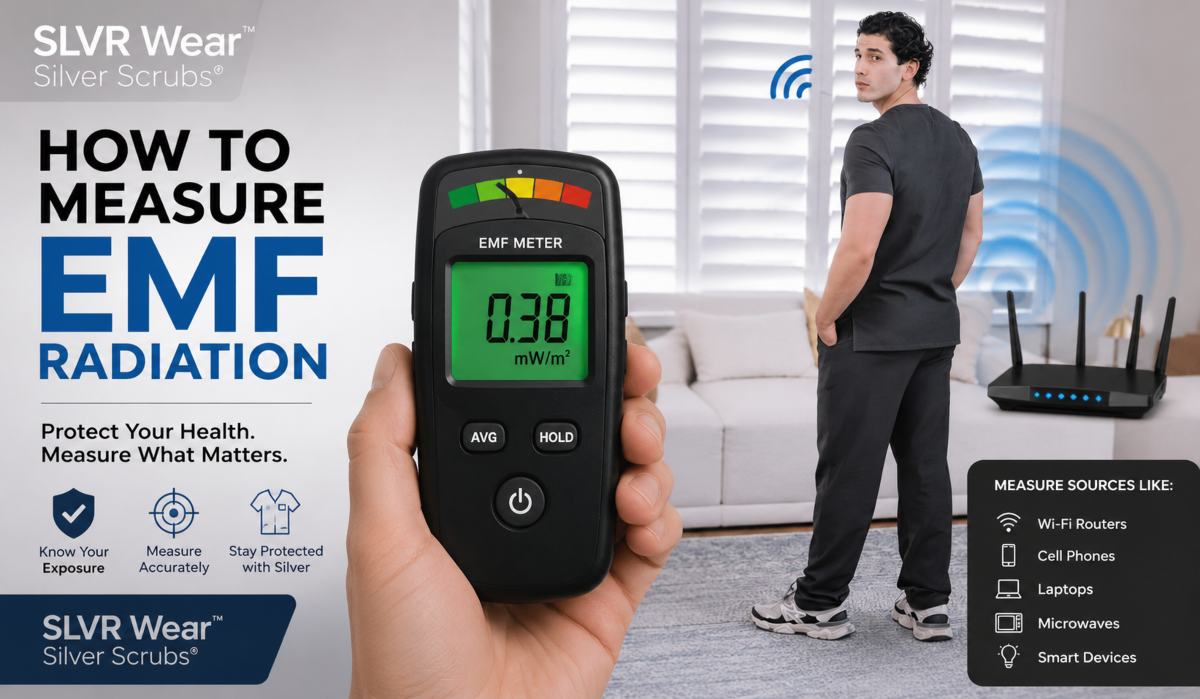
What SAR does not tell you is the full picture. The rating is measured under specific laboratory conditions phone held at a fixed distance, transmitting at maximum power which rarely reflects how a phone actually behaves in your pocket or against your body across a full day. SAR is a ceiling test, not a daily average. If you want a clearer picture of your own real-world exposure rather than a lab benchmark, you can measure EMF radiation at home with a basic RF meter.
Transmission power and therefore EMF output scales with what the phone is actively doing. A voice call over a cellular network is one of the higher-bandwidth scenarios, particularly when signal strength is poor and the phone is working harder to maintain the connection. Video streaming over Wi-Fi also generates sustained EMF, though typically at lower power than cellular transmission.
The scenario most people underestimate is signal searching: a phone in a low-coverage area a basement, a rural road, a building with thick walls will ramp its transmitter to maximum power continuously as it hunts for signal, producing higher EMF output than a phone on a strong connection doing active work. An idle phone with screen off still pings towers, checks push notifications, and runs background data it is never fully silent unless in airplane mode.
The answer depends on which 5G band is in use. Low-band 5G (sub-1 GHz) and mid-band 5G (2.5–6 GHz) operate at frequencies close to 4G LTE and produce comparable EMF levels. High-band 5G millimeter-wave at 24-39 GHz operates at significantly higher frequencies. However, millimeter-wave signals have very limited range and low penetration, so the phone uses them in short, localized bursts rather than sustained transmission.
The more relevant shift with 5G is that modern devices are managing more simultaneous radio connections than ever cellular, Wi-Fi 6, Bluetooth, and, in some cases, UWB making the aggregate EMF environment around a 5G phone broader in frequency range, even when individual band power levels remain within regulatory limits. SLVR Wear tests to 50 GHz specifically to ensure shielding performance covers that full expanded range.
EMF from a phone travels outward in all directions and does not stop at a fixed boundary but its intensity drops off rapidly with distance, making proximity to the device the single most controllable variable in daily exposure.
The physics governing EMF exposure over distance is straightforward: intensity decreases in proportion to the square of the distance from the source. Double the distance between your body and your phone, and exposure drops to roughly one-quarter. Triple it and exposure falls to approximately one ninth. This relationship the inverse-square law applies to all point-source radiation, including radio-frequency EMF from phones.
In practical terms, the difference between a phone resting against your thigh in a front pocket and the same phone sitting on a desk two feet away is not marginal. It is substantial, and it compounds across the hours most people spend with a phone on or near their body each day. Distance is not a workaround it is a legitimate exposure reduction strategy grounded in physics.
Yes, and the effect is immediate rather than cumulative. Because EMF intensity follows the inverse square law, even small increases in distance produce measurable reductions in the energy reaching body tissue. Moving a phone from direct body contact to six inches of separation reduces exposure to roughly 3% of what it was at contact. At one foot, that figure drops further still. These are not rounding errors they are orders-of-magnitude differences driven by geometry, not guesswork.
The limitation of distance alone is practical, not physical. Most people cannot maintain meaningful separation from their phone throughout a workday. It is carried in pockets, held during calls, placed on laps during meetings, and kept on nightstands during sleep. Distance helps when it is achievable. Shielding addresses the exposure that distance cannot.
Where a phone is carried determines how much EMF the nearest body tissue absorbs, and some carry positions are significantly closer to sensitive tissue than others. A phone in a front trouser pocket sits within centimeters of the upper thigh and, depending on fit, the lower abdomen. A phone tucked into a bra sits directly against chest tissue with essentially zero air gap. Both represent sustained, high-proximity exposure across hours of daily wear rather than the brief, controlled conditions under which SAR ratings are measured.
A phone on a desk at arm’s length is fundamentally different from either of those. So is a phone in a bag better than a phone in a jacket breast pocket? Carry position is not a minor detail it is where the inverse square law either works in your favor or against it, compounded across every hour of the day.
EMF blockers work but what they block and how depend entirely on the product’s mechanism. Conductive shielding based on Faraday principles is physics. Everything else requires scrutiny.
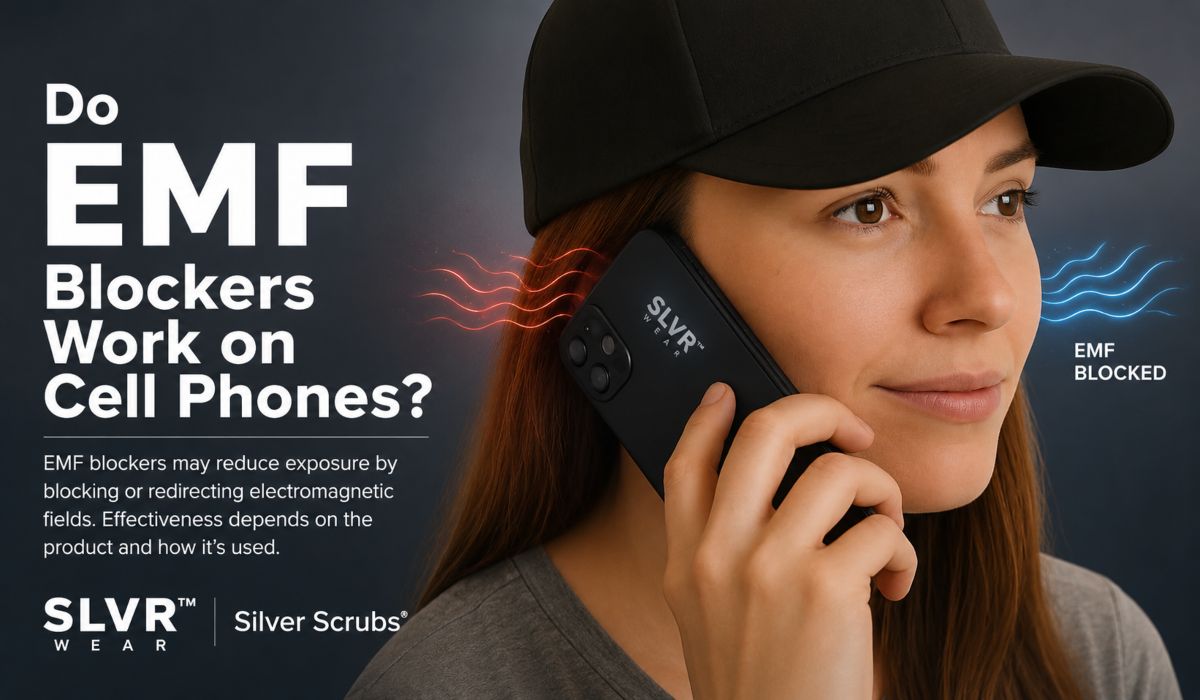 What “EMF Blocker” Actually Means Shielding vs Deflecting
The term “EMF blocker” is used loosely across a wide range of products, many of which lack a common mechanism. True EMF blocking requires a conductive material one that intercepts electromagnetic waves and either absorbs or reflects them before they reach the target. This is shielding in the technical sense: a physical barrier with measurable attenuation performance.
What it is not: a sticker, a chip, a crystal, or a passive polymer disc adhered to the back of a phone casing. These products do not create a conductive barrier. They have no mechanism to intercept or redirect a radio frequency wave. The distinction between shielding and deflecting sounds semantic it is not. One is an engineered material property. The other is a marketing claim without a physical basis.
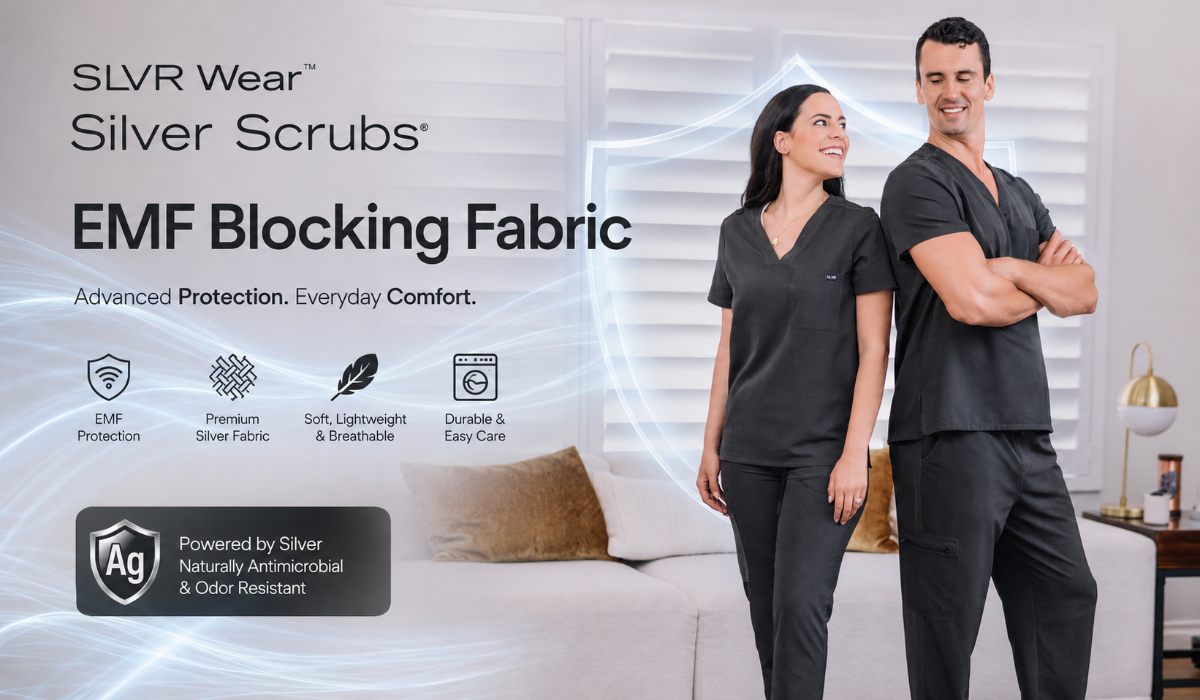
A Faraday cage works by surrounding a space with conductive material, causing incoming electromagnetic waves to induce opposing currents in the conductor that cancel the field inside. EMF blocking fabric applies this principle at the textile level: pure silver filaments are continuously woven through the fabric, creating an unbroken conductive mesh. When EMF waves from a phone contact the fabric surface, the conductive silver network redistributes the charge across the material rather than allowing it to pass through to the skin beneath.
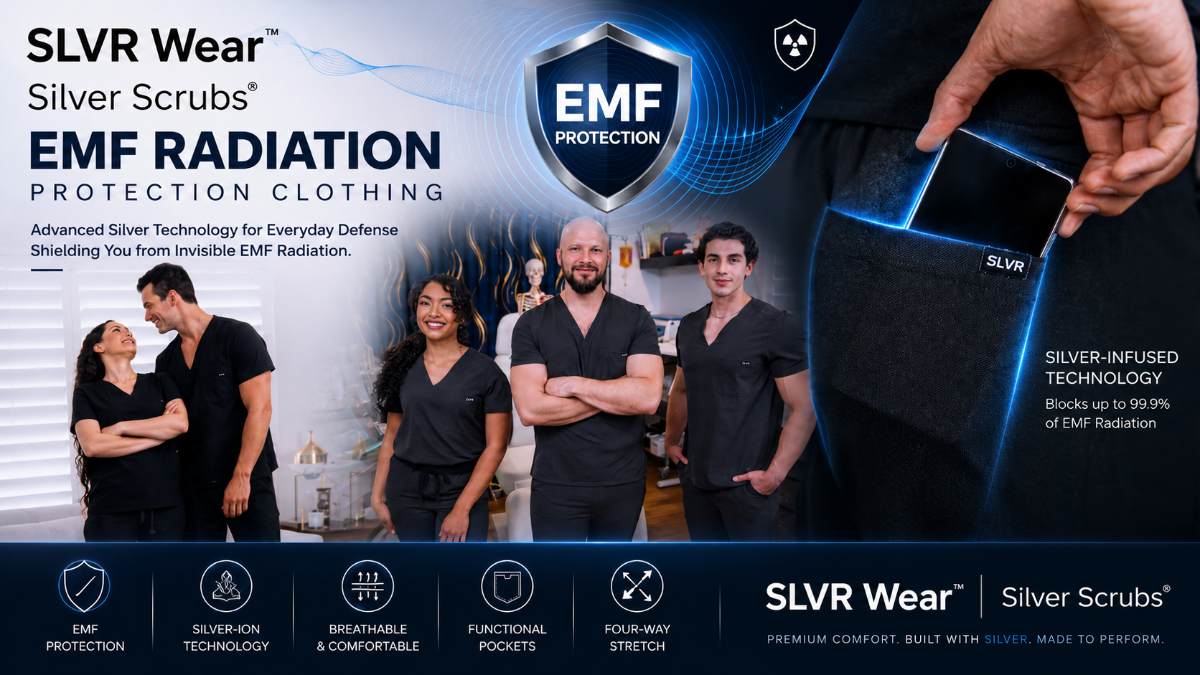
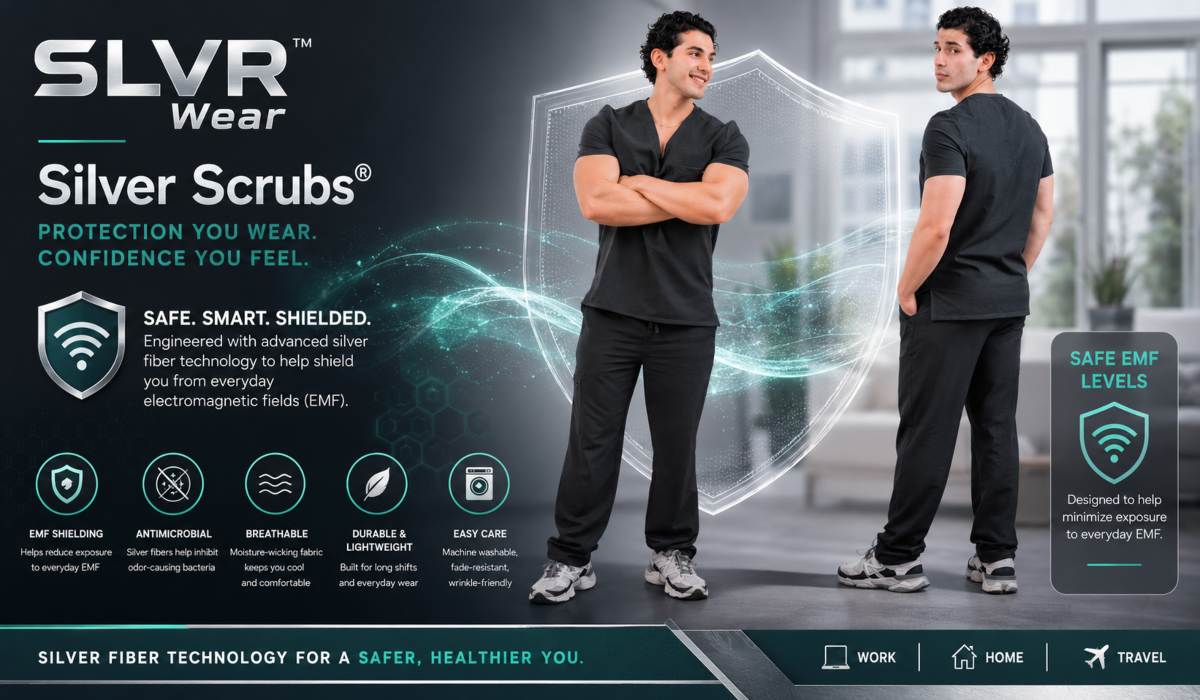
The effectiveness of this shielding depends on two factors: the continuity of the conductive mesh and the silver content density. SLVR Wear’s SilverScrubs® are constructed with 35% pure silver fiber not a silver coating, not a silver finish applied after weaving, but silver filaments integrated into the yarn itself. This ensures the conductive network remains intact through repeated washing and extended wear rather than degrading as a surface treatment would.
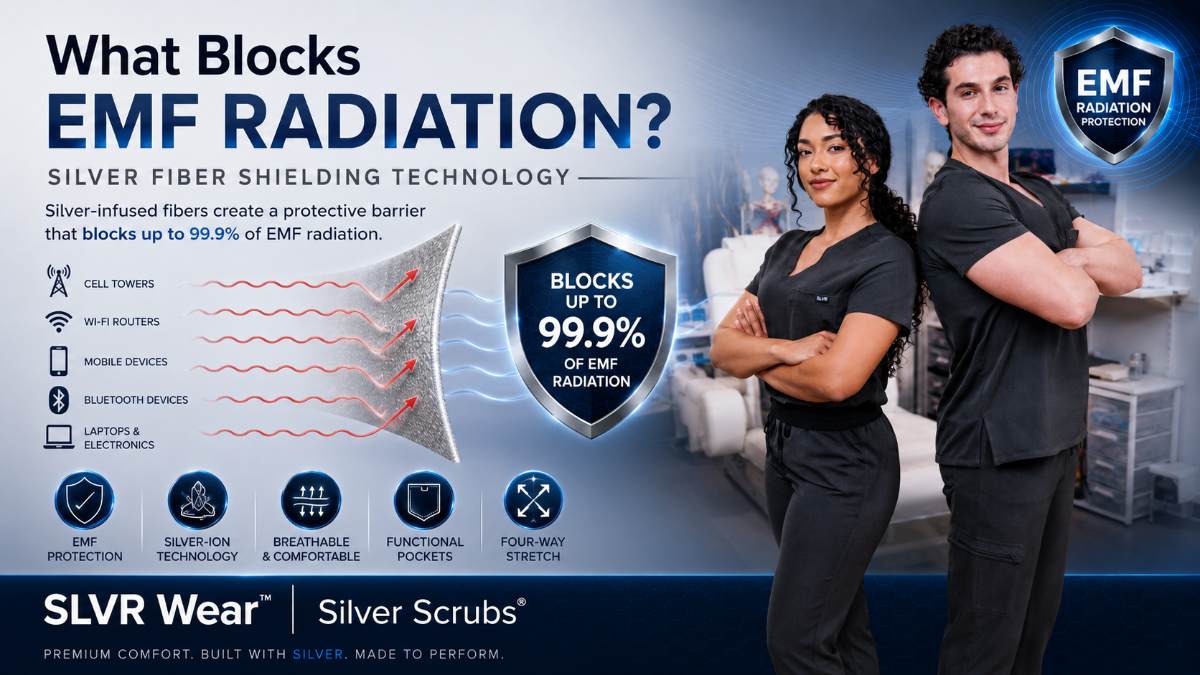
Independent laboratory testing of SilverScrubs® demonstrates up to 99.91% EMF blockage across frequencies tested to 50 GHz. This ceiling covers the full range of current consumer wireless signals, including cellular bands, Wi-Fi, Bluetooth, and high-band 5G millimeter-wave frequencies being deployed in major markets. The 50 GHz test ceiling is not arbitrary. It reflects the upper boundary of where consumer wireless technology currently operates, and where 5G infrastructure is actively expanding.
Lab-verified attenuation at that level is not a marketing approximation. It is a measured material performance result: the fabric intercepts that percentage of incident EMF before it reaches the body surface beneath it. That figure applies specifically to SilverScrubs® and was tested under controlled conditions, with a lab report available it is not a blanket claim applied to every product in the SLVR Wear range.
Silver-fiber shielding fabric reduces the EMF reaching the body surface it covers. That is what it does, and it does it measurably. What it does not do and what no EMF blocker does is eliminate the phone’s transmission. The phone continues to send and receive signals normally. Shielding apparel and Faraday pouches address the exposure pathway between the device and the body, not the device’s output itself.
A Faraday phone pouch takes a different approach: it blocks signal from reaching the phone entirely, which stops transmission but also means the phone cannot receive calls or notifications while pouched. Shielding fabric worn on the body allows the phone to function normally while reducing the EMF that reaches covered tissue. Neither approach is a substitute for the other they address different parts of the exposure equation. Used together, they cover the full range of phone-adjacent EMF exposure that distance alone cannot reliably manage.
The EMF-blocking product market ranges from lab-verified conductive shielding to products with no measurable mechanism. Knowing the difference determines whether you are reducing exposure or simply spending money.
A Faraday pouch is a signal-blocking sleeve lined with conductive material typically a silver-fiber or metallic mesh layer that forms a continuous conductive enclosure around the phone when inserted. Because the enclosure is conductive on all sides, incoming and outgoing signals cannot pass through it. The phone’s internal antenna is effectively isolated from all wireless communication: cellular, Wi-Fi, Bluetooth, GPS, and NFC signals are blocked simultaneously.
The practical consequence of that isolation is worth understanding clearly. A phone inside a Faraday pouch cannot receive calls, messages, or data. It is not in airplane mode it is electromagnetically sealed. This makes Faraday pouches most useful in specific scenarios: sleeping with a phone nearby, carrying a phone in a bag when connectivity isn’t needed, or reducing exposure during transit. SLVR Wear’s Faraday Phone Pouch uses signal-blocking silver-fiber construction to achieve this isolation without requiring the phone’s own software to be in any particular mode.
A Faraday pouch addresses the phone’s signal output at the source. EMF Protective Clothing addresses the exposure pathway between an active, transmitting phone and the body tissue nearest to it which a pouch, by definition, cannot do while the phone is in use.
When a phone is in a front pocket, tucked against the body, or resting on a lap during a call or an active data session, it is continuously transmitting with no barrier between it and the skin. Silver-fiber shielding fabric worn against the body creates that barrier. The 35% pure silver-fiber construction in SilverScrubs® forms a conductive mesh across the fabric surface, intercepting EMF at the material rather than allowing it to reach tissue beneath. This covers exposure scenarios that occur during normal phone use the hours when a Faraday pouch is open or set aside because the phone is in active use.
The two product types are complementary rather than redundant. One blocks signal at the source when the phone is stored. The other shields the body when the phone is in use.
The most important criterion is verifiable shielding performance not marketing language, not frequency-sounding terminology, not testimonials. A credible EMF blocking product will have independent laboratory test data showing attenuation across specific frequency ranges, expressed in decibels or as a percentage of EMF blocked. That data should be accessible, not paraphrased in an ad.
Material construction is the second criterion. Conductive shielding requires a continuous conductive network silver fiber woven into yarn, not sprayed onto finished fabric; a metallic mesh lining that wraps fully around a pouch interior, not a partial panel. Gaps in conductivity are gaps in shielding. Third, look for material safety certification. OEKO-TEX® Standard 100 certification confirms that the yarn has been tested for harmful substances relevant when the product will be worn directly against the skin for extended periods. A product that shields EMF while introducing chemical exposure from untested synthetic materials has not solved the problem it claims to address.
EMF from phones is a measurable physical reality, not a fringe concern and reducing your exposure does not require giving up your device or waiting for the science to reach a final verdict.
The practical framework is straightforward. Distance reduces exposure dramatically, but most people cannot maintain meaningful separation from their phone across a full day. Carry habits matter a phone in a pocket or against the body for eight hours represents a different cumulative proximity than a phone on a desk. And the frequencies involved have expanded: a modern 5G device simultaneously manages cellular, Wi-Fi, Bluetooth, and millimeter-wave signals across a range that extends to 28 GHz and beyond in active deployments.
SLVR Wear builds products engineered for exactly this gap the hours when distance is not an option and the phone is on or near your body.
The Faraday Phone Pouch addresses stored-phone exposure. When your phone is in a bag, on a nightstand, or in any situation where you do not need active connectivity, the pouch’s signal-blocking silver-fiber lining creates a conductive enclosure that prevents wireless signals from entering or leaving. No app required. No settings to configure. Physics does the work.
SilverScrubs® address active-phone exposure the scenario the pouch cannot cover. With 35% pure silver fiber woven directly into the fabric and independent lab verification of up to 99.91% EMF blockage tested to 50 GHz, SilverScrubs® provide a certified conductive barrier between your phone and your body while you wear them. That is not a coating. It is not a finish. It is material-level shielding that holds up through repeated washing and extended daily wear.
Together, these two products cover the full exposure arc: the phone at rest and the phone in use. Neither eliminates EMF at the source. Both reduce the amount that reaches you measurably, verifiably, and without changing how you use your device.
Airplane mode disables a phone’s cellular, Wi-Fi, and Bluetooth radios, which are the main sources of RF EMF. Some extremely low-frequency EMF from the battery and internal electronics remains. For the lowest possible exposure, enable airplane mode and turn off Wi-Fi and Bluetooth.
Current research has not established that phone EMF causes harm at everyday exposure levels. Because long-term effects are still being studied, some people choose to reduce unnecessary exposure as a precaution. The scientific consensus remains that more research is needed.
Completely blocking a phone’s EMF would also prevent it from sending and receiving signals. A Faraday enclosure can block signals entirely, but the phone will no longer function normally. Shielding products can reduce exposure without fully blocking connectivity.
Most EMF stickers and chips do not provide measurable EMF shielding. Effective shielding requires conductive materials that create a barrier between the source and the user. When evaluating EMF products, look for independent laboratory testing and verified attenuation data.
Phone EMF weakens rapidly with increasing distance, following the inverse-square law. Even a small increase in distance can significantly reduce exposure. Keeping your phone in a bag, on a desk, or away from direct contact with your body reduces exposure.
EMF and cell phone radiation generally refer to the same type of wireless energy from different perspectives. EMF refers to the electromagnetic field, while radiation refers to the energy it emits. Cell phone radiation is non-ionizing and differs from ionizing radiation sources such as X-rays.
SLVR Wear products are not medical devices and are not intended to diagnose, treat, cure, or prevent any disease.