Medical Scrubs: Complete Buying Guide 2026 | SLVR Wear ™
Medical scrubs are lightweight, durable garments worn by healthcare professionals including nurses, physicians, dentists, and technicians—in clinical settings. In 2026,…
The most effective materials for blocking EMF radiation are electrically conductive metals silver, copper, aluminum, and lead each of which reflects or absorbs electromagnetic frequencies rather than allowing them to pass through. Not all of them are equally practical, and some of the most popular alternatives people reach for, from crystals to tin foil, have little to no measurable shielding effect.
This guide breaks down every material people ask about, explains the physics behind why some work and others don’t, and cuts through the myths that dominate search results on this topic. By the end, you’ll know exactly what blocks EMF radiation, what doesn’t, and how to apply that knowledge in a real environment at home, at work, or on your body.
Blocking EMF radiation means placing a conductive or absorptive barrier between a source of electromagnetic frequency and the person or device you want to protect the barrier either reflects the signal away, absorbs its energy, or does both. The term “blocking” is commonly used, but the more precise term in physics and engineering is shielding, and understanding the difference matters when evaluating whether a material actually works.
EMF exists on a spectrum. The frequencies most people are concerned about today Wi-Fi (2.4 GHz and 5 GHz), cellular LTE and 5G (600 MHz to 39 GHz), and Bluetooth (2.4 GHz) are non-ionizing radiofrequency radiation. Shielding these frequencies requires a material that can interact with oscillating electromagnetic fields at those specific wavelengths. A material that works well at 900 MHz may perform differently at 28 GHz, which is why the frequency range is one of the most important specifications to consider when evaluating any EMF blocker.
 How Electromagnetic Frequencies Interact with Materials
When an electromagnetic wave encounters a material, one of three things happens: the wave passes through largely unaffected (transmission), the wave bounces back from the surface (reflection), or the wave’s energy is converted to heat inside the material (absorption). Most real-world shielding involves a combination of reflection and absorption, with the ratio depending on the material’s properties and the wave’s frequency.
The key variable is how the material responds to a rapidly oscillating electric field. Metals with high electrical conductivity silver, copper, aluminum cause the free electrons in the material to move in response to the incoming electromagnetic wave, generating an opposing field that cancels or deflects it. This is the fundamental mechanism behind every practical EMF shielding material. Non-conductive materials like wood, plastic, fabric, and most building materials have few or no free electrons, which is why they offer negligible shielding at radiofrequency ranges.
Shielding effectiveness is measured in decibels (dB) and quantifies how much of an incoming signal a material attenuates. A 20 dB rating means the material reduces signal strength by 90%. A 40 dB rating reduces it by 99%. The three mechanisms that produce this attenuation work differently depending on the material.
No material blocks all EMF radiation across all frequencies this is a physical constraint, not a manufacturing limitation. Shielding effectiveness varies by frequency, and every material has a range where it performs best and ranges where attenuation drops. A Faraday cage designed for one frequency band will not perform identically at another, which is why rigorous shielding products are tested across a defined frequency spectrum rather than at a single frequency.
There is also the geometry problem: a shield only protects the area it covers. Gaps, seams, openings, and conductive paths through the material a zipper, a button, an unhemmed edge all degrade real-world performance compared to lab conditions. This is why construction quality matters as much as material choice. Lab-tested shielding figures, such as the GJB 5792A-2021 military-grade standard used to test silver-fiber fabric up to 50 GHz, are measured under controlled conditions; real-world performance depends on how well the shielding is designed and worn. That said, a well-constructed silver-fiber garment or signal-blocking pouch still delivers meaningful, measurable attenuation in everyday use the goal is not perfection but significant, documented reduction in exposure.
The materials that actually block EMF radiation are electrically conductive metals primarily silver, copper, aluminum, and lead. Each works through the same fundamental mechanism: free electrons in the metal respond to incoming electromagnetic waves, generating an opposing field that reflects or absorbs the signal. What separates them is how well they perform, at which frequencies, and whether they’re practical for everyday shielding applications.
Silver blocks EMF radiation more effectively than any other naturally occurring element because it has the highest electrical conductivity of any material 6.30 × 10⁷ siemens per meter. That conductivity is the entire basis of its shielding function. When an electromagnetic wave encounters silver fiber, the dense population of free electrons responds almost instantaneously to the oscillating field, generating a counteracting current that reflects the wave before it can pass through. This is a physical property of the element, not a manufacturing enhancement.
What makes silver particularly relevant for modern EMF shielding is its performance at high frequencies. As wireless technology has moved into the 5G millimeter-wave bands which operate between 24 GHz and 40 GHz many conventional shielding materials have begun to lose effectiveness. Silver-fiber fabric tested to the GJB 5792A-2021 military-grade standard has demonstrated consistent attenuation up to 50 GHz, covering Wi-Fi, cellular LTE, 5G sub-6 GHz, and millimeter-wave frequencies within a single material. That breadth of coverage is difficult to achieve with lower-conductivity alternatives.
Silver is also uniquely suited to wearable shielding because its conductivity does not depend on thickness. A fabric woven with 35% silver fiber content can achieve high attenuation rates while remaining flexible, breathable, and washable properties that copper mesh, aluminum film, and lead sheeting cannot replicate in a garment. This is why silver-fiber scrubs and EMF radiation protection clothing built on this material can deliver both daily comfort and documented shielding performance.
Copper is the second most conductive element after silver, with an electrical conductivity of 5.96 × 10⁷ siemens per meter approximately 94% of silver’s conductivity. In most shielding applications, that difference is small enough that copper performs comparably to silver at lower and mid-range frequencies. This is why copper is widely used in shielded cables, RF enclosures, grounded building panels, and electronics shielding where the material is stationary and not subject to wear.
Where copper falls short relative to silver is in wearable and textile applications. Copper fiber is stiffer, heavier, and more prone to oxidation than silver. Over time and with repeated washing, copper’s conductivity degrades as the surface oxidizes reducing shielding effectiveness without any visible change in the fabric. Copper-lined pouches and wraps are available on the market, but the long-term attenuation performance of copper-based textiles is less stable than that of silver-fiber equivalents. For stationary shielding installations wall panels, grounded screens, cable shielding copper remains a practical and cost-effective choice. For body-worn or frequently handled shielding products, silver is the more durable option.
Aluminum does block EMF radiation, and there is legitimate scientific basis for this. Aluminum is a conductive metal with an electrical conductivity of approximately 3.77 × 10⁷ siemens per meter lower than both silver and copper, but sufficient to produce measurable attenuation across a broad frequency range. Aluminum enclosures and foil-lined structures are used in legitimate RF shielding applications, including equipment housings, shielded rooms, and cable sheathing.
The question most people are actually asking, however, is whether household aluminum foil blocks EMF radiation and the honest answer is: partially, under specific conditions, and not reliably in practice. A 2012 study published in IEEE Transactions on Electromagnetic Compatibility confirmed that aluminum foil produces measurable shielding at certain frequencies, but real-world effectiveness depends heavily on how it is applied. Gaps, folds, and ungrounded surfaces dramatically reduce performance. A loosely wrapped foil layer around a phone, for example, will not produce the consistent seal required for meaningful signal attenuation and may actually amplify signal strength in some configurations by creating a resonant cavity. The physics are sound; the DIY execution rarely is.
For practical use, aluminum shielding works best in rigid, engineered applications where the foil is properly sealed and grounded. As a household solution for personal EMF shielding, it does not deliver reliable or measurable protection.
Lead blocks EMF radiation and is one of the oldest shielding materials used in industry and medicine. Its effectiveness comes not from high electrical conductivity lead is actually a relatively poor conductor compared to silver, copper, and aluminum but from its exceptional density. At 11,340 kg/m³, lead is effective at attenuating ionizing radiation (X-rays and gamma rays) through absorption, which is why it remains the standard material for X-ray aprons, radiation shielding in medical facilities, and nuclear containment applications.
For the non-ionizing radiofrequency radiation that most consumers are concerned about Wi-Fi, 5G, cellular signals lead’s density advantage is less relevant. RF shielding at these frequencies is driven primarily by electrical conductivity, where lead underperforms copper and aluminum. Lead-lined enclosures do provide RF attenuation, but the weight, toxicity, and handling requirements make it impractical for consumer shielding products. Lead is also a regulated hazardous material; products containing it face significant compliance barriers in consumer markets. In everyday EMF shielding contexts, there is no practical reason to choose lead over silver, copper, or aluminum.
Tin foil, which in modern usage almost always refers to aluminum foil rather than actual tin, does have some theoretical basis as an EMF-blocking material for the same reasons aluminum does it is conductive, and conductive materials can reflect electromagnetic waves. The myth is not that the material is completely ineffective; it is that a loosely applied sheet of kitchen foil provides meaningful, reliable EMF protection in practice.
The shielding effectiveness of any conductive barrier depends on achieving a continuous, sealed enclosure with no gaps the Faraday cage principle. Kitchen foil applied around a phone, a router, or a person does not create that enclosure. At the radio-frequency ranges used by modern wireless devices (600 MHz to 39 GHz), even small gaps relative to the signal wavelength can cause significant signal leakage.
A 2013 study from MIT’s Media Lab measured the shielding performance of aluminum foil hats and found that, while some frequency attenuation was observed, the effect was inconsistent, and in some frequency bands the foil actually increased signal exposure rather than reducing it. The DIY tin foil approach does not constitute a reliable or tested EMF-blocking method, and the same standards should not evaluate it as engineered, lab-tested shielding materials.
Crystals, plants, and stones do not block EMF radiation none of them possess the electrical conductivity required to reflect or absorb electromagnetic waves at radiofrequency ranges. They remain among the most searched EMF-related topics online precisely because the wellness market has built a significant commercial category around them. Still, their popularity is not supported by electromagnetic physics or any peer-reviewed shielding research.
Understanding why these materials don’t work is just as useful as knowing which ones do. It also helps explain what the word “blocking” actually requires a standard that separates legitimate shielding materials from products that appeal to intuition but deliver no measurable attenuation.
Crystals do not block EMF radiation. No peer-reviewed study in electromagnetic engineering or materials science has demonstrated that any crystal shungite, black tourmaline, orgonite, or otherwise produces measurable attenuation of radiofrequency signals. The claim persists because crystals have a long history of use in alternative wellness practices, and that cultural familiarity makes the EMF-blocking claim feel plausible to people who are already concerned about wireless radiation exposure.
The physics reason crystals fail as shielding materials is straightforward: they are not electrically conductive like metals. EMF shielding requires free electrons electrons that can move through a material in response to an oscillating electromagnetic field and generate a counteracting current. Crystals are either insulators or semiconductors with highly restricted electron mobility. When an RF wave encounters a crystal, the electrons cannot respond quickly enough or in sufficient quantity to reflect or absorb the signal. The wave passes through essentially undisturbed.
Shungite, which is perhaps the most widely marketed crystal for EMF protection, does contain carbon in a form that gives it mild electrical conductivity higher than most minerals, but far below the threshold required for meaningful RF shielding. A small shungite stone placed near a router or worn as a pendant does not create an electromagnetic barrier. It does not have the geometry, conductivity, or surface area to function as a Faraday-type shield at any common wireless frequency.
Plants do not block EMF radiation. The claim that certain houseplants cacti, spider plants, and succulents are frequently cited as absorbing or neutralizing wireless radiation has no basis in electromagnetic science. Plants are composed primarily of water, cellulose, and organic compounds, none of which are electrically conductive at the levels required to interact with radiofrequency waves. An RF signal at 2.4 GHz or 5 GHz passes through plant tissue the same way it passes through wood, plastic, or air with negligible attenuation.
The confusion likely stems from two separate facts being incorrectly combined. First, plants do absorb certain forms of radiation specifically, visible light and ultraviolet radiation through photosynthesis. Second, some studies have noted that dense vegetation can marginally reduce signal strength outdoors at scale, the way a thick forest slightly attenuates a radio signal over distance. Neither of these observations applies to a potted plant in a room. A single plant, or even several plants arranged near a Wi-Fi router, does not produce a measurable reduction in RF exposure for people in that room. No electromagnetic shielding standard recognizes organic plant matter as a shielding material at any frequency.
Stones and minerals marketed for EMF protection including tourmaline, selenite, obsidian, and various volcanic rocks do not block EMF radiation. Like crystals, they are non-conductive or weakly semiconductive materials that lack the free-electron density needed to reflect or absorb radio-frequency electromagnetic waves. Their presence in the EMF-protection market is driven by consumer demand and wellness marketing, not by electromagnetic engineering.
Some minerals do have genuinely interesting electrical properties. Tourmaline, for example, is piezoelectric it generates a small electric charge when physically stressed. This is a real phenomenon, but it has nothing to do with radiofrequency shielding. Generating a static charge under pressure is entirely different from reflecting a 5G signal. The two mechanisms operate at completely different physical scales and frequency ranges, and no credible research has proposed a pathway by which piezoelectricity in a mineral would attenuate an RF field in its vicinity.
The reason it is worth addressing these claims directly is not to dismiss the people asking about them the concern driving the search is legitimate, even when the proposed solution is not. Someone searching for “crystals that block EMF radiation” wants to reduce their exposure to wireless signals. That concern deserves an honest answer: the only materials with documented, measurable shielding effectiveness at modern wireless frequencies are electrically conductive metals, and any product claiming otherwise should be evaluated against that standard.
Blocking EMF radiation at home comes down to three variables: distance from the source, barriers between the source and your body, and reducing unnecessary signal output from devices you control. No single strategy eliminates exposure, but a layered approach applied consistently across the environments where you spend the most time produces meaningful, cumulative reduction.
The most direct way to block EMF radiation from reaching your body is to wear fabric that is engineered to shield it. Wearable EMF shielding works on the same Faraday principle as any conductive enclosure: silver fiber woven into the textile creates a conductive layer that reflects electromagnetic waves before they reach the skin. Because the shielding is built into the fabric structure rather than applied as a surface treatment, it functions continuously during wear without requiring any active component or power source.
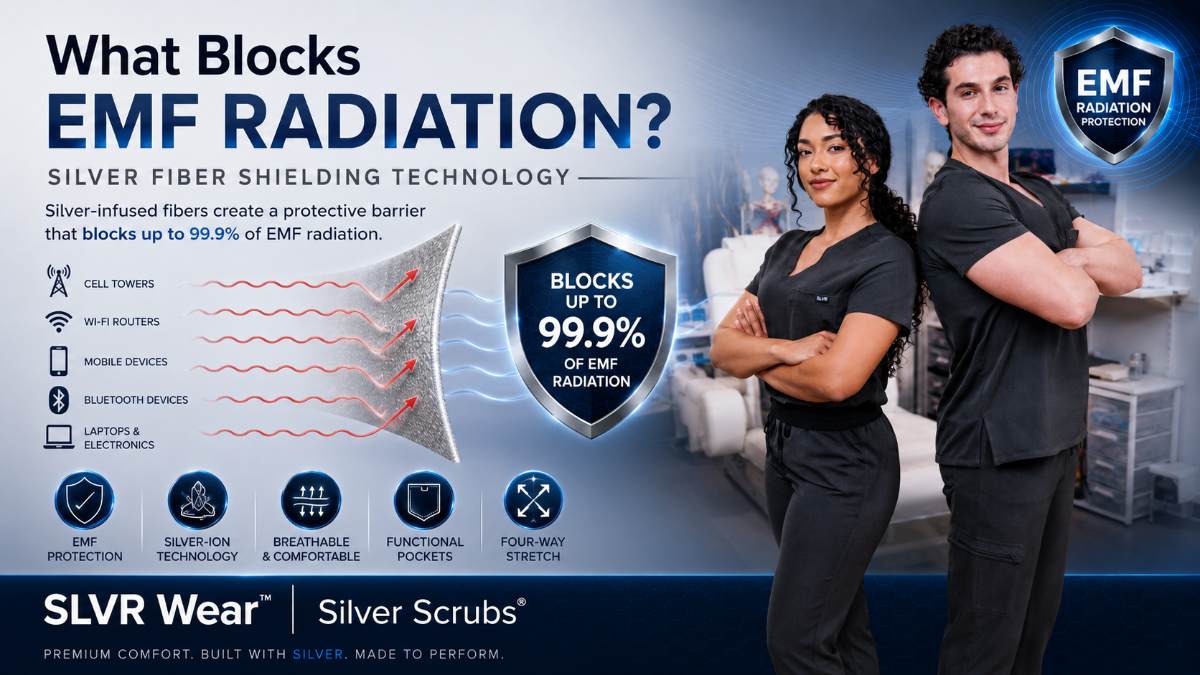
The practical advantage of silver-fiber shielding fabric over other at-home strategies is that it moves with the person. Distance-based strategies and room shielding only work when you stay in a specific location wearable shielding works wherever you are, including in environments where you have no control over signal sources. For people who work in high-RF environments, spend significant time near wireless infrastructure, or simply want consistent shielding during their working hours, a silver-fiber garment provides coverage that passive room strategies cannot. Silver-fiber scrubs tested to the GJB 5792A-2021 standard have demonstrated up to 99.91% EMF blockage at peak frequency, covering Wi-Fi, cellular, and 5G millimeter-wave frequencies up to 50 GHz.
If you work in clinical settings or high-RF environments, silver-fiber medical scrubs combine professional function with continuous, body-worn shielding. For those prioritizing everyday comfort alongside protection, softest medical scrubs built on silver-fiber construction offer both. A broader overview of fit and fabric choices is covered in this complete medical scrubs guide.
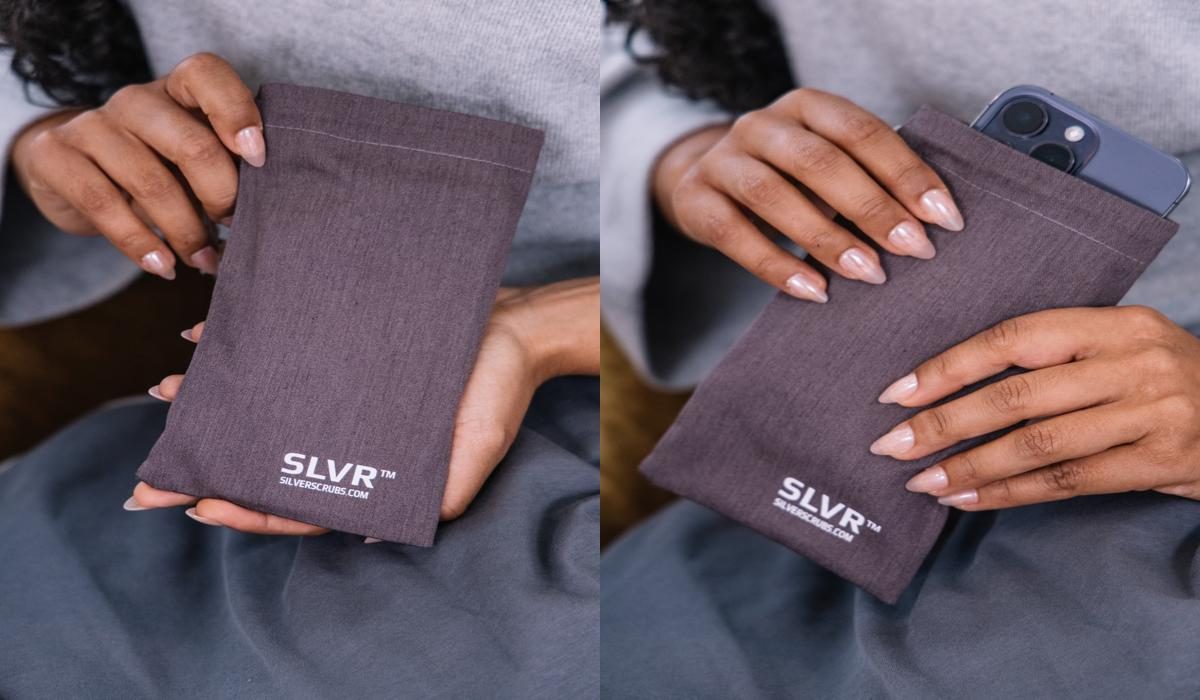
A signal-blocking pouch for your phone works by enclosing the device in a conductive silver-fiber lining that forms a complete Faraday cage, preventing electromagnetic signals from entering or leaving. When a phone is sealed inside a properly constructed pouch, it is simultaneously isolated from cellular networks, Wi-Fi, Bluetooth, and GPS the pouch does not selectively filter frequencies; it blocks the full RF spectrum the device operates on.
This has two practical implications worth understanding. First, a phone inside a signal-blocking pouch cannot send or receive calls, messages, or data it is effectively offline for the duration. This makes a Faraday pouch most useful during periods when you want to carry your phone without it actively transmitting: while sleeping with the phone nearby, during focused work blocks, or when traveling and wanting to prevent location tracking. Second, the effectiveness of any signal-blocking pouch depends entirely on the quality of the enclosure seal.
A pouch with a loose flap, a gap at the seam, or a non-conductive lining will allow signal leakage regardless of what the marketing claims. Look for products that specify which frequencies are blocked and at what attenuation level a Faraday phone pouch built with silver-fiber shielding and a fully sealed closure will block cellular (including 5G), Wi-Fi, Bluetooth, and GPS signals.
The bedroom is the highest-priority room for EMF reduction at home because it is where most people spend 6 to 8 consecutive hours with minimal movement making cumulative exposure during sleep a significant part of total daily exposure. The most impactful change requires no shielding materials at all: moving wireless devices away from the sleeping area. Signal strength follows an inverse-square law, meaning that doubling the distance between your body and a source reduces exposure by approximately 75%. Moving a phone from the bedside table to across the room, or switching a router off overnight, produces a significant reduction without any additional investment.
For people who want active shielding during sleep, an EMF-blocking blanket creates a conductive barrier between the body and ambient RF signals in the room. A silver-fiber blanket functions the same way a silver-fiber garment does the woven conductive layer reflects incoming electromagnetic waves but applied as a sleep layer rather than worn clothing. For a detailed breakdown of what to look for, see this guide to the best EMF protection blanket.
Workplace EMF exposure at home is driven primarily by proximity to a Wi-Fi router, the density of connected devices on a desk, and the cumulative signal environment created by neighbors’ networks and building infrastructure you cannot control. Addressing the first two is straightforward and costs nothing. A router placed on the desk directly in front of a person radiates at its highest intensity at the closest point moving it to another room, a high shelf, or the far side of the space reduces exposure substantially without degrading usable signal strength in most home layouts.
Where possible, replacing Wi-Fi with wired ethernet connections for stationary devices desktop computers, monitors, smart TVs eliminates that device’s continuous RF transmission. A device connected via ethernet does not broadcast a Wi-Fi signal; it communicates only via the cable. For devices that must remain wireless, disabling radios when not in active use (Bluetooth off when no peripherals are connected, Wi-Fi disabled on a laptop when working on local files) reduces unnecessary ambient transmission.
For those in high-RF environments or healthcare settings, EMF protective clothing designed for professional wear provides continuous coverage that room-based strategies cannot. You can also explore the full range of EMF radiation protection clothing options to find the right combination for your environment.
A phone EMF radiation blocker works when it is built on Faraday cage principles a conductive enclosure that prevents electromagnetic signals from entering or leaving. Products that meet this standard produce verifiable, measurable signal blocking. Products that don’t stickers, chips, pendants, and adhesive discs marketed as phone radiation blockers have no mechanism by which they could function and no credible evidence that they do.
The distinction matters because the phone EMF blocker market includes both categories, which are often presented identically. Knowing what to look for separates products that deliver documented attenuation from those that don’t.
An EMF radiation blocker for an iPhone works only if it physically encloses the device in a conductive shielding material that forms a complete, sealed barrier around it. An iPhone like any smartphone transmits across multiple frequency bands simultaneously: cellular (including 5G), Wi-Fi at 2.4 GHz and 5 GHz, Bluetooth at 2.4 GHz, and GPS at 1.575 GHz. A blocker that works must attenuate all of these, not selectively filter one while leaving others active.
A properly constructed silver-fiber Faraday pouch achieves this. When the phone is fully enclosed and the pouch is sealed, the conductive lining reflects the full RF spectrum the device operates on. The phone loses signal across all wireless protocols simultaneously which is the functional confirmation that the shielding is working. If the phone still shows signal bars or connects to Wi-Fi while inside the pouch, the enclosure is incomplete, and the product is not functioning as an EMF blocker, regardless of what the label claims.
The category of products that does not work includes adhesive stickers, thin metallic films applied to the back of the phone, and small chips or discs placed near the antenna. The FTC has issued warnings about several such products, and independent laboratory testing has consistently found zero measurable attenuation from sticker-format phone radiation blockers. These products do not create an enclosure; without one, there is no Faraday effect or shielding.
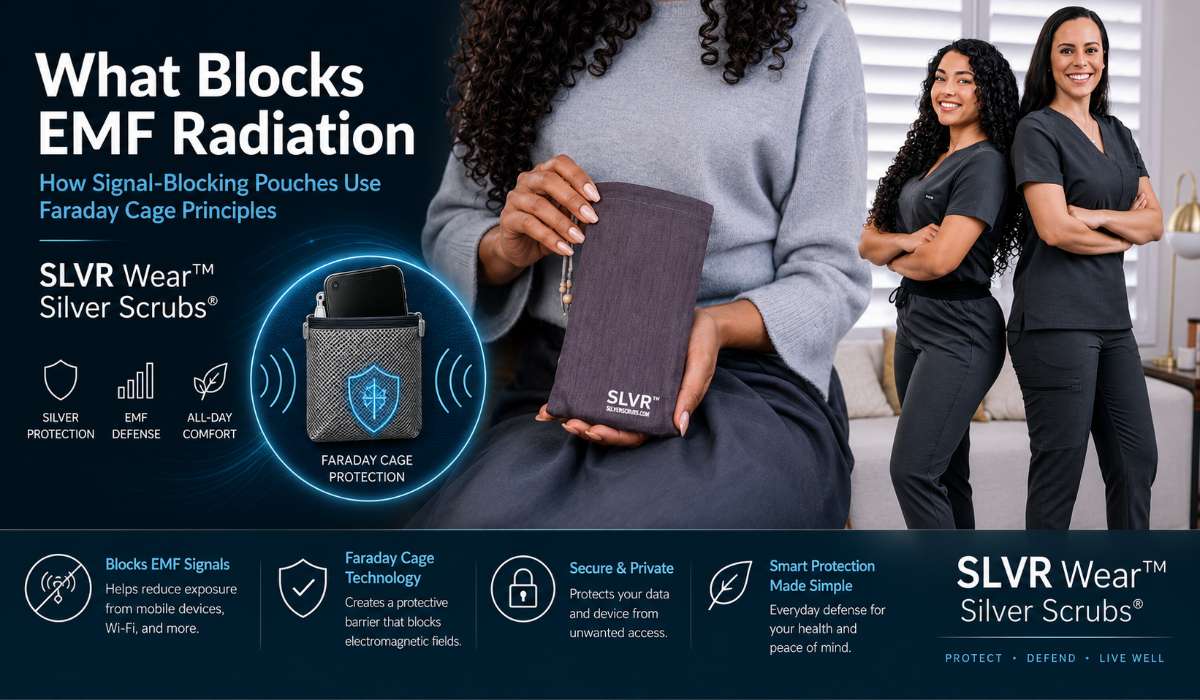
A signal-blocking pouch works by replicating the core principle of a Faraday cage in a flexible, portable format. A Faraday cage is any conductive enclosure that distributes an incoming electromagnetic charge across its surface, preventing the field from penetrating the interior. The cage does not need to be rigid or made of solid metal it only requires a continuous conductive layer with no gaps large enough relative to the signal’s wavelength.
In a silver-fiber signal-blocking pouch, the conductive layer is the woven silver fabric lining the pouch’s interior. When a phone is placed inside and the closure is sealed, the silver-fiber lining surrounds the device, forming a Faraday cage. The incoming electromagnetic waves from cell towers, Wi-Fi access points, Bluetooth devices, and GPS satellites encounter the conductive layer and are reflected rather than transmitted through to the phone. The phone’s own outgoing transmissions are similarly contained inside the pouch and cannot reach external receivers.
The critical engineering requirement is continuity. A gap in the seam, a non-conductive flap closure, or a lining that covers only part of the interior breaks the Faraday enclosure, allowing signal leakage. This is why construction quality is as important as material choice. To explore the best EMF blocker for phone options with documented construction standards, verified seal quality is the first criterion to check.
 What Frequencies a Phone EMF Blocker Needs to Cover in 2026
A phone EMF blocker in 2026 needs to cover a substantially wider frequency range than was required even five years ago, because 5G deployment has added millimeter-wave bands that older shielding products were not designed to address. A complete phone shielding solution needs to attenuate signals across the following active bands.
This is the core reason frequency range specification matters when buying a phone EMF blocker. A product should state explicitly which frequencies it has been tested against and at what attenuation level, with lab documentation available to support those figures. Silver-fiber shielding fabric tested up to 50 GHz covers the full range of frequencies a modern smartphone operates on, including current 5G millimeter-wave deployments, making it the appropriate material standard for a phone EMF blocker built for 2026 and beyond.
Shielding effectiveness is a function of material composition, construction density, garment geometry, and testing conditions figures from one product in a line are not automatically transferable to other products without independent testing of those specific items.
OEKO-TEX® Standard 100 certification verifies that every component of a fabric including threads, dyes, fixatives, and accessories has been tested for harmful substances and found to meet or exceed international safety thresholds. For silver-fiber fabric specifically, this certification addresses a reasonable question about any textile with a high metallic content: whether the materials used are safe for prolonged skin contact.
OEKO-TEX® Standard 100 tests for over 100 substances, including heavy metals, pesticide residues, formaldehyde, allergenic dyes, and pH levels outside the skin-safe range. A fabric that carries this certification has passed that battery of tests on the actual yarn used in production not on a representative sample from a different batch. SLVR Wear uses OEKO-TEX® Standard 100-certified silver yarn, meaning the silver fiber itself has been verified as safe for direct skin contact under this standard. This is the appropriate third-party verification for a material claim about fabric safety, and it is distinct from and more rigorous than a brand’s own assertions about material quality.
Across the three conductive materials used in commercial EMF shielding textiles silver fiber, copper fiber, and aluminum lining silver-fiber fabric leads on every performance dimension that matters for a wearable, long-term shielding product.
Silver’s electrical conductivity of 6.30 × 10⁷ S/m is approximately 6% higher than that of copper and 67% higher than that of aluminum. In practice, this translates to higher attenuation at equivalent fabric weights and more consistent performance at millimeter-wave frequencies, where copper- and aluminum-lined textiles begin to struggle above 10 GHz. For a phone pouch or garment that needs to shield 5G mmWave frequencies up to 39 GHz, silver-fiber construction is the only textile format with documented performance at that range.
Copper-fiber fabric performs comparably to silver at lower frequencies but degrades faster in washable textile applications because copper oxidizes on contact with moisture and air. The oxidation layer that forms on copper fiber reduces conductivity over time, meaning a copper-fiber garment washed regularly will show lower attenuation after six months than when new. Silver does not oxidize under normal conditions, which is why silver-fiber fabric maintains consistent conductivity across its usable life.
Aluminum-lined products typically pouches or wraps with a foil-laminate interior rather than a woven conductive layer are the lowest-cost option and the least durable. Aluminum foil laminates are rigid, prone to cracking at fold points, and lose their conductive continuity when the foil layer develops micro-fractures from repeated use. A cracked foil lining has gaps, and gaps break the Faraday enclosure. For single-use or occasional-use applications this may be acceptable. Still, for a product used daily, a woven silver-fiber construction outperforms aluminum lining on durability, flexibility, and long-term shielding consistency by a significant margin.
Aluminum foil does attenuate EMF because aluminum is electrically conductive. However, a loosely applied foil layer does not form the sealed enclosure required for reliable shielding gaps and folds allow significant signal leakage. Purpose-built Faraday products using woven silver-fiber construction deliver far more consistent, documented results than any DIY foil application.
Crystals and plants cannot block EMF radiation neither possesses the electrical conductivity required to reflect or absorb radiofrequency electromagnetic waves. No peer-reviewed study in electromagnetic engineering has demonstrated measurable RF attenuation from any crystal, mineral, or plant material. The concern driving these searches is legitimate; these materials are simply not an effective response to it.
Silver is the most effective material for blocking EMF radiation, with the highest electrical conductivity of any naturally occurring element at 6.30 × 10⁷ siemens per meter. Silver-fiber fabric woven with 35% silver content has demonstrated up to 99.91% EMF blockage at peak frequency in independent lab testing to 50 GHz. Copper and aluminum both provide meaningful attenuation but underperform silver at high frequencies and degrade more quickly in flexible, washable applications.
Yes, silver blocks EMF radiation more effectively than any other naturally occurring element because of its exceptionally high electrical conductivity. When an electromagnetic wave encounters silver fiber, free electrons in the material generate a counteracting field that reflects the signal before it passes through. This is the physical basis of silver-fiber shielding fabric and the reason silver is used in engineered EMF protection products rather than other metals.
Complete blocking of all EMF radiation across all frequencies is not achievable in practical conditions. Every material has frequency-dependent performance, and any gap in a shielding enclosure allows some penetration. What is achievable is substantial, documented reduction: a well-constructed silver-fiber Faraday enclosure has demonstrated up to 99.91% blockage at peak frequency under lab-tested conditions. The realistic goal of EMF shielding is meaningful, measurable attenuation not theoretical perfection.
EMF blocking and EMF shielding describe the same outcome reducing electromagnetic wave transmission through a conductive barrier and are used interchangeably in consumer contexts. In technical usage, “shielding” is the more precise term, referring to attenuation measured in decibels across a defined frequency range under standardized test conditions. “Blocking” is the common consumer shorthand for the same effect, though it implies a more absolute result than shielding, which is always frequency-dependent and quantified.
A phone EMF blocker is worth it when it is a properly constructed Faraday pouch with a conductive silver-fiber lining and a fully sealed closure verified by the phone losing signal across cellular, Wi-Fi, Bluetooth, and GPS when sealed inside. Adhesive stickers, chips, and surface-applied metallic films lack a Faraday mechanism and credible attenuation evidence, making them ineffective regardless of marketing claims. The product category works; the specific construction is what determines whether an individual product delivers on it.